


This article explains how the innovation cycle evolves step by step to reach technology-market fit. Today’s story will delve into the commonalities between Uber, Pendle, and EigenLayer. I hope this helps you dispel the doom and gloom on Twitter and find a new perspective.
For thousands of years it was believed that humans were unable to fly. 112 years since the first human flight, a method has now been found on how to catch a rocket returning from space. Innovation seems to be a gradual process that transcends time.
The real magic of technology is rarely found in the initial invention; it’s in the ecosystem that grows around it. Think of it as compound growth, only with innovation instead of money.
While the first movers who create something new grab the headlines and receive venture capital, it’s often the second wave of builders who unlock the greatest value — those who see untapped potential in the existing foundation. They see possibilities that others don’t. History is filled with innovators who never predicted how their inventions would reshape the world. They are simply trying to solve the problem at hand. In the process, they open up possibilities that extend far beyond their initial vision.
The best innovations are not destinations but launching pads for entirely new ecosystems to take off. Today’s article will explore how this phenomenon manifests itself in Web3. Starting from the Global Positioning System (GPS) that is used every day, and then traced back to the cryptocurrency field through re-staking and points mechanisms.
A weekend that changed the Internet
The Global Positioning System (GPS) has been used to accurately locate the Earth's position since its introduction in 1973. But Google Maps does much more than that; it enables billions of people to access, use and understand this raw material.
Google Maps began with three strategic acquisitions in late 2004.
First up is Where 2 Technologies, a small Australian startup working out of a bedroom in Sydney. They developed "Expedition", a C++ desktop app that uses pre-rendered map tiles for smooth navigation. The user experience is far superior compared to MapQuest's clunky experience.
At the same time, Google acquired Keyhole (satellite imagery technology) and ZipDash (real-time traffic analysis), integrating core parts of its mapping vision. Together, these acquisitions formed the foundation of Google Maps: combining interactive navigation, rich visuals, and dynamic information into a single application.
Expedition was a desktop application, but Larry Page insisted on a web-based solution. Initial attempts were slow and uninspired. Bret Taylor, a Stanford graduate and former associate product manager at Google, set out to fix the problem.
Bret Taylor rewrote the entire front end using asynchronous JavaScript and XML (AJAX). AJAX is an emerging technology that allows websites to update content without reloading the entire page. Before AJAX, web applications were static and clunky. But with AJAX, the response speed can be comparable to desktop software. Maps became draggable, and new tiles loaded without refreshing the page - a revolutionary user experience in 2005.

The real genius came later that year when Google released its Maps API, transforming it from a product to a platform. Developers could now embed Google Maps and build on top of them, leading to thousands of “mashups” that grew into full businesses. Uber, Airbnb, and DoorDash all exist because Bret Taylor made maps programmable over one fateful weekend.
Bret Taylor’s hunch is a recurring one in tech: The most profound value often comes not from foundations but from what others build on them. These “second-order effects” represent the true compounding magic of innovation — a single breakthrough can empower an entire ecosystem, giving rise to unimaginable applications.
When Google Maps became programmable, it set off a chain reaction. Airbnb, DoorDash, Uber and Zomato were the first to join in, integrating GPS into the core of their services. Pokémon Go goes a step further by overlaying augmented reality technology on top of location data, blurring the line between reality and virtuality.
What is behind all this? Of course it’s payment. Because what good is an on-demand service if you can’t pay for it seamlessly?
The GPS technology they rely on is nothing new. But GPS alone can't work miracles. It’s the culmination of decades of technological evolution, like satellite positioning, mobile hardware, AJAX, APIs, and payment channels, all of which were quietly taking shape.
This is why second-order effects are so powerful. They receive little attention at the moment. But one day you look up and discover that your daily affairs are being coordinated by an invisible network of innovations that have been quietly building up over the years.
How re-staking can help create products
In June 2023, EigenLayer introduced the "re-staking" function to the Ethereum mainnet, completely changing the security landscape of Ethereum. The concept is novel yet simple enough for anyone interested in crypto to understand: “What if you could stake your ETH twice?”
In traditional staking, you can earn a steady but modest 3.5% – 7% yield on your ETH. Re-staking essentially allows the same batch of ETH to play a dual role, protecting both the Ethereum network and the EigenLayer protocol network at the same time - the same funds, multiple sources of income, and improved capital efficiency.
By April 2024, EigenLayer has moved from a theoretical innovation to a fully operational system with significant adoption. The data speaks for itself: 70% of new Ethereum validators choose to join the protocol immediately. By the end of 2024, over 6.25 million ETH (about $19.3 billion) will be locked in re-staking. If ranked by countries with the highest GDP, it would be around 120th.
What’s interesting is not just that EigenLayer makes re-staking a reality. But others followed suit. EtherFi is a liquidity staking provider that quietly launched in early 2023.
ether. I expect EigenLayer staking to be one of the most popular opportunities in DeFi. You stake ETH, get ETH tokens, and then automatically re-stake on the feature layer. And, as a bonus, you can use eth and play in other DeFi sandboxes. Pander is such a sandbox. It's like getting paid multiple times for doing the same thing — crypto finance, people.
Ether.fi expects EigenLayer re-staking to become one of the most popular opportunities in the DeFi space. You stake ETH, get eETH tokens, and then automatically re-stake them on EigenLayer. And, as a reward, you can use eETH to experience other DeFi sandboxes. Pendle is such a sandbox. It's like everyone is getting paid multiple times for doing essentially the same thing.
What are the results? Quite impressive. By May 2024, Ether.fi’s TVL had soared to approximately $6 billion. Their “Liquid Vault” offered around 10% APY, back when regular staking wasn’t that exciting.
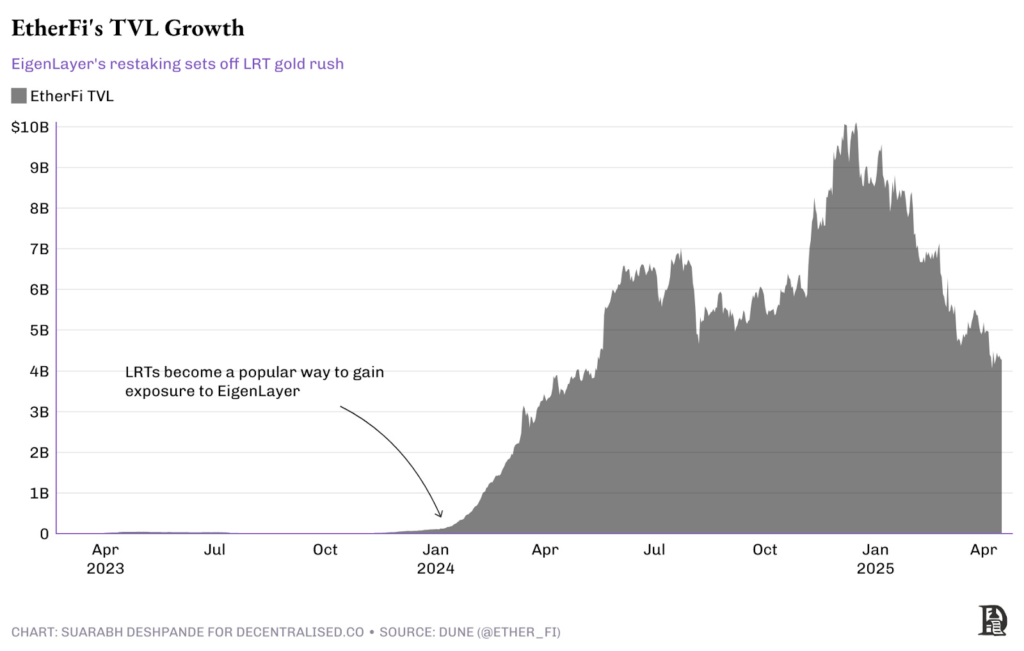
What Ether.fi does with re-staked ETH is effectively the same thing that Lido did previously with staked ETH. Make restaking practical, mainstream, and profitable by creating liquidity, accessibility, and usability for restaking ETH.
In addition to chasing profits, there is also "points mining", where people not only pursue immediate profits, but also accumulate "points", which may become valuable tokens in the future. Call it a speculative flywheel, if you will. As more users re-stake through Ether.fi, more eETH tokens are put into circulation and deeply integrated with other DeFi projects like Pendle, where you can trade future earnings and even the points themselves, creating entirely new financial instruments out of thin air.
What happened to points? Cryptocurrency is, after all, a playground for efficient capital mercenaries. When the protocol started offering points as a reward, a large number of users emerged to try to maximize the points and manipulate the system in the process. The original intention behind points is to achieve a fairer and wider distribution of tokens. But once it turned into a competition, the results became distorted. The most active “miners” are not always the most consistent users. While many projects still use points to distribute tokens, this strategy is no longer as attractive as it once was.
So, as always, the lesson is not just about innovation being important. What’s more, the biggest winners are often not the ones who create the things people are talking about in the first place. They are the ones who come later, see what is really going on, and create just the right thing at just the right time.
Sure, EigenLayer laid the foundation, but Ether.fi and others who saw the second-order effects also got a piece of the action, ultimately capturing over 20% of the Ethereum staking market by mid-2024. In crypto, being the first is far less important than being the best at knowing what everyone else is doing.
Points and Pendle
Points went mainstream in December 2023 after the huge success of the Jito airdrop. This Solana-based protocol received over $1 billion in FDV on its debut, sparking a "gold rush". Suddenly, the entire ecosystem of protocols shifted from direct token distribution to a points system. They began rewarding users for participating in the protocol with points, which could later be redeemed for governance tokens. This initially novel allocation mechanism quickly evolved into the dominant strategy.
Pendle launched in June 2021, focusing on tokenization and future earnings trading. Pendle’s core innovation is quite clever as it splits yield tokens into two parts: the principal token (PT) that represents the underlying asset and the yield token (YT) that captures future returns. This separation allows users to trade these components separately, thereby controlling their profit strategy more than ever before.
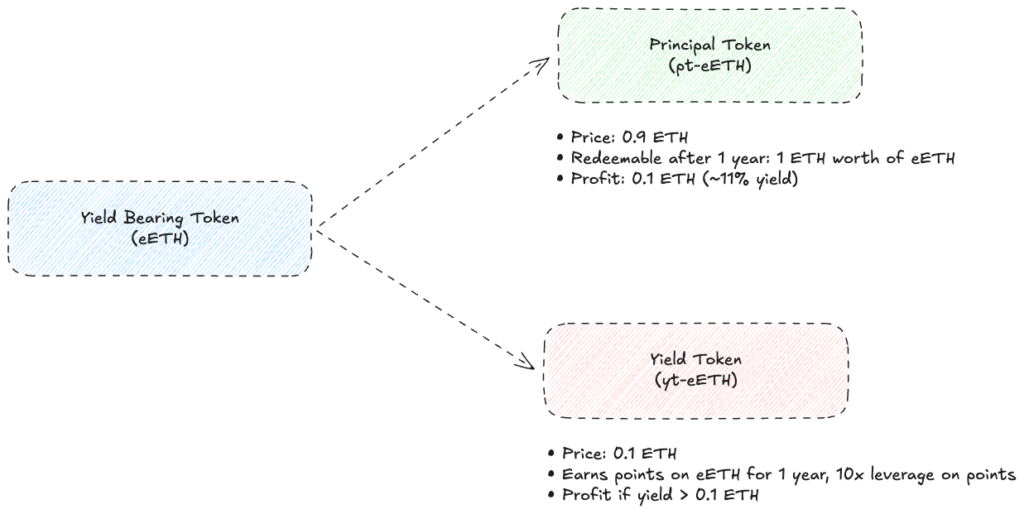
When the points race officially began, Pendle found himself in a strong position with a feature that was built for an entirely different reason. The platform’s YT token establishes a mechanism equivalent to leveraged points mining. Users can simultaneously receive the floating income of their assets and any related points, thereby expanding their points accumulation without the need for additional funds.
Here’s how it actually works. Suppose Sid wants to earn points from a protocol like EigenLayer that rewards liquidity providers. Traditionally, he would need to deposit ETH into EigenLayer’s staking contract and lock up the funds for weeks or months. With the combination of Liquidity Restaking Tokens (LRT) and Pendle, Sid can purchase Yield Tokens (YT) representing future earnings and points without depositing ETH directly into EigenLayer.
For example, assuming the price of eETH is $2,000, 24 EigenLayer points can be earned per day. pteETH represents a fixed-income token, and yteETH represents a floating-income token, priced at $200. pteETH holders give up points in exchange for fixed income. yteETH holders receive floating income and points. Now, for just $2,000, Sid can earn 240 points (worth 10 ETH) per day instead of just 24.
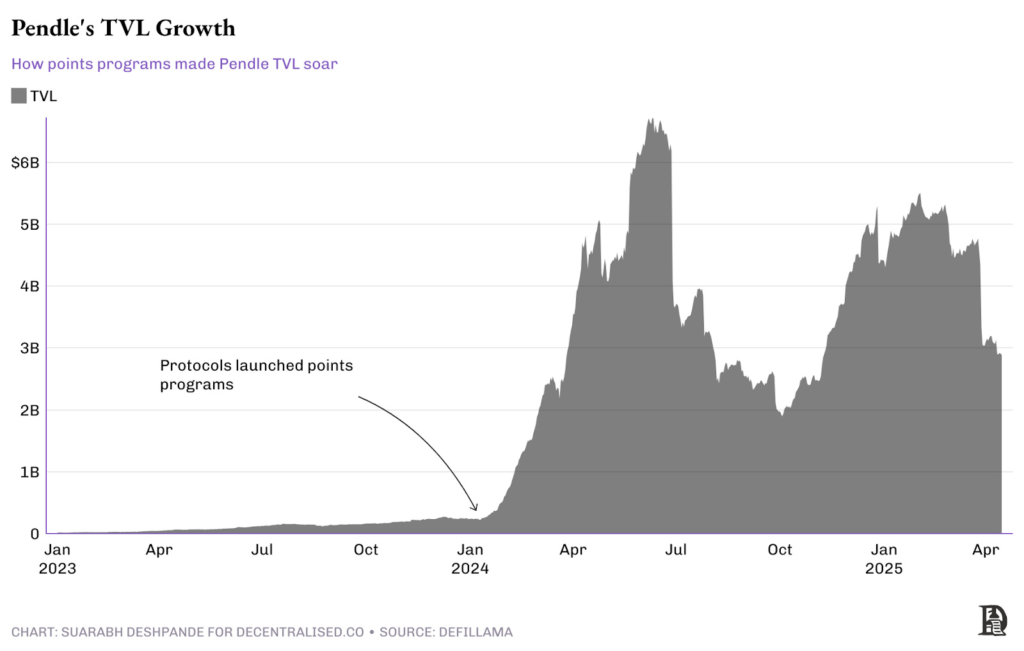
Pendle founder TN Lee once analyzed this in detail in a podcast. The team did not build a meta-architecture for points. They couldn't have predicted this. But they had built the perfect infrastructure for this emerging behavior and were well capitalized. Even if this trend eventually cools down and TVL drops to ~$2.5 billion, their market cap will still be 10-15x higher than before the points appeared.
Memecoins, Pump.fun and Raydium
Sometimes, second-order effects emerge from the most unexpected places, invigorating entire ecosystems in the process. Solana’s resurgence in 2023-2024 is a fascinating example of how quickly crypto can change, and how value can be captured by those who position themselves at critical crossroads.
After the FTX collapse in late 2022, many industry insiders wrote an obituary for Solana. This logic seems to make sense. SBF and his company have a huge influence on the ecosystem, providing funding, liquidity and market support. Without them, Solana struggles. The technology has been plagued by reliability issues, with news of “Solana crashes” becoming a laughing stock. The blockchain that once positioned itself as the “Ethereum killer” appears to be on its last legs.
Yet a remarkable transformation is taking place. Throughout 2023, Solana's technology has steadily improved. There are fewer and fewer crashes. Transaction finality and user experience are significantly smoother. Developers who were attracted to Solana’s technical foundations (such as high throughput, low costs, and sub-second finality) are starting to return, albeit cautiously.
By early 2024, the situation had decisively reversed. As people become disappointed with traditional DeFi governance tokens and people generally turn to so-called "financial nihilism", users' attention and funds begin to flock to memecoin. These tokens often have little use beyond community ownership and cultural signaling, but have captured the market’s imagination. Solana, with its lightning-fast transaction speeds and extremely low fees, provides the perfect environment for this new wave.
PumpFun went live in January 2024. This “memecoin factory” streamlines the token creation process—once the province of developers with programming skills—into a process that takes just minutes. PumpFun democratizes token creation in a way that fits perfectly with the experimental spirit of crypto finance. Almost overnight, thousands of new tokens with names like “BONK,” “Dogwifhat,” and “POPCAT” flooded into the Solana ecosystem.
Seemingly frivolous cryptocurrencies are quickly showing their potential as catalysts for complex value chains. These new tokens will need something crucial: liquidity. Without a trading platform, even the most ingenious memecoin concept will be worthless. Raydium, the decentralized exchange of the Solana ecosystem, is in an enviable position.
Since its inception, Raydium has been committed to becoming the top trading platform for Solana, focusing on improving capital efficiency and reducing slippage. The protocol was not designed specifically for memecoin. But it turns out that its technical architecture, similar to Uniswap’s centralized liquidity pools and permissionless token listing process, is well suited to handling the sudden influx of new assets.
The timing is perfect. Years of infrastructure development created the solid foundation needed for this unexpected use case.
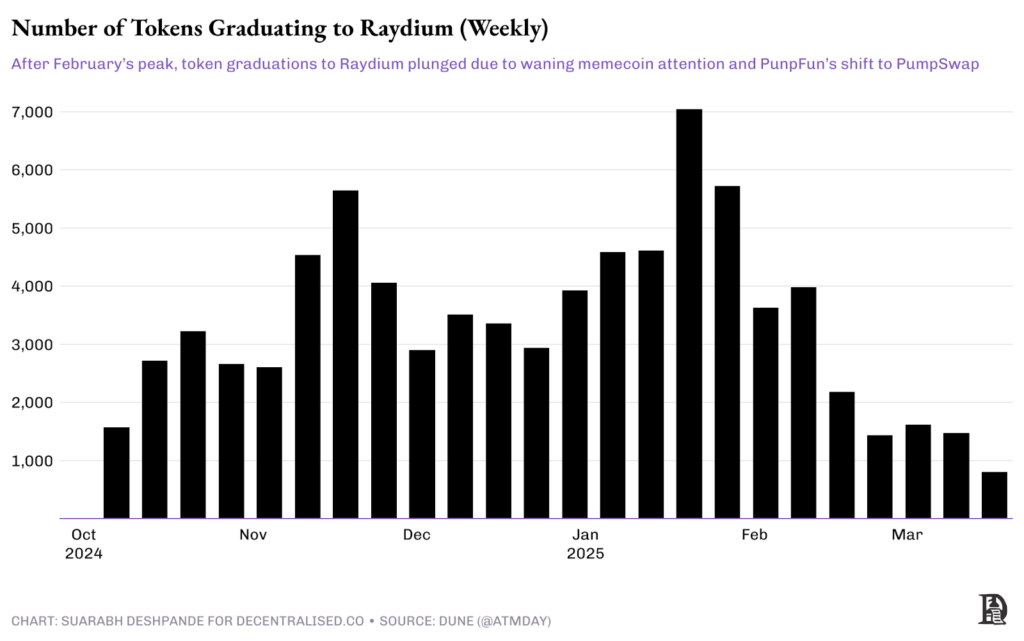
Listing on Raydium marks a significant milestone for these emerging tokens, adding credibility and visibility to an increasingly crowded market. By early 2025, this symbiotic relationship had become so critical that over 40% of Raydium’s Swap revenue came from tokens generated by PumpFun.
The relationship is mutually beneficial: PumpFun needs Raydium’s existing liquidity pool to elevate its tokens from niche products to tradable assets, while Raydium thrives on the explosive trading volume these tokens bring.
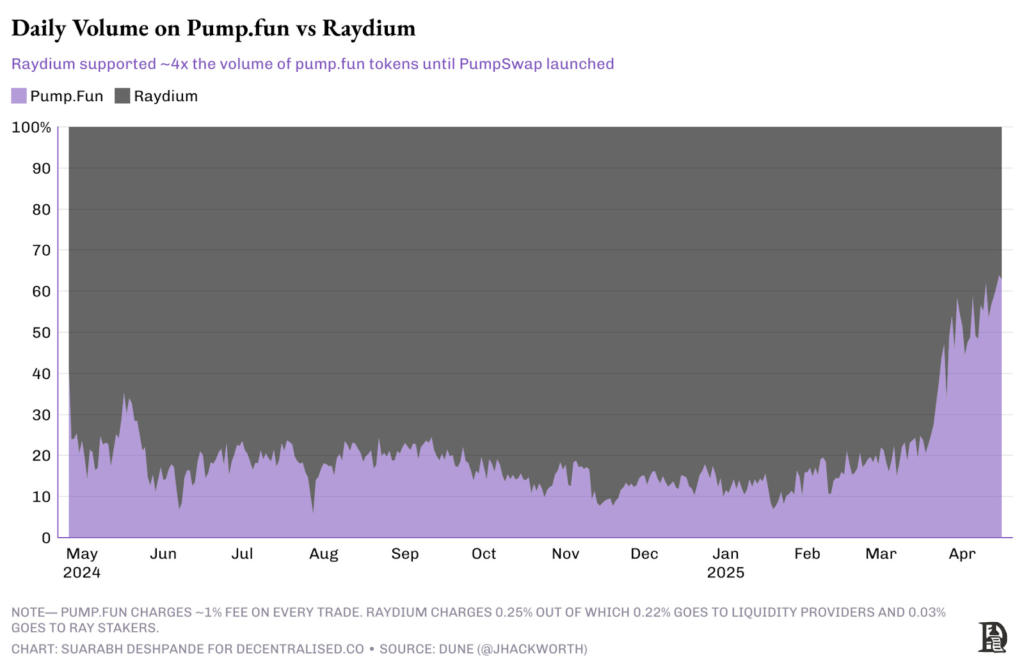
The economics of the PumpFun team are also impressive: tokens traded exclusively on the PumpFun platform are charged a 1% fee per transaction, while Raydium’s fee structure is 0.25%. This means that Raydium would need to generate four times the volume to match PumpFun’s revenue per token. Raydium consistently managed to surpass this threshold between August 2024 and February 2025 due to its deeper liquidity and broader user base.
Raydium is not the original creator of memecoin, nor is it the originator of the token factory concept. However, by providing a robust infrastructure for trading these assets and responding quickly to competitive threats, they capture much of the value in the ecosystem.
The saga of the Solana memecoin illustrates a key aspect of second-order effects: value often accrues not to those who create new behavior, but to those who facilitate it at scale. PumpFun simplifies token creation, while Raydium enables efficient price discovery and trading. Each innovation triggered further adaptations. PumpFun’s vertical integration move led Raydium to establish LaunchLab, which had a cascading second-order effect that reshaped the entire ecosystem.
This attention has not only revitalized the ecosystem, but it has also been actively leveraged. As the memecoin craze intensifies, tokens like Trump and Libra are likely to be launched just for the hype. Their strategies rely on narrative, timing, and virality. While Trump taps into the power of political memes, Libra leans into broader internet culture. Both tokens initially gained huge traction and reached absurd valuations shortly after their launch.
But this energy did not last long. Attention comes quickly and goes quickly. The secondary market cooled down. Traders shifted their focus. The community gradually dwindled. The success of these tokens is that it demonstrates how attention can be captured at the right moment and turned into speculative gold. However, what they have failed to do is maintain their market capitalization. They have no real utility, no roadmap for sustained development, and are just a flash in the pan.
But they prove a point: innovation attracts attention. And in crypto, attention is one of the most powerful raw materials. If used properly, it can spark a new craze; if used improperly, it will quickly die out.
For observers of crypto innovation, the lessons are clear. When new primitives emerge, it is important to look not only at the immediate impact, but also at who is best suited to facilitate, optimize, and extend the suite of behaviors they support. This is often where excess returns are truly realized.
What now?
Having read this, you may be wondering what the next second-order outbreak will look like. Maybe you call it compound innovation, or maybe it’s technology convergence, but the point is the same. This article is about multiple technologies colliding at the same time, causing a chain reaction that is greater than the sum of its parts.
We’ve already seen this happen: restaking reshaped DeFi incentives, memecoin infrastructure reinvigorated the entire ecosystem, and yield protocols accidentally leveraged airdrops. So, what's the next domino to fall? Maybe it's the EVM experience. Maybe. It's literally being rewritten, redesigned, and polished to feel like real software -- at least that's the promise. Whether it becomes the next great compounding layer or just another incremental upgrade remains to be seen.
But if these links are connected smoothly, it may trigger an unprecedented chain reaction.
Behind the noise of the L2 debate and scaling wars, a race is brewing — not only to scale Ethereum, but also to increase its utility by improving its usability. True usability, meaning that others can build on it without being bothered by wallet issues, fees, or transaction failures. Because when friction disappears, innovation flourishes. And when innovation thrives, compound returns emerge in the most unexpected places.
Over the past few months, we have hosted some of the great people who are leading this revolution: Andre Cronje from Sonic, Keone Hon from Monad, and Shuyao Kong from MegaETH. While their approaches vary, the goal is clear: eliminate latency. Eliminate friction. Even eliminate the wallet. Replace it with something faster, smoother, and more invisible. Create a true software experience, not a cumbersome click process.
Both MegaETH and Monad claim to be able to process 10,000 transactions per second. This is comparable to Solana speed, but with Ethereum semantics. It should be noted that the crypto field has always had a tendency to exaggerate. If this can be achieved, this will be the first EVM-based chain that puts Solana in a passive position in terms of user experience. (This is kind of funny considering that EVM blockchains have long been plagued by slow confirmations and wallet pop-ups from hell.)
Andre’s pitch is not focused on pure speed, but rather on removing complexity. He said Ethereum’s performance ceiling is far from being reached. According to him, its current execution capacity is only around 2% of the total capacity. This is not due to hardware limitations, but rather to the way the Ethereum Virtual Machine (EVM) accesses and writes data. Sonic has reduced data storage requirements by 98% through its new database structure. His Sonic roadmap bets on abstraction — abstract fees, abstract accounts, abstract wallets. If all goes according to plan, by the end of this year, users won’t even realize they are on a blockchain, while still maintaining a fair degree of decentralization. And that’s exactly the point.
So, who will win in this brave new world? It may not be the infrastructure teams busy re-hashing TPS benchmarks, but the applications built on top of that infrastructure, like Pumpfun leveraging Solana’s infrastructure to make $500 million in less than a year. Social protocols, in particular, could see a breakthrough. Projects like Farcaster have demonstrated the potential to combine the permanence of cryptocurrencies with the convenience of web-native blockchains. No more paying to post, no more MetaMask pop-ups. Only content is shared.
Then there’s DeFi. The next generation of financial applications requires better input. Andre put it bluntly: “We have no on-chain volatility, implied volatility, or realized volatility.” When this material does emerge, expect to see real options markets, coherent derivatives, and properly structured perpetual contracts — the financial layer that cryptocurrencies have been pretending to already have.
Perhaps most exciting are the applications that haven't yet been imagined. Because that’s how things always go. In 2005, no one looked at Google Maps and said, “You know what this needs? Ride-sharing.” But once the foundation changes, everything on top of it changes too.
So, I am personally skeptical. I’ve been in crypto long enough to know that every promised tenfold improvement usually just gets you a slightly better dashboard and more Discord notifications, but it’s exciting nonetheless. Because this time, the underlying technology feels real. And behind them, a new generation of builders is quietly working on second-order magic that may reshape everything. Because for every breakthrough underlying technology we see today, there are dozens of builders already working on second-order applications that will demonstrate the true value of that underlying technology.






