Written by: TechFlow
As an editor, I can't help but engage with cutting-edge narratives and technologies.
For instance, Vitalik's technical blog often puts forward some serious and hardcore technical perspectives, which become material for various media outlets to report on quickly.
However, being able to access something is one thing, and being able to understand it is another.
A few days ago, Ethereum's founder Vitalik proposed a bold idea - to replace Ethereum's core component, the EVM (Ethereum Virtual Machine), with something called RISC-V.
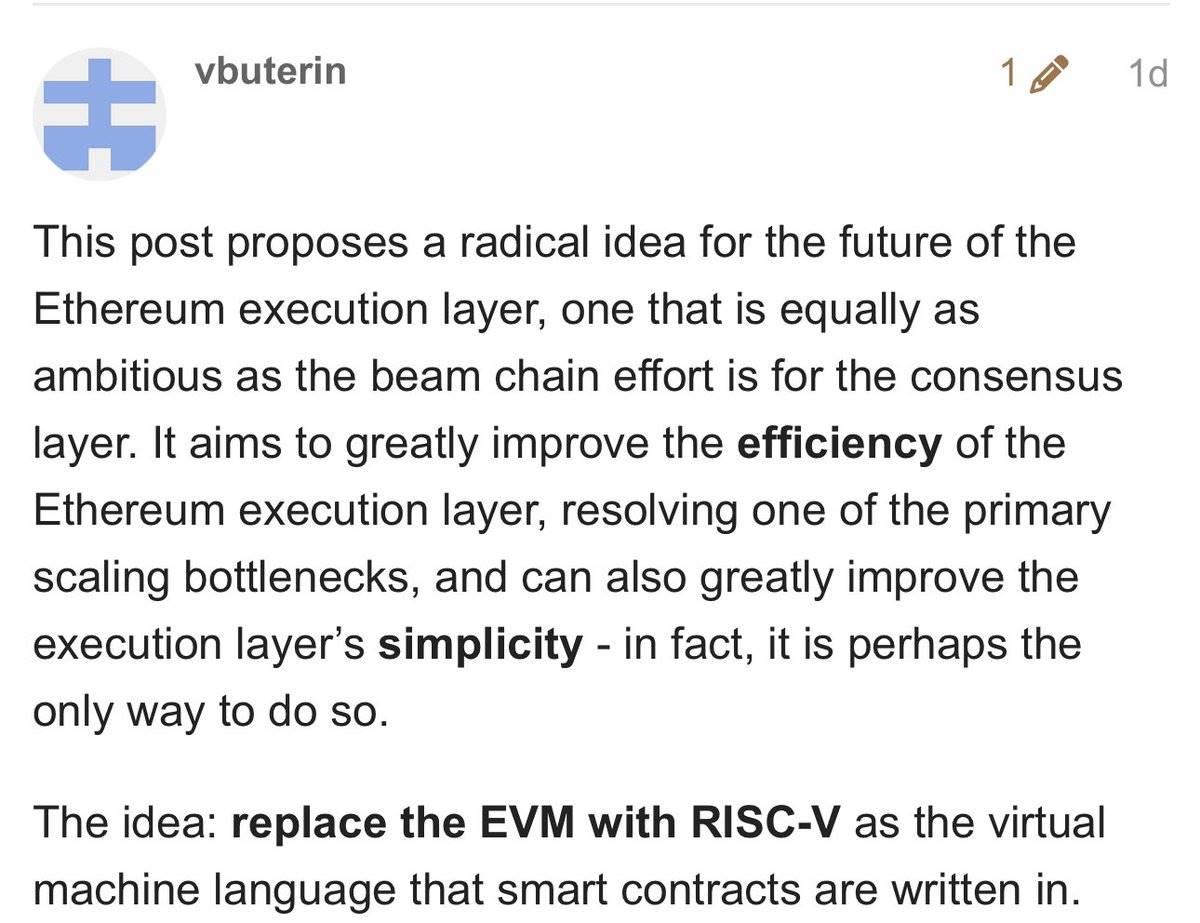
The English-speaking crypto Twitter has already had many discussions about this, but the Chinese-speaking community seems less focused on such hardcore and difficult-to-understand technology.
In any case, the fact that ETH's price can't seem to rise is undisputed, and the notion that technical improvements can't save the "E-guards" has become a tacit consensus.
But with curiosity and a desire to potentially rescue the ETH already buried in my hands, I carefully looked into the RISC-V that Vitalik proposed and tried to explain its changes and potential impacts in layman's terms.
After all, you might still be interested in ETH-related matters.
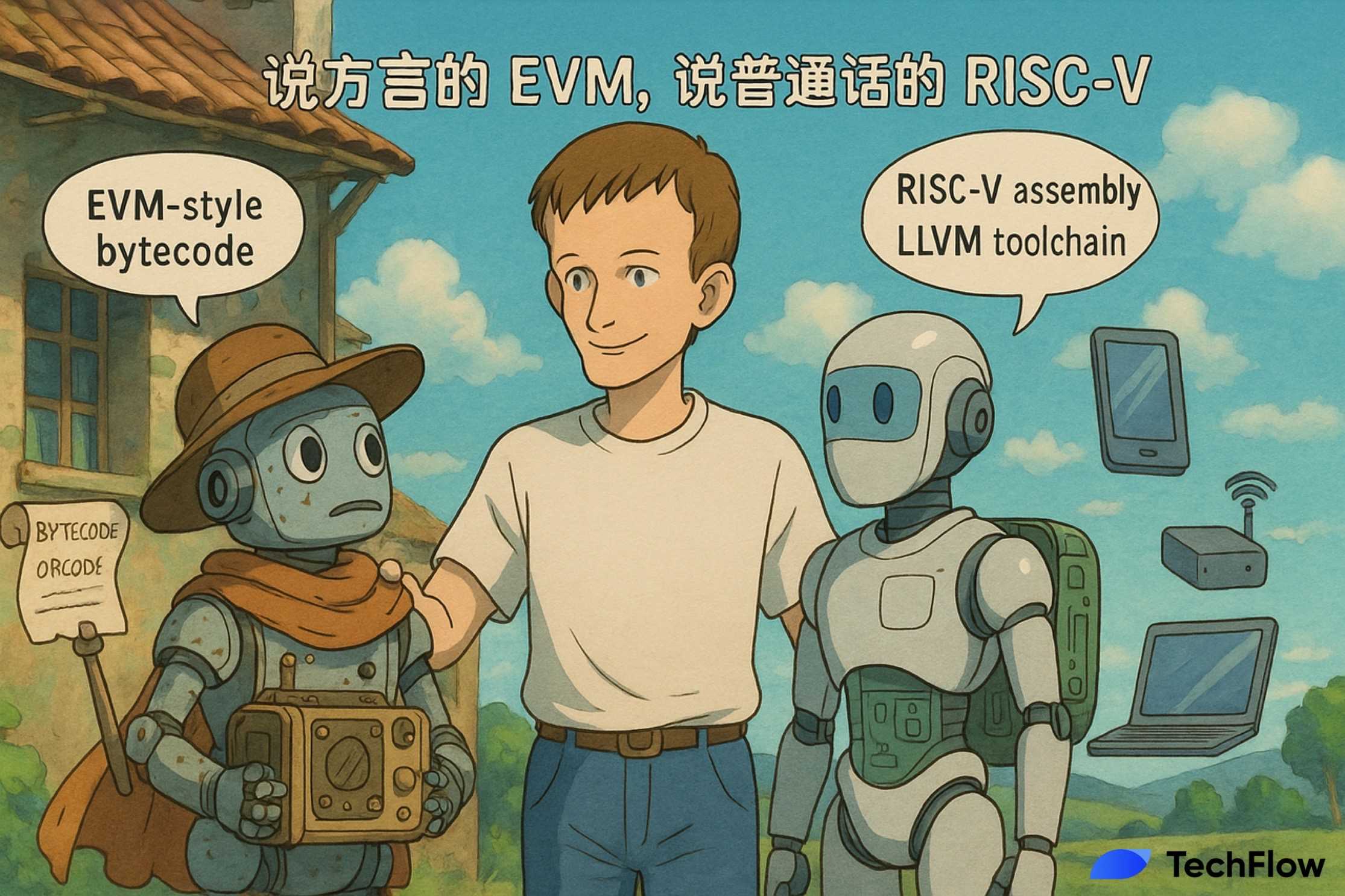
EVM Speaking a Dialect, RISC-V Speaking Standard Language
Let's start with some background knowledge.
First, Ethereum is a blockchain platform, similar to a decentralized "supercomputer". It can run smart contracts, which are automatically executable programs, such as those used for DeFi applications or Non-Fungible Token trades.
The key is that Ethereum's smart contracts run on something called EVM (Ethereum Virtual Machine).
EVM is like a translator, converting the code written by developers (such as smart contracts written in Solidity) into instructions (bytecode) that Ethereum can execute.
The idea was good, and it had been running this way before.
However, EVM has a problem: it's a custom system that's not very compatible with mainstream computer languages, leading to low running efficiency, especially when handling complex tasks.
So what does RISC-V have to do with this?
RISC-V (pronounced "risk-five") is an open-source computer instruction set, somewhat like a "language standard" for computers.
Developed by the University of California, Berkeley in 2010, it is now widely used in chips for mobile phones, laptops, sensors, and other devices. Unlike traditional Intel or ARM chips (which use proprietary instruction sets), RISC-V is completely open-source, and anyone can use it to design chips, essentially the "Linux" of the hardware world.
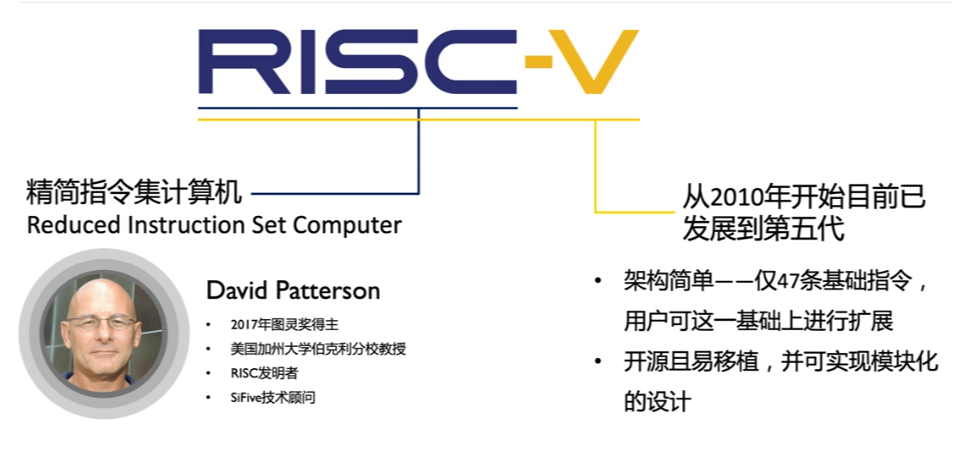
(Image source: CSDN)
You might wonder what this instruction set used in hardware chips has to do with Ethereum. Why did Vitalik take a liking to RISC-V?
Simply put, RISC-V can solve many of EVM's issues. As we mentioned earlier, EVM is a "translator", but its "dialect" is too old, incompatible with mainstream computer languages, and requires tedious translation every time a smart contract is run, which is frustratingly inefficient.
RISC-V is different; it's a modernized "universal language" already used by many devices, with mature tools and technologies. If Ethereum could directly write smart contracts using RISC-V, it wouldn't need to translate back and forth, potentially improving efficiency significantly.
Specifically, RISC-V could be used in Ethereum's "execution layer".
What's the execution layer? It's the "core engine" where Ethereum runs smart contracts. Vitalik's idea is to replace the old EVM engine with the new RISC-V engine, allowing smart contracts to run directly using RISC-V.
In his blog on April 20, 2025, he mentioned that this replacement could improve Ethereum's execution efficiency by 100 times.
Moreover, RISC-V could better support ZK (Zero-Knowledge Proofs), particularly suitable for expanding Ethereum's capacity (such as in zk-Rollups).
However, this idea is currently just a "proposal" that was only recently put forward.
The community has just begun discussing it. Some think it's good, while others believe the risks are high and could make the system more complex.
Vitalik himself said this is a long-term plan that might take years to actually implement. Ethereum is currently busy with other upgrades (such as the Pectra upgrade on May 7, mainly optimizing layer-2 and user experience), so the RISC-V matter is still far off, with no major actions expected in the short term.
Can Learning Medicine Save Ethereum?
Mr. Lu Xun once said that learning medicine cannot save the Chinese people. Because the spirit is numb, physical rescue is meaningless.
Ethereum might be facing a similar situation.
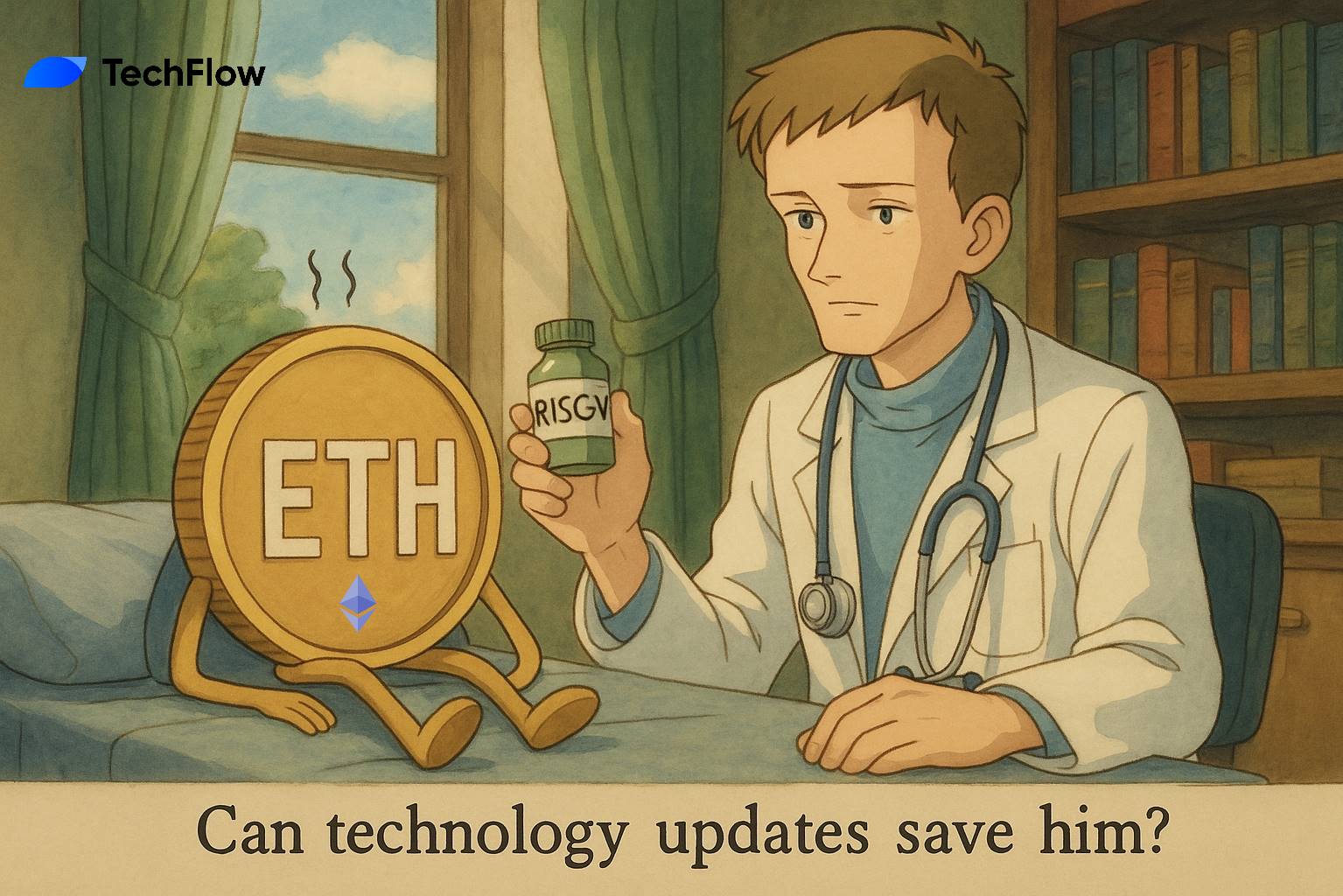
Is it feasible to approach the problem from a technical perspective and solve physical performance issues? What impact would switching to RISC-V have on Ethereum?
After all, Ethereum is now a $400 billion ecosystem (ETH market cap is around $189 billion, plus locked asset value), and such a major surgery must be approached with caution.
Let's first discuss the potential benefits of switching to RISC-V. The biggest change would be that Ethereum would become faster. Currently, Ethereum can get quite congested, especially during peak times, like when NFTs were hot and everyone was rushing to buy profile pictures, with transaction delays and gas fees skyrocketing, proving it to be an aristocratic chain.
In the longer term, adopting RISC-V could make Ethereum more competitive. L1 chains like Solana, with their primary feature of being extremely fast, have already stolen many users.
If Ethereum could use RISC-V and align with mainstream technology, developers would find it easier to develop new DApps, potentially attracting more users.
From Vitalik's perspective, his goal might be to ensure Ethereum not only works now but remains at the forefront for decades to come.
However, switching to RISC-V is not without problems, and the risks are actually quite significant.
Some older smart contracts might not work with RISC-V and would need to be made compatible. Some people are concerned that while RISC-V is fast, it may not be entirely suitable for Ethereum's needs and could potentially complicate the system or affect current expansion solutions (like Rollups).
Another issue is that developers would need to learn new things. Currently, developers are accustomed to developing smart contracts using EVM, but switching to RISC-V would require them to learn new tools and methods. Some might find this troublesome and be reluctant to change.
The community's views on this proposal are quite divided. Supporters see it as an important step for Ethereum's future, potentially making it faster and more cost-effective. Opponents believe the risks are too high and could make the system more complex, suggesting it's better to optimize the current EVM first.
If you're holding ETH and forced to become an E-guard, of course, you'd hope Vitalik's idea could make Ethereum better and potentially boost ETH.
But honestly, it's hard to say whether technical upgrades can save ETH's price.
After all, the market sometimes looks at sentiment rather than technology.
However, this RISC-V idea is indeed interesting and shows that Ethereum is still striving to move forward. If you're interested in ETH, it might be worth paying attention to this matter - there could be a surprise in the future.