Original author: Weilin, PANews
Following the trend of Bitcoin investment and financial accumulation strategies inspired by Strategy, there are many Solana strategy imitators, including the Canadian listed company Sol Strategies Inc., the NASDAQ-listed company Janover, and the consumer goods listed company Upexi, which has become the latest traditional company with a similar strategy.
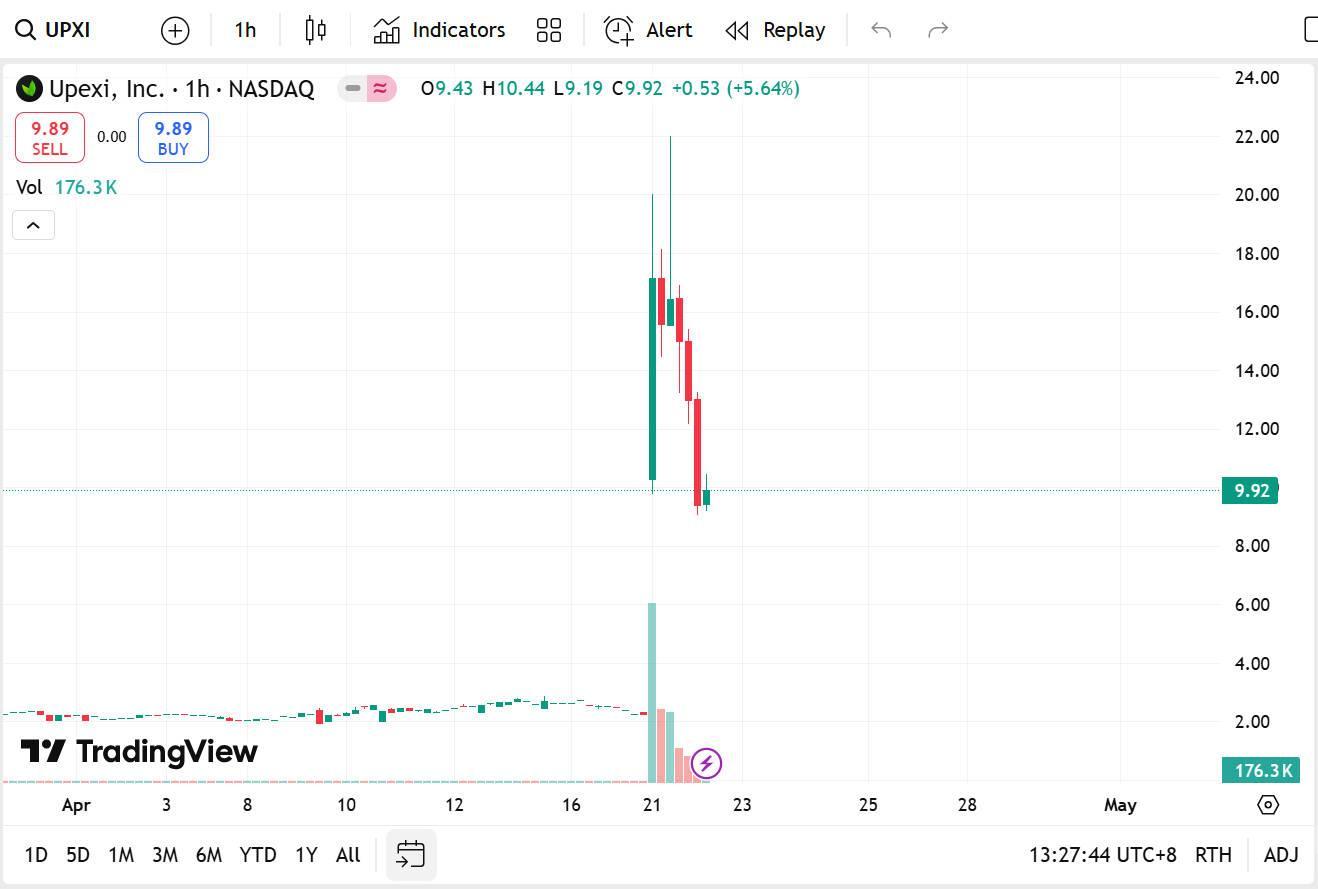
On April 21, the well-known crypto trading and investment company GSR announced a private equity investment (PIPE) of up to $100 million in the NASDAQ-listed consumer goods company Upexi, Inc. (stock code: UPXI), betting on its upcoming comprehensive Solana financial strategy. Affected by the news, Upexi's stock price surged by over six times during the day.
As early as February this year, Upexi had announced a roadmap around cryptocurrencies. This consumer goods development, manufacturing, and distribution company showed a significant decline in revenue in its latest financial report, with continued net losses. Embracing cryptocurrencies has become a transformation strategy.
GSR Bets on Upexi's Solana Financial Strategy, Leading a $100 Million Private Equity Investment
GSR provided direct financial support for Upexi's new on-chain strategy. Upexi announced that it has signed a securities purchase agreement with some investors to issue 43,859,649 common shares (or prepaid warrants as an alternative) at $2.28 per share, with a total fundraising amount of approximately $100 million (before deducting placement agent fees and other issuance expenses).
Upexi plans to use about $5.3 million for working capital and debt repayment, with the remaining funds to be used for building a Solana-based fiscal system and accumulating Solana assets.
In addition to GSR's lead investment, many crypto institutions and individuals participated in this round of financing, including Big Brain, Anagram, Delphi Ventures, White Star Capital, Maelstrom (Arthur Hayes family office), Hivemind, Borderless, Morgan Creek, Elune Capital, Delta Blockchain Fund, and many well-known angel investors such as Austin Federa, Frank Chaparro, Joey Krug, Bartosz Lipinski, Larry Wu, Jordan Prince, and Upexi CEO Allan Marshall.
Solana Foundation President Lily Liu also stated that this transaction marks another step in connecting traditional financial institutions with decentralized infrastructure.
The market after the announcement showed that Upexi's NASDAQ-listed stock price rose by 639.20% to $16.78. By the close of the US stock market on April 21, Upexi's stock price had fallen back to $9.89.
While attracting widespread attention in the crypto market, some crypto industry professionals also offered positive views. Arif Kazi, Business Development Lead at Sonic SVM, said on X platform: "The public market's perception of on-chain yields has changed. Upexi is not hedging risks - they view SOL staking as infrastructure. Native staking is becoming an institutional-level financial tool."
He suggested this might be the largest Solana native fiscal allocation for a US-listed company, priced above market value, without tokens, lockup, or convertible debt terms. Solana's architecture makes this possible: parallel execution through Sealevel technology, sub-second finality time, and a stable validator network layer. This is infrastructure built for institutions. When fiscal strategies combine with DeFi primitives, it's not just a fit, but an acceleration. Solana now provides a playbook for capital allocators.
From Gummies to Cryptocurrencies: Upexi's On-Chain Transformation
Headquartered in Tampa, Florida, Upexi was previously focused on consumer goods R&D, manufacturing, and distribution, with brands including medicinal mushroom product Cure Mushrooms, pet care brand LuckyTail, and the Prax series of energy gummies. Although this traditional consumer goods model once established its market presence, it never gained significant attention in the capital market, with a market value of only $3 million as of April 18.
Upexi, Inc.'s latest financial report shows significant financial challenges. In the 6 months ending December 31, 2024, the company's revenue declined, and net losses continued. The revenue for the reporting period was $8.36 million, a significant drop from $15.74 million in the same period last year. The company's net loss was $2.93 million, slightly better than the $3.79 million loss in the same period last year.
Possibly under such financial pressure, cryptocurrencies are viewed by Upexi as a new opportunity. In fact, Upexi's crypto strategy had been gradually unfolding months ago. On March 3, Upexi announced that its subsidiary Quantum Hash had signed a letter of intent (LOI) to acquire a 2 MW crypto mining farm, currently operating at less than half capacity. Quantum Hash plans to upgrade existing equipment and introduce the latest, fastest mining machines to maximize computing power and monthly Bitcoin production.
On February 6, Upexi announced that it was actively seeking further investment opportunities by directly investing in cryptocurrencies, mining businesses, and mergers and acquisitions in the fintech sector. The company updated shareholders on its current business operations and disclosed its long-term crypto and mining strategy.
Upexi's CEO Allan Marshall, 55, joined the company as CEO in May 2019 after retirement, having been a serial entrepreneur focusing on the tech industry in recent years. His career began in transportation and logistics. He stated, "The company is in a series of rapidly developing opportunities and will continue to promote the implementation and advancement of various strategies in the coming weeks and months."
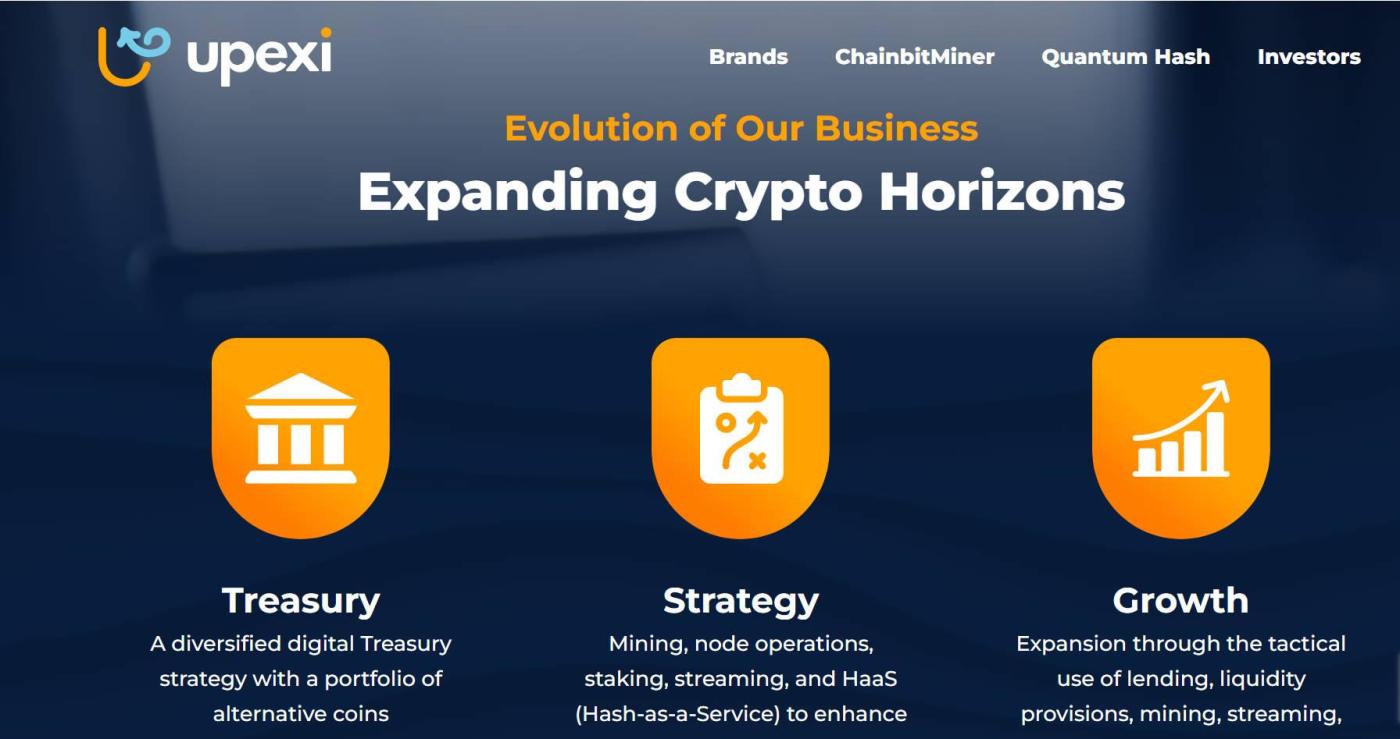
According to the official website, after transformation, Upexi has the following development strategies: First, a financial strategy: a diversified digital financial strategy covering multiple Altcoin asset portfolios; second, strategic direction: enhancing financial returns through mining, node operations, Staking, streaming services, and HaaS (Hash as a Service). In terms of growth path, it will expand its business through strategic use of lending, liquidity provision, mining, streaming services, and capital markets.
Currently, Upexi has announced its 2025 strategic roadmap, including:
Bitcoin and Altcoin Mining: Owning at least 1-3 MW of low-electricity-price mining operations within 90 days; completing due diligence on current 2-5 MW running mining projects; targeting development to 10-20 MW mining facilities; expanding mining business to other Altcoins such as Ethereum and AI-driven blockchain assets.
Crypto Asset Portfolio Building: Constructing a diversified digital asset portfolio, including Bitcoin, Ethereum, Solana, Render, Chainlink; strategically buying during market fluctuations; holding assets with blockchain infrastructure growth potential and AI integration value.
Blockchain-based Financial Focus: Exploring opportunities in Staking, DeFi Lending, and blockchain projects with revenue generation models.
Long-term focus areas include: Web3, DeFi, AI-driven blockchain growth
Sol Strategy Aims for Organic Growth, Market VolatMayility "Unrealized Loss Dilemma"
In this investment by GSuR, more specific Solana financial strategy details were disclosed. approach ofL strategies which proposed the Sol strategy, provide a forxi with its CEO Leah Wald recently saying when discussing the company's strategy that SOL to Strategies Solratis not a comprehensive analogy. Leah Wald said, In ", limitation of is simply playing the AV that is, enhancing company value by accumulating assets, but this alone is not enough. Our strategy our strategy is to through a a slower but stable way.. Initially, mainly we rely on external acquisitions (inorganic growth) to expand business, such as acquiring validators and related assets. As time goes on, we will gradually shift to relying on our own capabilities for (organic p growth).
He stated that SOL's ultimateimate goal is to become a Solana infrastructure company. In this process, we are indeed many SOL as and staking our nodes. just part of of the overall overall strategy,, we are not simply "buying SOL", but playing an actual role role in Solana's infrastructure ecosystem.
It is worth noting that as more listed companies actively implement crypto asset reserve plans, this strategy is becoming a new trend in corporate asset allocation. However, with global economic environment fluctuations, panic caused by policy uncertainties, and concentrated profit-taking exits, the crypto market is experiencing severe volatility, and many listed companies may fall into an unrealized loss dilemma.
Overall, Upexi, struggling to break through in the traditional consumer goods market, is embarking on a radical transformation from "gummies to cryptocurrency". The $100 million financing not only provides strong support for its Solana financial strategy but also opens up broader imagination for its mining, crypto asset portfolio, and blockchain financial layout. With the backing of mainstream institutions like GSR, Upexi may provide a reference for companies entering on-chain finance.
However, this transformation journey remains full of uncertainFrom stock price volatility to continuous losses in the consumer goods main business, and the high risks and policy challenges of the crypto market itself, Upexi can truly emerge a sustainable growth path from this "crypto experiment" remains by time.