



Interview: Chloe, PANews
Written by: Weilin, PANews
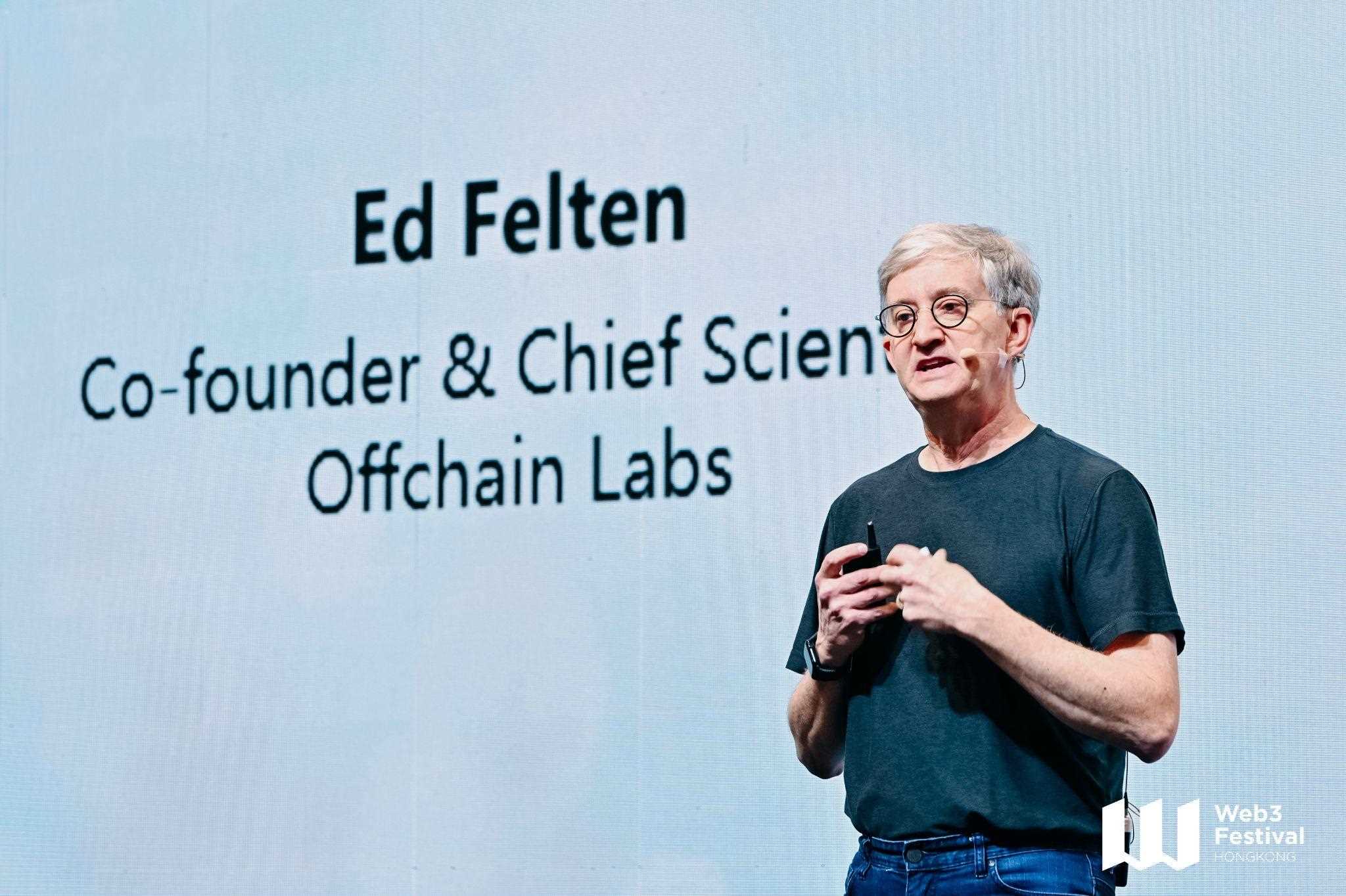
Ed Felten is perhaps one of the most academically inclined entrepreneurs in the blockchain industry. He currently serves as the co-founder and chief scientist of Offchain Labs and is a key driving force behind Arbitrum, the Ethereum Layer 2 scaling solution.
As early as 2003, Ed was promoted to professor of computer science at Princeton University and became the first chief technology officer of the US Federal Trade Commission in 2010. From 2012, he returned to academia and began researching Bitcoin and blockchain technology. In early 2015, Arbitrum initially caught Felten's attention as a course project at Princeton, and he subsequently delved into researching the Rollup technology route. Shortly after, he was invited to join the White House as deputy chief technology officer, primarily responsible for technological security matters. After returning to academia in 2018, Felten restarted the Arbitrum project with two doctoral students and co-founded Offchain Labs in the same year, officially pushing Arbitrum into a systematic development phase.
During the Hong Kong Web3 Carnival, PANews exclusively interviewed Ed Felten, who shared in-depth insights into his journey from academic research and policy to blockchain entrepreneurship, and discussed topics such as how Layer 2 can balance Ethereum ecosystem development, Arbitrum's technical competitiveness, and the integration of AI and blockchain.
In his view, Ethereum indeed faces a choice: does it want to maximize income for validators or have the most users and most active developers? Currently, its strategy tends towards developing users and developers, which is precisely what L2 excels at. When discussing Arbitrum's development path, Ed mentioned that sustainable development must start with "creating value," and his role is precisely focused on this.
[The rest of the translation follows the same professional and accurate approach]But you can't increase block space while also wanting to raise prices, right? Because these two are contradictory.
In my view, Ethereum is indeed facing a choice: whether it wants to maximize income for validators or have the most users and most active developers? Currently, its strategy seems to lean towards developing users and developers, which is exactly what Layer 2 is very good at. But I believe you can't have both.
PANews: Currently, Optimistic occupies the vast majority of the Layer 2 market share. Compared to ZK and other technologies, what are its core competitive advantages? How does Arbitrum ensure the long-term competitiveness of its technology stack?
Ed Felten: Compared to ZK, Optimistic Rollup has two main advantages: first, it is simpler, and second, it is more cost-effective.
Specifically, it is simpler because it does not involve very complex cryptographic techniques and does not require a massive and entirely new toolchain to convert programs into mathematical proof systems - which is a very complex process.
Another advantage is that the Optimistic protocol's cost is very low. When using ZK, generating proofs itself is extremely expensive. In the Optimistic protocol, on-chain verification is only needed when disputes occur. If a dispute actually happens, it means one party is malicious, and their stake will be confiscated. Therefore, in the Optimistic system, honest participants never need to pay for verification, which brings huge cost advantages.
Of course, ZK's costs are gradually decreasing. I do believe we will eventually enter a stage where different chains will mix Optimistic and ZK verification mechanisms. But to achieve this hybrid approach, ZK's costs still need to be lower than they are now.
Currently, Arbitrum only supports Optimistic. In the future, we expect to support both mechanisms, allowing users to freely choose based on cost or other factors.
PANews: DAOs are playing an increasingly important role in ecosystem governance, but also face challenges such as centralized decision-making, improving voter participation, and balancing commercial interests. How will Arbitrum DAO further improve governance efficiency and maintain decentralization principles?
Ed Felten: The Arbitrum DAO independently decides its own actions. So I do not represent the Arbitrum DAO in any form, but I can share my personal views.
One thing I learned while working in government is that decision-making processes driven by public participation are both challenging and powerful. Yes, this process can be messy and sometimes slow, but I think it is very resilient. When the community reaches a consensus, it can achieve some very ambitious things.
I think we are still in a very early stage. The Arbitrum DAO is different from other DAOs in that it has real power and indeed operates in a decentralized manner. You can see different voices presenting different perspectives and engaging in debate - this is a healthy state. This is exactly what we hoped to see when transferring the chain's control to a DAO.
I think overall this is successful, but it also faces - and will always face - some challenges common to governing any large and diverse group.
PANews: Offchain Labs recently launched Onchain Labs to support early projects. Can you reveal what specific support will be provided to these projects (such as technology, funding, or market resources)? What other plans are there to incentivize diversity in the Arbitrum ecosystem?
Ed Felten: I prefer to see it as a "lightweight incubator" aimed at promoting project launch and ensuring these projects receive funding support.
One of Onchain Labs' goals is to spark creativity and promote rapid action.
We do not intend to impose strong guidance or control on these teams, but rather hope to help them launch projects, provide some funding support, and then let them grow independently.
PANews: We noticed that Arbitrum is also laying out in the AI track, such as proposing the Trailblazer AI agent grant program and supporting AI projects like ElizaOS. How do you think AI technology will revolutionize the blockchain industry, and what unique advantages does Arbitrum have in AI deployment?
Ed Felten: I think there are two distinctly different ways of interaction between AI and blockchain.
One is off-chain AI agents that perform actions on behalf of users or are blockchain users themselves. For these off-chain agents, their needs are very similar to ordinary users: they need a low-cost, reliable blockchain system. And for them, response speed is even more important than for human users. For users, 0.1 or 0.2 seconds is already fast, but for a machine, this might already be considered a "long" delay.
When these AI agents become widely adopted, I believe we will see more complex and dynamic DeFi markets and some more interesting game applications.
The next important stage is to achieve on-chain AI agents. This requires stronger computational and data processing capabilities than most current blockchains can provide.
We are working hard to expand the chain's capacity to directly support this goal, and also developing specific support mechanisms for training, validating, and evaluating AI models on-chain.
PANews: Buyback plans are becoming a common strategy for crypto projects, but some believe this can only boost market confidence in the short term and cannot solve fundamental problems. What specific considerations, long-term goals, and execution methods are behind Arbitrum's buyback plan?
Ed Felten: I believe my role is actually to focus on long-term growth and sustainability. I have always believed that we must start by "creating value". If you can create value for users and the community, people will naturally find ways to utilize and obtain these values.
So for me, as I said before, my focus is on creating value, and how to capture these values should be decided by the community.
PANews: Currently, the Altcoin market is generally sluggish. Besides buybacks, does Arbitrum have deeper plans to enhance the token's intrinsic value?
This question should actually be answered by the DAO, not me. However, I believe that value ultimately comes from people's willingness to participate in governance and the income generated on-chain. And income comes from traffic and usage rate. Therefore, promoting technological usage growth is the most important factor in achieving all this.
Offchain Labs has always viewed technological development and value creation from a long-term perspective. I believe the DAO's stance is similar.
In my view, the DAO is focusing on driving growth to achieve long-term value creation.






