Dr. Gavin Wood, founder of Polkadot, was recently invited to an interview with Empire. He shared his views on the current crypto industry, believing that the hype phenomenon is far greater than the teams that actually do things. In such an environment, we have not seen too many practical uses and landing applications, which has also led to the fact that Web3 has not yet achieved large-scale adoption. The Polkadot Hub that Polkadot is working on and the next evolutionary stage JAM are expected to bring real large-scale adoption to the entire industry!
Want to know what he talked about? Take a look at the important topics in this article first!
Why is the current crypto world a failure?
Is Solana creating “value”?
If crypto fails, why stick with it?
Why haven’t the applications been implemented? Why haven’t the number of users on the chain exceeded one billion?
What did Polkadot do right and what did it miss?
Polkadot’s Next Evolutionary Stage: JAM and Its Marketing Problem
Speculative narratives are also built on narratives of real value
Web3 and Al are opposites on a philosophical level
If we care about democracy, autonomy and freedom, we need a reliable mechanism for proving character
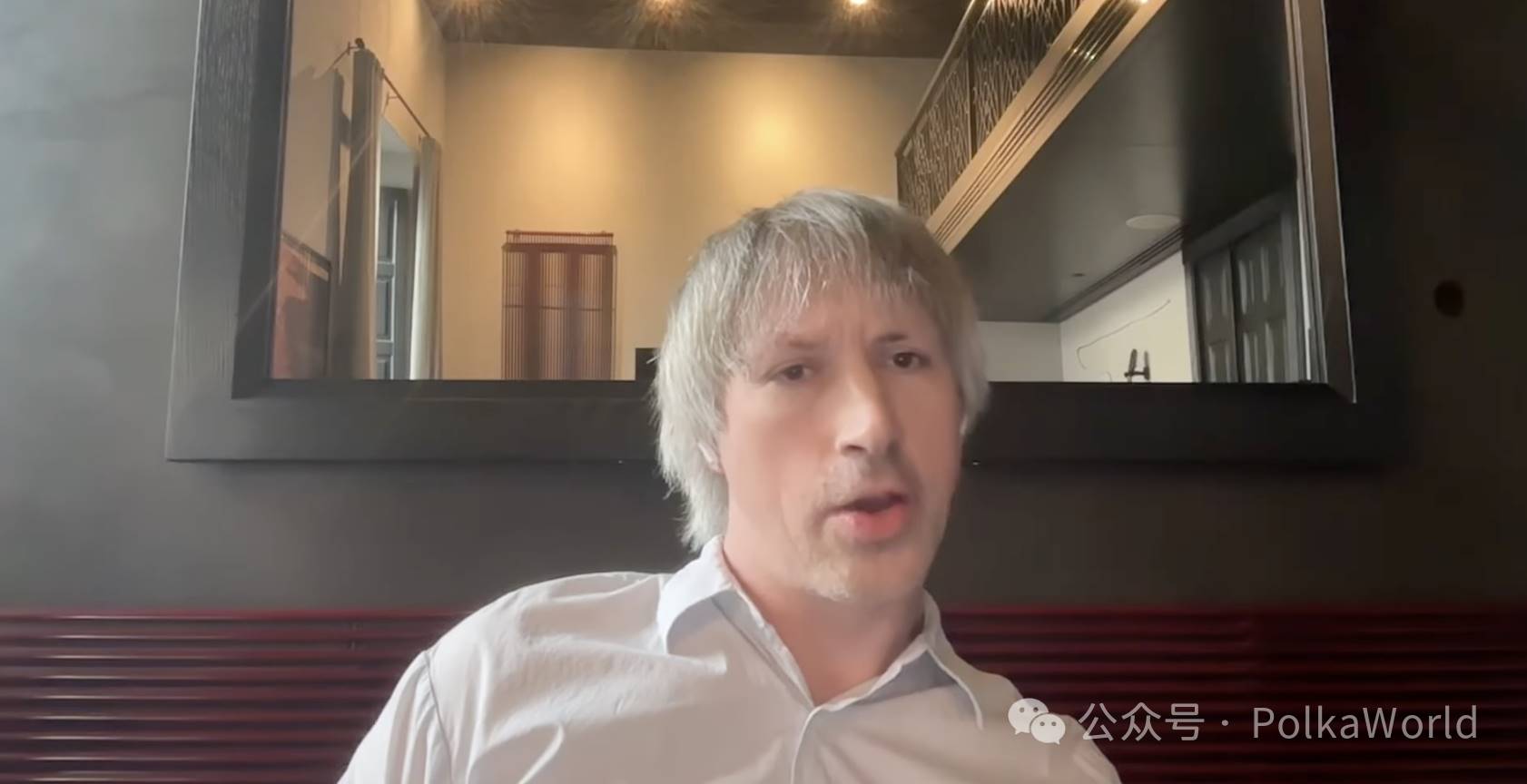
Why is the current crypto world a failure?
Yano: Hello everyone, welcome back to Empire. I'll kick off today, and Santi will join us later. We are very honored to have Gavin Wood, co-founder of Ethereum and also co-founder of Polkadot. Gav, welcome to the show!
Gav: Thank you for the invitation.
Yano: Great, how are you doing lately? Anything new?
Gav: I just came back from India and China a few weeks ago, mainly speaking at universities about the JAM protocol. It was quite interesting, meeting a lot of people and visiting a lot of cities. Now I'm just resting at home and taking a break.
Yano: Not bad, not bad. Let's get down to business today. I have a lot of questions for you. First of all, from a macro perspective: you have been involved in the creation of Ethereum since 2014, and have been working in the Ethereum circle. Later, you withdrew from the Ethereum Foundation around 2015, and left the Ethereum ecosystem around 2017 to fully invest in the Polkadot ecosystem. This is roughly the timeline, right? You are also considered a "veteran" in the industry. What do you think of the development of the entire crypto industry? Are you satisfied? For example, now there is a pro-crypto president and stablecoins are developing rapidly. Do you think it is "beyond expectations" or "below expectations"? Do you think the industry should have gone further a long time ago?
Gav: I prefer the latter. Gandhi once said, "There are two kinds of people in the world, those who do things and those who take credit." I think there is a similar division in the current crypto industry. Many projects started with hype, and there are not many people who really do things seriously. There are indeed some teams doing solid software engineering, but there are very few who really push the original core concepts of Web3, encryption, and Bitcoin forward. On the contrary, there are more people who want to "take credit" - to put it bluntly, they rely on gimmicks and capital inflows to make tokens rise. To be honest, I am not surprised by this situation, but it is not what I had hoped to see.
Yano: Is your feeling of “disappointment” because you feel that industry resources are misallocated? People are focusing on the wrong things?
Gav: Very misplaced, very serious. This reminds me of a funny advertising slogan in the British satirical comic magazine "Viz" in the 1990s: "No need for technological breakthroughs, just market hype." Too many crypto projects are in this state now - not focusing on creating new value, not committed to technological upgrades to make blockchain a truly usable social operating system, and only thinking about how to attract funds to flow into their own economic system.
Yano: Let me sing a slightly different tune. The problem you mentioned is actually the same for the entire technology industry: there are always ups and downs, bubble periods and troughs. When the bubble is there, all projects are paid attention to; after the bubble bursts, there may be only a few survivors, perhaps 3 out of 100 projects will eventually survive, but the truly excellent projects often come out of the bubble. In fact, hype also has its value. It gives a large number of startups the opportunity to emerge. Although most of them will fail, the few that remain in the end may be great companies. This is actually one of the two aspects of building a company. On the one hand, there is engineering and products. I know you are an engineer among engineers, but on the other hand, there is long-term hype, which can be classified as marketing and sales. So, from this perspective, hype is also part of entrepreneurship. How do you view this duality?
Gav: Promotion is indeed a part of marketing, but it is by no means all of it. I think hype is essentially an over-marketing that ignores fundamentals. You are right that hype sometimes has side effects - it can indeed make many projects in the entire industry "rise with the tide". But the problem is that if there are only one or two truly valuable projects, then this way of driving capital allocation by hype is very inefficient. From the perspective of Adam Smith, this is not an efficient way to allocate resources in the market at all, and this is what I am really worried about.
Is Solana creating “value”?
Yano: So which projects are "worth hyping"? For example, is it worth hyping Hyperliquid? Is it worth hyping Solana? Is it worth hyping Worldcoin? The founding teams of these popular projects do have real talent. Of course, we may all agree that pure hype products such as Meme Coin lack value, but some high-profile projects do have excellent founders and real users. How do you define the standard of "worth hyping"?
Gav: I may not agree with the so-called "real users". Of course, some founders are indeed very talented, but the question is - who do their talents serve? Are their abilities for the benefit of the public, or just for themselves? I think some meme coin founders are indeed talented, or at least lucky enough. But you can also say that one of the real talents is "being able to create your own luck".
Yano: Let's talk about Solana, Hyperliquid and Worldcoin. These three are very hot projects in the market, and their teams are also very strong. What do you think of these projects?
Gav: I think they are really talented at making money for themselves.
Yano: But who can say that Solana users don’t create value? They just choose the transaction targets and participation methods in the free market. Isn’t this the normal operation of the market mechanism?
Gav: The key here is the definition of "value". If the so-called value is unregulated gambling - not even fair gambling, full of insider trading and fake bets; if value means making a small group of insiders rich, then this kind of "value" is obviously untenable. But if you insist on defining it this way, then Solana is indeed creating "value".
But if we return to the original intention of Web3 - building a decentralized social operating system, Solana obviously has not made any substantial achievements. This is exactly why I proposed the JAM protocol. I observed that there was a fundamental error in the direction of Solana's development, and I also clearly expressed why I thought so.
Santi: I want to talk more about the topic of "practicality". In the crypto industry, it's not just Solana that is often criticized by the outside world, the entire crypto industry is facing the question of "casinoization". I'm curious about how you view this issue. After all, from an outsider's perspective, it's not just Solana, the entire crypto industry is obsessed with speculation such as leveraged trading and meme coins. So I want to ask you, what do you think is the most practical application scenario in the entire crypto field at present? After all, speculation exists on all chains.
Gav: Taking the Polkadot ecosystem as an example, multiple parachain projects are using Polkadot's strong determinism and finality (i.e., as a "world computer") to conduct business. One of the most interesting projects I think is Mythos, the chain behind Mythical Games. They use blockchain technology to ensure that players truly own game assets. This level of utility is much higher than meme coin transactions because there is a clear demand substitution: even without Polkadot, Mythical still needs servers to manage game assets, but the core value of choosing blockchain is to give players sovereignty. The interoperability brought by this sovereignty allows assets to flow freely in the Polkadot ecosystem, and even cross-chain to Ethereum, be integrated by exchanges, and authorized to other game developers. This is an example of Web3 empowering the real economy - it really brings additional benefits to Mythical Games. The key is that what they do on the blockchain, even if the Web3 part is removed, will be implemented using traditional Web2 technology, which shows that these functions have practical value. On the other hand, we can't see things like meme coins in the Web2 world. This shows that they are just "unlicensed casinos" that have emerged in the specific environment of Web3, and the rules of the game are very opaque.
If crypto fails, why stick with it?
Yano: Well, Gavin, let's change the perspective - you often talk about the "post-Snowden Internet", and I'm curious about how you understand the Internet today? What is wrong with it? Do you think encryption technology can be part of the solution to these problems?
Gav: I don’t think encryption can solve too many problems. Although I work in this industry now, I consider myself more of a Web3 practitioner rather than a “crypto person”. Because most of the current encryption industry has become a “Mickey Mouse finance game”, which is just some immature tricks, which is not what I am interested in at all.
Yano: The reason I asked this question is that I vaguely felt that you seemed to be somewhat disappointed (maybe this word is a bit strong) with the development of the industry in the past ten years, or that you had a certain critical eye. You are a talented engineer and you could have switched to AI or other fields, and even become financially independent. If you are dissatisfied with the current situation, why do you still stick to this industry? I think this is the question I really want to know.
Gav: That's a good question. Indeed, I don't think everyone in this industry has good intentions. But I also believe that there are some people who are really trying to do something good for the world and are not completely caught up in the vortex of "self-interest". And it is these people who keep me in this industry. If I felt that the entire industry was just a bunch of people desperately chasing the next thousand dollars, then I really wouldn't be interested in staying. But I do see and meet some people who firmly believe that Web3 is not the entire crypto industry - it is just a part of it, but it is far from the vision I described in the Web3 Manifesto. Although the technology is currently used to support the meme coin market on Solana, or what is essentially unlicensed gambling, I still believe that it can achieve much more than that.
These chaos are like "scabies" in the development of technology: they may bring some attention and even indirectly benefit Polkadot, but they are ultimately pathological. If these bubbles are eliminated, capital may flow more rationally to projects that truly promote social change.
So what does the social change I'm talking about include? For example: personal data sovereignty, transparent governance systems, voting systems that can operate without a large bureaucracy, etc. Look at the collapse of trust in the government in the United States over the past 50 or 60 years. People question the existence of the "deep government" and whether taxes are used for public welfare. What we need now is a system that can be open, transparent, reasonable and effective in resource allocation, and truly serve those who pay for it. And I believe that this technology can indeed be a tool to achieve this goal. Although the relevant applications are still in their early stages and there is still a need for breakthroughs in expansion and mechanism design, I firmly believe that this technology can greatly improve the effectiveness of social governance.
Why haven’t the applications been implemented? Why haven’t the number of users on the chain exceeded one billion?
Yano: Why have these ideas been delayed? In 2018, Blockworks held an event with the theme of "Supply Chain". You should also remember that at that time, various advertisements promoted that Walmart would move the supply chain to the blockchain; Hernando de Soto wrote an article saying that blockchain would be used to improve the real estate registration system in emerging markets. But none of these really landed. What did we get? A bunch of perpetual contract trading platforms, NFT markets, and large crypto exchage. If you ask me, I would think these things are actually quite valuable, at least they have created a new industry. But if you look at it from the perspective of traditional social benefits, there are almost no results. Why is this the case? Why haven't we seen major applications truly successfully landed?
Gav: In a nutshell: the product itself is not good. In other words, the basic platform products that support Web3 are not good enough to support more complex and meaningful application scenarios. Of course, there are some exceptions. For example, in terms of supply chain and traceability, there are indeed several real-world examples that are doing well. There are also many such projects on Polkadot.
For example, the "social graph" should be controlled by the users themselves, not by the platform, which is what the Frequency project is doing. It is a Web3 social network project led by Frank McCourt, and I think this is a very interesting direction.
There are also projects like Peaq that track information traceability, which also have great potential. We are now starting to see some truly scalable and practical systems. Most applications are meaningless if they cannot be expanded, which is also one of the problems that Polkadot is working hard to solve.
Another key issue is economic sovereignty. Many Web3 or "Web3-like" platforms are designed to limit the economic autonomy of projects. Taking Ethereum as an example, the project has to force users to use ETH to pay gas fees, which not only limits the flexibility of developers, but also raises the threshold for users. No one wants to buy a coin they don't know, no one wants to download a special wallet for it, and no one wants to go to DEX or centralized exchanges to exchange coins. This is the problem of the product. The basic platform product is not good enough. But now we have begun to see that some projects with real practical uses are turning to Web3, and most of the platforms they choose are like Polkadot, which can provide "economic autonomy" infrastructure. In other words, the project can design its own economic system, and users can use the product directly without having to touch a certain underlying platform currency.
There is also the issue of scalability. Truly useful applications need to support thousands of interactions per second. If the platform cannot do this, it cannot support real applications.
Santi: I agree with you on this point. Currently, the cryptocurrency field is mainly speculative. Every technological revolution in history has been accompanied by speculation, but we can do better - ten times or a hundred times better. There are actually some core products in the crypto field now, but they have not received enough attention and user growth. I think what you are doing in Polkadot is very interesting, especially after talking to the Mythos team and understanding why they decided to migrate over. The question is, why haven't these high-quality technologies been adopted on a large scale? If blockchain technology is really superior to Web2 as Web3 claims, why haven't the number of on-chain users exceeded one billion yet?
Gav: The user base has not yet exceeded one billion, partly because it takes time for user migration to settle. Especially when it comes to the economic system, user stickiness is beyond imagination - there are actually profound economic principles behind this. Taking capital drive as an example, we see that well-funded projects such as Polygon and Solana will directly spend money to attract developers to port their applications to their chains. If the project party lacks technical foresight, their CTO is likely to lose to the CFO in internal discussions and ultimately choose to accept subsidies to deploy a chain that cannot meet long-term needs.
These chains can neither support scale expansion nor achieve true economic autonomy. So in essence, this is a "stickiness" problem that takes time. Project parties also need to realize the problem through trial and error. Just like the Mythos team initially chose Ethereum, but later found that neither scalability nor economic autonomy could meet the needs, so they began to ask themselves: "Are there other platforms to use? Should we give up Web3?" It turns out that Polkadot can actually meet these needs. But it takes time to understand these. Humans do not move at the speed of light, and there are too many things that hold them back - such as sunk costs of investment and fear of loss. These obstacles need to be slowly eliminated.
As a believer in technology, I must believe that high-quality platforms will eventually receive the recognition they deserve, but I must also face reality: capital conservatism, market short-sightedness, and obstruction from vested interests will slow down the process. Fortunately, I have time - after 11 years in this industry, I can stick with it for another 11 years.
What did Polkadot do right and what did it miss?
Yano: Gavin, what do you think was right and what was wrong with your original vision for Polkadot?
Gav: Regarding the success, it is not the result of my single-handed efforts. Although I am the main author of the Polkadot white paper, the development of the protocol is the result of the wisdom of the team. What we really did right was to achieve breakthrough scalability while maintaining universality and risk resistance. Bitcoin created a risk-resistant system, Ethereum achieved universality breakthroughs through Turing-complete language, and Polkadot built a scalable architecture on this basis - this technological breakthrough is still rarely achieved by projects.
Another success point is the economic autonomy design, which allows project parties to purchase blockchain resources in bulk and then allocate them to users according to their own needs. This is completely different from Ethereum's "pay for each transaction separately" model.
Regarding the shortcomings, the product level is actually very solid, but the early access mechanism has defects. Polkadot 1.0 version is like an "all-in" solution: if you want to go on the chain, you must form a professional team, participate in crowdloan and slot auctions, design a token economic model, and conduct market promotion. This high threshold has seriously restricted the development of the ecosystem, which is exactly the direction we have focused on improving in the past one or two years. We are building a more friendly experimental environment, just like Ethereum allowed developers to try and fail at low cost in the past - although there are not many applications that have finally run out, the innovative vitality brought by the low threshold is crucial. Polkadot must maintain its core advantages of scalability and economic autonomy, and also create a sandbox environment that allows developers to try easily. This is the direction we continue to optimize.
Yano: Yes, its biggest advantage is that people can quickly deploy code and get started. So what do you think of these Ethereum L2 projects now? If I, an outsider who has never developed on Polkadot, describe Polkadot, its core is a "native rollup main chain" that allows users to deploy their own chains and realize an interoperable world. It should be you and Cosmos who first proposed this vision - to help everyone build their own chains, and at the same time, through a shared security mechanism, you can "use the security cost of one chain to ensure the security of a hundred chains." This is a great vision. But now we see that many L2 projects, such as Arbitrum, Optimism, and Polygon, have transformed into chain factories. They are no longer just L2, but provide frameworks such as "OP Stack" to allow others to use their stacks to build chains, focusing on interoperability. Projects such as Zora and Base are also using their frameworks. They did not choose you Polkadot, nor did they choose Cosmos, but chose these Ethereum solutions. What do you think?
Gav: This just proves the value of our early route. But it must be pointed out that the multi-chain architecture currently regarded as the "ultimate antidote" by these L2 projects is a thing of the past in the Polkadot ecosystem. This is also the reason why we launched the JAM protocol - we have already reached this stage and realized its limitations. JAM (Polkadot's next-generation architecture) is based on our lessons learned over the years and our observations of the market and ecosystem status.
We realized that: "Deploy rollup, build your own chain, and we will help you with security and interoperability" - this is just a reasonable product form, but it is far from the optimal solution. Especially these Ethereum-based projects, they rely on "looking interoperable with Ethereum" to attract users, but I think this interoperability is actually exaggerated. The Ethereum Foundation itself has begun to realize this, so they are now starting to want to do "native rollup" and don't want to rely entirely on OP Stack or Polygon. After all, if you look at the verification nodes running on the OP Stack chain, you will know what level this is - it's really a bunch of "cowboy-style" methods.
So now the Ethereum Foundation is also trying to build a scaling solution that they think is more "reliable". This solution actually looks a lot like Polkadot 1.0, or maybe Polkadot 2.0. But what they are conceiving is definitely not JAM. JAM is the product of my careful consideration, a summary of everything we have built so far, and a reflection and redesign of the status quo of other ecosystems.
The core of JAM is "system consistency" (coherence) and to some extent "interoperability". I am worried that the native rollup route that Ethereum is taking, the L2 wanting to become L1, and even our own Polkadot design back then, all have the same problem - expanding by splitting use cases to different chains, but causing the ecosystem to be permanently divided. I call it "persistent partitioning". This is an inefficient way to expand - although it is feasible, it is not optimal. The goal of JAM is to solve this problem.
Polkadot’s Next Evolutionary Stage: JAM and Its Marketing Problem
Yano: I read the 71-page JAM gray paper. Although I only took a quick look, I roughly understood that you seem to be combining the advantages of Ethereum and Polkadot - retaining the low threshold characteristics of Ethereum's general smart contract environment, while inheriting Polkadot's scalable and composable architecture. Is this correct?
Gav: That really sums up our intentions very well. This idea is reflected in both JAM and the concept of Polkadot 2.0. We are now launching the concept of "Polkadot Cloud" or "Polkadot Hub", which will be launched in the next few months of this year. This Hub will be compatible with Ethereum, and you can deploy smart contracts on Polkadot, and it will basically be very low cost. You will get a high-performance, fully synchronized, and structurally consistent smart contract environment, just like Solana or Ethereum mainnet. We want to combine the scalability, decentralization, and resilience of Polkadot with a low-threshold, easy-to-use, highly compatible, and highly interoperable smart contract system.
JAM is the next evolution of this concept. Your understanding is very accurate - we are indeed doing these things, but JAM is taking a slightly different approach. It is a small adjustment to the underlying platform. It is not a disruptive research, but more of a product-level optimization, but it is very critical. Through this optimization, I believe we can provide a smart contract environment: not only low threshold, easy to use, strong compatibility, good interoperability, but also "infinitely scalable" - most importantly, there is no need to cut the system into a fragmented structure such as a main chain, an Arbitrum chain, and an OP Stack chain. If you have to cut it, you are back to the parachain model. Of course, parachains are good for some single use cases - for example, when you don't need too much interoperability, it is the best solution. But to build an Ethereum-style "low-threshold innovation sandbox", more advanced architectural design is required.
Yano: OK Gavin, let's put all the discussions together. Assuming you can really build the JAM protocol you mentioned (I fully believe it with your engineering ability), there is another key angle - I can feel from the conversation that you may not like the part but have to face it: marketing, ecological growth, and frankly, the "behind-the-scenes games" common in the crypto industry. How do you view these? When the JAM protocol is launched and the technology runs perfectly, how do you plan to deal with "soft links" such as brand promotion and user growth? After all, technology alone is not enough, you also need to play with industry rules.
Gav: You are right. This is not an area I am particularly eager to get involved in. I don’t really want to jump into this “quagmire”. However, there is a category that I am more accepting of. I call it “technology promotion” or “technology evangelism”. Just like this interview, and for example, my previous tour in Asia and blogging, I am willing to do these things, and even more, to help everyone better understand what Polkadot is doing and why it is worth spending so much time and energy to build these technologies. We hope that everyone knows that what we do is meaningful and valuable for the future.
But back to the kind of marketing at the "daily operation level", such as hype and hot spots - I think some people are very good at doing this, and I believe that Polkadot's treasury will eventually be able to identify and incentivize these people and let them use them for the ecosystem, but this is not my expertise. As a technical expert, my core value lies in continuous innovation and in-depth interpretation. After all, I used to be a teacher, and I also like teaching. This kind of "technical explanation" can actually be regarded as a kind of preaching or propaganda. But if I want to use simple, easy-to-understand and non-deep language to advertise and promote to the public, that is not what I am good at.
Yano: Will you hire someone to do this? Or will you outsource it? Because whether you like it or not, someone has to do it.
Gav: It should be clear that I do not hold an operational management position in the Polkadot ecosystem - I am not the executive director of the Web3 Foundation, nor am I the CEO of Parity. Of course, many people in the community have expressed their opinions on the use of Polkadot's treasury funds, and I usually do not participate in such discussions (only occasionally express my opinions). I think reasonable market investment is necessary, but the problem is that I lack the professional ability to judge "how much value a certain expenditure can create", which is beyond my cognition. Therefore, such decisions should be left to professionals, and I trust the personnel decisions of the existing management team. As for the use of treasury funds under the decentralized governance system, it is essentially a process of joint decision-making by the community.
Fortunately, many activists have emerged spontaneously in the ecosystem - they actively promote Polkadot technology and may be motivated in the future. This reminds me of the community atmosphere in the early days of Bitcoin: although Satoshi Nakamoto held a large number of Bitcoins, it was countless grassroots evangelists who really promoted the development of the ecosystem. They promoted the technology spontaneously out of belief (not profit). If we can build a strong enough mission statement and let more people identify with JAM's vision, we can hopefully form this bottom-up advocacy force. At that time, there will be no need for difficult recruitment decisions or value judgments, and the ecosystem will naturally attract the right marketing talents.
The speculative narrative is also built on the narrative of real value
Santi: Yeah, that's true. A lot of what you just talked about is community building, and the power of crypto is that it enables large-scale collaboration, and I think that with the right incentives, you can achieve amazing things like Bitcoin. For example, Ethereum's transition from PoW to PoS is a very challenging and fascinating transition. The point I want to discuss is that it's not a black-and-white issue - it's not that "speculation" is dirty and meaningless. Just like capital markets like Wall Street exist, they are also an important part of the collaboration mechanism. If there is no value exchange, there can be no effective collaboration - that's my point. Of course, all of us hope that the future will not be just pure speculation and infinite leverage games on the chain, but will actually bring real utility. I believe we will get there eventually. So, from your perspective, what are you most excited about now? What are you focusing on now? You have made a lot of contributions to this field, what do you want to continue to do in the next stage? Where do you think you can still make a real impact?
Gav: I think part of the value of speculation is based on the fact that these systems can create real value for society (not specific individuals), and although I think the industry has indeed strayed from this original intention in recent years, I think this concept of value creation is still deeply hidden in the core of the entire crypto world. As you said before, we will eventually face a storm, and those projects that do not create real value, those "zombie projects" will eventually be eliminated. These projects are barely maintaining their valuations because the funds are deposited there, but they do not have a real valuable vision or the ability to continuously improve. I hope to see these "washed away". At the same time, I am also worried that we will fall into a trend of increasing centralization. In recent months, I have seen a lot of projects moving closer to the center of power and seeking to be "approved" by a few powerful people. I think this is not good for the entire crypto ecosystem, but in general, I believe that the projects that will eventually go further are those with real product power, resilience, and the ability to flexibly adjust their direction. They can continue to evolve and flexibly respond to changes in market demand. The market here is actually not just the market in the general sense, but the whole world, the technological and socio-political environment in which blockchain exists. In fact, when it comes to blockchain, it is a very interesting technology. It is not just an application on a mobile phone, but a socio-political technology. At present, we see that the world is undergoing tremendous changes, which will inevitably eliminate some projects and force other projects to change direction and transform and evolve.
Web3 and AI are philosophically opposed
Yano: You mentioned that "the world is changing dramatically", so we can end with AI. Now that AI is developing so fast, I want to talk about how you view the relationship between AI and crypto. You said before that AI and crypto are opposites, I want to hear what you think now - are AI and crypto a community of shared destiny? Will AI run in the crypto world? Do AI agents have to hold tokens? Are they collaborative relationships? Or antagonistic relationships? What do you think?
Gav: First of all, I don’t really like to use the word “Crypto”. For example, central bank digital currencies (CBDCs) can technically be considered “cryptocurrencies”, but they are obviously highly centralized. USDT is also called a cryptocurrency, but it is also completely centralized. So, the word “cryptocurrency” itself does not have a clear relationship with AI.
The word I really want to use is Web3. Web3 is a technical paradigm, and its core concept is "less trust, more truth". AI is the opposite of it - it is "less truth, more trust". Why do I say that? Because the working mechanism of AI is to ingest a large amount of data from the world and then output an "opinion" (usually black-box and opaque). This means that when we use AI, we must trust the organization behind it that runs AI. We trust that their data sources are comprehensive and have not been "directed and edited"; we trust that they have not fed false data; we trust that they have not tampered with the model; but the key is that we have no way to verify whether they really did so. In the end, what we get is a super-centralized, super-trust-dependent "information system", which gives us the "illusion" of obtaining information, but this "information" is based on complete trust in a certain person or organization, which is contrary to the concept of Web3.
Web3 encourages us to collect data ourselves and understand and analyze it using first principles. This is why many people in the Web3 community hate RPC (remote call) servers: we don’t like that Ethereum’s operation depends on servers hosted by others, even if it is stable and transparent most of the time. AI is a super version of a “trust-based” information system. It brings us a “passive feeding” method of information from a single source. For example, you can only believe the “facts” said by a CEO. This is very dangerous to me - a world where the world’s information acquisition depends on one person or one organization is a sick world, and this is exactly what many AI companies are pursuing now - they want to become “dictators of truth”.
Therefore, I think Web3 and AI (especially mainstream centralized AI) are opposites at the philosophical level. And I also believe that if humans want to survive in a future world where AI is prevalent, we must develop a sound Web3 system.
If we care about democracy, autonomy and freedom, we need a reliable mechanism for proving character
Yano: Gavin, let’s talk about “Proof of Person” last. I saw you tweeted last December: “This is exactly why we need a solid Web3 Proof of Person system, and it’s urgent.” I’m curious, first, why do you value Proof of Person so much? Second, what do you think of Worldcoin’s approach?
Gav: Worldcoin's approach is flawed. It is based on trust, which is essentially the same as the trust we need to trust when using RPC nodes. Worldcoin requires us to trust a single institution: Who is issuing the certificate? Who has the right to decide whether my iris is scanned? Who controls everyone's biometric database? This is essentially a central authority controlled by a single key. What's more terrifying is that this institution not only has the absolute power to determine "who is a human", but also controls the iris data of users around the world. This is ridiculous, and it's the same as the AI we just talked about, not to mention that it's the same person behind it.
If you want to implement proof of personhood in a Web3 system, it must be built on the "first principles" and there cannot be some "arbitrary authority" to decide who is a person and who is not. The reason I think this is important is that most of our human interactions are based on the premise that "this is another human". Although sometimes it doesn't matter whether it is a person or not, such as in market transactions, you don't care whether the buyer or seller is a robot, but in many scenarios we care whether the other party is a person or a machine. For example: dating ads. I want to make sure that this is really sent by a person, not a robot. Or the chat room needs to ensure that the 200 members are people, not robots, because we will gain knowledge and judgment of the world through these interactions. If I believe that I am communicating with multiple independent people, then I am more likely to be close to the truth. But if it is actually one person controlling multiple accounts to say one thing, then I will be misled. We humans are not completely rational animals. When we see many "different avatars" saying the same thing, even if these avatars have different language styles, we will subconsciously think "Oh, this view is very popular", and then change our minds, not because this view is right, but because we subconsciously do not want to conflict with the group, or think that others know more than us. And these psychological mechanisms will be exploited by those with ulterior motives. Now AI has given them unprecedented tools.
We have experienced this before, such as the Cambridge Analytica incident, and the Romanian election, where there were 60,000 to 70,000 Twitter political accounts, which were actually manipulated by a Russian-backed organization. AI makes this kind of manipulation more powerful, but we have not found a more effective way to counter it, or to use AI to fight AI. If AI is controlled by someone or an organization that can be influenced, then it is inherently problematic. So I think that if we still believe in "Enlightenment liberalism", if we still care about democracy, self-sovereignty and basic freedoms, then we need a reliable personality proof mechanism to ensure that our interactions in the digital world are based on these values. If we can't do this, then we are actually living in a world of "digital dictatorship".
Yano: Okay, I was going to end the show with this, but it sounds too dystopian. Let’s switch to a more positive question: Gavin, what are you most optimistic about in the next few years?
Gav: Looking back, our social system is far from perfect. I am 44 years old and grew up in the UK. I have witnessed an era when the public service system and social ties were relatively stable. But in the face of the impact of Internet technology, these systems have shown signs of fatigue. Today we are witnessing a double change: breakthroughs in Web3 technologies such as Bitcoin and BitTorrent, as well as cognitive changes among global leaders (politicians, civil servants, etc.). Although crises are bred in turmoil, there is also a historical opportunity to reconstruct the social operating system - replacing the outdated and inefficient old system with a more transparent, flexible and fair technological system. This is exactly where my hope lies, and it is also the driving force behind my efforts to develop Web3 infrastructure. We need the right technology to support a better social future.
Yano: Great. Gavin, congratulations on all you have accomplished along the way. It’s been an amazing journey. We are all rooting for you and look forward to seeing you again.