Preface
Last week, Paul Atkins was sworn in as the 34th Chairman of the U.S. Securities and Exchange Commission (SEC), inheriting the most substantial workload in SEC history related to cryptocurrencies: over 70 cryptocurrency exchange-traded fund (ETF) applications awaiting review.
Atkins, just three days into his role, is facing his first major cryptocurrency decisions. He has postponed the rulings on multiple ETF proposals until June.
These delays were not unexpected. However, they highlight the challenging task facing the new chairman, who is known to be crypto-friendly.
Interestingly, as the Altcoin ETF fever rises, funds tracking the second-largest cryptocurrency - ETH - are losing assets at an astonishing rate.
Despite this, fund companies are racing to apply for various ETFs. From established Altcoins like Solana and XRP to meme coins like Dogecoin and Penguin, and even Trump Coin, Atkins faces significant challenges.
This contrast raises an intriguing question: Given ETH's troubling precedent, why are Altcoins still competing to apply for ETFs?
ETF Applications Piling Up
Asset management companies have submitted ETF applications for at least 15 cryptocurrencies beyond Bit and ETH.
Grayscale alone has applied for funds tracking Solana, Cardano, XRP, Dogecoin, Litecoin, and Avalanche. Bitwise hopes to get approval for Dogecoin and Aptos ETFs, while Canary Capital has been particularly aggressive, submitting applications for Hedera, Penguin, Sui, and recently a staking TRX product with yield generation features.
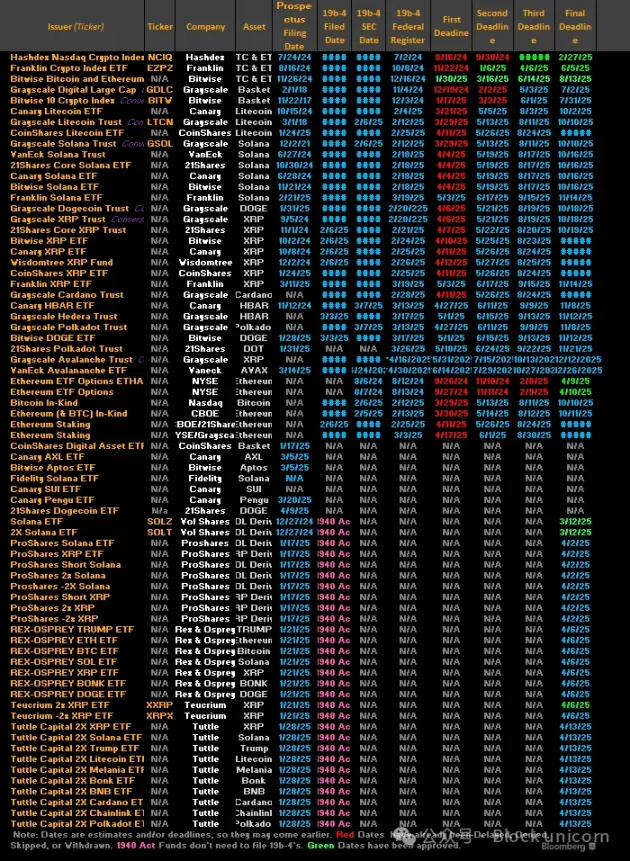
First, a basic question: Why apply for ETFs?
Bloomberg ETF analyst Eric Balchunas recently posted: "Turning your cryptocurrency into an ETF is like a band adding their songs to all music streaming services. While it doesn't guarantee listeners, it puts your music in front of most potential audiences."
Simply put, this means providing better accessibility for investors and broader adoption through fund companies.
This issue extends beyond the cryptocurrency realm, involving political complexity, particularly concerning former U.S. President Donald Trump.
Trump's media and technology group recently announced plans to invest up to $250 million in cryptocurrency-related ETFs.
ETH ETF's Dilemma
The timing of these applications is especially puzzling, as they come when the ETH ETF is experiencing an investor confidence crisis.
As of April 18, the ETH ETF has seen seven consecutive weeks of outflows, totaling over $1.1 billion. By April 11, its managed assets had plummeted to $5.24 billion, a historic low since these products launched in July 2024.
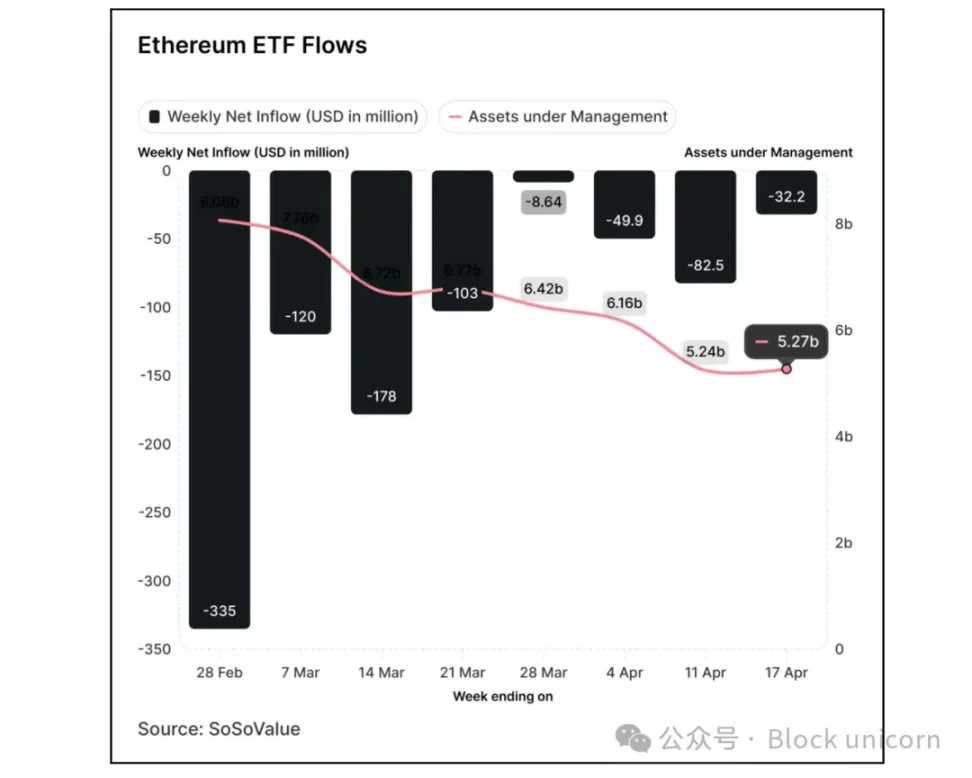
This struggle contrasts sharply with the Bit ETF, which recorded nearly $1 billion in inflows on Thursday and Friday last week, pushing Bit prices back to $95,000.
For Altcoin investors hoping to get an ETH ETF, the ETH ETF experience raises a disturbing question: If the second-largest cryptocurrency by market cap can't maintain investor interest in an ETF wrapper, what hope do less mature tokens have?
Lessons from ETH
Beyond the numbers, the ETH ETF story involves fundamental issues that Altcoin ETF investors must carefully consider to avoid a similar fate.
First is the fee structure issue, with Grayscale's ETHE being a typical example. With competitors like BlackRock offering similar investment opportunities at a tenth of the price, its 2.5% annual fee is unsustainable.
This fee difference creates a mathematical inevitability - over time, high-fee products will significantly underperform low-fee products tracking the same asset. This is crucial for investors planning long-term holdings.
Second is ETH's increasingly complex value narrative. While Bit benefits from its straightforward "digital gold" positioning, ETH's value proposition covers smart contract platforms, DeFi settlement layers, NFT market pillars, and potential staking-generated assets - features currently absent in the ETH ETF.
This complexity creates marketing challenges. When financial advisors can't easily explain investment rationales to clients in one or two sentences, adoption rates suffer. Bit's simplicity wins this battle easily.
The third issue is the SEC's cautious attitude towards staking. By prohibiting the inclusion of staking yields in the Ethereum ETF, the regulatory body has stripped away a differentiating feature. This contrast became particularly evident when Canary Capital recently applied for a staking-based TRX ETF, indicating that some issuers are already trying to overcome this limitation.
Why Still Bet on ETFs?
Despite the worrying performance of the Ethereum ETF, the wave of Altcoin ETF applications has not slowed down. This apparent contradiction is driven by several powerful factors that overwhelm the direct concerns raised by Ethereum's predicament.
The most important catalyst is the "Atkins Effect". Paul Atkins' appointment marks a massive shift from Gary Gensler's tenure, which was viewed by the crypto industry as a period full of regulatory hostility.
Atkins, known for his reputation of supporting innovation and history of favoring market-driven solutions, has provided issuers with an unprecedented opportunity: a viable approval pathway.
Data supports this optimistic sentiment.
Bloomberg analysts estimate the approval probability for assets like Solana, Litecoin, and XRP is between 75-90%.
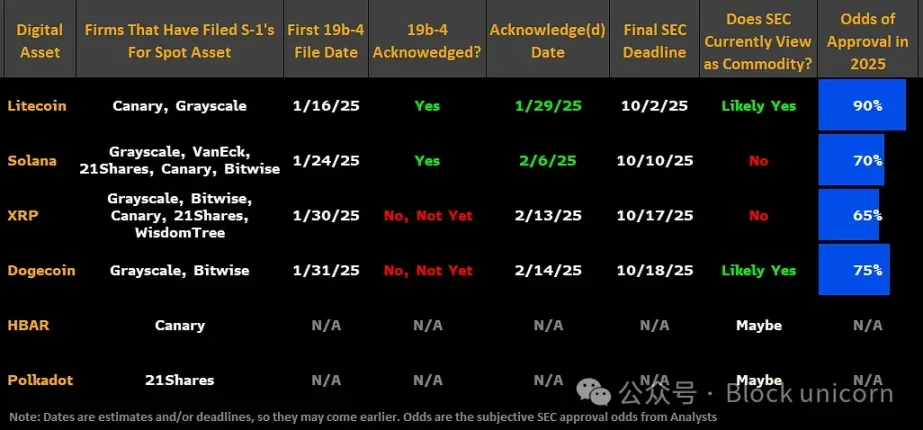
Atkins' leadership has effectively opened a regulatory window that asset management companies are racing to utilize before it potentially closes.
Institutional demand provides another compelling reason for this ETF frenzy. According to a March 2025 report by Coinbase and EY-Parthenon, approximately 83% of institutional investors plan to increase their crypto allocation this year, with many targeting over 5% of managed assets.
Each Altcoin offers a differentiated value proposition that may resonate more than Ethereum's complex narrative.
Solana's ultra-fast transactions and growing DeFi ecosystem provide a clear efficiency story. XRP focuses on cross-border payments, offering a more easily explainable use case to institutional investors. Hedera's enterprise adoption lends it corporate credibility lacking in pure retail cryptocurrencies.
The growth potential of smaller market cap cryptocurrencies also provides a compelling argument for ETF issuers.
While Bitcoin and Ethereum may offer stability, their trillion-dollar market caps limit upside potential. If mid-cap Altcoins gain mainstream adoption, they could deliver more significant returns, attracting growth investors who missed Bitcoin's early gains.
Potential Market Impact
The most direct impact will be capital flow. JPMorgan analysts predict that the Solana ETF alone could attract $3-6 billion in its first year, while XRP might draw $4-8 billion. These fund flows could significantly impact token prices and market dynamics.
In comparison, the entire spot Ethereum ETF market currently holds about $5.27 billion in assets. If two to three major Altcoin ETFs reach these predictions, they could collectively exceed the Ethereum ETF in scale within months of launch, creating a significant market realignment.
However, institutional capital spread across multiple crypto ETFs also risks asset dilution.
This could disperse institutional investors' interests across multiple products. Such a surge might prevent any Altcoin ETF from reaching a critical mass, thereby reducing their attractiveness to institutional portfolios.
For retail investors, the impact is twofold. On one hand, ETFs offer regulated, safe crypto investment positions without self-custody challenges. On the other hand, continuously growing ETF investor premiums (through management fees and potential tracking errors) mean their investment returns may consistently lag behind direct holders of underlying assets.
If large amounts of Altcoins are locked in ETFs, it could reduce circulating supply and potentially exacerbate volatility in the underlying spot market.
Our Perspective
While Ethereum struggles, the Altcoin ETF gold rush reveals the power of narrative over performance. Everyone is fascinated by an ironic phenomenon: people rushing in while Ethereum, as one of the pioneers, continues to incur losses. What they need to focus on is not replicating the Ethereum ETF, but leveraging its failure experience.
Smart issuers are already planning different routes.
Canary Capital's staking-based TRX application is the most obvious evidence of this strategic shift. By introducing staking yields - precisely what the Ethereum ETF lacks - they are addressing the core structural deficiencies that caused massive outflows in recent weeks.
The "Atkins Effect" merely provides an opportunity.
The catalyst is people recognizing that the Ethereum ETF's failure is not because it's an ETF, but because it cannot replace native Ethereum. When investors compare ETHE's 2.5% fees and zero staking yields with simply holding Ethereum, the decision becomes mathematically obvious.
Analysts' predictions for Altcoin ETFs indicate this is more than blind optimism. These predictions suggest that in the context of Ethereum's complex narrative failing, specific Altcoins with clearer value propositions can succeed.
The ultimate biggest winners might be small market cap tokens with the largest growth space. Bitcoin and Ethereum's trillion-dollar valuations limit their upside potential, but precisely positioned Altcoin ETFs might provide the growth multiples institutional investors crave.
The Ethereum ETF is not a cautionary tale but potentially a sacrificial pioneer paving the way for a more successful second wave. Today's Ethereum ETF failure will not prove crypto ETFs don't work; instead, they will be necessary market feedback to make the next generation perform better.