


Interview: Tong, PANews
Editor: Yuliya, PANews
Against the backdrop of increasingly fierce public chain competition, Aptos is steadily moving towards its strategic positioning as a "global transaction engine" through technological innovation and ecosystem expansion. Since first breaking through $1 billion in total locked value (TVL) last November, Aptos reached $1.03 billion by the end of March. Additionally, its stablecoin market value first exceeded $1 billion on March 24, growing over tenfold year-on-year, demonstrating strong ecosystem attraction and capital-carrying capacity.
In this context, Aptos has not only achieved continuous technological iteration but also made multiple breakthroughs in ecosystem construction: Aave completed its first non-EVM testnet deployment, significantly improving DeFi activity. To meet rapidly growing transaction demands, the Aptos team continues to advance technical solutions like Zaptos and Shardines, accelerating the construction of underlying architecture supporting millions of TPS, and strengthening its core advantages in performance, stability, and user experience.
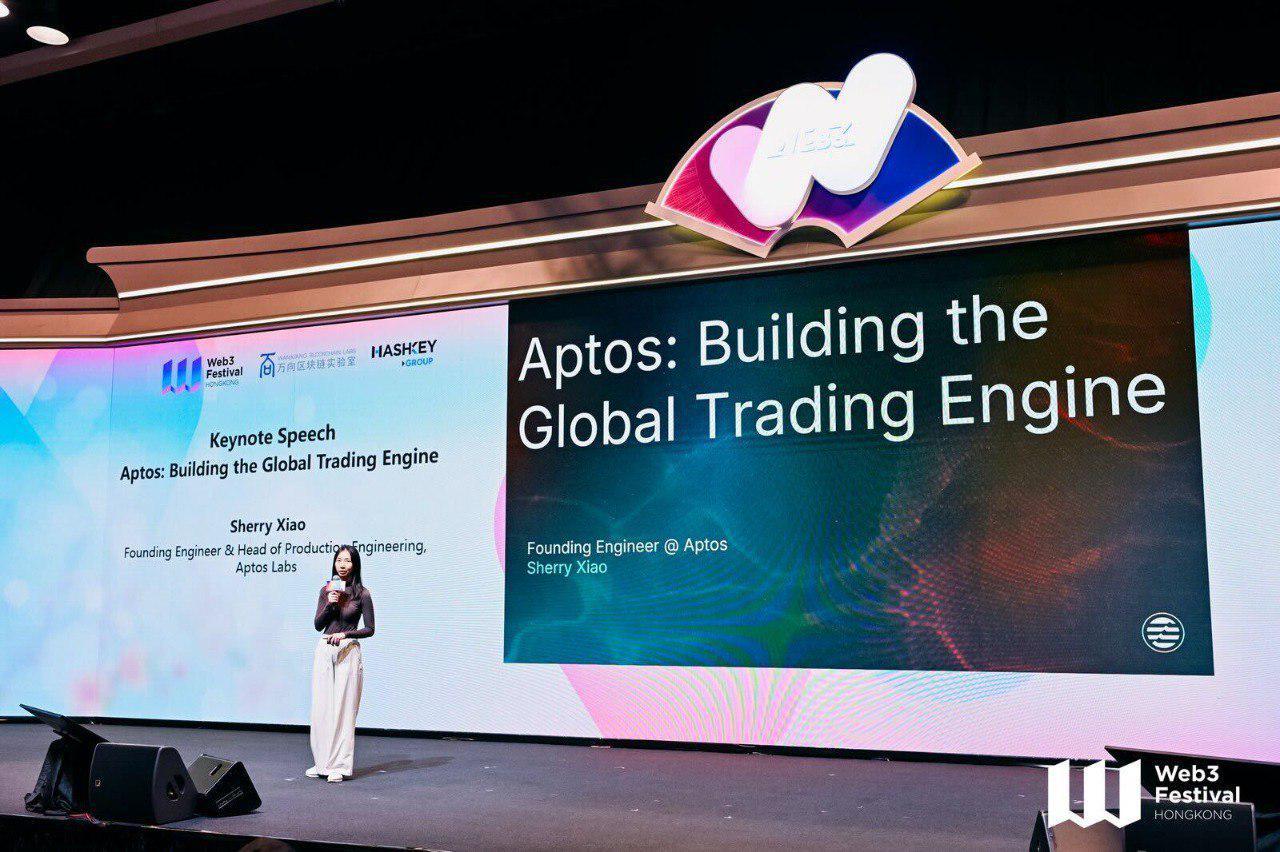
Against this trend, PANews conducted an in-depth dialogue with Aptos early founding engineer Sherry Xiao, exploring key topics such as the technical architecture of the global transaction engine, ecosystem expansion strategies, and developer support, to provide insight into how Aptos stands out in the new round of public chain competition through technology and ecosystem.
High-Performance Public Chain Crafted by Meta "OG"
PANews: Could you introduce your background and role at Aptos?
Sherry: I'm Sherry Xiao, one of the early founding engineers at Aptos. Before joining Aptos, I worked as an engineer at Instagram, primarily responsible for scalability architecture. Later, I joined Meta's (formerly Facebook) Libra/Diem team, handling validator nodes and infrastructure construction, helping institutions like Mastercard, Visa, PayPal, and eBay deploy validator nodes.
When the Libra project encountered policy obstacles, our entire team started a business with our leadership in 2022, establishing Aptos. In fact, many talents came out of Facebook's blockchain team - some joined Sui, some joined a16z's crypto team, and some created other startup teams, like David Marcus's Lightspark. You could say Facebook has supplied a large amount of talent to the Web3 industry.
PANews: As an engineer, how do you evaluate Move language's advantages compared to other smart contract languages?
Sherry: For people with an engineering background, switching languages is routine. Move language is developed based on Rust, and its biggest advantage is that it was designed for smart contracts from the beginning, providing many guarantees in asset management and security, and offering formal verification tools.
Compared to Solidity and EVM, Move can effectively avoid many common security vulnerabilities, reducing the risk of fund losses. The Move prover tool can help developers verify the correctness of smart contracts written in the Move programming language. Additionally, Move provides innovative features like dynamic distribution, Account Abstraction, and permission signatures, enabling developers to build more advanced products.
For developers familiar with programming languages and data structures, learning Move is not as difficult as imagined, because the basic principles of programming are universal.
PANews: What bottlenecks still need iteration on the current technical infrastructure?
Sherry: Overall, I believe the developer and user experience in Web3 still has significant room for improvement. Taking Aptos as an example, the infrastructure is already quite complete, with throughput, speed, and gas fees reduced to very low levels, but the challenge is how to provide unique functions on-chain that allow developers to create standout products.
We are deeply cultivating ZK-based login solutions and innovations in privacy protection. Because if we want to achieve large-scale payments, user privacy is an important consideration. We recently launched a project in our open-source code repository that can hide transaction details, where users can only know a transaction occurred between Alice and Bob, but cannot see the specific amount or balance. This technology combines privacy protection and blockchain decentralization characteristics to create interesting products.
PANews: Aptos focuses on high-performance blockchain. What unique advantages does it have in scalability compared to other public chains?
Sherry: Scalability is our core advantage. As engineers from Facebook, we have rich experience in building highly scalable systems, having been responsible for large-scale infrastructures like Instagram and Facebook.
Aptos's design is highly modular, with each module having its own expansion space:
At the consensus layer, our latest Raptr is the most advanced consensus algorithm implementation in the industry, taking parallelization to the extreme;
At the execution layer, our Block-STM technology is also industry-leading, with many newly released public chains and L2s adopting this technology, such as Movement, Monad, and Polygon;
In storage, we have implemented sharding technology and will continue to research sharding techniques and related cache layers to further improve system performance.
These technologies are open-source and welcome community use. However, even if other chains copy our technology, there will be a delay. For example, when they are still using Block-STM V1, we are already working on V2; by the time they catch up, we have released Move 2.0 performance optimizations. So developing directly on Aptos is a wiser choice.
Ecosystem Layout: Stablecoins, Transactions, and DeFi
PANews: Aptos's on-chain data performance is impressive, with over 47 million accounts and weekly transaction volume exceeding 39 million. What drives this progress?
Sherry: Our ecosystem layout is mainly focused on several aspects:
First, infrastructure construction - we already natively support three major stablecoins: USDT, USDC, and USDE. Users generally feedback that transfers on Aptos are very smooth, with point-to-point payments becoming one of our major advantages.
Secondly, we've collaborated with institutions like Franklin Templeton to launch multiple RWA projects on-chain.
Early this year, we announced a $2 million ecosystem fund to incentivize community building and support different DeFi protocols and projects. This has also promoted DEX trading volume and on-chain activity.
Additionally, we launched the LFM program to help ecosystem projects plan roadmaps, conduct token generation events (TGE), connect with exchange resources, obtain venture capital, and provide marketing and KOL guidance. These efforts have enabled stable growth in our ecosystem over the past period.
PANews: Is the rumor true about HKDA stablecoin potentially being issued on Aptos? What are your plans for compliant development in Hong Kong?
Sherry: Aptos is the only L1 blockchain platform participating in Hong Kong's e-HKD project, and we have been actively involved in related discussions. We maintain close communication with Hong Kong banks and government departments, with BCG also being our partner.
We have extensive innovative collaborations with Cyberport, and our official community organization Movemaker recently hosted a hackathon at Cyberport, hoping to cultivate local projects.
Although we don't have a large office in Hong Kong, through Movemaker, we've established a co-creation space called Aptos Space in a core downtown area, providing a venue for builders to collaborate and gather, and actively hosting offline events to attract Web3 talent. We greatly value the activity of developers in the Asia-Pacific region, as many high-quality ecosystem projects come from Chinese-speaking areas. Our deployment in the Asia-Pacific region will become increasingly deep, investing more resources to achieve more collaborations and encourage better development teams to join our ecosystem.
PANews: In the current market environment, which track projects will Aptos focus on supporting in its ecosystem?
Sherry: From our recently launched global transaction engine, we can see that transaction-related tracks are a direction we highly value. We focus on payment, stablecoin application scenario expansion, and the DeFi track, especially establishing top projects in the DeFi "three-piece set" (DEX, lending, liquidity staking).
We also hope to deeply collaborate with large institutions and partners with distribution channels. Aptos has obvious advantages in transfers - low latency, low cost, which is very suitable for large-scale payment businesses. We are also paying attention to the combination of games and DeFi, as well as AI agent and trading application scenarios.
PANews: Aptos recently announced the creation of a global trading engine. How will this vision be realized?
Sherry: In the past few years, we have been deploying the infrastructure for a global trading engine. We believe that the basic infrastructure of blockchain has been solved quite well, and now we are focusing on innovation at the user experience layer:
For example, Keyless is a zk-based technology that allows users to log in directly using Google, Facebook, or Apple accounts, solving the pain points of private key management and seed phrase memorization;
We have implemented Account Abstraction and permission signing functions, enabling DeFi developers to better control user authentication and entry processes;
On the Move language, we have added dynamic script and dynamic dispatch functions to help DeFi or trading applications achieve functional innovation.
These technical points form our vision: to build a global trading engine and invite developers to create innovative applications using these infrastructures.
Talent Cultivation: Developer Ecosystem Building and University Collaboration
PANews: In the context of AI becoming a hot direction, how does Aptos attract and retain developers?
Sherry: Indeed, some developers will be attracted to hot fields, but each application scenario has its own developer base. Even when AI is hot, many developers are still interested in cryptography, decentralization, and blockchain, which are features that AI cannot satisfy.
For developers, the most important thing is to see future possibilities, not just short-term speculation. Developers have dreams and hope to create products that can be widely used. As long as we can show them market prospects, demand, and opportunities, we can attract developers to continue focusing on the blockchain field.
PANews: What initiatives does Aptos have in university talent cultivation?
Sherry: We place great importance on university talent cultivation. As a team of former Facebook engineers, we deeply understand that universities are the largest talent pool. We have in-depth collaborations with blockchain associations at Stanford University, UC Berkeley, and have cooperation projects with SMU in Singapore and Tsinghua University domestically.
We collaborate with professors to design blockchain courses, allowing students to directly learn Aptos technology and use Aptos as their first blockchain lesson. Most of our company's engineers have doctoral degrees, and they often give lectures at MIT, UC, and other universities to attract excellent developers to join the community.
In the recent hackathon in Hong Kong, teams from Zhejiang University and Tsinghua University blockchain associations showcased very excellent projects, and we look forward to their future growth.
PANews: What are your personal expectations for the future development of Web3?
Sherry: My personal and the entire team's vision remains focused on the transaction and payment fields. Starting from the Libra project, we have hoped to build a global financial infrastructure that allows more people to enjoy the convenience of modern financial systems.
I particularly look forward to seeing innovative payment projects combined with stablecoins. For example, on Aptos, streaming payment is entirely possible - getting paid by the second for work done, which traditional financial institutions cannot achieve.
Migrating traditional payment software to the chain and combining it with privacy protection functions can create exciting new scenarios. These innovative applications are the key to truly promoting the popularization of blockchain technology.
PANews: How will recent changes in the team's top management affect Aptos?
Sherry: Personnel changes are normal for many teams. For the team, this is actually a good opportunity to review past plans and make adjustments. We used to be heads down working, and such changes actually allow us to unite and think about the future strategic direction.






