Focused on RWA, the DEX Ostium recently launched a point system, attracting many players to trade or deposit into liquidity pools for earnings, with transaction fees reaching $1.6 million in April. For users interested in traditional finance, this platform may allow hedging with stablecoins without withdrawing to the real world, perhaps against recently record-breaking gold? Or hedging currencies like the euro or yen?
Table of Contents
ToggleWhat is Ostium?
Ostium is an Ethereum L2 trading platform focused on bringing real-world assets on-chain for trading, including market indices, commodities, and foreign exchange, providing transparent and non-custodial trading services with up to 200x leverage. Investors and partners include GSR, Coinbase, Alchemy, and Two Sigma.
According to Dune data, Ostium has accumulated $5.74 billion in trading volume, with 7,050 users and total trading fees of $2.29 million.
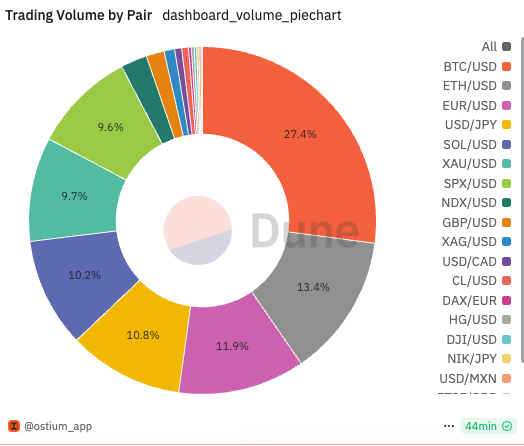
In terms of trading volume, besides Bitcoin and Ethereum taking the first two positions, the euro and yen also have good trading volumes at 12% and 11% respectively. Additionally, gold and the S&P 500 index account for around 10% of trading volume, indicating that many traders use this platform to trade traditional financial products.
Ostium's Shared Liquidity Layer Design
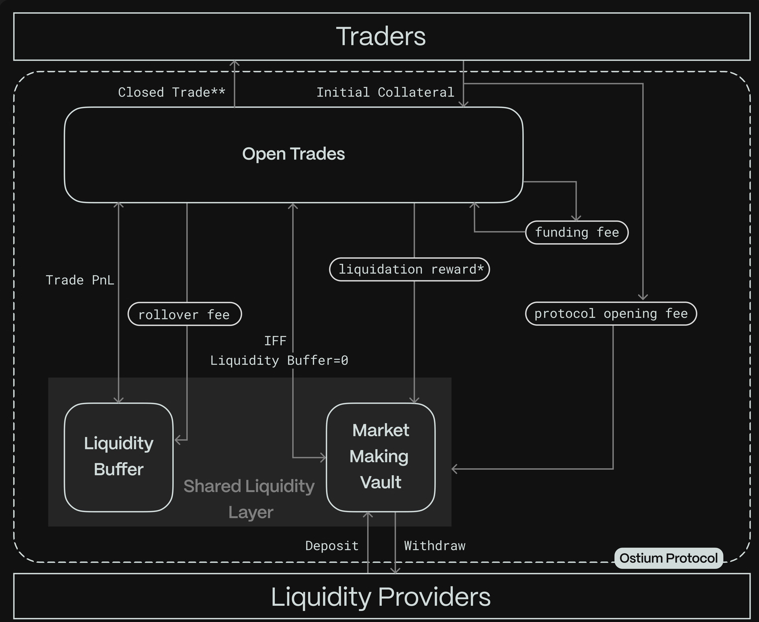
Ostium does not use a traditional central limit order book, but instead supports a Shared Liquidity Layer (SLL), which consists of a Liquidity Buffer and a Market Making Vault, reducing direct liquidity provision from liquidity providers to traders.
The model's main feature is introducing traditional financial quotes, with the liquidity buffer acting as the counterparty, and the market making vault extending liquidity when the buffer cannot. In return, the market making vault receives liquidation rewards and trading fees. Liquidity providers' funds are only deposited and withdrawn through the market making vault, avoiding liquidity fluctuations in the buffer.
Is There No Risk in Trading with Users?
Since Ostium uses a single reference price for each trading asset from real-world oracle prices, it is equivalent to trading against users, and when users make significant profits, it may cause losses in the liquidity buffer.
Ostium's research report from last year indicates that because each trading pair is priced in USD, diversifying asset portfolios and long-short combinations can distribute risk by channeling all trades into a single liquidity buffer.
The report emphasizes the benefits of integrating real-world assets and develops an imbalance score to provide a new perspective on quantifying and managing risks in complex systems. Simulations and data analysis show that adding risk-weighted assets can significantly reduce risks, lowering the average and variance of imbalance scores, and highlight the value of synthetic risk-weighted assets in diversifying and stabilizing AMM portfolios.
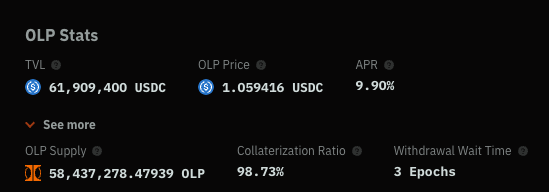
Liquidity providers deposit their capital into the market making vault to mint OLP tokens, representing their share in the vault. Additionally, they receive trading fee rewards for bearing potential delta risks, with a current annualized return of 9.9%. Observing a Collateralization Ratio of 98.73%, which is below 100%, indicates that LP providers still bear the risk of trading against users.
How TALKCHAIN Introduces Airdrop Points
The on-chain analysis team TALKCHAIN recently introduced methods of obtaining points in a video, recommending trading to earn points instead of risking being a liquidity provider, with a potential chance of airdrops. For users interested in traditional finance, this platform may allow hedging with stablecoins without withdrawing to the real world, perhaps against recently record-breaking gold? Or hedging currencies like the euro or yen?
Risk Warning
Cryptocurrency investment carries high risks, with potentially volatile prices, and you may lose all your principal. Please carefully assess the risks.