Table of Contents
ToggleGlobal Student Loan Dilemma Emerges: Pencil Finance Seizes New Opportunities in Education Financing
According to Pencil Finance data, the global student loan total has exceeded 3.8 trillion USD, with interest rates reaching over 10% in many countries, especially in Latin America, Southeast Asia, and Africa, where education financing options are extremely limited.
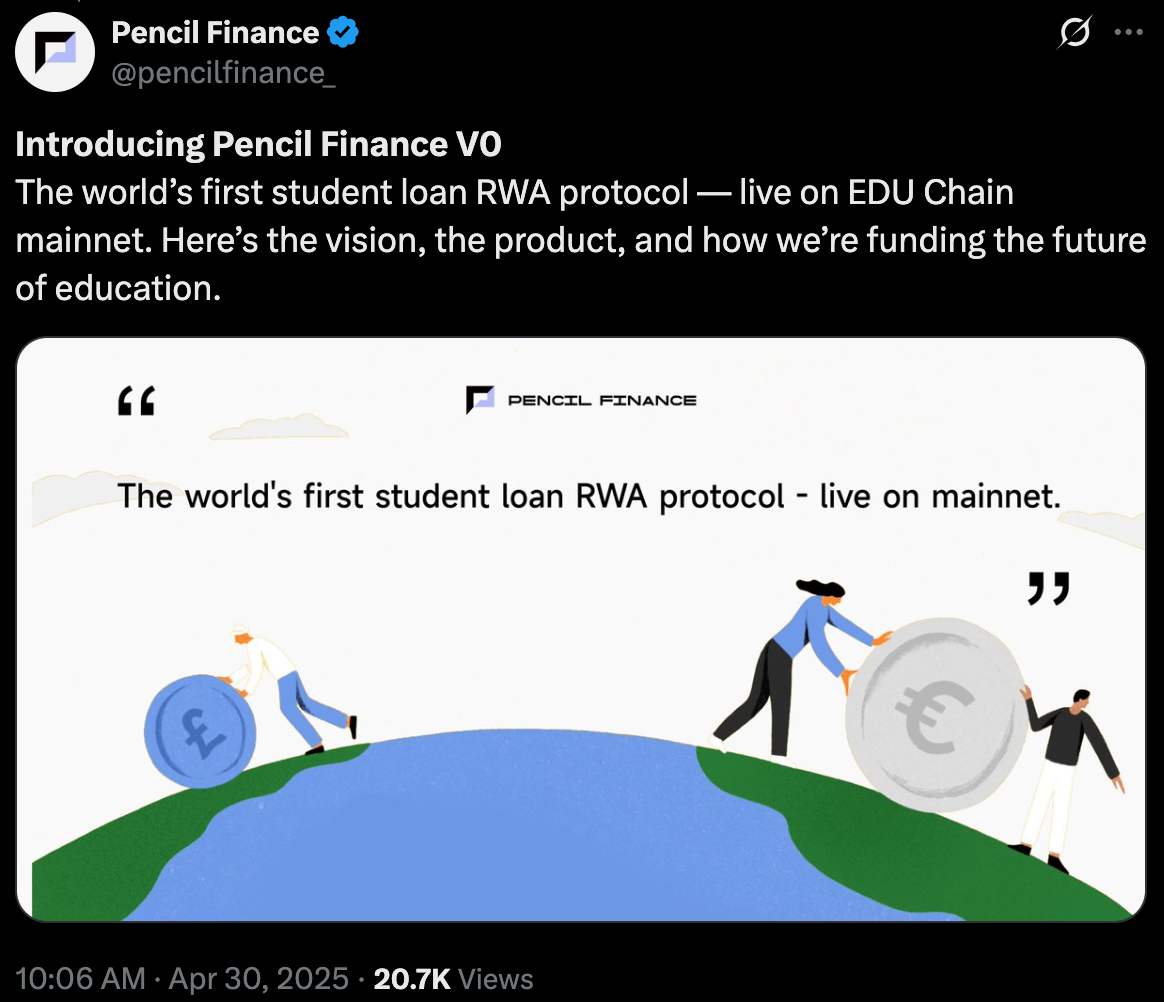
In the past, few DeFi solutions have addressed this field, and we hope to fill the market gap through Pencil Finance's innovative mechanism.
As an EduFi protocol running on EDU Chain on Arbitrum Orbit, Pencil Finance recently received a 10 million USD investment from Animoca Brands and Open Campus.
Merging Financial Technology and Social Responsibility: Pencil Finance's Core Vision and Platform Design
Pencil Finance is committed to creating an education financing platform with transparency, cross-border liquidity, and high capital efficiency. Its core operating model includes:
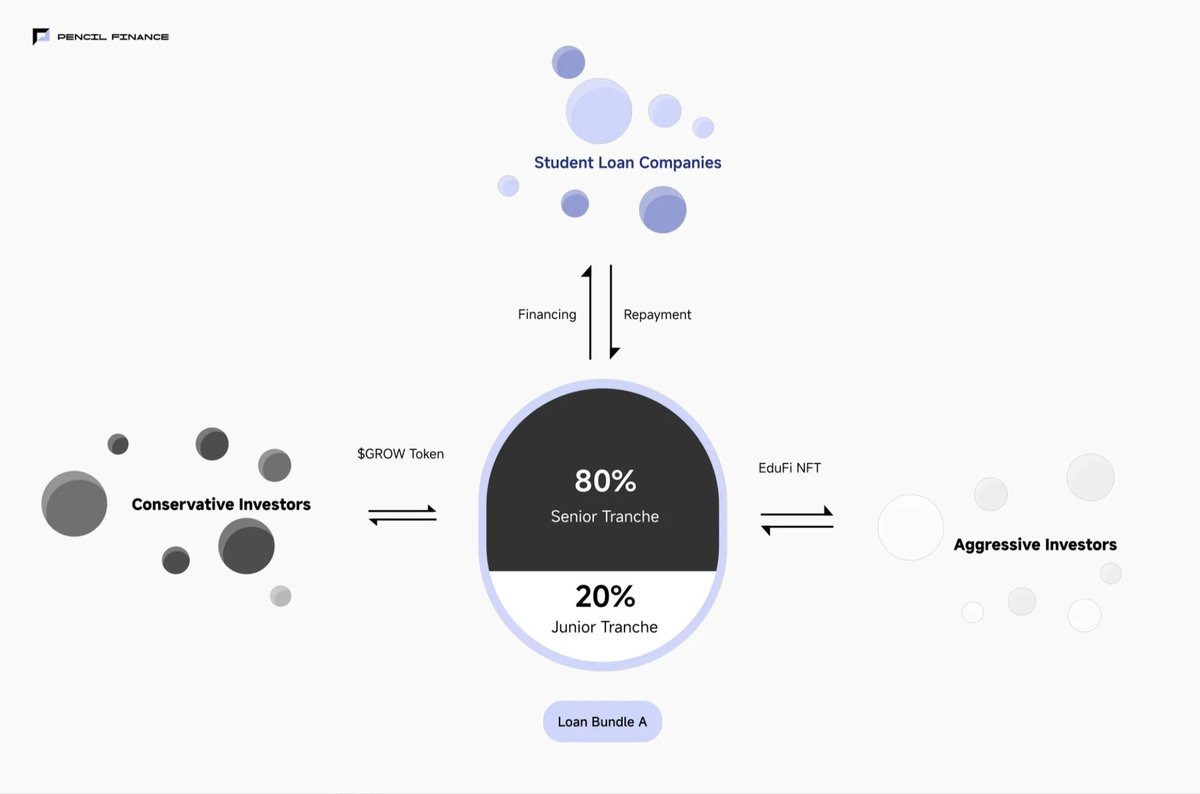
Student Loan Tokenization: Tokenizing real student loans through whitelisted partners
Dual Tranche Model:
Senior Tranche (80%): Invested with $GROW tokens, lower risk and prioritized for repayment, suitable for investors with lower risk tolerance
Junior Tranche (20%): Invested with EduFi Non-Fungible Tokens, bearing more default risk but receiving higher returns, suitable for investors with higher risk tolerance
- GROW Token: GROW is Pencil Finance's native token with the following functions:
Staking Rewards: Users can stake GROW tokens to earn additional income.
Governance Rights: Holders can participate in protocol governance decisions.
Fee Discounts: Discounts are available when paying fees with GROW tokens.
- EduFi Non-Fungible Token: EduFi is a Non-Fungible Token representing student loans with the following characteristics:
Transferability: Users can trade EduFi Non-Fungible Tokens in the secondary market, increasing asset liquidity.
Transparency: Each Non-Fungible Token contains detailed loan information, enhancing borrowing and lending transparency.
Risk Control Design: Analyzing the Dual-Layer Structure and Waterfall Repayment Mechanism
Pencil Finance adopts a fund allocation structure of 80% senior tranche and 20% junior tranche. The repayment order is: "Senior tranche principal ➡️ Senior tranche interest ➡️ Junior tranche principal ➡️ Junior tranche interest."
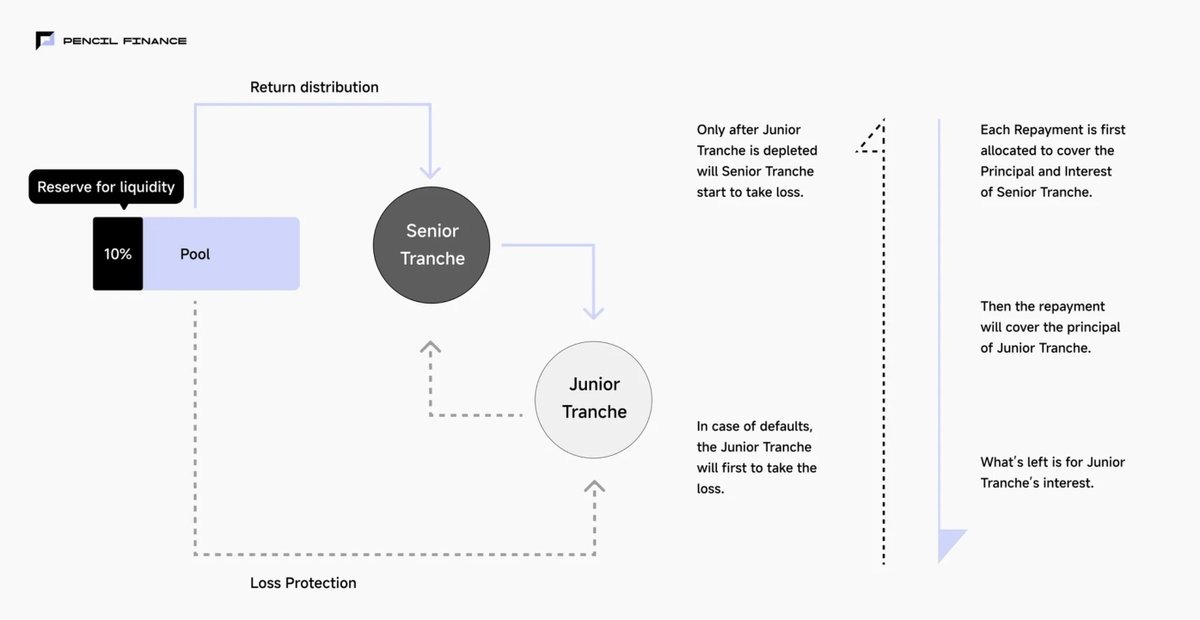
This "waterfall" design can maximize the interests of $GROW token holders and borrowers, and distribute default risk across different investor levels, forming a robust risk isolation mechanism.
In terms of other risk control measures, the team also establishes an insurance fund (amount not disclosed), adjusts loan interest rates based on market conditions to address potential default losses, and maintains the liquidity health of the fund pool.
On-Chain Researcher Pix's Enthusiastic Review: This is the True RWA
It's worth mentioning that on-chain researcher @PixOnChain showed high interest and affirmation for Pencil Finance:
Is someone really bringing student loans on-chain? And it can be invested in? Pencil Finance might be the most bizarre (or smartest?) RWA I've seen recently.
He states that by tokenizing real student loans, capital flows to students, and repayments transparently flow back, which can benefit everyone outside traditional finance:
You are not farming cartoon tokens, but rather funding real people and obtaining genuine returns, backed by real debt. This may be the original form of RWA.
Challenging Traditional Finance: A New Future for Educational Financing Begins Here
Pencil Finance is not just an investment platform, but a force driving educational equity and cross-border financial innovation. Through tokenization and on-chain transparency, it may open a brand new door for educational funding for global students, injecting unprecedented social value and application scenarios into DeFi.
Risk Warning
Cryptocurrency investment carries high risks, and its price may fluctuate dramatically. You may lose all of your principal. Please carefully assess the risks.