


Preface
One of my research principles is to "understand the principle first".
Without understanding the underlying logic, analyzing the market may lead to overfitted conclusions,and ultimately, it's one's own wallet that pays.
Today, I want to discuss BTC.D (Bitcoin market dominance) and some common misapplication areas.
Cause and Effect
One day, person A was awakened by a dog barking outside, and upon waking, discovered it was pouring rain. After getting up, they found a basin on the floor and learned that the ceiling was leaking, so their roommate placed a basin to catch the water.
After experiencing similar situations a second and third time, person A concluded:"When dogs bark, a basin appears on the floor"
Clearly, this conclusion has an obvious flaw.
"Heavy rain → Dog barking → Ceiling leaking → Roommate placing a basin" is logically sound,but this is also the most common pitfall for most people.
The contradiction is: "Heavy rain can cause dogs to bark, but dogs barking does not necessarily mean it's raining heavily"
Does BTC.D Decline Trigger Altcoin Season?
Similarly, let's look at the following statements:
- BTC's growth slows down + Altcoins surge → BTC.D declines
- ETH's surge typically corresponds with Altcoins' surge
The question is:Are these two statements correct, and can we conclude that "BTC.D decline triggers Altcoin season"?
Apparently not.
First, "BTC's growth slows down + Altcoins surge" leads to BTC.D decline,but this does not mean BTC.D decline will necessarily bring an Altcoin season!
(Rain makes the floor wet; it doesn't mean a wet floor always indicates rain)
Secondly, while it's true that ETH's surge typically corresponds with Altcoins' surge,thehistorical sample size is too small, andthere is no inherent causal relationship between them(no logic).
Put simply,we cannot use such an imprecise reasoning process as a basis for our bets.
Finally, everyone seems to overlook the fact that "crypto market capitalization is extremely uneven".
BTC has an extremely high market share,and ETH, as the second-largest, also has a very high market share.
BTC.D's trend is largely influenced by ETH's performance.
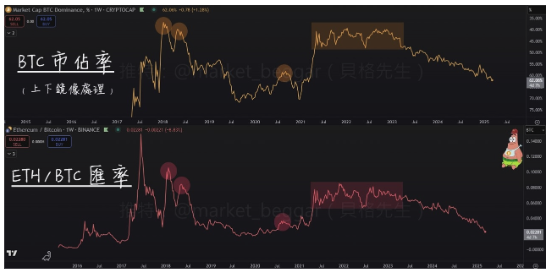 As shown in the image, I flipped the BTC.D chart vertically and compared it with the ETH/BTC exchange rate trend, marking several reference points for readers' comparison.
We can clearly see that the two lines have an extremely high similarity!
Conclusion
To summarize:
- BTC.D is a result, not a cause
- Although historically, ETH and Altcoins' surges were close in time, it doesn't mean the next time will be the same
- BTC.D's trend is largely influenced by ETH's performance
Therefore, using BTC.D as a factor to determine if Altcoin season has started is clearly problematic.
When you see BTC.D dropping significantly, it's likely just ETH is rising;and BTC.D's technical chart cannot be used as a basis for analysis or prediction.
Let me say again: BTC.D is just a result, not a cause!
Using results to infer causes is logically impossible. It's like seeing "rain makes the floor wet" and cannot conclude "a wet floor means it's raining".
That's today's sharing, hope it helps, and thank you for reading.





