


The annual event of the investment community, Berkshire Hathaway Shareholders Meeting, kicked off on May 2, and the shareholder Q&A session began at 9 pm Beijing time on Saturday, May 2. Buffett, the "stock god", participated in the whole process again, answering shareholders' questions with his CEO successor, Greg Abel, head of Berkshire's non-insurance business, and Ajit Jain, head of insurance business.
Wall Street News summarized the main points of the Buffett Shareholders Meeting as follows:
1) About trade
" Trade should not be a weapon ," he said. The United States should seek to trade with other countries and do what each country is good at. Protectionist policies are a "serious mistake."
2) About the United States
" Fiscal policy is my biggest concern in the United States ," and when the government takes irresponsible actions, the value of the currency may be "terrifying." Buffett hinted that he is going all in on the United States and supports American exceptionalism, saying that his luckiest day is the day he was born in the United States, which is a model of capitalism.
3) About Japan
We will not invest overseas easily unless I think it is an opportunity with great potential. He plans to continue to hold the shares of Japanese trading companies for 50 to 60 years. Even if the Bank of Japan raises interest rates, he will not consider selling. Berkshire's current investment in Japan has reached 20 billion US dollars. I even wish we had invested 100 billion US dollars instead of 20 billion.
4) About US stocks
The recent volatility experienced by the U.S. stock market is "not a major fluctuation" and compared with past crashes, "it is not a severe bear market" or a similar situation.
5) On record cash reserves
There may be investment opportunities in the next five years for how to use Berkshire's record cash reserves. Berkshire recently came close to investing $10 billion.
6) About the successor
Abel, who heads Berkshire's non-insurance businesses, is expected to take over as CEO by the end of the year. He will not sell any of his Berkshire shares but will gradually donate them.
7) About Berkshire
If Berkshire's stock price drops by half one day, it will be an opportunity for me. It's not that I don't have emotions, but the fluctuation of stock prices will not affect my rational judgment. It will not affect my assessment of value. Overall, Berkshire's profitability will continue to grow for some time.
8) About investment companies
Buffett believes that the balance sheet is a good starting point for evaluating whether a company is worth investing in. He said: "I spend more time studying the balance sheet than the income statement. Wall Street doesn't really pay much attention to the balance sheet, but I like to look at a company's balance sheet for eight to ten years before looking at the income statement, because some things are harder to hide or manipulate on the balance sheet."
9) On young people’s investment
If your life has a direction, then you should strive to make friends with those you respect and aspire to be like. The fastest path to success is to find the kind of truly outstanding people and walk with them. At the end of the Q&A session, Buffett announced that he plans to propose to the board of directors that he step down as CEO at the end of this year. That will be the beginning of the end of the "Buffett era" at Berkshire. Investors should be prepared for a Berkshire without Buffett at the helm.
Before the Q&A session of the shareholders' meeting, Berkshire Hathaway also released its first quarter financial report for this year. Some of the key points are as follows:
The company's operating profit in the first quarter was $9.64 billion, down 14% from $11.2 billion in the same period last year, which was lower than analysts' expectations. The company warned that tariffs could further hit the company's profits. Berkshire's overall profits were also hit by the depreciation of the US dollar in the first quarter. The company said it recorded a loss of approximately $713 million in foreign exchange, while it gained $597 million due to exchange rate fluctuations in the same period last year.
Berkshire has been a net seller of stocks for the tenth consecutive quarter, with a net sale of $1.5 billion in stock assets in the first quarter. The financial report shows that Berkshire's cash reserves reached $347.7 billion in the quarter, setting a new record high. In an environment of extremely high uncertainty caused by tariffs, Buffett is cautious about current investments and expects that there may be good investment opportunities in the next five years. He said that Berkshire's suspension of repurchases was partly due to the law introduced by the Biden administration last year to impose a 1% consumption tax on stock repurchases.
The following is a transcript of the key points of the Buffett shareholder meeting question and answer session, arranged in the order of questions asked:
21:00 Opening remarks for the Q&A session of the 2025 Annual General Meeting
The shareholders' meeting began. Buffett said at the opening that this was his 60th shareholders' meeting. There was thunderous applause.
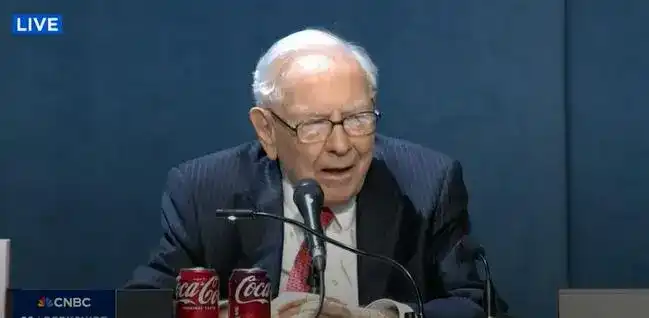
Buffett said that this year, 19,700 people came to attend the shareholders' meeting, setting a record for the number of spectators. At the shareholders' meeting, See's Candies' sales reached $317,000. Brooks running shoes' sales were $310,000, and Jazwares' toys and other products sold $250,000.
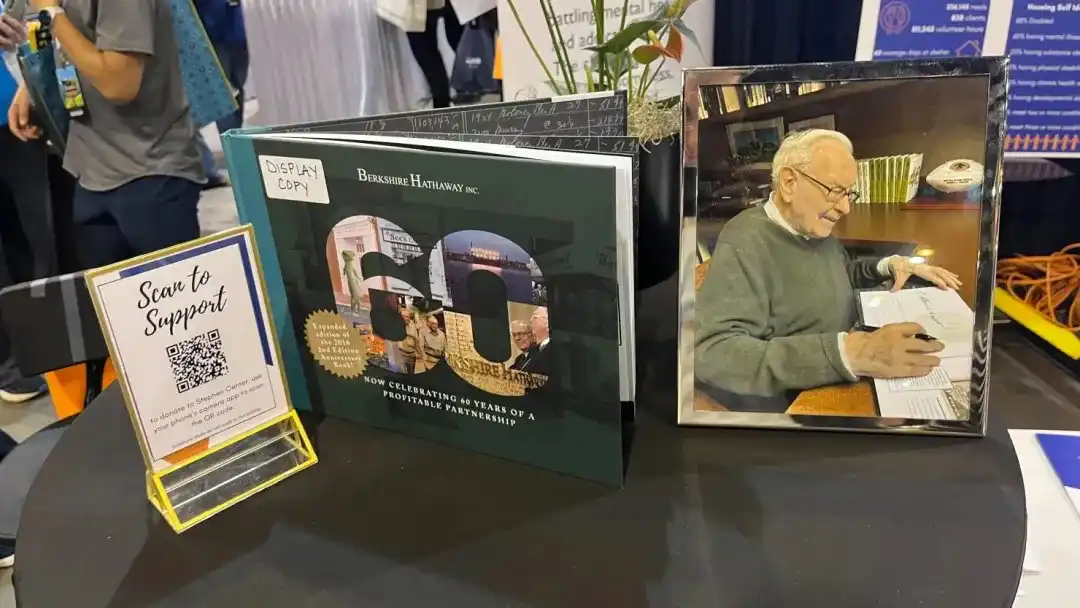
Buffett introduced that this conference will sell a limited number of books commemorating the 60th anniversary of Berkshire's acquisition. This is the only book sold at the official bookstore Bookworm this year. Berkshire printed and published about 8,000 books, about 3,000 more than the initial plan, and about 4,000 copies have been sold at the conference.
21:21 The first question of the shareholders' meeting: Trade
The first question to Buffett was about import certificates, a proposal he made in a 2003 column to reduce the U.S. trade deficit. "Import certificates are designed to balance trade," Buffett said. "I designed this import certificate idea. It's a bit gimmicky, but I think it's certainly much better than anything we're talking about right now."
Buffett criticized tariffs and protectionism and said " trade should not be a weapon ." He pointed out that the United States has gone from nothing to an extremely important country. "We should seek to trade with the rest of the world, we should do what we do best, and they should do what they do best. The more trade, the better," Buffett said.
“You can make some very good arguments that balanced trade is good for the world,” Buffett said in response to a question about trade barriers. “There’s no question that trade and tariffs can be an act of war . I think it has had adverse consequences, just in terms of the attitudes that it has engendered.”
Buffett believes that protectionist policies may have a negative impact on the United States in the long run, especially after the United States has become the world's leading industrial country. He said, "In my opinion, this is a serious mistake . When you have 7.5 billion people who have nothing good to say about you, and you have 300 million people who are somehow showing off their achievements. I don't think this is right, nor do I think it's wise. I do believe that the more support and prosperity the rest of the world gets, it will not harm us."
We have grown from nothing 250 years ago to become an extremely important country, which is unprecedented in history. Buffett's speech won applause from the audience. Buffett did not directly mention US President Trump in his speech.
21:26 Second question of the shareholders' meeting: Japan
When asked if he would stop investing in Japanese stocks if the Bank of Japan raises interest rates in the future, Buffett said he would not sell his stocks. "We will not sell these stocks in the next 50 years. These Japanese companies have a very good operating history," Buffett said, noting that companies such as Apple, American Express and Coca-Cola have performed well in Japan.
Buffett said that the investment in Japan is in full compliance with Berkshire's investment philosophy. The five Japanese trading companies invested by Berkshire have performed very well in the past, and Berkshire intends to continue to hold the shares of these trading companies for 50 to 60 years, and hopes to establish a long-term and deep cooperative relationship with them. Buffett said that the culture and habits of these trading companies are different from ours, and the way of operation is also different, but because of this, we cherish this cooperation even more. "We will not sell any shares. It will not happen for decades . The investment in Japan is just what we want."
Buffett said that Berkshire has no plans to sell the shares of the Japanese trading companies in the short term. Their current operations are very successful, even though he is now 94 years old. Berkshire also plans to further expand cooperation. Buffett said that Berkshire's current investment in Japan has reached 20 billion US dollars. I even wish we had invested 100 billion US dollars instead of 20 billion.
21:35 The third question of the shareholders' meeting: the deployment of Berkshire's huge cash
When asked about Berkshire's current huge cash reserves, Buffett joked that he stopped investing not to make Greg Abel "look good" in the future. Buffett is cautious about current investment opportunities. He said he is always looking for investment opportunities and that Berkshire is "opportunistic" and he wants to reduce the cash on hand, possibly to $50 billion.
Buffett said Berkshire will find opportunities to put the company's record cash pile to work, most likely within the next five years. "Occasionally there will be very attractive opportunities. But good opportunities don't come every day. It's unlikely that a great deal will appear tomorrow, but not in five years. We have made a lot of money by not investing all of our money at certain times."
Buffett revealed that Berkshire almost spent $10 billion on an investment recently. "For example, not long ago, we almost spent $10 billion, but now we will spend $100 billion. I mean, when a project makes sense for us, we understand it and it has good value, it's not difficult to make such a decision."
Buffett pointed out that one problem with the investment industry is that things don't proceed in an orderly manner.
21:43 Fourth question of the shareholders' meeting: Challenges of real estate investment in an uncertain global environment
When asked how to deal with the challenges of the real estate industry in the current global environment full of uncertainty, Buffett said that real estate investment is more complicated and difficult than stocks. Whether it is communication, negotiation, or bargaining, there are many people and links involved, such as who is the owner, legal structure, funding arrangements, etc. It is really not easy to negotiate a deal in real estate and get a good price, because there are too many variables.
If you choose to invest in stocks, there is a huge advantage: countless opportunities can be seen every second, especially in the US market. In contrast, real estate transactions are slow-paced and highly dependent on personal communication and negotiation. Real estate investment may be done by one person alone or by a team.
Billions of dollars are traded every day on the New York Stock Exchange, and thousands of unknown investors are participating in market activities. You only need a suitable price to trade 20,000 shares of Berkshire Hathaway in 5 seconds. But real estate is not like this. To complete a real estate transaction, the process is not only cumbersome, but also takes a long time. Even if the transaction scale is large today, once it enters the negotiation stage, there are many factors to weigh and coordinate.
Buffett said that Berkshire has also invested in real estate, such as during the financial crisis in 2008 and 2009. He suggested that if you want to invest in real estate, you must compare and choose in a more intelligent and strategic way.
21:49 Fifth question of the shareholders' meeting: The impact of AI on the insurance industry
The question of whether artificial intelligence (AI) can change the insurance industry was first answered by Jain, head of Berkshire's insurance business. Jain said that people have invested a lot of time and money in AI. AI will be a tool used to change the rules of the industry. AI technology may "really change" the way the insurance industry currently evaluates, prices and sells risks, as well as the current claims settlement method.
But Jain noted that Berkshire will not be the first to adopt AI in the industry, and Berkshire has taken a more cautious approach to any high-profile new technology claims. "I certainly think that people will eventually invest huge amounts of money to chase the next new hot thing," Jain said. "We are not good at being the fastest or the first to move. Our approach is more of a wait-and-see approach until the opportunity materializes and we have a clearer understanding of the risks of failure, the pros and cons."
However, Jain added that Berkshire would not hesitate to invest once the right opportunity arises. He said, "Currently, some insurance companies are indeed experimenting with AI and trying to find the best way to use it, but we have not consciously invested a lot of money to seize this opportunity. I guess we will be ready and we will invest quickly once the opportunity arises."
Buffett said he would let Jain decide what Berkshire's insurance business will look like over the next decade. Whether to use AI will be a choice made by Jain.
21:52 Shareholders' Meeting Question 6: Why did Berkshire invest in the hot dog company Portillo's?
When asked why Berkshire bought Portillo's, a Chicago hot dog chain, Buffett responded that he didn't know much about Portillo's. He joked that someone might have bought it on the sly. Buffett then switched to an anecdote about Jay Pritzker, a relative of Illinois Governor JB Pritzker who bought a Brooklyn chocolate company decades ago. Buffett called Jay an excellent manager. Abel clarified that Berkshire did not own Portillo's. The company was actually owned by an investment company with a similar name to Berkshire.
22:00 The seventh question of the shareholders' meeting: The United States seems to be undergoing a huge change. Are we pessimistic or optimistic about the United States?
The questioner said that Buffett has always believed very much in the long-term advantages of the United States, but today the United States seems to be undergoing some unprecedented and almost "revolutionary" changes. As an investor, how should one evaluate the current situation and should one remain optimistic or pessimistic?
Buffett responded to this question by saying that the questioner is a new generation of investors. In Berkshire's annual manager report, you usually don't see these macro-level comments. But he can say that the United States will not experience that kind of drastic "revolutionary" change. Buffett said that the United States was once an agricultural country, but then society changed and the economy performed very well. It used to be a male-dominated era, but then fair reforms were carried out, the constitution was amended, and women had the same opportunities.
“I mentioned that we started out as an agricultural society. We started out as a society of promise, but we haven’t lived up to our promises very well. We’re always changing. We’re always going to find all kinds of criticism in this country, but the luckiest day of my life was the day I was born , (because) I was born in the United States.”
Buffett said that the transformation from 1920 to now, from 1776 to now, we have done a lot and it has taken a long time. I was born in the United States, and almost everything happened in the United States at that time, but it is different now. I am very lucky as a man born in the United States - it is not easy, but the United States has changed.
"We've been through the Great Depression, we've been through world wars, we've been through the development of the atomic bomb, which was something I never dreamed of when I was born, so even if we don't seem to have solved all the problems that arise, I won't be discouraged. If I were born today, I would keep negotiating in the womb until they let you go to the United States." From 1930 to now, we have been through a lot of things, such as the Great Depression, two world wars, and the tensions caused by the atomic bomb. These are all experiences we have along the way. We are a very lucky country, and I am a very lucky person. I feel much more fortunate to be born in the United States than to be born anywhere else.
22:04: The eighth question of the shareholders' meeting: Can the principle of patience be broken in investment?
Someone asked, is there a time in investing when you can be impatient and break the patience rule? Buffett said, sometimes you have to act quickly. Berkshire made a lot of money because it was willing to act quickly. You don't want to be patient on deals that make sense.
Buffett said, "When a good opportunity comes, you should not be patient at that time. You should be patient to wait for those occasional opportunities. But you should not hesitate for those reasonable transactions. You should not be patient to listen to those empty talks that will never come true."
22:13 The ninth question of the shareholders' meeting: Geico, the auto insurance company
Jain said that Geico did face a crisis, but we turned the crisis into an opportunity. When we first took over, there were two major problems: the first was that our rate structure was unreasonable, and the second was that we had systemic problems in actuarial and pricing mechanisms. Five or six years ago, these were the areas where we were worried.
Through rapid technical adjustments and process optimization, these problems have now been solved. We have not only improved the pricing model, but also done a lot of work on risk matching and optimized the overall pricing system. Today, Geico is able to price everyone based on their comprehensive risk level. We have done a great job in this regard, and it has also turned into considerable profits.
Although we have achieved a lot, I don't think the mission is complete. We still have a lot of technology to take advantage of, such as new tools such as AI. Our goal is not to "catch up with others" but to "do better." Buffett said that this is a very interesting case study, especially about how a company responds to changes in the rules of the game in the industry. Every business has its own challenges and opportunities.
Berkshire bought Geico for $50 million in the 1970s, and it was only a partial stake at the time. Later, Geico brought us huge benefits. Now we own 100% of the company, and the profit in just one quarter can reach $2 billion. But this is the result of decades of continuous investment and improvement. 100 years ago, auto insurance was almost non-existent; but now, in addition to property and casualty insurance, auto insurance has become one of the largest insurance products. Geico's profits are very considerable, with up to $29 billion in liquid cash on hand. I bought the company for 50 million, which was a very cost-effective investment.
Geico was founded in 1936 by a government employee who was originally an employee of USAA. He made a profit in the first year, and even more in the second year, and then the company grew and successfully went public. The auto insurance industry began to take off. No one likes to buy insurance, but everyone likes to drive, which makes auto insurance a necessity. Geico's development story is very interesting. It once tripled in a few years, and although it went off track, it finally got back on track. We talk about Geico at the annual meeting almost every year.
Buffett specifically mentioned Geico CEO Todd Combs. He said Combs did an excellent job in this transformation. He successfully turned the subsidiary around. Telematics, which was once considered a disadvantage, is no longer a competitive disadvantage. Combs also significantly streamlined the company's staff structure, cutting thousands of jobs, which played an important role in improving efficiency.
22:22: The tenth question of the shareholders' meeting: Why do you think Abel is a suitable successor?
Buffett didn't answer the question directly. He said it's important to surround yourself with great people you enjoy working with. Buffett gave advice on choosing a job and starting a career. He said you need to "do what you love." Buffett warned that employees' habits may affect their colleagues, so it is crucial to choose your workplace carefully.
Buffett suggested that although you should "carefully" choose your employer, you don't have to get too hung up on factors such as starting salary. "If you can find excellent colleagues there, go there." Abel said he was honored to be involved in Berkshire's work.
22:31: Shareholders' Meeting Question 11: US dollar depreciation and currency risks
Someone asked about the weakening of the U.S. dollar and currency risk. In response to a question about how to reduce exposure to the risk of a depreciating U.S. dollar, Buffett said his company would not invest in "worthless" currencies. "We don't want to own any currency that we think is going to depreciate." Buffett also mentioned an increase in positions in the Japanese yen. He did not rule out the possibility of exploring and focusing on other currencies in the future.
Buffett also emphasized the complexity of currency games and pointed out that one of the responsibilities of the government is to devalue its currency. Buffett said that he would not take any actions based on quarterly or annual earnings to manage currency risks. It is very difficult to build an effective check and balance mechanism in the currency value system.
In addition, Buffett said: " U.S. fiscal policy scares me because the way it is formulated and all the motivations are to do a lot of things that could get you in trouble with money. But this is not limited to the United States, but the whole world." "I briefly mentioned in the annual report that fiscal policy is my biggest concern in the United States because that's the way it is formulated."
"All the dynamics are driving some behavior that can and does cause trouble on currency issues ," he said. "But this is not limited to the United States, this is true in many parts of the world. In some places, this situation often gets out of control." Buffett said, "We would not really invest in a currency that is about to "collapse," adding that the value of a currency can be "terrible" when governments act irresponsibly.
“Charlie always felt that if he had to pick an investment area other than stocks, he felt he could make a lot of money in the foreign exchange market,” Buffett said of his late vice chairman, Charlie Munger. “We tried it once. I can’t say we won’t do it again, but it’s unlikely. Unless something happens in the United States that makes us want to own a lot of other countries’ currencies.”
22:41 Shareholders' Meeting Question 12: Mongolia
The questioner said that Mongolia is an emerging market located between China and Russia. We have animal husbandry and mining, and the economy is still growing. We held a Mongolian investor conference in New York last year, which attracted many interested investors. What does Buffett think of emerging markets like Mongolia? Do you have a long-term investment plan?
Buffett said, "I remember that about 20 years ago, I attended an annual meeting and started to pay attention to Mongolia and heard about Mongolia, so I still have some understanding of Mongolia's situation - that was a long time ago. Now we will listen to some reports from the government and evaluate which business opportunities can be truly developed. But we will not easily invest overseas unless I think it is an opportunity with real great potential."
Many people think that to make money you have to go to places with high inflation, where you can make a lot of money, but I don't think so. At present, our company has no short-term investment plans in Mongolia, unless it is a project that is very attractive in terms of scale. Maybe 20 years ago we would consider going there to take a look. But I don't know much about your economy, such as livestock industry, mining, etc. This is my current view.
22:45 Shareholders' Meeting Question 13: Private equity firms competing in the insurance industry
Some people asked, Blackstone, Apollo and KKR private equity firms are expanding in the insurance field, and what do you think of these companies being more aggressive? Jain admitted that competition from private equity has made Berkshire's investment in insurance business more difficult. "There is no doubt that private equity firms have entered this field and we have lost competitiveness in this field. We used to participate in this field a lot, but in the past three or four years, I don't think we have made a single deal."
But Jain said private equity is modeling higher leverage and more aggressive investment strategies. When the economy is doing well, private equity firms take on some risk in terms of leverage and credit risk, especially in the life insurance sector. "When the economy is good and credit spreads are low, they make a lot of money," Jain said. However, there is always a risk that at some point, regulators may be unhappy and say that you are taking too much risk on behalf of policyholders, which could end in tragedy. "We don't like the risk-reward ratio in these scenarios, so we chose to raise the white flag and decided not to compete with private equity firms in the life insurance sector."
Buffett said many companies want to emulate Berkshire's model, but their CEOs don't invest all their assets in the company like we do. Buffett added that the difference between Berkshire and its competitors is that he takes greater personal responsibility for investments. He said: "They may have a different sense of fiduciary responsibility for what they do. Sometimes it works, sometimes it doesn't, and if it doesn't work, they turn to other things. But if what we do at Berkshire doesn't work, I will regret everything I created for the rest of my life, so it's a completely different personal relationship. In the field of property and casualty insurance, no company can really copy Berkshire's model."
22:50: Shareholders' Meeting Question 14: Young People's Investment
The questioner was a young girl. She said she had just started learning about investing and wanted to hear Buffett's opinion on what lessons he had learned in the early days of investing. Buffett said, "This is a very good question. I really wish someone had given me this advice when I was young."
It's all about the kind of people you surround yourself with. Don't expect every decision you make to be right. If you have a direction in life, make an effort to surround yourself with people you respect and aspire to be like. I just mentioned a few people I've worked with in the past. Maybe they didn't do things on the same scale as I did, but they were people I really liked and it meant a lot to me to be around them. It's invaluable to walk the path of life with like-minded people. Unfortunately, these things are often not truly appreciated until later in life. When you're older, you'll understand that these are the things that really matter.
Buffett mentioned two former Berkshire directors, Tom Murphy and Walter Scott. He said that if you have people like Tom Murphy and Walter Scott around you, your life will definitely be better. But this does not mean that you should follow the rich and copy their lifestyle. I would suggest that you get close to those who are really smart and wise, learn from them, ask them for advice, and try with them.
If you are looking for a meaningful job and you are not in a hurry to make money, then I suggest you spend time with outstanding people like Charlie Munger. Find such opportunities and share their success; if you can't find them, it doesn't matter, just keep doing what you are doing and keep working hard. Persevere, and you will eventually find people who live and think as seriously as you do. Buffett recalled that when I first went to Geico, the door was locked and I didn't know who was behind the door. Ten minutes later, I met the man who later had a great influence on my life. When you meet such people, remember their help to you, and also think about repaying them and helping them in the future. Never forget these noble people.
Of course, sometimes you may find yourself in situations that are less than ideal. But if you are really lucky and live in a good environment and are surrounded by great people, cherish it. You don't need to feel guilty about being lucky. There are 8 billion people in the world and only more than 300 million people in the United States. If you live here, you are already ahead of the game in this field, and you should take advantage of it. If someone at work asks you to do something you don't want to do, don't be with them. Different industries have different selection criteria for people, but if you find a direction that makes your heart beat, work hard at it, especially if it is a career you want to do for a lifetime.
The investment industry is very interesting. Many people don't want to continue doing it after making their first pot of gold. But I am personally lucky that I saw its long-term charm from the beginning. Like Tom Murphy, he lived to be 98 years old. He has an ability to see the potential in others. We haven't met another person who can spot talent as keenly as he does. If you want to be a better person, you must work hard to find people like him and work with them.
There are many successful people in the world, but not everyone can make the right choices. The fastest way to success is to find the truly outstanding people and walk with them. Berkshire's experience is also very valuable to me. Sandy Gottesman has been managing assets for us since 1963 until he passed away a few years ago. There is also Walter Scott and Abel. They all embody what long-term success is. You can learn a lot of truly valuable things from them.
That's the advice I can give you. Some people live longer, maybe because they are surrounded by good people, or maybe because they drink Coke every day (laughs). But I believe that happy and joyful people live longer because they are always doing what they really love.
22:59 Shareholders Meeting Question 15: Does the recent market shock provide investment opportunities?
Asked if recent market volatility offers an opportunity to make big investments, Buffett downplayed recent market volatility, saying it 's "really nothing" and that it's part of investing. He downplayed the stock market swings that have unnerved investors in the past few weeks.
“What’s happened in the last 30 days, 45 days, 100 days… is really nothing,” Buffett said, noting that Berkshire’s stock price has fallen 50% less than three times in the past 60 years. During that time, the company did not have any fundamental problems.
Berkshire Hathaway's stock price has fallen 50% less than three times in the past 60 years. He pointed out that during this period, the company did not have any fundamental problems. Given this, Buffett believes that the recent trend of U.S. stocks is " not a huge move " compared to periods such as the stock market crash in 1929. "This is not a dramatic bear market, nor is it a situation like that."
Buffett recalled that on his birthday in 1930, August 30, 1930, the Dow was at 240, and then fell to 41. Despite some "horrifying" events, the Dow closed above 41,300 on Friday.
For those who worry about the cyclical ups and downs of their portfolios, Buffett advises that they should change their investment philosophy to adapt to the world - rather than the world adapting to them. "If it's important to you whether your stocks go down 15%, then you need to change your investment philosophy ," Buffett said. "The world doesn't adapt to you, you have to adapt to the world ." He added: "Everyone has emotions. But you have to control your emotions when investing."
23:03 Shareholders' Meeting Question 16: How to deal with setbacks in life
A shareholder from Shanghai, China, sought advice on how to deal with setbacks in life. Buffett said, "I would focus on the good things, not the bad things. Life can often be wonderful - but it can also be a bad setback."
23:09 Shareholders' Meeting Question 17: Autonomous Driving
Someone asked, autonomous driving has not yet been fully popularized in the United States. If it really comes into being in the future, how will Geico's insurance business be affected? How do you view the division of responsibilities, software issues, and broader changes brought about by autonomous driving?
Jain, who is in charge of insurance business, replied that from the perspective of insurance, autonomous driving will not bring about immediate fundamental changes. Currently, most car insurance premiums are priced based on the frequency of driver errors, and our insurance policies and claims systems operate according to this risk calculation method.
Jain said that autonomous driving technology may indeed reduce the chance of accidents, and Geico and other insurance companies hold the same view. But once this technology is truly popular, we will make corresponding adjustments.
Buffett said, this reminds me of what Charlie Munger once said to me. When we decided to enter the textile industry, we could not foresee the future transformation of the entire industry.
The world is always changing. Just like in baseball or golf, not every swing will result in a home run or a hole in one. Accept that you will make mistakes.
Today we are talking about whether auto insurance will be changed, which is a very important question. However, at present, autonomous driving has not yet been fully commercialized, and the United States has not yet promoted it on a large scale. No one can accurately predict what the insurance industry will look like in the next 100 years.
But one thing is clear: the world is dynamic. People like to drive, and we don't want to destroy the world. We have learned how to better protect the earth, although it is difficult. We know that there are 8 countries in the world that have a significant impact on the development of all mankind, and we hope that these countries can have the best leaders.
Einstein published his theory of special relativity in 1905, which led to the study of how energy can be transformed into powerful forces, and ultimately led to the threat of nuclear weapons. I was born in 1930 and have witnessed the consequences. Even Einstein could not have anticipated the way these inventions would eventually change the world.
We've also seen what's happening with North Korea. No one can really predict what they're going to do next. These uncertainties are not going away anytime soon.
Even so, there have been many benefits from change, making our lives much better today than they were 100 years ago. But we still have to deal with real problems like weapons of mass destruction.
Just like car insurance now, we see rapid technological development, but to me, this change is not as big as the impact of the textile industry. Now should be one of the "luckiest" stages in human history. You should enjoy life and pay attention to the changes in the insurance industry.
Insurance is an industry we do very well in. Although it has a lot of structural problems, we can't control everything. If you don't know how to swing, don't play golf.
There are indeed many clauses that need to be clarified regarding product liability and accidents caused by autonomous driving. Once an accident occurs, the cost of repair will increase significantly due to technological upgrades. Today's cars are becoming more and more like high-tech products, and these new technology-related issues have not yet been fully resolved.
For example, when I first went to Geico in 1950, the average annual premium was about $40, depending on which state you lived in. Now, $2,000 a year is the norm. At the same time, however, the number of traffic deaths has dropped dramatically. If you look at it from another perspective, it is actually much safer to drive now than it was before. It is difficult to predict the future direction of the entire industry. You have to look at it in combination with research, reality and various data.
Changes in the energy industry, medical care, and political environment may also lead to adjustments in industrial structure. In the business world, many problems do not have "answers", only "action points". The rules of the game today are completely different from the past, so you have to rethink how to run your industry every day when you wake up.
Some additional notes on Berkshire's first quarter earnings:
Our insurance sector's performance declined significantly in the first quarter of this year. Last year was very strong, but this year it was under pressure due to falling prices and rising risks. Some of our achievements cannot be replicated, and we do not recommend that you copy others' models. We do have some advantages. Our investment income has not changed much because we have not made many mistakes overall. We expect total investment this year to be around $40 billion. Although the overall return will be lower, the negative impact will be less than in the past.
The railroad business has grown slightly this year compared to last year, and some problems are being improved. It is still a high-quality asset for Berkshire. The problems in the energy sector have been basically solved, and earnings have also rebounded this year. We need to continue to work hard on other businesses. We have made a lot of estimates, some of which have increased and some have decreased, but overall they are not bad. Regarding cash flow, please be patient. Munger once told me: "As long as you are patient and willing to read financial reports and listen to politicians' speeches every day, you will find very good opportunities."
We still have plenty of cash, and as long as the business we underwrite is profitable, this cash will be useful. We may make important investments in the next 50 or 100 years. Of course, there will be difficult years, and then these cash reserves will be particularly important. The current retention rate of the life insurance part is -2.2%. If you are not prepared for the future, you are likely to get into trouble. You have to think differently when running a business.
We haven't made any acquisitions this year. If you buy Berkshire stock, you'll get your share. Buffett said Berkshire suspended its stock buyback program this year in part because about a year ago, the Inflation Reduction Act was enacted, which imposed a 1% excise tax on stock buybacks . This hurt us more than other companies.
Buffett said: "This does make it (buyback) slightly less attractive than before." Buffett cited Apple as an example, which performed well this year and spent $100 billion on buybacks. The taxes they paid for these buybacks were also huge. The price they bought back was even higher than the price you bought it at - this is good news.
Nowadays, people are looking for ways to increase their chances of success, but I want to emphasize: you must read carefully. Without in-depth reading, you cannot make wise decisions. If there are major changes in the future, our company will still adhere to a conservative and prudent participation strategy. Although we have made some repurchases, the tax burden is already not to be underestimated.
0:05 Opening remarks of the second half and question 18 of the shareholders' meeting: What can we learn from Munger and others?
Before the second half of the Q&A session, Buffett recommended a documentary about the late Washington Post publisher Katharine Graham: "Becoming Katharine Graham" to the audience. Buffett appeared in the film because of his friendship with Graham and his role on the board of directors of The Washington Post. Jain did not take the stage in the second half, and Buffett and Abel continued to answer questions.
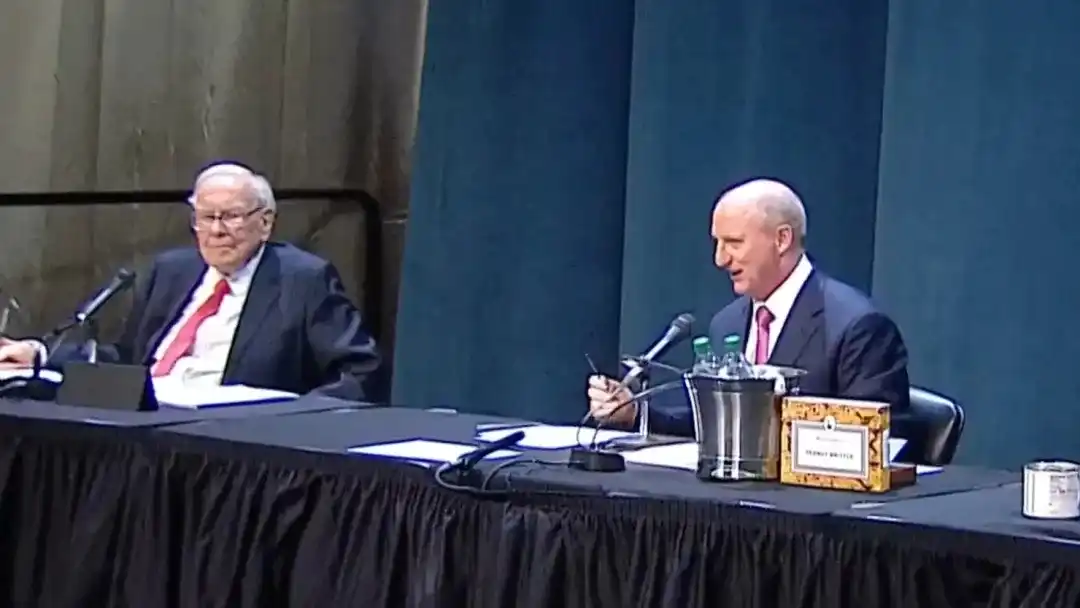
A shareholder asked how Abel wanted to be remembered. He said his role as a father and coach was very important to him. Buffett quipped that he wanted to be remembered for his "old age," which drew laughter from the audience. Buffett explained why he thinks the balance sheet is a good starting point for evaluating whether a company is worth investing in.
“I spend more time looking at balance sheets than I do income statements,” he said. “Wall Street doesn’t really pay much attention to balance sheets, but I like to look at eight to 10 years of a company’s balance sheet before I look at its income statement because some things are harder to hide or manipulate on a balance sheet.”
He added: “Neither of these, of course, can give you the whole answer.”
0:13 Shareholders Meeting Question 19: Berkshire's capital allocation after Abel takes over from Buffett
Someone asked, over the past decade, everyone has been paying attention to the investment strategies of Buffett and Charlie Munger. Now Abel will succeed Buffett as CEO, and more capital allocation decisions may be led by him in the future. How does he view this inheritance and how does he view the future?
Abel first mentioned that Berkshire has a very strong investment culture, which is the result of Mr. Buffett's long-term establishment. All of our colleagues uphold common values. Capital allocation is the core of our business philosophy. When we make decisions, it is not just a discussion among management, but more importantly, we have a clear sense of risk. These values are the key to the success of our company.
We always value Berkshire's reputation , which is our greatest wealth . Buffett once reminded everyone that when making any investment decision, the first thing is to look at the income statement and understand the real numbers. Now we have a lot of cash, which is a huge advantage, but it also brings challenges - how to allocate these funds? This is not a simple question, but a profound philosophy. We have the ability to allocate at any time, but we pursue "better allocation".
We have always emphasized that Berkshire will not rely on others in any environment, and we will not rely on bank loans for capital operations. Whether it is insurance or non-insurance business, we must have sufficient cash flow to ensure that Berkshire can continue to operate.
We will continue to look for quality opportunities in various industries, not just insurance. Our goal is to fully understand the vision of a company when investing, whether we buy 100% of a company or just hold a portion. As Buffett mentioned before: We completed a $10 billion acquisition last quarter. Sometimes a full acquisition is appropriate, and sometimes buying just a portion of the equity can work. The key is that whether we hold 1% or 100%, we must understand what kind of company the company wants to be in the next 5, 10, or 20 years.
We will continue with this philosophy. This is the core of Berkshire's success over the past 60 years, and we will not change. Buffett went on to emphasize that the United States is indeed facing some major transformation needs. Our American power grid and highway system have fallen behind the current population and economic growth rates. To promote these changes, the US government must take stronger measures. There are 50 states in the United States, and each state has a different way of thinking. Just like after World War II, we mobilized the entire manufacturing industry to support the war in a very short period of time, and the efficiency was amazing at the time. But it is not easy to achieve the same efficiency in peacetime.
Investment depends on the situation. We have knowledge and capital, but we also need to make strategic changes. How to play the role of Berkshire requires a plan that is meaningful to the country, the people and the company. Abel may put forward his views on these issues next. But one thing is clear: we need to prepare sufficient cash reserves to intervene at critical moments.
We have done many cooperative projects in the past. For example, the highway system in the United States was completed under the promotion of the federal government. If it were just one company, it would not be possible. Similar large projects in the future will also require close cooperation between the government and the private sector. Abel said that from the perspective of the energy industry , we do have a lot of areas to advance. At present, the demand for electricity is growing rapidly. To meet long-term energy demand, necessary capital investment must be made. We have strong capabilities in this area and are actively addressing related risks.
Only after these risks are resolved can we deploy the capabilities to meet future needs. And we must start preparing now. Buffett agreed, and he went on to say that we must rely on the power of the U.S. federal government. Just like the construction of the highway system during World War II, it would not have been possible to complete it quickly without national coordination.
We do have the capital and knowledge to participate. But the desire to cooperate is not enough. We also need the ability to "concentrate our efforts on big things." We were able to do this during World War II, but it is very difficult to promote similar national construction in peacetime. This task may eventually fall into the hands of the next generation.
0:26 Shareholders' Meeting Question 20: A 14-year-old girl wants to join Berkshire. How can she work hard?
A 14-year-old girl from Hong Kong said she hopes to join Berkshire in the future and asked what kind of job she could do in the future. Abel said hard work and a desire to contribute will take you far. "We sincerely look forward to the day when you become a member of Berkshire." Buffett added: "Stay curious and read more."
0:29 Shareholders' Meeting Question 21: Wildfires affect utilities, what are the strategies for protection?
Speaking of wildfire risks, Abel said: "It's not going away. The company has decided that when a fire comes, sometimes it needs to cut off the power to the equipment. This is not just about turning off the lights." Wildfires are happening in California and Texas. Where to invest is the first point of view. Speaking of the responsibilities that Berkshire utilities bear when wildfires spread, Abel said, "We can't just be the last insurer. We can't be responsible for everything that happens."
Buffett assured shareholders that Berkshire would not spend their money on things the company considers "stupid." If they did, he added, shareholders "should kick us out." "It's easier to do stupid things with other people's money than with your own. That's one of the problems with government in general. We don't want to bring that to the private sector," quipped Buffett.
0:43 Shareholders' Meeting Question 22: Female fans hope Buffett will arrange a meeting in his office
The question came from a Polish lady. She said that 74 years ago in January 1951, Buffett took an 8-hour train to Washington, just to learn about insurance, and he has been on this path ever since. This is a very touching experience. In 2011, she was only 15 years old, but she also set a goal for herself: one day she must meet you. Today, she finally fulfilled this promise, and she wanted to ask Buffett to fulfill a small wish: Can you give her some time to stay in your office for an hour?
Buffett thanked her for the question and smiled, saying, "You don't need to announce my life story, but I appreciate your persistence and hard work. There are 40,000 people here today, and your question is really special." Buffett said, "When I was young, I often drove around the country to visit various companies. At that time, these companies usually did not have investor relations departments, so many times the CEO personally received me. I was also worried that they might not pay attention to me, but I would prepare two very specific questions in advance."
This is not a bad idea. If you want to visit someone and talk to them for ten minutes, you should think about what you want to say and what you want to ask. You set the terms of the ten minutes, not the other party. You will find that most companies now have investor relations departments whose job is to tell you why you should buy their stock. This is a growing business. But you can learn and understand the world in your own way. Berkshire has our own way, and we don't copy others' ways.
Now we have enough information and talents, so we don't need to interview one by one like in the past. There are more than 40,000 people here today, and we really can't meet everyone's one-hour request. But I really appreciate your enthusiasm and persistence, and that's all I can say to you.
0:50 Shareholders' Meeting Question 23: Acquisition of the remaining assets of Berkshire's own energy division
Regarding Berkshire's decision to acquire the remaining assets of its own energy division. Buffett is not optimistic about the utility industry, saying, "The utility business is not as good as it was a few years ago." He blamed this on social factors, saying that values change, and not always upward.
Buffett talked about investment opportunities in the U.S. energy sector and the role Berkshire can play. "The way to solve this problem is to have some kind of government-private partnership, like in wartime. I don't think the government sent people out to lay a lot of concrete or anything like that when they built the highway system," he added. "We do have the capital, and we also have some knowledge that only very few places have."
0:54 Shareholders Meeting Question 24: Berkshire's future earnings
Someone asked Buffett, what is the company's earnings forecast for the most recent fiscal year? Will future earnings increase or decrease? Buffett said, I think our public utility revenue will be affected to a certain extent. Profits may not be entirely determined by mergers and acquisitions, but it is undeniable that we do make mergers and acquisitions from time to time. This year we spent $10 billion on investment.
A lot of these questions depend on the market environment and people's mood. Some people are more pessimistic. As someone born in the 1930s, I have experienced very difficult times. Sometimes you find certain opportunities particularly attractive, but you don't act and miss the opportunity. This has happened many times in my life.
Many times, I choose not to try something that I feel uncertain about - for example, if you ask me to walk a tightrope, I won't do it. But in the financial market, there are some things that others are afraid of, but I am not afraid. If Berkshire's stock price drops by half one day, it will be an opportunity for me. I know that many people will react differently from me, but I will not worry. It's not that I don't have emotions, but the fluctuation of stock prices will not affect my rational judgment. It will not affect my assessment of value.
Overall, Berkshire's profitability will continue to grow over time. What we have to do is keep the money we earn and then make rational decisions. Everyone has different abilities and risk tolerances, and it is these differences that create opportunities in the investment market.
0:59 Shareholders' Meeting Question 25: Tech Giants' Stocks
Tech giants are currently investing heavily in capital expenditures and AI. Buffett said that tech giants have made a lot of money and have made a lot of investments. For example, Coca-Cola has its own bottling company, and these investments are not actually very large. The initial investment of the company, such as the machinery required, is large, and then there is less. Buffett said it will be very interesting to observe the future capital intensity of the Magnificent 7. "There are many people in the United States who have become very rich by watching how others invest."
1:09 Shareholders' Meeting Question 26: What high school courses or activities will help you invest in the future?
Buffett said that future school teachers can learn from their work.
1:17 Shareholders Meeting Question 27: Is DOGE good or bad for the US in the long run?
When asked about the Department of Government Efficiency (DOGE), Buffett smiled and said, "Why do you ask me such a difficult question? For me, the government bureaucracy has always been a confusing thing. In the capitalist market, many bureaucratic structures are "contagious" , that is, their inefficiency may spread to other areas. In fact, many systems have better management methods, and even Berkshire has room for streamlining and improving efficiency."
But the government is the government. It has no real "superior" to supervise it, which makes people feel uneasy about future governance and fiscal conditions. Especially when the elected people say one thing and do another, it is really worrying. I have always believed that if a politician has money but no credit, it is a very negative signal to me. In terms of fiscal policy, the United States has not really solved the problem of fiscal deficit for a long time. This has never been a thoroughly resolved issue.
As for the United States , “ We are in a fiscal deficit situation that is not sustainable for a long time. We don’t know if that means two years or 20 years, because there has never been a country like the United States, and this situation cannot continue forever.”
Sometimes you know something can't last, but you don't know how to stop it - you just throw up your hands and give up. It was (former Federal Reserve Chairman) Paul Volcker who saved the US from the worst inflationary collapse. Now, the US has a serious inflation problem, and we have experienced the consequences of such policies.
Buffett did not directly talk about DOGE, but he admitted that reducing the budget deficit is a difficult but important task. To be honest, I would not want to be responsible for repairing the financial system and balancing the revenue and expenditure - "That is not a job I want to do, but it is a job I should do ." It just seems that Congress has not taken up this issue.
We are a great country with the most innovative people in the world, but we do have a lot of structural problems. If something goes wrong, these problems won't explode immediately, but they will definitely ferment slowly. Of course, there are incentives and checks and balances in governance. Just like in a company, even the most successful companies cannot be without problems.
Buffett mentioned the risk of dollar depreciation again. He said: "However, the root of all this is to have a currency that does not depreciate. If all the people who trust the government are deceived, and all the people who find ways to profit from it become rich or richer, then what impact will the depreciation have on the stability of society? I don't think you want a society that operates in this way."
1:23 Shareholders' Meeting Question 28: If you were to travel back in time to 1776, how would you create the foundation of capitalism for the United States and support its long-term prosperity?
"When people are most pessimistic, we will make the best deals," Buffett said. He said Berkshire will continue to increase its profitability, but the growth will not be linear. Buffett defended Berkshire's long-term decision not to use other people's capital to make transactions.
Buffett called the United States a shining example of capitalism and compared the system to a cathedral with a casino attached. He said, "American capitalism has been unprecedentedly successful. It is the combination of a magnificent cathedral that has created an economic system that the world has never seen, and a huge casino attached to it. The temptation is very great, especially now, the temptation is to walk into that casino."
"In that cathedral, people are basically designing systems that can produce goods and services for more than 300 million people, a scale that has never been seen before in history." While it is tempting to invest all your time and energy in this metaphorical casino, Buffett warns that it is important to maintain a balance. "In the casino, everyone has a lot of fun and money flows a lot, but you also have to make sure that the cathedral is fed. Over the next 100 years, the United States must ensure that this cathedral is not swallowed by the casino."
He added: “We’ve built an interesting system, but it works. Capitalism seems to be very arbitrary and capricious in how it distributes rewards . ”
1:31 p.m. Shareholders Meeting Question 29: Berkshire's model for operating subsidiaries
Berkshire adopts a "non-interventionist" management approach to the operation of its subsidiaries. Someone asked if he could talk about how it works in detail. Abel said that since 2018, I have begun to understand Berkshire's various businesses more deeply. Buffett's knowledge is very admirable, and he is very willing to share: he will point out the possible risks in the business model, and we will communicate with him in a timely manner if we encounter problems.
He and I usually discuss framework issues , such as how to view the trend of an industry, whether a strategy is reasonable, etc. However, in daily operations , we have a lot of autonomy and can make decisions and advance projects independently.
If an opportunity suddenly appears in a certain industry, or we intend to pursue a new direction, we will discuss with Buffett whether it is worth doing. But at the execution level, we have a high degree of freedom. The managers selected by Berkshire are very familiar with the operation of their own industries, such as the leaders of Geico. Especially in the past few years when the insurance field has undergone changes, a visionary leader is very critical. We benefit from past experience.
Buffett smiled and said, "I have worked with Abel for many years. He is very serious about his work. Sometimes I wish I could be more relaxed like an artist and not work so hard. But to be honest, if a business is doing well, you don't have to worry about being fired."
Abel did a great job. Not everyone is cut out to be a manager. Some people want to be told what to do; some people will quit if you give them an order, and I don't blame them. But Abel is different. He has autonomy and is willing to accept suggestions or assistance from others. He is a true leader.
At Berkshire, we don’t expect every manager to do things the same way. Some are highly admirable, and some may not be. But the quality of an organization’s management can be seen—if the atmosphere of the organization begins to decline, it means that the leadership may also need to make improvements.
For example, in one of our retail stores, an employee once told a friend, "Come and buy something and I'll give you a discount." Although they were just well-intentioned, they violated the company's employee discount rules. This behavior is "contagious." We don't want to see upper-level managers take the lead in changing the rules for personal gain. Once they do this, the entire organization may go in the wrong direction.
1:38 Shareholders Meeting Question 30: What does Berkshire think about environmental changes?
Abel said Berkshire considers this issue when supporting and acquiring energy companies, which must take into account the requirements of the federal and state governments. Abel provided an example of the change in Iowa's power structure in the early 21st century. Abel said that in the early 21st century, Iowa had a power shortage, and the state was powered by coal. He discussed with the governor to determine how to maintain a long-term supply of energy. A variety of energy types were discussed at the time.
Abel stressed that with the support of state legislators, Iowa built a large wind power project and phased out a number of coal-fired units. Berkshire built the largest wind power station project in the United States in Iowa, investing






