


Editor's Note: This article traces the evolution of the crypto industry from early idealism to realism, pointing out that we are currently at a critical turning point after disillusionment. Although most projects tend to imitate and remain conservative, true opportunities still lurk at the edges of "definite pessimism".
The following is the original content (slightly edited for readability):
I've brought another article inspired by Peter Thiel. As a self-proclaimed "Thielogian", I often view the future through the lens of his classic work "Zero to One". Thiel's analytical framework is flexible and can be used to dissect various ideas, trends, and movements. However, sometimes it's more like Wittgenstein's ruler - its reliability is extremely dependent on the observer's perspective and doesn't always provide a clear, consistent view.
As a crypto investor, I often analyze narratives to better understand potential opportunities. At this turning point in the industry - a critical moment when emerging technology market arbitrage spaces are narrowing - I'm also thinking about how to discover and stimulate better ideas and products.
Through Thiel's perspective, I see the crypto world's timeline as an evolution: from Bitcoin's early "definite optimism", to the "indefinite optimism" under the Web3 grand vision - where finance was ultimately seen as a killer app; then to the meme coin casino era of "indefinite pessimism"; and now, with regulations becoming clearer, we seem to be strategically accepting a "definite pessimism".
This is a journey from cypherpunk idealism, through startup fever, sliding into decadence, and ultimately moving towards standardization.
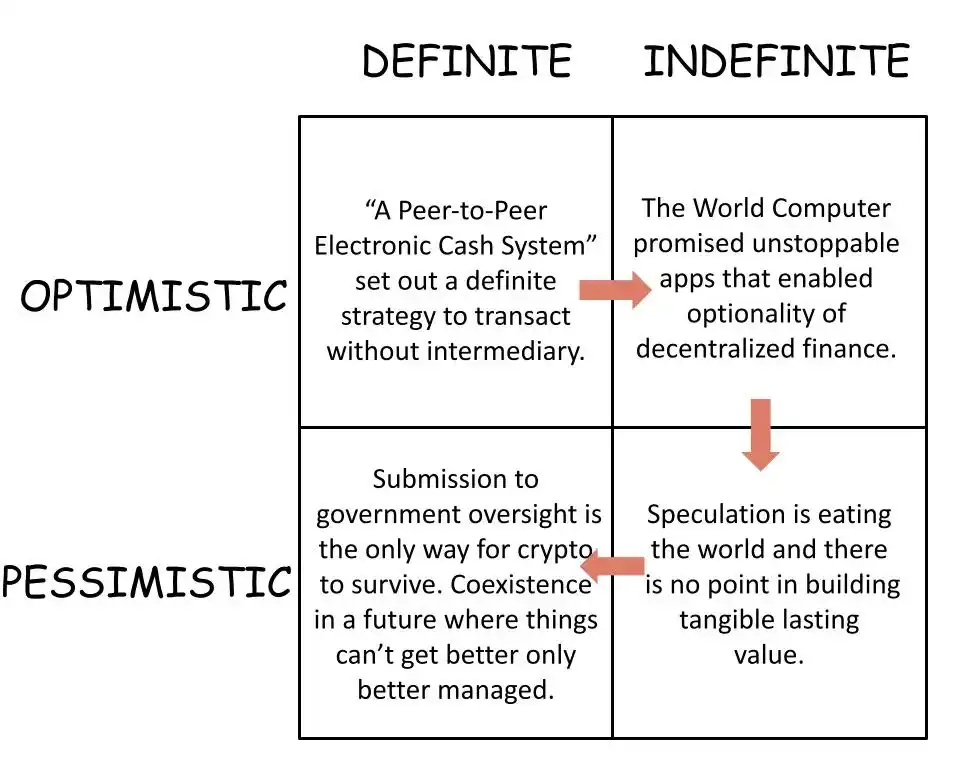
Is this trajectory universal across various trends? A revolutionary idea, once partially validated, is often deified into a panacea; when it fails to deliver those high expectations, it is cursed, and ultimately gradually integrates into the status quo. The revolution is never truly completed, but we remain in the Gartner hype cycle loop, repeatedly staging a cycle that is (for some) satisfactory.
In the crypto realm, this grand hype cycle is often obscured by price fluctuations. Each crypto cycle - Bitcoin, ICOs promising to build a "world computer", DeFi, meme coins, and now regulatory integration and traditional finance interface - looks like a fractal of a larger pattern. Currently, we are in the "trough of disillusionment". According to Carlota Perez's technology wave framework, this is precisely the critical turning point.
Web3 once promised to "chain" Web2's profit models, decentralizing and tokenizing them. But Web2 or Web3 is not a place, nor a clearly distinguishable "thing". As I said years ago, it's more like a "user preference"; and today, this preference still belongs to a niche group. If you always need to rely on the old world's language to explain new things, you're not actually creating something truly new.
The crypto industry is no longer a frontier market, but opportunities still exist at the edges of this established field. At this maturing stage, where do the biggest victories come from? Intuitively, from players in growth periods or with late-mover advantages.
It's worth mentioning that those centralized exchanges that once raised the "definite optimism" flag and promoted crypto adoption have now turned into pessimists, more focused on defending existing market share than driving on-chain adoption.
In the past, exchanges and first-layer blockchains (L1) brought the most lucrative returns for investors. Ironically, where competition is fiercest, optimism exits, and pragmatism takes the stage, the biggest winners are born.
Does this mean we have no more "secrets" to uncover? I don't think so. Today's "secrets" are yesterday's lessons. Have we truly built many innovative and valuable companies or networks?
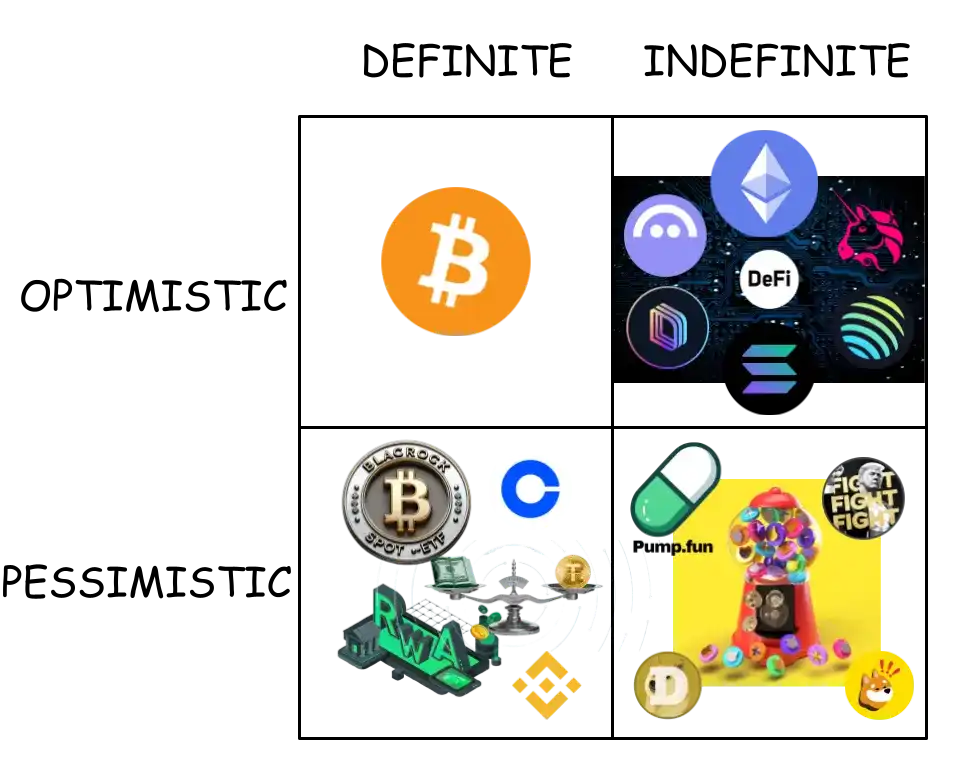
The low-hanging fruits have been picked - most projects today are either imitating predecessors or slightly repackaging things, pretending to be original. Many "solutions" are chasing problems that don't even exist, while others are simply trying to transplant traditional finance onto the chain.
Crypto was originally a force inherently tinged with revisionism but failed to complete a true revolution. Today, it's trapped by a core (perhaps false) question: "Do you want to do the right thing, or do you want to make money?" In other words, are you willing to "sell yourself" at the price the old system is willing to pay? Those revolutionaries who have cried themselves out in the meme coin casino are increasingly accepting this trade.
Building blurry products that developers think users "should want" (no, people don't really want to own their own data), along with the obvious success of centralized service providers, have together pushed the industry to its current impasse. Now, in the crypto world, it's almost impossible to find true "definite optimists". But it's precisely in this "almost impossible" that your frontier investment opportunities are hidden.
Welcome to join BlockBeats official community:
Telegram Subscription Group: https://t.me/theblockbeats
Telegram Discussion Group: https://t.me/BlockBeats_App
Twitter Official Account: https://twitter.com/BlockBeatsAsia






