Written by: TechFlow
In recent years, the crypto world has gradually developed into one of the most vibrant investment fields, but in this rapidly developing digital territory, risks and opportunities coexist, and security issues require constant vigilance. Based on this, Binance conducted a "Crypto User Security and Anti-Fraud Awareness" questionnaire survey, collecting 7,967 Chinese-language questionnaire results. TechFlow analyzed the survey data results and produced this report, aiming to help users find direction and move forward safely in this crypto jungle. This survey delved into users' security awareness and risk management capabilities in crypto asset transactions, aiming to help users enhance their anti-fraud abilities, strengthen risk management awareness, and better protect their asset security. Binance's industry survey not only provides users with practical educational resources but also reflects its continuous investment and commitment to user security education, demonstrating Binance's responsibility and commitment as an industry-leading platform in promoting crypto ecosystem security. [The rest of the translation follows the same professional and accurate approach, maintaining the original structure and meaning while translating into English.]The proportion of users enabling 2FA authentication is the highest, reaching 80.8% - such a high percentage indicates that most users recognize the importance of two-factor authentication and prioritize this measure to protect account security. Additionally, independent transaction passwords are also valued, with over half (53%) of respondents setting up independent transaction passwords. 21% of users have enabled whitelist addresses, which can effectively prevent funds from being transferred to unauthorized addresses. The usage rate of anti-phishing verification codes is 29.3%, suggesting that some users have a certain awareness of preventing phishing attacks. Moreover, 1.6% of users chose other security measures, demonstrating the diversity of user security strategies.
However, 10.4% of users have not enabled any additional security measures, which may be due to a lack of security awareness or finding security measure setup too complicated.
Overall, most users have adopted multiple security measures to protect their Binance accounts, but some users still need to enhance their security awareness and measures.
According to the survey data, most users carefully verify the recipient address or smart contract address before transferring, with a proportion reaching 79.2%, indicating that users generally recognize the importance of address verification to avoid transfer errors and potential financial losses.
13.9% of users remain cautious most of the time but may not check addresses in certain situations.
5.3% of users occasionally verify addresses, suggesting they recognize the importance of verification but have not developed a stable habit.
From the overall data, the vast majority of users verify recipient/smart contract addresses before transferring, reflecting a high regard for financial security. Notably, 1.6% of users never verify transfer addresses and need to strengthen their focus on transfer security.
Decentralized wallets allow users to fully control their private keys and assets, but also face management difficulties and the risk of key loss. In the survey, 47.8% of users chose paper offline backup when using decentralized wallets, a traditional and secure method that effectively prevents digital device failures or network attacks. 10% of users store private keys or seed phrases using hardware wallets, showing a preference for specialized devices to enhance security. Simultaneously, 8.8% of users opted to store encrypted digital files, which protects privacy while providing convenient access.
A significant proportion (30.7%) of users directly store private keys or seed phrases on phones, computers, or cloud drives. While convenient, this method carries security risks such as device theft or network attacks.
Additionally, 2.7% of users chose other storage methods, demonstrating the diversity of user security strategies.
Overall, most users tend to use relatively secure methods to store private keys or seed phrases, but some users still need to improve their security awareness to avoid potential risks.
In this questionnaire survey, we counted the types of cryptocurrency scams encountered by respondents. The survey shows that although scam varieties are increasing, phishing link scams remain the most common. This was a multiple-choice question where each respondent could select multiple options. The proportions for each option are:
77.4% of users have seen phishing links, a common network scam method typically disguised as legitimate websites to steal user information.
60.8% of users encountered "authority figure" insider information or shills, a scam that exploits users' trust in authorities to mislead investment decisions.
51.7% of users have seen scams leaking private information such as passwords, private keys, or seed phrases, which directly threaten user asset security.
56.6% of users have seen fake airdrops, gifts, or token pre-sales, scams that exploit users' pursuit of free or discounted offerings to commit fraud.
51.6% of users have seen fake exchange apps or wallets, scams that disguise themselves as legitimate applications to defraud user assets.
48.8% of users encountered Ponzi schemes and MLM funds, which promise high returns to attract investors but actually rely on funds from subsequent investors to pay earlier investors.
33.2% were victims of malware attacks, which steal user information or control user devices by implanting malicious software.
Fake investment promises (such as high-yield mining pools) are also a common scam method, seen by 44.9% of users, often attracting investments with unrealistic high returns.
2.3% of users have seen other types of scams, indicating that scam methods are becoming increasingly diverse and hard to prevent.
We surveyed users about cryptocurrency-related scams, and surprisingly, nearly half (41.7%) of users have experienced cryptocurrency-related scams; among the remaining users, 9.4% are unsure if they have been scammed, with only 48.9% clearly stating they have not been scammed.
Overall, cryptocurrency scams remain a critical security issue that requires raising user vigilance and identification capabilities.
Here's the English translation:Scale of Funds Lost in Cryptocurrency-Related Fraud
65.4% of users were not scammed, demonstrating a strong awareness of prevention.
8.3% of users were scammed but did not lose money, possibly taking timely remedial measures.
13.7% of users lost less than $1,000, indicating small-scale losses are common.
8.3% of users lost between $1,000 and $10,000, showing that medium-scale losses also exist.
4.3% of users lost over $10,000, revealing that a minority experienced severe financial losses.
Verify sender information in the "Binance official verification channel": Although it is an official channel, only a portion of users (35.8%) are likely to choose it, possibly due to unfamiliarity with this channel.
Check official information published by Binance's official or executive social media verified accounts: 32.8% of users rely on social media to obtain information.
Other methods:
Confirm with Binance staff or Binance Angels: 22.3% of users choose to communicate with staff in the community to confirm information.
Others: A very small number (1.1%) of users will use unique methods to verify.
Overall, most users rely on official channels and applications to confirm the authenticity of information, but some users still perform multiple verifications through social media and direct communication. This indicates that users have adopted diverse strategies in information identification to ensure accuracy and reliability, with more users prioritizing official website information for confirmation.
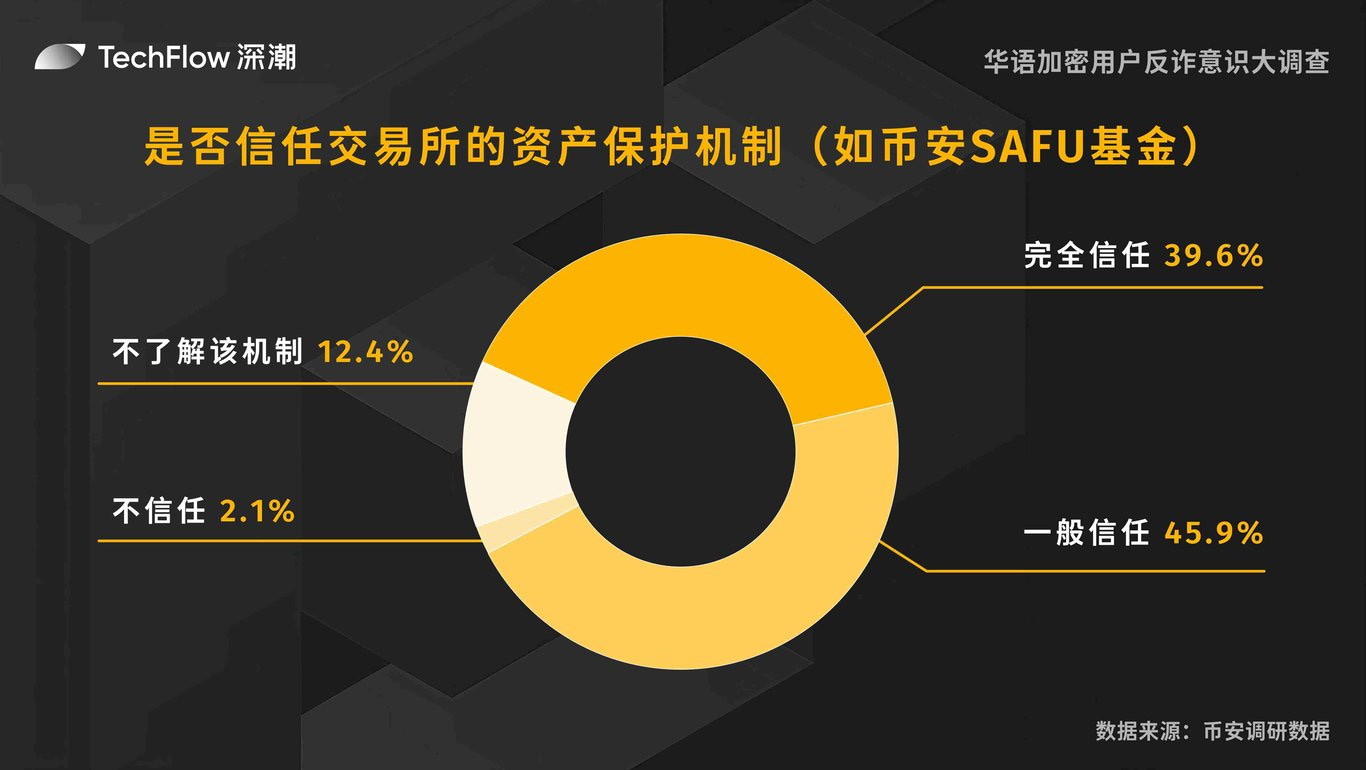
[The rest of the translation follows the same professional and accurate approach, maintaining the original structure and meaning while translating into clear English.]Specifically, 39.6% of users completely trust the exchange's asset protection mechanism; 45.9% of users have a general level of trust; only 2.1% of users express distrust, while 12.4% of users indicate they do not understand these mechanisms.
The survey results show that the vast majority of users have a certain level of trust in the exchange's asset protection mechanism. However, some users still need more information to enhance their understanding and trust in these mechanisms. Exchanges can further improve user confidence in their security measures through transparent information disclosure and user education.
Areas for Improvement in Platform Anti-Fraud Education Content
With the continuous upgrading of cryptocurrency-related fraud methods, the importance of platform anti-fraud education content is increasingly prominent. We investigated several aspects that users believe could be improved. This question allowed multiple selections, with each respondent able to choose multiple options.
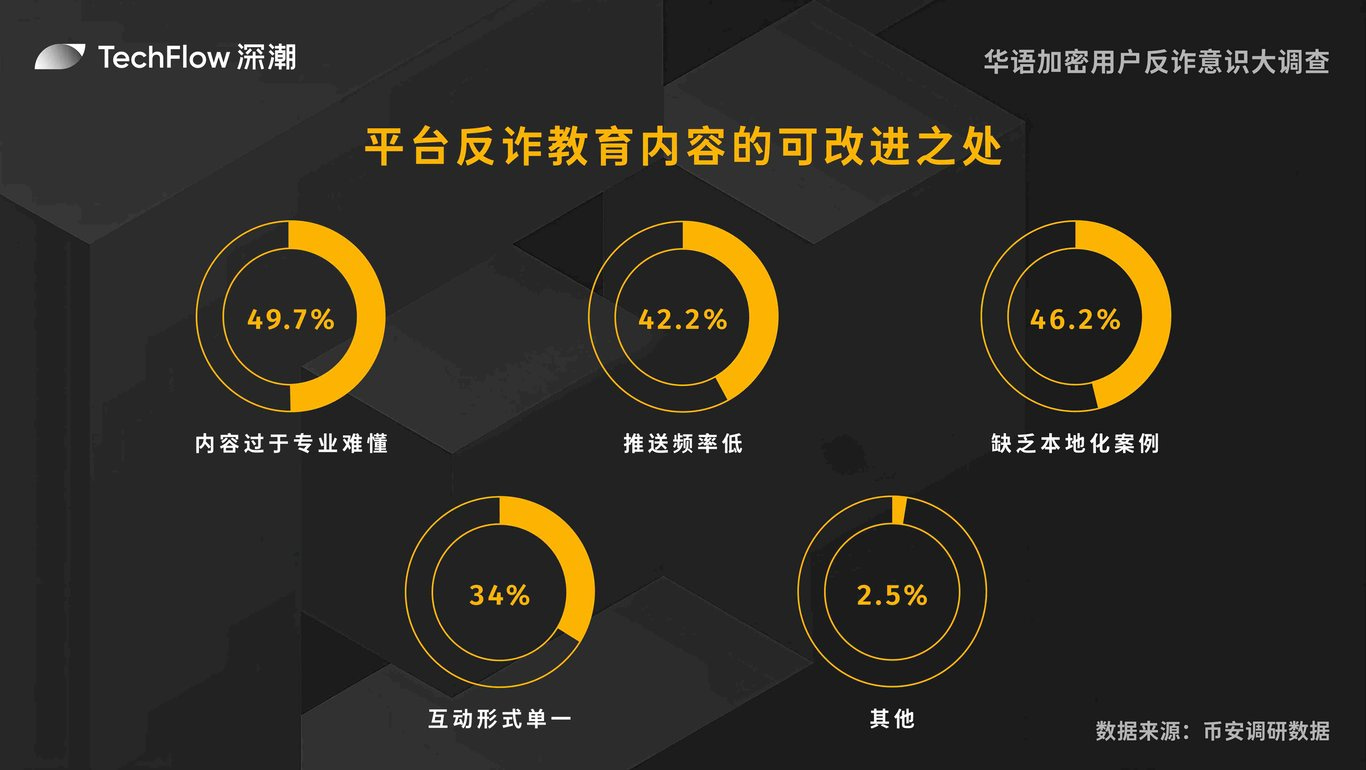
49.7% of users find the anti-fraud education content too professional and difficult to understand, with nearly half hoping the content could be more accessible to better understand and apply.
42.2% of users indicate that the frequency of anti-fraud content push is too low, suggesting increasing push frequency to enhance user vigilance and knowledge level.
46.2% of users point out that anti-fraud education content lacks localized cases, hoping to see real cases related to their living environment to improve content relevance and practicality.
34% of users believe the current interactive format is too monotonous, suggesting adopting more diverse interactive methods to enhance user engagement and learning effectiveness.
Additionally, 2.5% of users proposed other improvement suggestions, demonstrating users' personalized needs for anti-fraud education content.
The survey results indicate that users' understanding and acceptance of platform anti-fraud education content need to be improved, by enhancing anti-fraud education efficiency in a way that better meets user needs, helping users better identify and prevent online fraud.
Section Five: Security Features and Educational Preferences
This section focuses on users' anti-fraud awareness, emphasizing users' tendency to receive security warnings and willingness to participate in platform-organized anti-fraud simulation tests, which helps platforms more effectively help users identify and prevent cryptocurrency-related fraud.
Tendency to Receive Security Warnings
In today's era of increasingly important information security, users have different preferences for receiving security warnings. We investigated users' specific tendencies in this regard.
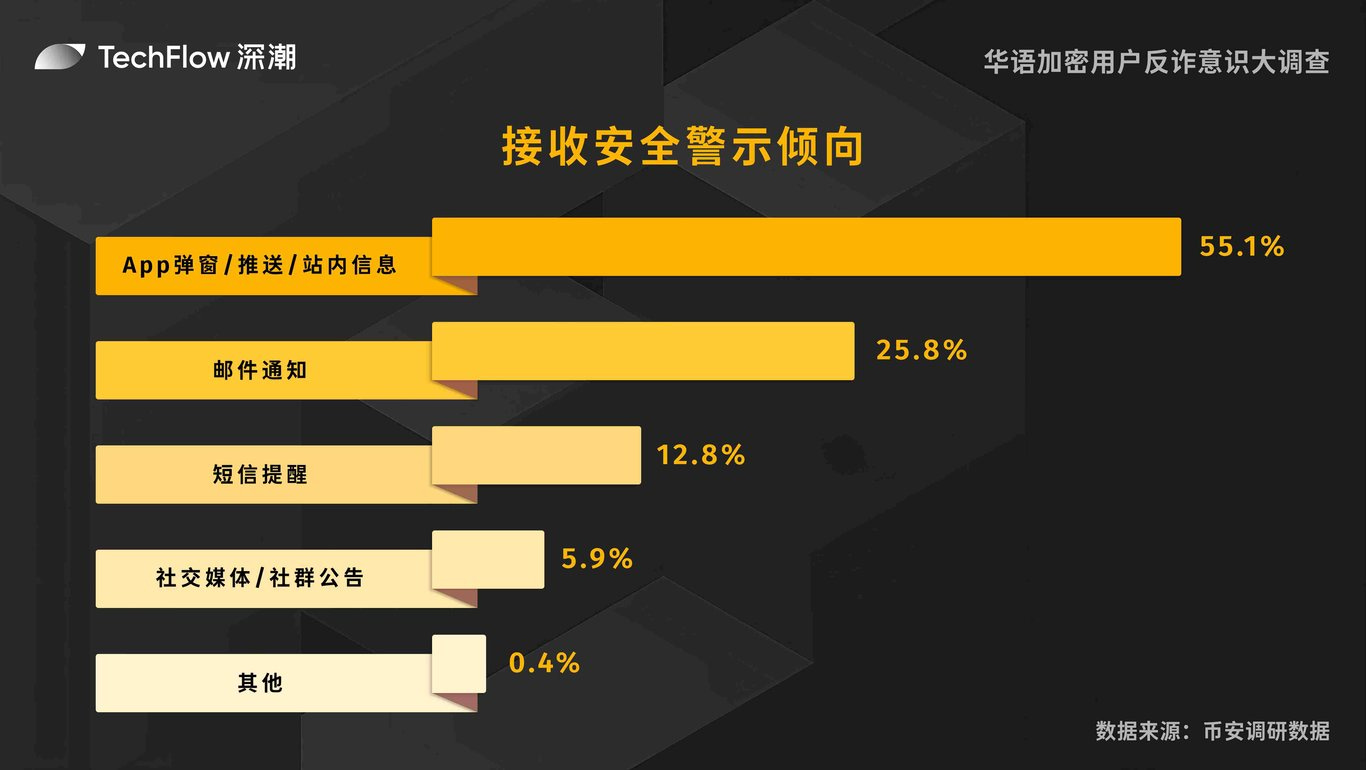
55.1% of users prefer to receive security warnings through app pop-ups, push notifications, or in-site messages. This instant notification method is considered the most effective reminder by most users.
25.8% of users prefer to receive security warnings via email. This method is suitable for users who frequently check emails in work or daily life.
12.8% of users choose SMS reminders, reminding us that traditional methods should not be overlooked.
5.9% of users prefer to obtain security warnings through social media or community announcements, which may not be widely accepted because users cannot obtain information immediately.
0.4% of users proposed other receiving methods, showing the personalized needs of a small number of users.
The survey results show that most users prefer to receive security warnings through instant app notifications. However, to meet different user preferences, platforms can provide multiple notification methods to ensure that security information can be timely and effectively communicated to all users.
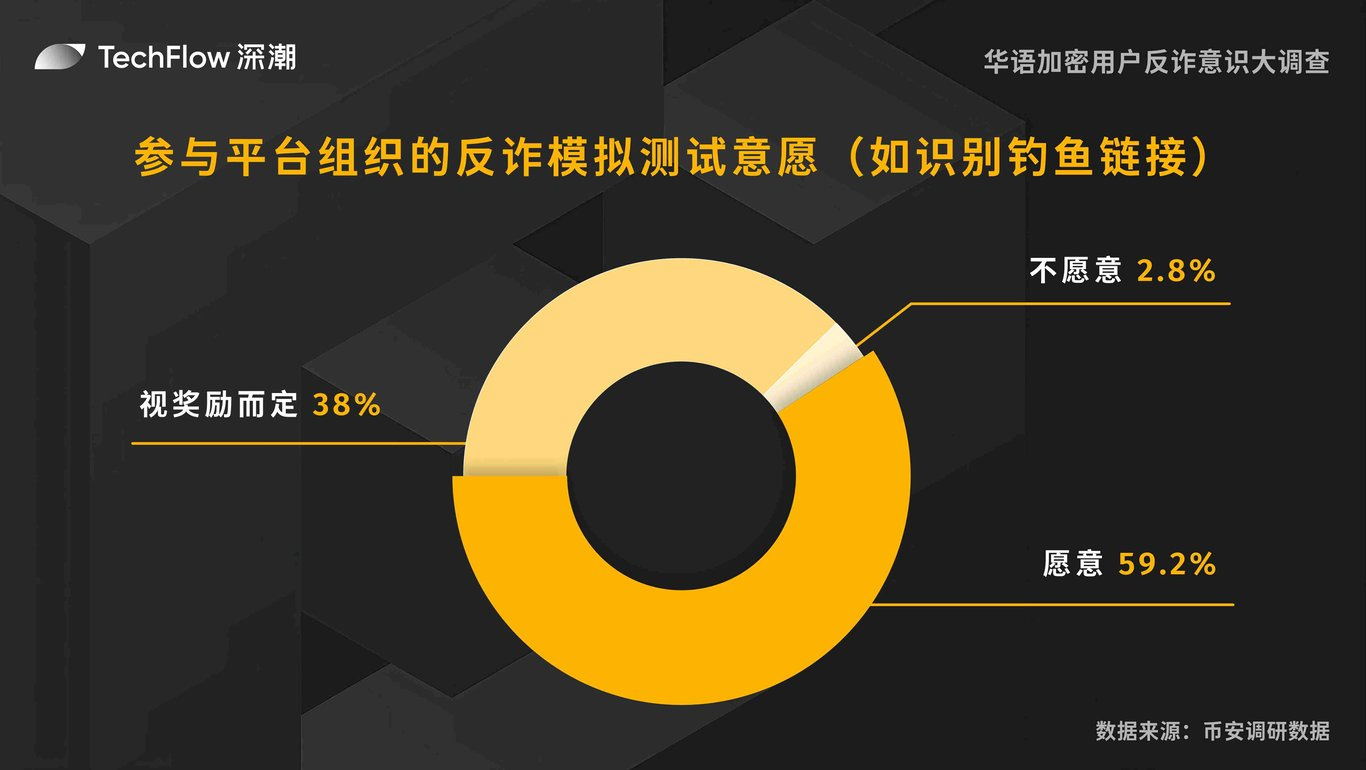
Willingness to Participate in Platform-Organized Anti-Fraud Simulation Tests (such as identifying phishing links)
Anti-fraud simulation tests are an important means of improving user security awareness and skills. We investigated users' willingness to participate in platform-organized anti-fraud simulation tests.
Specifically, 59.2% of users are willing to participate in anti-fraud simulation tests, 38% of users' willingness depends on rewards, and only 2.8% of users are unwilling to participate.
This indicates that the vast majority of users have an open attitude towards participating in such tests. Platforms can also design reasonable incentive mechanisms to increase user participation and thereby enhance users' security prevention capabilities and awareness.
TechFlow is a community-driven in-depth content platform dedicated to providing valuable information and thoughtful perspectives.
Community:
Public Account: TechFlow
Subscription Channel: https://t.me/TechFlowDaily
Telegram: https://t.me/TechFlowPost
Twitter: @TechFlowPost
To join WeChat group, add assistant WeChat: blocktheworld
Donate to TechFlow, receive blessings and permanent record
ETH:0x0E58bB9795a9D0F065e3a8Cc2aed2A63D6977d8A
BSC:0x0E58bB9795a9D0F065e3a8Cc2aed2A63D6977d8A