Raoul Pal, a former Goldman Sachs executive, author of 'Global Macro Investor', and founder of Real Vision, is known for successfully predicting the 2008 financial crisis. Recently, in his dialogue with "When Shift Happens" and speech at Dubai Sui Basecamp, Raoul Pal delved into how to steadily accumulate wealth in the cryptocurrency field, discussing topics such as Bitcoin, ETH, MEME, AI, Non-Fungible Token, Sui ecosystem, Strategy's Bitcoin strategy, investment strategies, macro trends, and market directions.
Here's the English translation:Currently, Strategy convertible bond buyers are mostly TradFi hedge funds and other institutions, such as sovereign wealth funds like Norway Bank that may only focus on the Bitcoin element. Large hedge funds like Citadel, Millennium, and Point72 are also conducting arbitrage. These institutions are experienced in risk management, potentially receive systematic support, control position sizes reasonably, and are less likely to face liquidation.
In stark contrast, traders who excessively use high leverage face enormous risks, with market cases of trading failures due to over-leveraging being commonplace.
Six, Raoul Pal's Capital Allocation
Regarding capital allocation, Raoul Pal states that Sui occupies 70%, now far exceeding Solana. Sui's adoption and developer activities are performing well. Additionally, he owns some DEEP (DeepBook), which is a liquidity layer protocol in the Sui ecosystem.
Seven, NFT's Value and Potential
As an innovative technology capable of permanently storing and trading non-transferable assets, Pal is full of expectations for NFT's prospects. From a macro perspective, the current Crypto industry is worth $3 trillion. If it grows to $100 trillion in the next 10 years, it will create $97 trillion in massive wealth; even a conservative estimate of $50 trillion would generate $47 trillion in wealth increment.
This wealth will flow to different people. Art is upstream of everything, and digital art as an emerging field is expected to become an important destination for wealth. In the digital art field, we have XCOPY and Beeple, which later spawned the generative art movement. I spent a lot of time talking to some very famous people, and these high-level individuals are very interested in this field. After crypto OGs earned enough money, their willingness to collect art became extremely strong. For example, CryptoPunk symbolizes your identity and allows you to meet like-minded people. From institutions to super-rich to ordinary people, everyone is gradually becoming aware of digital art's importance. We are still in the early stages. I hold many artworks, and I believe this spans over 10 years.
Eight, Ethereum's Advantages and Prospects
Regarding Ethereum, its network capacity has exceeded current system requirements, and it may adjust some mechanisms in the future, returning to Layer1. EVM's position is like Microsoft, with many banks, insurance companies, and large enterprises worldwide relying on Microsoft, not Apple or Google.
Once you have an enterprise sales model, it's almost impossible to remove it from the company because you don't want to change it or take risks. From the Lindy effect (the longer something has existed, the higher its probability of continuing to exist), Ethereum has stood the test of time and can well meet financial market needs. Would Goldman Sachs or JPMorgan build on Solana? Unlikely. Ethereum might bring a completely new narrative and is expected to outperform Bitcoin in the short term. Looking ahead five years, unless they mess everything up, its importance will become increasingly prominent.
Bitcoin Lightning Network and payment concepts have limited effect on price increase; Bitcoin's core value lies in being a store of value. The same will happen to ETH.
Nine, About AI
AI's development is rapid, and its performance has surpassed 99% of analysts. After deep reflection, Pal believes AI's rise has triggered profound questions about consciousness and humanity's future role. He suggests people actively participate in, deeply understand, and skillfully use AI technology.
Secondly, we don't know what this means for employment or how we'll create wealth, but I know what humans are best at? What can humans do that AI cannot? Being human.
I developed an AI Raoul that can read news daily, with news also written by AI, and built a chatbot trained on its own voice, with training data covering all its X content, YouTube content, and 100 books. Now, Real Vision users can interact with this chatbot. Pal predicts that these two technologies will soon merge, a transformation that will profoundly impact podcasts and media industries, with future media content becoming highly personalized. Moreover, human memories and behaviors might ultimately become AI's "nutrients", achieving a kind of "immortality" in a certain sense.
Ten, Market Attention and Quality Project Selection
This is an attention game. People's focus on key tokens is dispersed, and many narratives are relatively short-lived. Pal emphasizes that holding Bitcoin is always a wiser choice. Additionally, buying Solana at the cycle bottom and SUI last year were good strategies.
Investors should focus attention on the top 10 or top 20 tokens, concentrating on projects that can continuously improve network adoption, which often have higher investment value. According to Metcalfe's law, project potential can be assessed through active user numbers, total transaction value, and user value.
Bitcoin network has many users and involves sovereign nation purchases, which is why Bitcoin is more valuable; Ethereum has a massive user base and rich applications. Although L2's emergence slightly complicates the situation, it still has significant value. Investors should actively seek projects with simultaneous growth in user numbers and value applications. For example, Solana at the cycle bottom had a continuously growing developer community, stable user numbers, and Bonk's emergence further enhanced market confidence in Solana; Sui is similar.
Highlights of Raoul Pal's Speech at Dubai Sui Basecamp
1, Macro Core Factors: Liquidity and currency depreciation. Cryptocurrencies and economy present a four-year cycle, rooted in the debt refinancing cycle. Since the global high debt in 2008, we've been maintaining economic operation by borrowing to repay old debts.
2, Population Aging and Economic Growth: Population aging leads to economic growth slowdown, requiring more debt to maintain GDP growth. This phenomenon is widespread globally, which can be clearly observed through debt and GDP correlation charts.
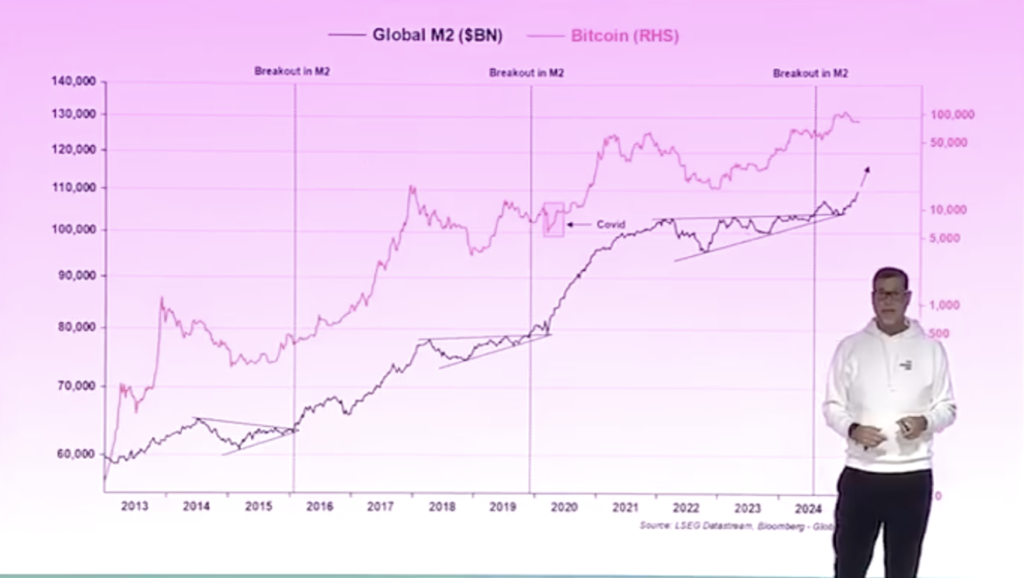
3, Liquidity Drives Everything: The Federal Reserve's net liquidity is a core indicator. From 2009 to 2014, it mainly relied on balance sheet expansion to provide liquidity, and later added tools such as bank reserve adjustments. Currently, total liquidity (including M2) is crucial, with an astonishing explanatory power for Bitcoin (90% correlation) and Nasdaq (97% correlation) trends.

4, Currency Depreciation Mechanism: Currency depreciation is equivalent to a global tax, with an 8% hidden inflation tax globally each year, plus 3% explicit inflation, meaning you need an 11% annual return to maintain wealth. This explains why young people are flocking to the crypto field - traditional assets (real estate, stocks, etc.) have insufficient returns, forcing them to choose high-risk assets to seek excess returns.
5, Wealth Disparity and Crypto Opportunities: The rich hold scarce assets, while the poor rely on labor income (purchasing power declining year by year). The crypto system subverts this pattern - young people seek breakthroughs through high-risk assets.
6, Crypto Asset Performance: Annualized at 130% since 2012 (including three major corrections), Ethereum at 113%, Solana at 142%. Bitcoin's cumulative increase is 2.75 million times, extremely rare in the investment field, and crypto assets are gradually becoming a "super black hole" attracting funds.
7, Sui Ecosystem Has Enormous Potential. DEEP (DeepBook Liquidity Layer Protocol) has recently performed best. SOL/SUI ratio shows SUI is relatively strong.
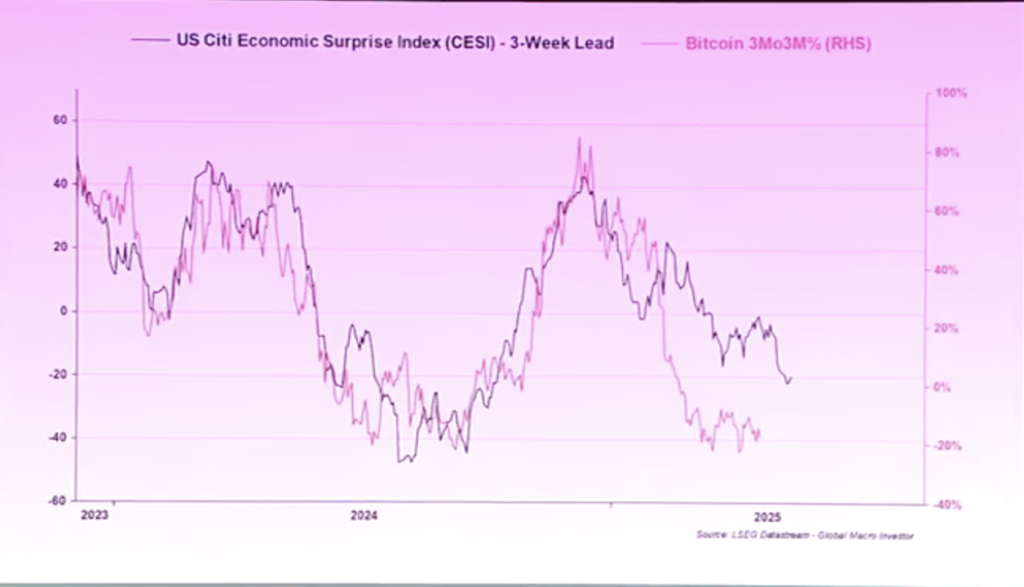
8, Current Market Misjudgment Analysis: People often interpret current market narratives using liquidity conditions from three months ago (such as tariff panic), but this is biased. Actually, the tightening of financial conditions in Q4 2024 (rising US dollar interest rates, rising oil prices) produced a three-month lag effect. The economic surprise index (comparing the US and global) indicates that the current economic weakness is only a temporary phenomenon. Looking back at Trump's tariff cycle in 2017, the US dollar first rose then fell, followed by liquidity driving asset prices to rise significantly.
9, Global M2 and Asset Relationship: When global M2 reaches a new high, asset prices should rise synchronously. Taking Bitcoin as an example, its price trend usually shows a breakthrough, pullback, and then accelerates in the "banana zone". Comparing the 2017 cycle, Bitcoin rose 23 times that year. Although the current market is different, considerable appreciation is still expected. The market is currently in the correction phase after the first part of the "banana zone" breakthrough, about to enter the second part, which usually brings an Altcoin market.
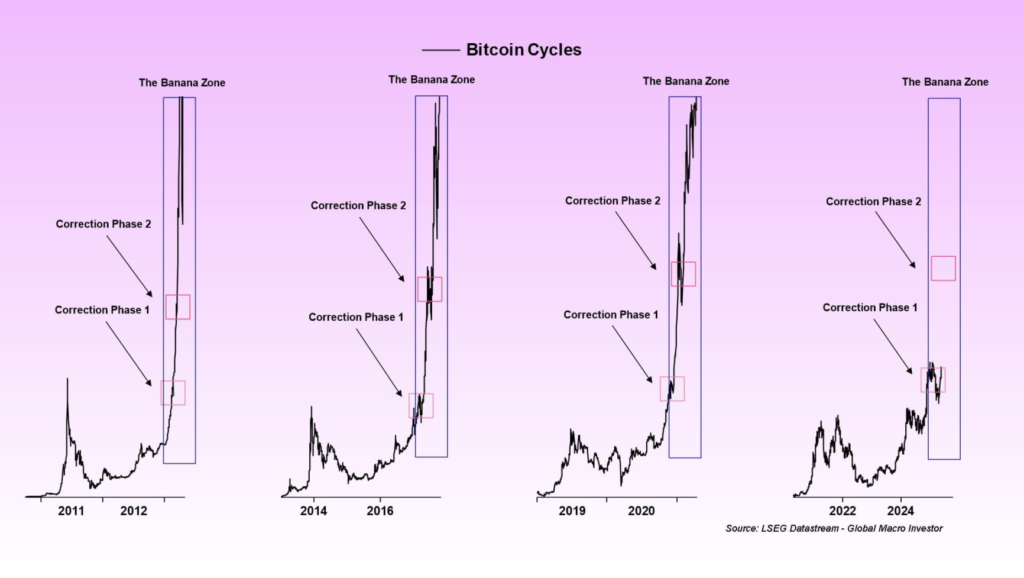
10, Business Cycle and Bitcoin Trend: The ISM Manufacturing Index is an important forward-looking indicator. When this index breaks 50, it signals economic growth recovery, increased corporate earnings, and active reinvestment, which will accelerate Bitcoin price increases. If the ISM index reaches 57, Bitcoin price could even reach $450,000. As the business cycle warms up and household cash increases, risk appetite rises, making Altcoin investment logic similar to junk bonds and small-cap stocks.
Note: Raoul Pal is also a board member of the Sui Foundation.