If consensus is the foundation of currency, Meme might be worth redefining.
Written by: ChandlerZ, Foresight News
Meme coins have always been one of the most attention-grabbing yet easily overlooked asset types in the crypto world. On one hand, they can quickly activate market enthusiasm with an extremely low threshold, leading to a surge in trading volume in a short time; on the other hand, most Meme coin projects have an extremely short lifecycle, lacking deep governance logic and value support, ultimately becoming consumables in speculative cycles.
Based on this, MemeCore announces the launch of the "Proof of Meme (PoM)" mechanism, combining its new-generation Meme economic model "Meme 2.0" vision, to open up a completely new development path for the Meme coin ecosystem. Unlike traditional Meme projects' tendency towards speculation and short-term price pumping, MemeCore's core goal is to transform Meme into "sustainable cultural capital" and drive a scalable participation network among creators, communities, and protocols through a systematic on-chain incentive model.
Meme Coins' Short-Cycle Dilemma: Difficult to Maintain Consensus, Sustain Culture, and Generate Incentives
The logic of Meme coin popularity has always been clear: using community memes, emojis, and hot symbols to quickly stimulate market sentiment, thereby obtaining extremely high trading momentum. However, the essence of this mechanism is fueled by attention, and without subsequent mechanisms to support it, heat quickly transforms into selling pressure, with community activity experiencing a cliff-like decline, making it difficult for projects to enter the next evolutionary stage.
The more critical issue is that past Meme coin projects mostly failed to provide sustainable value participation paths for creators, spreaders, and ordinary token holders. With transmission behavior disconnected from asset returns, and cultural participation lacking positive incentives, many genuine content contributors are marginalized, with discourse power concentrated in the hands of early token hoarders and secondary market traders.
Therefore, the problem MemeCore is trying to solve is not "how to create the next hot spot," but how to provide continuous motivation for actors in the Meme coin ecosystem, forming content sedimentation, incentive closed loops, and positive value cycles.
Meme 2.0: Transforming Cultural Influence into On-Chain Economic Capability
The "Meme 2.0" concept proposed by MemeCore is not a simple extension of traditional Meme gameplay, but a dual narrative and model transformation. It positions Meme as a collaborative and value-adding cultural asset, rather than a one-time emotional projection tool. Its core argument is: if Meme can create resonance, it should have an incentive channel; if propagation has value, it should be confirmed and rewarded on-chain.
The implementation of this concept relies on infrastructure-level support. MemeCore is not deployed on a third-party public chain but has independently built a Layer1 network with native incentives, asset minting, and contract interaction capabilities. Behind this decision is a clear positioning: transforming the integration of cultural content and on-chain incentives from peripheral plugins to protocol-layer native capabilities.
Its EVM-compatible technology stack lowers the migration threshold for developers and project parties, while the dedicated standard MRC-20 designed for Meme assets further supports the high coupling of meme content and asset behavior. This not only enhances the asset's expressive ability but also establishes a mechanism foundation for Meme's composability and ecological evolution.
PoM Mechanism: Driving Participation Network through Staking, Supporting Cultural Continuation through Rewards
The PoM mechanism is the core mechanism for MemeCore ecosystem operation, designed to connect the incentive paths between Meme's transmission behavior, asset value, and community participation. In the PoM mode, creators, holders, and verifiers are no longer fragmented but collaboratively construct a conversion mechanism for Meme coins from cultural identity to network equity.
PoM Staking: A Consensus Mechanism Driven by Behavior
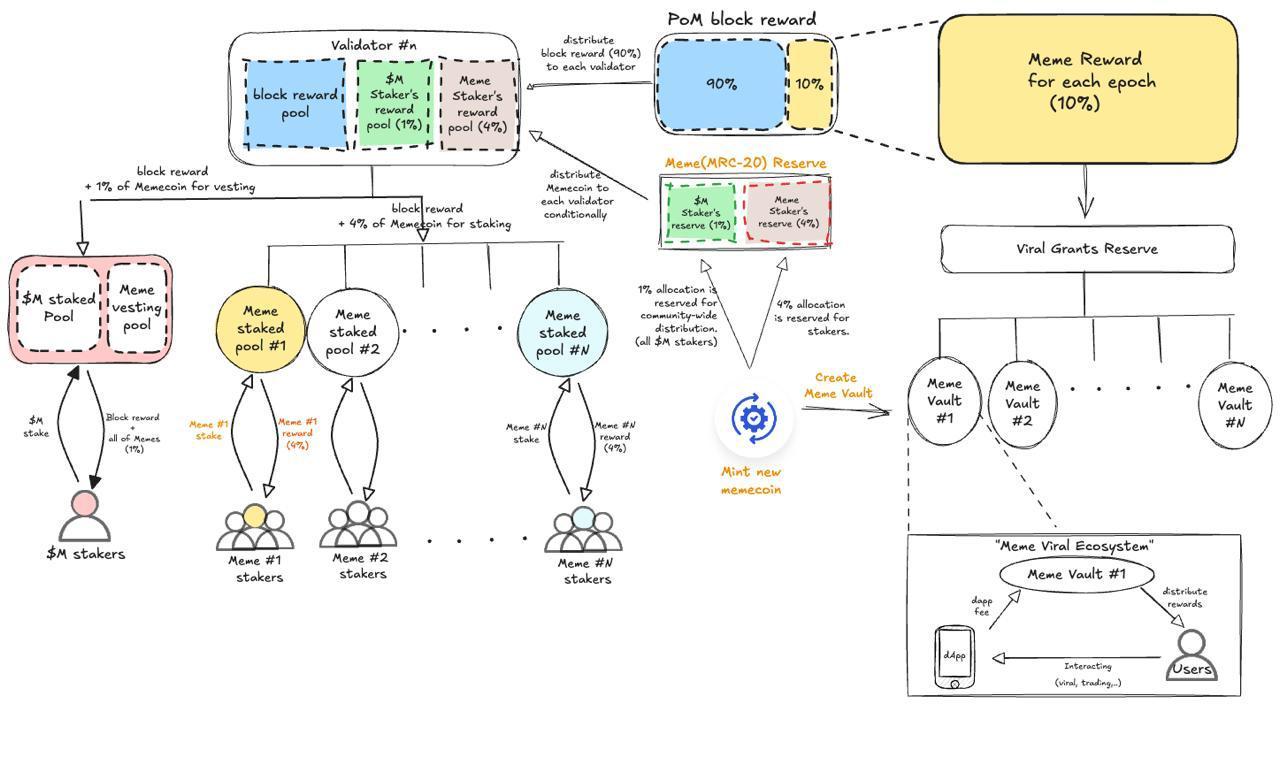
In the MemeCore network, PoM Staking is the most basic and critical incentive link. Users can stake not only the platform's native token M but also MRC-20 Meme coins approved by PoM in the ecosystem. This design significantly expands the participation boundaries of Staking, allowing various Meme projects and their communities to interact with validators through token staking, participate in block generation, and network governance.
For holders, PoM Staking provides a Delegation mode. That is, users holding a PoM-approved Meme coin can delegate their tokens to specific validators, thereby proportionally sharing the block rewards obtained by that validator. This means that the more active project owners or community participants are, and the more voting rights are concentrated on certain nodes, the higher the probability of block generation and network discourse power for their validators, thus achieving a complete closed loop of "content transmission - node empowerment - value incentive".
PoM access is not permanently valid. If a Meme coin no longer meets MemeCore's minimum standards in terms of propagation power, community activity, or contribution indicators, its PoM qualification can be dynamically revoked. This dynamic mechanism ensures reasonable allocation of incentive resources and maintains ecosystem vitality.
Meme Vault: Providing Intrinsic Incentive Pools for Each Meme Project
On the MemeCore mainnet, every Meme coin issued through the MRC-20 standard automatically generates a Meme Vault. Traditional Meme projects generally fade out after initial financing, struggling to continue narratives, organize communities, or reignite content production. MemeCore attempts to break this industry fate by reserving a growth buffer for every potential Meme project.
The resources carried by Meme Vault are mainly used to incentivize content producers, activate community operations, and promote ecosystem interaction behaviors. For example, when a project's community continuously contributes cultural content and promotes Meme heat dissemination, the project's Meme Vault will release resources according to preset allocation ratios to reward creators or core participants.
This ensures that projects no longer rely on airdrops or speculative hype to maintain attention, but instead build an ecosystem operation model of "content as asset, participation as profit sharing" around the medium and long-term incentive logic released by the Vault.
Viral Grants Reserve: Periodic Co-Creation Support for Meme 2.0 Projects
In each Epoch of the MemeCore network, 10% of the validator block rewards are automatically allocated to the Viral Grants Reserve. These resources are specifically used to support Meme 2.0 project creation activities, secondary propagation, and community collaboration. Compared to the project-specific nature of Meme Vault, Viral Grants adopt a more open approach towards excellent Meme projects and individual creators across the network.
It's worth noting that not all projects are eligible for Grants. MemeCore has established a set of "Meme 2.0 Standards" as a basis for judging whether a project has sustainable cultural output and propagation potential. Only Meme projects meeting this standard are eligible to apply for periodic Grants allocation. This threshold setting aims to focus public incentive resources on content sources with real influence and creative vitality.
In the future, detailed rules will be gradually disclosed under community governance and guided by community voting mechanisms.
MRC-20 and M Token Economy: Meme's Asset Carrier and Liquidity Bridge
In terms of on-chain standards, MemeCore has tailored the MRC-20 standard for Meme assets, maintaining compatibility with ERC-20 while expanding deep integration capabilities with the PoM system. Each MRC-20 asset can natively integrate Vault binding, propagation trajectory tracking, and community governance entry points, enhancing the governability and ecosystem belonging of Meme projects.
The M token, as the value anchor of the MemeCore ecosystem, carries multiple functions:
- Registration and governance mortgage for Meme project launch;
- Primary distribution medium for PoM incentive pools;
- Credentials for Staking and community voting;
- Payment medium for ecosystem services and NFT exchange.
This value system based on cultural behavior incentives endows M with a cultural circulation attribute different from traditional functional coins.
From Emotional Speculation to Cultural Capital: Is the Upgrade Path of Meme Coins Feasible?
The interaction between the PoM mechanism and the Meme 2.0 concept is essentially a response to the question of whether meme coins can sustainably exist. MemeCore attempts to extend the lifecycle of meme coins by using clear incentive tools, participation logic, and propagation mechanisms, enhancing interaction depth between users and communities, and transforming cultural output into participation value.
This attempt is not easy. The essence of meme is informal, decontextualized, and even de-authoritative, while mechanism establishment often requires rules, measurements, and boundaries. This internal tension means the practical effect of PoM will largely depend on the community's acceptance of incentive tools and whether there is sufficiently rich and creative content productivity to support it.
Moreover, the introduction of the PoM mechanism is still in its early stages, and its long-term effects still need market validation. However, it can be clearly stated that it has proposed an experimental direction for sustainable operation of meme coins for the first time.
If Consensus is the Foundation of Currency, Meme Might Be Worth Redefining
In the process of Web3 moving towards mass narrative, the boundary between culture and assets is blurring. For a long time, meme assets in the crypto market have been seen as symbols of speculative bubbles. However, if meme is reinterpreted from the perspective of cultural participation and incentives, it is essentially a decentralized form of consensus generation. When this consensus can be measured, incentivized, and shared in a clear way, it may escape the past fate of "pump and dump" and become a viable network cultural capital.
What MemeCore proposes through the PoM mechanism is a method to make meme "survive". It does not expect meme coins to become stablecoins, DeFi protocols, or infrastructure networks, but tries to move meme from the "periphery of attention" to the "entry point of cultural collaboration".
What Meme 2.0 and PoM are attempting is to transform cultural expression into economic collaboration, turn propagation behavior into incentive channels, and convert short-term attention into long-term network effects. It raises a new topic for the crypto industry: if culture itself can generate value, then it should also have its own blockchain consensus and resource allocation logic.