



Author: Eli5DeFi
Translated by: TechFlow
The cryptocurrency field is rife with scammers and various suspicious behaviors. The launch of @ethos_network aims to distinguish between good and bad through tokenized reputation.
Here's why Ethos stands out 🧵
Ethos 101
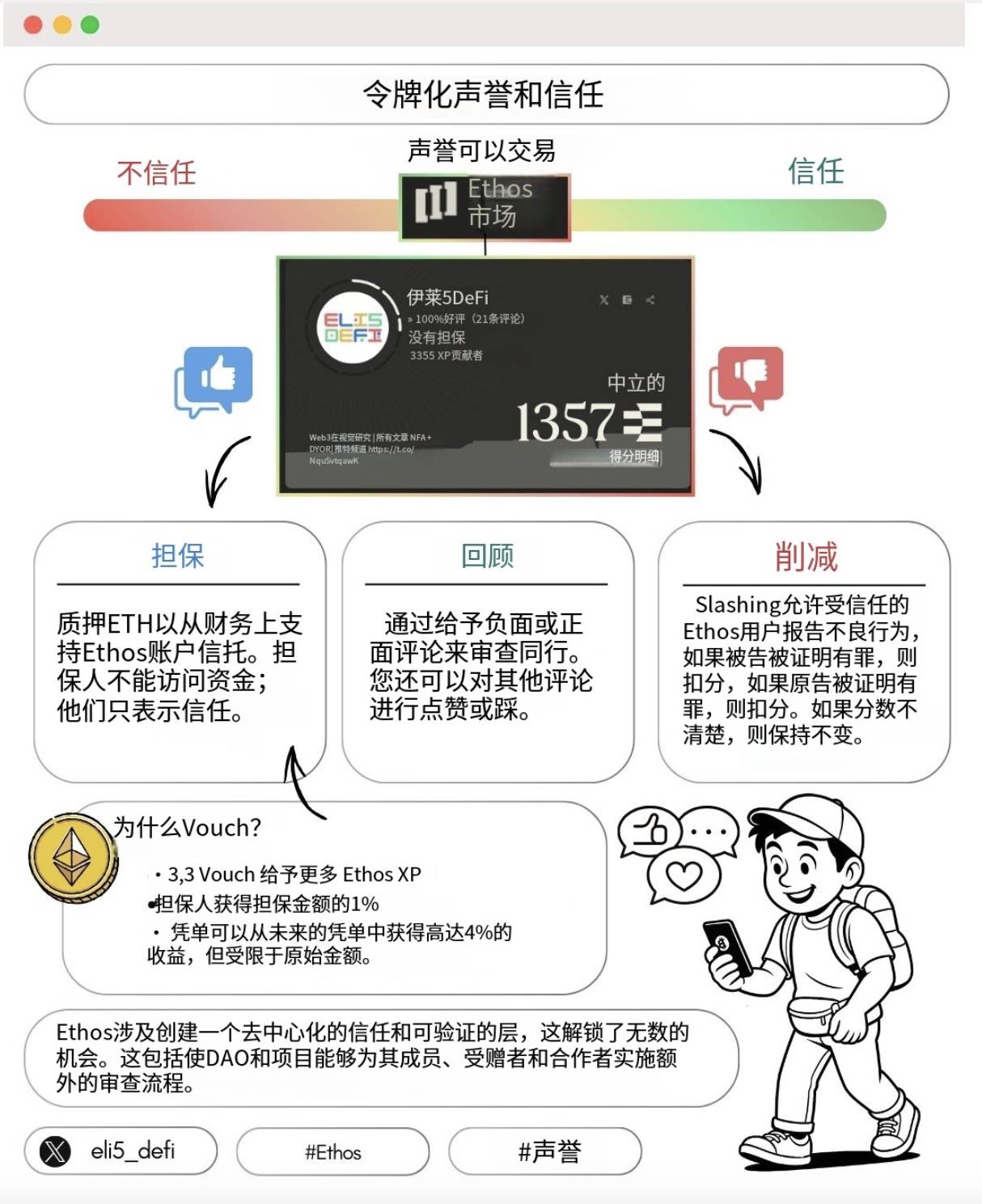
Ethos is, in a sense, a tokenized reputation platform that builds a trustless and verifiable system that can represent the credibility of accounts in the crypto realm.
Ethos's reputation score measures credibility based on community sentiment and public interactions from accounts like Twitter and ENS. A detailed breakdown can be seen in each Ethos profile, primarily including:
Peer reviews
Community votes on your profile
Number of supporting endorsements
Reciprocal endorsements
ETH staked on your reputation
Age of your Twitter account
Age of your Ethereum address
It's important to note that these scores aggregate user feedback and metrics, but are not absolute measures of reputation or character, and are dynamic and may change over time.
To participate in Ethos, you must be invited by registered members who have already reached a certain score, which adds a layer of verifiable trust.
How to Use Ethos
In Ethos, you gain points and reputation scores through the following actions:
Reviews
In reviews, you can review your peers by giving positive or negative evaluations. You can also vote for or against other reviews.
Endorsements
Endorsements involve staking your $ETH to an Ethos account, indicating financial support. This demonstrates strong support and reputation.
Staking more Ethereum means more trust. The endorsed cannot access these funds; they merely indicate trust.
You can also collaborate with your peers by mutually endorsing to achieve 3,3 (originating from game theory, where participants achieve a win-win result through mutual cooperation), thereby amplifying both parties' reputation scores and rewards.
Through endorsements, you can also receive the following incentives:
Users earn 1% when endorsed by others.
If users endorse others, they can earn up to 4% from future endorsements, but limited by the initial amount.
A 1% protocol fee applies when endorsing/un-endorsing.
Penalties
Penalties allow trusted Ethos users to mark unethical behavior. If successful, the accused's score drops by the guarantee amount. If unsuccessful, the accuser's score drops. If the conclusion is unclear, the score remains unchanged.
Several requirements must be met before someone can penalize other Ethos accounts, and the impact of the penalty will be capped based on the penalizer's score.
Ethos Market
If you think that's all, consider this core feature that illustrates why tokenized reputation is a truly novel concept: the reputation market.
The Ethos reputation market is based on Hanson's LMSR, similar to @polymarket, but with some key differences. Here, you can trade and speculate on the reputation of Ethos accounts by choosing to trust or distrust. Prices will fluctuate with sentiment, and the market will never resolve.
However, since reputation can change dramatically if an account faces controversy, it is also susceptible to manipulation, similar to how whales might influence the market through large bets on Polymarket.
Summary
Ethos is an emerging tokenized reputation protocol aimed at solving trust issues in cryptocurrency. It combines community reviews, rewards, Ethereum-based endorsements, and a reputation market, creating a dynamic and real-time reputation metric.
Ethos achieves decentralized trust by allowing users to verify each other, reward good behavior, and mark bad behavior, all done on-chain without a central authority. This transparent system provides a clear and native signal for trust, opening new opportunities for Decentralized Autonomous Organizations (DAOs) and decentralized applications (dApps).
I believe Ethos is a key step in Web3, helping the community rebuild trust and accountability in a decentralized world.
Source: Eli5DeFi; Translated by: TechFlow





