I. Industry Fundamentals and Development Trajectory: Why Oracles are the "Intelligence Hub" of Blockchain
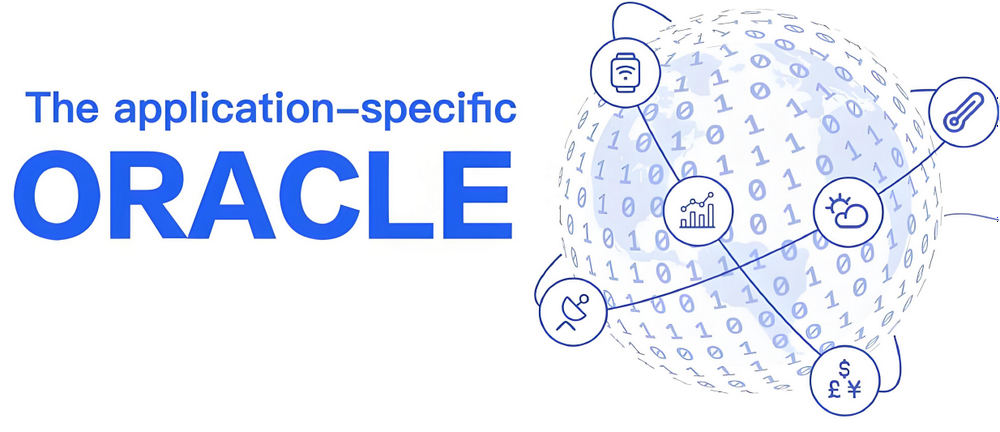
The essence of blockchain is a decentralized trust machine that ensures the immutability of on-chain data and system autonomy through consensus mechanisms, encryption algorithms, and distributed ledger structures. However, due to its closed and self-consistent nature, blockchain cannot actively access off-chain data. From weather forecasts to financial prices, from voting results to off-chain identity verification, on-chain systems cannot "see" or "know" external world changes. Therefore, Oracles, as the information bridge between on-chain and off-chain systems, play a crucial role in "perceiving the external world". They are not simple data movers, but the Intelligence Hub of blockchain - only when off-chain information provided by Oracles is injected into smart contracts can on-chain financial logic be correctly executed, thus connecting the real world with the decentralized universe.
1.1 Information Isolation and the Birth Logic of Oracles
Early Ethereum or Bitcoin networks faced a fundamental problem: on-chain smart contracts are "blind". They can only compute based on data already written on the chain, unable to "actively" obtain any off-chain information. For example: DeFi protocols cannot independently obtain real-time ETH/USD prices; GameFi games cannot synchronize real-world event scores; RWA protocols cannot determine if real assets (such as real estate, bonds) are settled or transferred.
The emergence of Oracles is precisely to solve this inherent flaw of information isolation. Through centralized or decentralized methods, they capture and transmit data from the external world to the chain, enabling smart contracts to have "context" and "world state", thus driving more complex and practical decentralized applications.
1.2 Three Key Evolution Stages: From Centralization to Modularity
Oracle technology has developed through three stages, each significantly expanding its role in the blockchain world:
First Stage: Centralized Oracles: Early oracles mostly used single data sources + central node push methods, such as early Augur, Provable, etc., but with extremely low security and anti-censorship capabilities, easily manipulated, hijacked, or interrupted.
Second Stage: Decentralized Data Aggregation (Chainlink Paradigm): Chainlink's emergence pushed oracles to new heights. By combining multiple data providers + node network aggregation + staking and incentive mechanisms, it built a decentralized data provision network. Security and verifiability were greatly enhanced, forming the industry mainstream.
Third Stage: Modular, Verifiable Oracles: With growing demands and emerging technologies like AI, modular oracles became a trend. Projects like UMA, Pyth, Supra, RedStone, Witnet, Ritual, Light Protocol proposed innovative mechanisms including "crypto-proofed data", "ZK-Proofs", "off-chain computation verification", "custom data layers", driving oracles towards flexibility, composability, low latency, and auditability.
1.3 Why Oracles are an "Intelligence Hub" Rather Than a "Peripheral Tool"?
In traditional narratives, oracles were often compared to blockchain's "sensory system". However, in the current highly complex on-chain ecosystem, this analogy is no longer sufficient: In DeFi, oracles determine the "baseline reality" for liquidation, arbitrage, and trade execution; in RWA, oracles synchronize "digital twins" of off-chain assets; in AI+Crypto, oracles become data input for models; in cross-chain bridges and restaking protocols, oracles bear the tasks of cross-chain state synchronization and consensus verification.
This means oracles are no longer just "sensory", but the neural center and intelligence network of the complex on-chain ecosystem. Their role is not merely to "perceive", but to establish consensus reality and synchronize the on-chain universe with the off-chain world.
From a national perspective, data is the oil of the 21st century, and oracles are the channel controllers of data flow. Controlling the oracle network means controlling the generation of on-chain "reality perception". Therefore, oracles are becoming the core infrastructure in DePIN, DeAI, and RWA modules.
II. Market Landscape and Project Comparison: Confrontation Between Centralized Legacy and Decentralized Newcomers
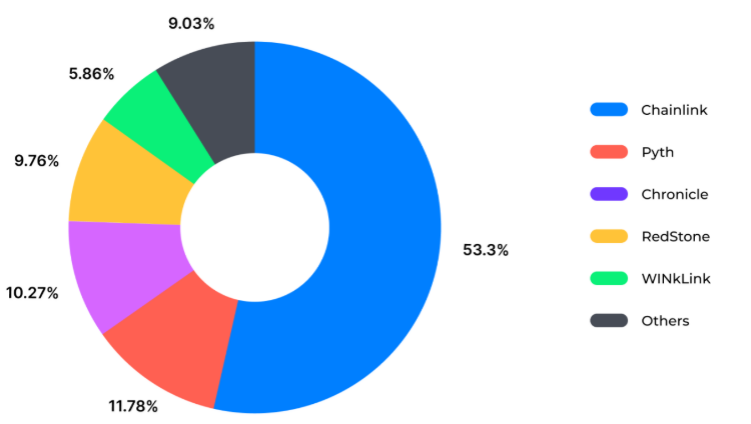
Although oracles are viewed as blockchain's "intelligence hub", the controllers of this hub have long been in a "quasi-centralized" monopoly state. Traditional oracle giants represented by Chainlink are both the creators of industry infrastructure and the biggest beneficiaries of order rules. However, with the rise of modular narratives, DePIN paradigms, and ZK verification paths, the oracle market landscape is undergoing an explicit power reconstruction.
Similarly, the "Optimistic Oracle" paradigm advocated by UMA is more radical. It assumes that the oracle itself does not need to provide absolutely correct data every time, but instead introduces economic gaming to resolve disputes. This optimistic mechanism largely delegates data processing logic off-chain, only returning to on-chain governance through a dispute arbitration module when disagreements arise. The advantage of this mechanism lies in its extremely high cost-efficiency and system scalability, suitable for complex financial contracts, insurance protocols, and long-tail information scenarios. However, its drawbacks are also extremely obvious: if the incentive mechanism within the system is not well-designed, it is easy to encounter gaming manipulation where attackers repeatedly challenge and tamper with oracles.
Emerging projects like Supra, Witnet, and Ritual are innovating at a more granular dimension: some are building bridges between "off-chain computation" and "cryptographic verification paths", some are attempting to modularize oracle services to freely embed into different blockchain runtime environments, while others are directly rewriting the incentive structure between nodes and data sources, forming a "customized supply chain" of on-chain trusted data. These projects have not yet formed mainstream network effects, but they clearly signal that the oracle track has moved from "consensus disputes" to "trust path disputes", and from "single price provision" to a comprehensive game of "generating trustworthy reality".
We can see that the oracle market is undergoing a transformation from "infrastructure monopoly" to "trust diversity". Established projects have strong ecosystem binding and user path dependencies, while emerging projects use verifiability, low latency, and customization as weapons to try to wedge open the cracks left by centralized oracles. But regardless of which side one stands on, we must acknowledge a reality: whoever can define "truth" on-chain will have benchmark control rights over the entire crypto world. This is not a technological battle, but a "battle for definition rights". The future of oracles is destined to be far more complex than simply "moving data on-chain".
[The rest of the translation follows the same professional and precise approach, maintaining the technical terminology and nuanced language of the original text.]The "economic attributes" of data are becoming more prominent, with its pricing model gradually transitioning from "Gas cost + node incentives" to "B2B enterprise-level subscription + SLA data protocol + commercial contract responsibility", forming a stable cash flow.
The transformation of supply and demand relationships directly drives the project valuation model from "narrative-driven" to "revenue-driven", providing a new investment anchor for long-term holders and strategic funds. Especially for top RWA projects, AI computing chains, and DID architectures, choosing a reliable, stable, and high-throughput Oracles service provider is an irreplaceable dependency at the contract level.
4.2 Three Key Directions with Long-term Alpha Potential
Under this new development paradigm, we recommend focusing attention on three Oracles development paths, each representing the extension capabilities of Oracles as the on-chain "intelligence hub" in different dimensions:
1) Modular, application-side native Oracles: Proximity to business means proximity to value. Compared to traditional "generic" Oracles models, new-generation projects like RedStone, PYTH, and Witnet emphasize "on-demand services" and "on-site deployment", embedding Oracles logic into application contracts or VM layers. This model better matches the needs of high-frequency trading and structured asset protocols, making data transmission faster, more responsive, and cost-effective. The advantage of such projects lies in their natural "product-protocol" stickiness; once a DeFi or RWA project selects a specific type of Oracles, its migration cost is extremely high, meaning long-term binding revenue and a defensive moat.
2) AI and Oracles Fusion Narrative: Interface Layer for Verification, Filtering, and Fact Generation: As AI models widely enter the crypto ecosystem, how to verify the authenticity of their generated content, behavioral predictions, and external calls becomes an unavoidable fundamental issue. Oracles are precisely the "logical anchor" for this problem: they not only provide data but can also verify whether the data comes from a trustworthy computing process and meets multi-party consensus mechanisms. Projects like HyperOracle, Ritual, and Aethos have begun attempting to provide "provably verifiable AI call results" for on-chain contracts through methods such as zkML, trusted hardware, and cryptographic reasoning, interfacing on-chain in the form of Oracles. This direction has high technical barriers and high capital attention, potentially being the ignition point for the next high-Beta wave.
3) RWA and Identity-Binding Oracles: Mapper of Offline Legal Status: From Chainlink's collaboration with Swift on asset universal message standards, to multi-asset yield status synchronization on Centrifuge, to Goldfinch introducing third-party assessment models, RWA is rapidly building a trust mechanism dependent on a "neutral information layer". The core of this mechanism relies on Oracles systems that can reliably bring offline legal, asset registration, and behavioral credit information on-chain. Such projects lean more towards "infrastructure" logic, with development paths highly related to regulatory policies. However, once industry standards are formed (like Chainlink's CCIP), they possess exponential network effects, belonging to "gray consensus assets" suitable for long-term layout.
4.3 Reconstructing Investment Logic: From "Price Feeding Narrative" to "On-chain Order" Pricing
In the past, the market often treated Oracles as "auxiliary tools for DeFi hot tracks", with market value assessment and investment behaviors mostly fluctuating with the broader market. However, in the future, Oracles will gradually obtain an independent value assessment mechanism because: they play an irreplaceable role as fact injectors in on-chain protocols; possess stable, calculable protocol income sources (such as Chainlink's data pricing model that has formed a B2B commercial subscription logic); and undertake underlying information coordination tasks in multiple structural growth tracks like RWA, AI, and governance, with multiplicative effects.
Therefore, we recommend that investors should not assess projects solely based on "market value" or "trading heat", but should screen Oracles assets with long-term value potential along three main lines: whether they have native deep binding with protocols, chains, and financial institutions; whether they have established a "data-fact-consensus" business closed loop; and whether they have scalability advantages in next-generation scenarios (RWA, AI, cross-chain).
In summary, Oracles are no longer marginal supporting characters in crypto narratives, but are gradually becoming the "fact benchmark system" and "order generation engine" of the on-chain world. Structural opportunities have formed, and investment logic urgently needs reconstruction.
Five, Conclusion: The Structural Dividend Era of the Oracles Track Has Arrived
The Oracles track stands at the forefront of blockchain ecosystem evolution, bearing the core role of bridging information between the on-chain and real-world. As the complexity of on-chain applications and the demand for real asset on-chain increase, Oracles are no longer merely price data providers, but have become the "intelligence hub" and "order generation engine" for trusted smart contract execution. Multidimensional technological improvements and deep application scenario expansions bring unprecedented development space and value re-evaluation opportunities for Oracles.
In the future, Oracles projects will develop towards more decentralized, modular, and scenario-specific directions. The fusion of AI with on-chain data and the RWA on-chain process will continuously inject growth momentum. Investors should examine Oracles project value from three dimensions: on-chain protocol binding, business model closed loop, and extensibility, focusing on innovative forces with long-term moats and structural growth potential. Overall, the Oracles track has gradually transformed from a supporting role to the "intelligence hub" of the blockchain world, and its ecological value and investment opportunities cannot be ignored - the structural dividend era has arrived.