


Editor's Note: HUSD is a public stablecoin project launched by Hyperliquid, which will recycle stablecoin interest into the ecosystem, used for repurchasing HYPE, subsidizing interface fees, supporting Builder Code mode, and promoting ecological growth. It breaks the USDC/Tether model, preventing funds from flowing to centralized institutions and instead feeding back to the community and product development.
Below is the original content (slightly reorganized for better readability):
What the Ecosystem Truly Needs
The story of HUSD is about how to disrupt a stablecoin market worth billions of dollars. Hyperliquid initially emerged as a leading decentralized perpetual contract exchange (perp DEX), superior to older players like DYDX and GMX. As the product continues to attract new users and gradually introduces spot markets, Hyperliquid has gradually evolved into a competitor to Binance / Coinbase. Next, the ecosystem aims to challenge the fiat stablecoin duopoly of Circle and Tether.
Currently, approximately $2.5 billion in cross-chain USDC is locked in HyperCore's order books, earning about 4.3% interest. These earnings can generate around $107.5 million in annual income for Circle Internet Financial, flowing into their private balance sheet. Every new USDC deposited into Hyperliquid further expands Circle's cash flow. But what if these values were not flowing to Circle, but instead used to strengthen the Hyperliquid ecosystem? Why should we be constrained by outdated stablecoin models like USDC when we have the opportunity to break through existing frameworks?
The Opportunity Cost of Continuing with Old Stablecoins
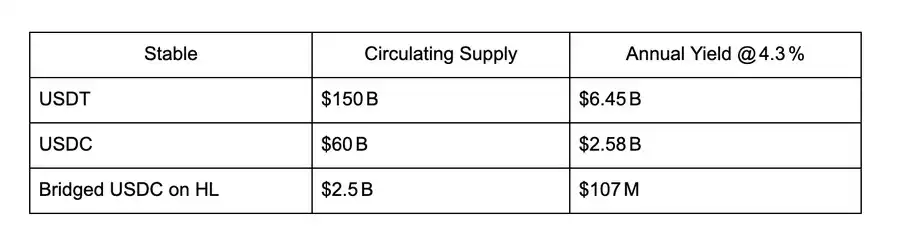
As Hyperliquid's on-chain trading influence continues to expand, fiat stablecoin net deposits also grow, providing liquidity for perpetual contract and spot markets. In a future where Hyperliquid grows 10, 100, or even 1000 times, the opportunity cost of continuing to use traditional stablecoins will become increasingly high. These values from the stablecoin layer will either continue flowing to Circle and Tether's balance sheets or be recycled back into Hyperliquid's own ecosystem.
A New Stablecoin Model Tailored for Hyperliquid
The "Assistance Fund" has proven through automatic HYPE repurchases that protocol-generated cash flows can and should directly benefit the community. In just the past 30 days, the Assistance Fund has repurchased millions of dollars worth of HYPE from the market.
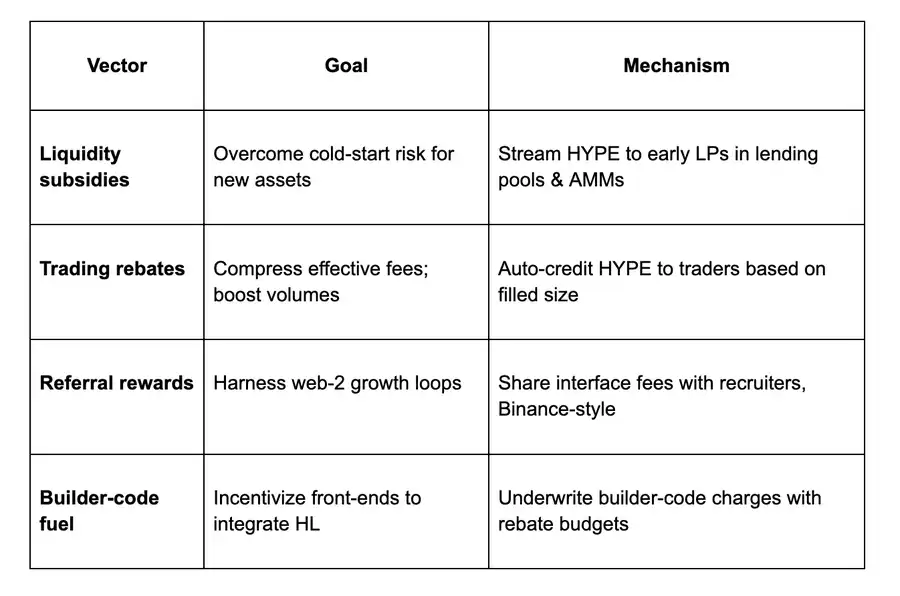
HUSD continues this strategy, but at the stablecoin layer: initially, a significant portion of HUSD's interest income will be used to purchase HYPE, which will then be deployed across various growth directions in the Hyperliquid ecosystem. In other words, every time you use HUSD, you'll add buying pressure to HYPE and reinvest value into Hyperliquid's development.
How Will Repurchased HYPE Be Used?
HUSD: Fueling the Builder Code Future
HUSD plays a crucial role in driving the "Builder Code" business model. Builder Code is a native Hyperliquid function allowing an interface operator to charge fees on spot or contract trades submitted on behalf of users. Its goal is to provide monetization for Hyperliquid's "last mile distribution" - meaning anyone who can effectively attract and retain users can establish a trading business through Builder Code, unrestricted by technical or liquidity limitations.
Such businesses might have very attractive unit economics, but in this early stage, new brands still face "cold start" problems, and moats between different interfaces are not yet clear. The emergence of HUSD can help these "Hyperliquid hybrids" complete their launch while providing a method for differentiation.
By subsidizing Builder Code fees through HUSD, interfaces can charge higher fees to users without increasing user costs. Interfaces can receive real-time income and further use these funds for growth strategies.
For example: Suppose Interface XYZ receives a 100 HUSD rebate budget. All contract trades with its Builder Code will be tracked by the system, with users' rebate balances continuously growing. Before users actually bear fees, the interface can handle approximately $100,000 in contract trading volume (100 HUSD divided by a 0.1% fee rate). Meanwhile, interface operators can reinvest Builder Code income into user acquisition or retention.
This is how HUSD provides momentum for "real-time growth" in the Hyperliquid ecosystem.
Summary
HUSD integrates two core insights: unifying the pricing asset (stablecoin) used in trading and its generated cash flow within the trading platform system. The ultimate result is a "public product" stablecoin that transforms static reserve interest into active, compounding growth for the Hyperliquid ecosystem.
HUSD is a public product project operated by Felix and supported by community members, which will be launched through the Felix Points system. This deployment is built on the foundation laid by @m0foundation, and it is their vision of a "global stablecoin platform" that makes HUSD possible.
Hyperliquid has already disrupted the centralized exchange landscape, and HUSD is preparing to do the same to traditional fiat stablecoins.
Welcome to join the BlockBeats official community:
Telegram Subscription Group: https://t.me/theblockbeats
Telegram Discussion Group: https://t.me/BlockBeats_App
Twitter Official Account: https://twitter.com/BlockBeatsAsia






