In the thoughts of many investors, Bitcoin (BTC) is like a dream of wealth—a magical asset with the potential to grow hundreds of percent each year and take its value "to the moon" with prices in the millions of dollars.
Analyst Willy Woo believes that Bitcoin's boom period may have passed. However, not everyone agrees with this.
Willy Woo predicts Bitcoin's CAGR will decrease and stabilize at 8%
Woo shared a chart titled "Bitcoin's Annual Profits", showing that Bitcoin's Compound Annual Growth Rate (CAGR) has sharply declined, from over 100% in 2017 to around 30-40% after 2020.
This was the period when large institutions, including corporations and governments, began to accumulate Bitcoin.
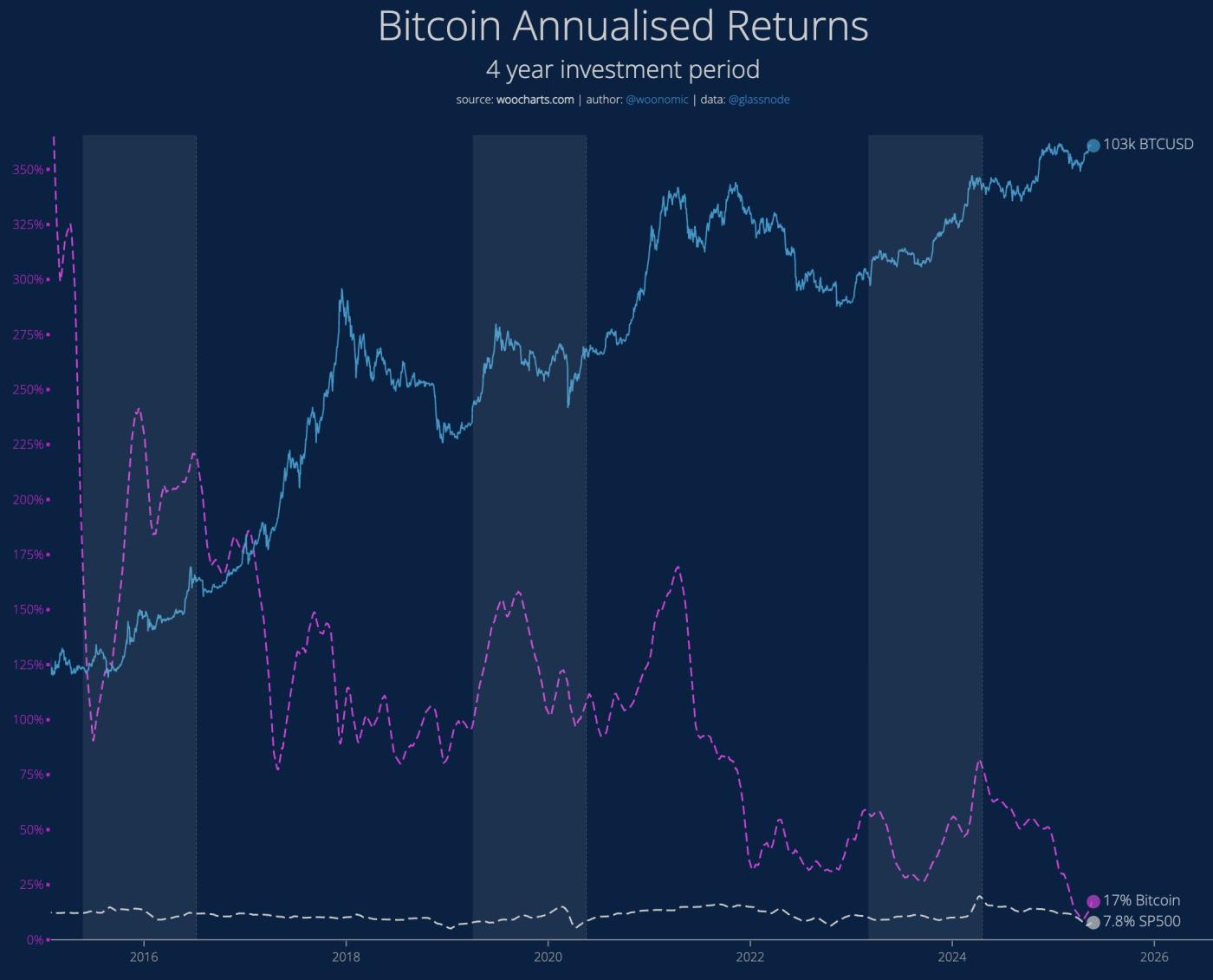 Bitcoin's Annual Profits. Source: Willy Woo.
"People think BTC is like a magical unicorn endlessly climbing moonbeams. This is the actual CAGR chart. We're past 2017, when we saw hundreds of percent growth," Willy Woo said.
Woo forecasts that Bitcoin's CAGR will continue to decrease over the next 15-20 years and ultimately stabilize around 8%. This rate aligns with long-term monetary growth (5%) and GDP growth (3%). He emphasizes that even with a lower CAGR, Bitcoin will still outperform most publicly traded assets.
However, investor and author Fred Krueger disagrees. He points out that Bitcoin has increased sevenfold from its December 2022 low, currently trading at 103,000 USD in May 2025.
Moreover, in a recent interview, Arthur Hayes went even further. He predicted that Bitcoin will reach 1 million USD before the end of Donald Trump's current term. He expects the price to reach 250,000 USD by the end of 2025, equivalent to a 1,000% increase in just four years.
GDP growth and liquidation are seen as the primary drivers of Bitcoin's future profits
Woo's prediction is primarily based on GDP expansion and monetary growth. Meanwhile, Paul Guerra, Head of Society at RealVision, provided deeper insights into this matter.
Discussing liquidation, he argues that traditional diversification strategies may no longer be effective in the current market environment. This is because assets like stocks, bonds, Bitcoin, and real estate currently tend to move together, driven by a primary factor: liquidation.
"The real driver of the market is liquidation — the amount of money flowing through the system," Paul said.
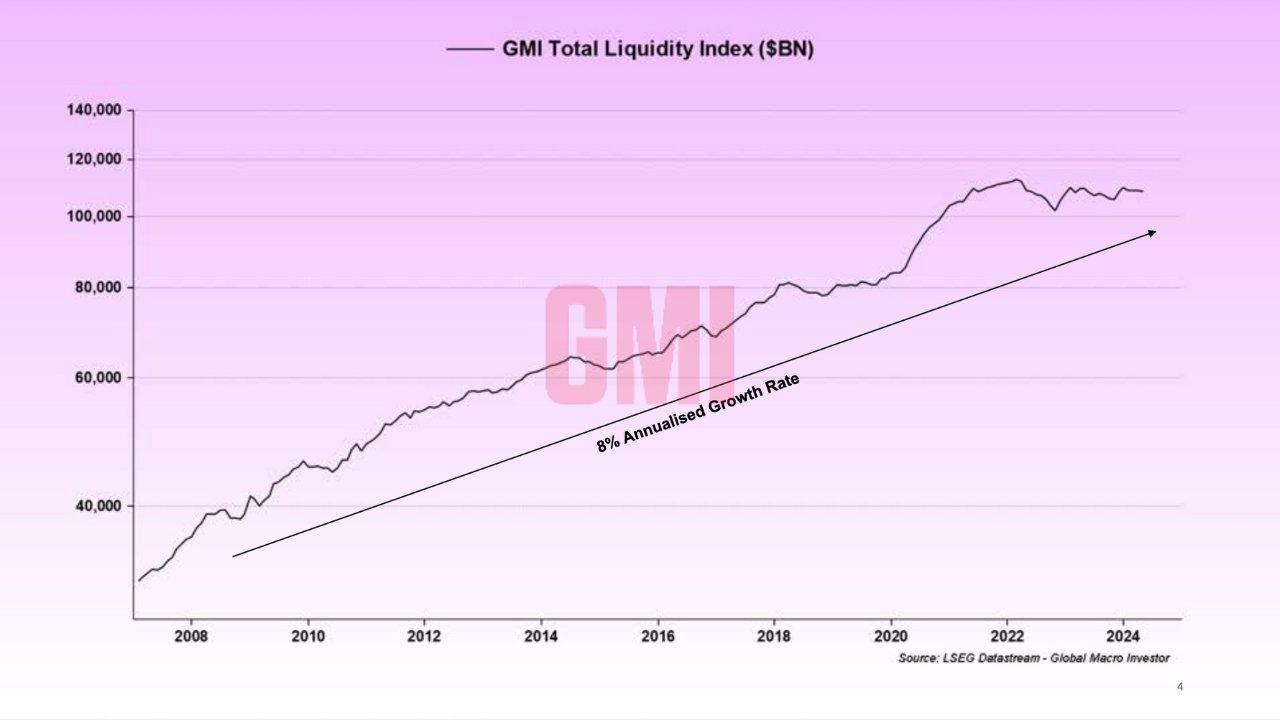 Global Liquidity Index GMI. Source: Paul Guerra.
The Global Liquidity Index is currently growing 8% annually. To understand liquidation, Paul suggests we must first understand GDP. He provides a formula for GDP growth: GDP Growth = Population Growth + Productivity Growth + Debt Growth.
However, population and productivity growth are currently declining globally. Therefore, governments are forced to inject liquidation to maintain GDP and support increasing debt.
"The population is AGING. Productivity benefits are STOPPING. Debt is EXPLODING. To keep GDP alive and serve people's debt, governments have only one tool: Inject liquidation," Paul explained.
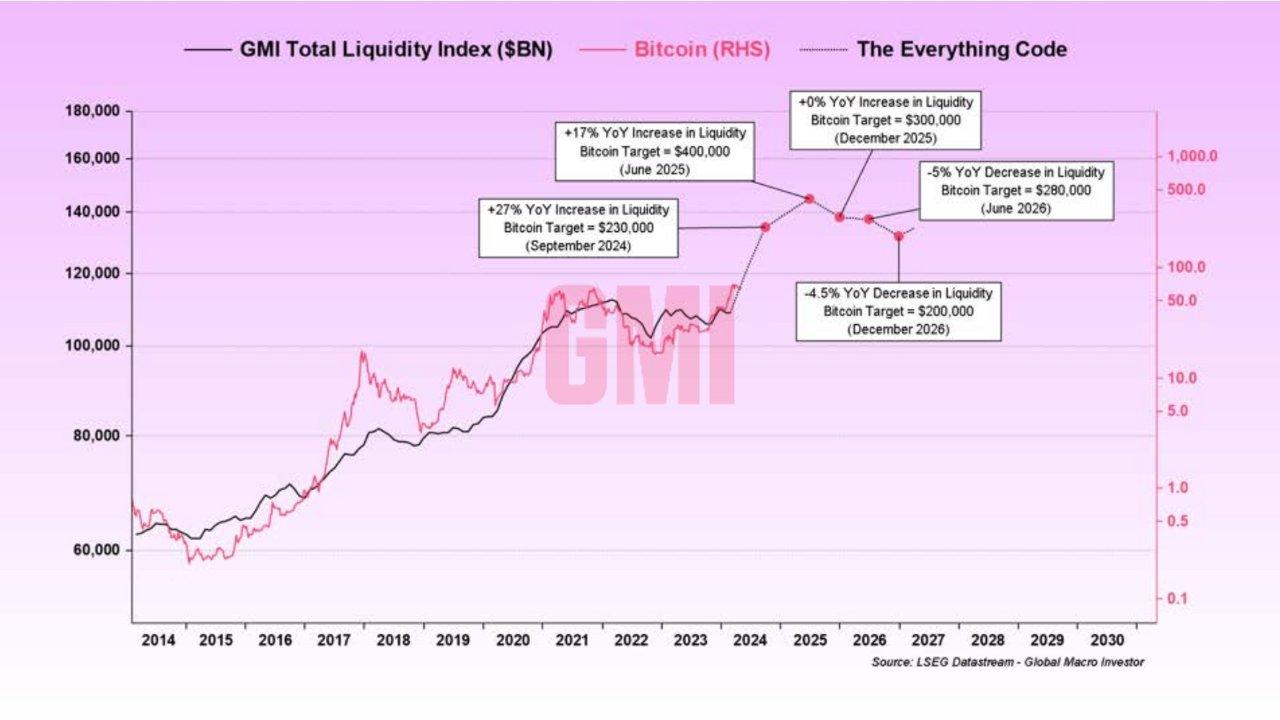 Bitcoin Price and Global Liquidity Index GMI. Source: Paul Guerra.
As a result, liquidation is expected to increase at a faster rate. Paul predicts that Bitcoin could reach 300,000 USD by the end of 2025 and enter what he calls the "Banana Zone." This term describes periods of strong asset price increases driven by abundant liquidation.
Historical examples include Bitcoin's 19,900% increase from 2013-2017, and Ethereum's 699,900% explosion in previous cycles.
However, these analyses focus heavily on macroeconomic factors while overlooking potential technical risks. For example, growing concerns that the development of quantum computing could threaten confidence in Bitcoin's long-term existence.