



Written by: Crypto Miao
A public blockchain is a decentralized, distributed ledger technology where anyone can participate in transaction verification and network maintenance. Compliance is crucial for public chains to be widely used in regulated industries like finance, requiring adherence to legal and regulatory standards, such as KYC (Know Your Customer) and AML (Anti-Money Laundering). Compliance not only enhances user and regulatory trust in public chains but also effectively reduces the risk of illegal activities like money laundering and fraud. Globally, public chains must also comply with regulations like the EU's General Data Protection Regulation (GDPR) to ensure legality and sustainable development.
Global Public Chain Regulatory Policies and Trends
As a core application of blockchain technology, the regulatory environment for public chains is rapidly evolving. From initial widespread skepticism to cautious acceptance, the international community's attitude towards public chains has gradually changed. The decentralization, transparency, and immutability of public chains are seen as having revolutionary potential, but also bring challenges such as market volatility, financial crime, and regulatory difficulties. To address this, global regulators are working to develop frameworks that balance innovation and risk control.
Regulatory Trends: Countries are continuously strengthening regulation of public chains and crypto assets. For example, the EU passed the Markets in Crypto-Assets Regulation (MiCA) in 2023, becoming the first global legal framework to comprehensively regulate crypto assets.
Policy Divergence: Regulatory strategies differ significantly between countries. China has completely banned cryptocurrency trading and mining, while the US and EU are gradually regulating through legislation. The EU implements bank-like regulation for stablecoins and cryptocurrencies to protect financial stability and consumer rights; the US tends to support stablecoins to maintain the global status of the dollar.
Innovation and Risk Coexist: Despite stricter regulation, many countries still recognize the potential of public chains in fields like finance, supply chain, and healthcare. For instance, Singapore and Japan reserve space for blockchain innovation while maintaining strict regulation.
Compliance and Development Paradox
The Web3 industry is unique due to its decentralization and anonymity, but this also subjects it to complex compliance requirements from various countries. These requirements aim to ensure legal operation but often limit free development and global expansion. Compliance not only increases operational costs but can also bring legal risks, potentially leading to lawsuits, massive fines, or even imprisonment for project founders or core members.
[The rest of the translation follows the same professional and accurate approach, maintaining the original structure and meaning while translating to English.]Here's the English translation: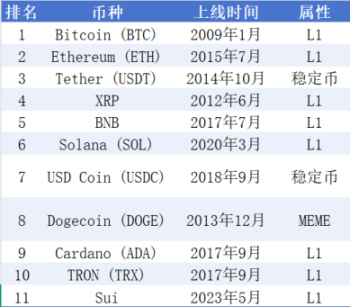
Figure 2: Cryptocurrency Listing Time and Attributes
So, how does Sui grow rapidly while maintaining compliance and establishing a foothold in the fierce WEB3 competition?
Sui Chain Characteristics
Sui Chain is an emerging L1 blockchain platform developed by Mysten Labs, aimed at providing fast, secure, and scalable solutions for Web3 applications. It uses the Move programming language, emphasizing high transaction speed and low latency, prioritizing fast and secure transaction execution, especially suitable for real-time applications like gaming and finance. Sui offers a familiar user experience, such as logging in via web credentials (zkLogin), and supports large-scale applications by scaling network capacity on demand.
[The translation continues in this manner, maintaining the original structure and translating all text while preserving any HTML tags and image references.]The decentralized nature of Sui makes it challenging to directly implement AML/KYC like traditional financial institutions, but by providing transparent transaction records and partner tools, it supports projects in meeting regulatory requirements. For example, the Sui blockchain collaborates with Ant Digital, utilizing its ZAN platform to provide KYC and AML tools to support compliant tokenization of real-world assets (RWA). ZAN, as a Sui RPC node operator, connects to Sui's infrastructure. This means ZAN's tools can seamlessly communicate with Sui's blockchain network, enhancing its scalability and security.
Additionally, Sui's terms of service allow for fund freezing or usage restrictions to comply with legal requirements, ensuring overall compliance. (If Bybit's theft of $1.46 billion occurs on the Sui chain, the funds could potentially be frozen according to the terms).
3. Project-Level Compliance
Sui itself does not enforce KYC or AML because it is a decentralized blockchain network. Research shows that Sui DeFi tools typically only require connecting a Sui wallet for use, without KYC, bank card, or email registration. However, when involving fiat deposits or withdrawals, such as selling Sui tokens through an exchange, multi-level KYC verification may be triggered. This indicates that compliance is primarily implemented by projects or third parties, with Sui providing supporting tools rather than direct enforcement.
Specific Compliance Measures
The Sui chain enhances compliance through on-chain infrastructure support, compliant partners, and project review, isolating compliance risks.
1. Infrastructure Support
Adopting innovative technologies to enhance compliance. For example, Walrus, Seal, and zkLogin significantly improve compliance with the EU's General Data Protection Regulation (GDPR). GDPR is an important EU data protection regulation aimed at protecting personal data privacy of EU citizens, requiring organizations to follow strict rules in data collection, processing, and storage, including data minimization, purpose limitation, storage limitation, integrity and confidentiality, and ensuring data subject rights (such as access, correction, deletion, etc.).
Walrus: Supporting Data Deletion, Satisfying the "Right to be Forgotten"
Walrus is a decentralized storage protocol designed for handling large binary files (blobs), allowing sensitive personal data to be stored on independent sub-chains for quick deletion, satisfying GDPR's "Right to be Forgotten" (Article 17 GDPR).
Seal: Secure Management of Sensitive Data
Provides secure storage and access control for sensitive data. Seal ensures personal data protection during storage and processing through its security mechanisms, complying with GDPR's data security and privacy requirements.
zkLogin: Privacy-Protecting Authentication, Supporting Data Minimization
zkLogin is a native Sui function allowing users to log into decentralized applications (DApps) using familiar Web2 credentials (like Google, Facebook) without managing private keys or seed phrases. By not exposing user credentials and using zero-knowledge proofs, it supports GDPR's data minimization principle (Article 5 GDPR). It reduces the amount of personal data stored on-chain while ensuring user privacy. Additionally, zkLogin's design avoids the complexity of traditional private key management, lowering the risk of data breaches.
2. Third-Party Collaboration
The Sui chain collaborates with third parties like Chainalysis through its community-driven Sui Guardian program to enhance compliance. Sui Guardian tracks fraud and phishing websites, while Chainalysis's analytical tools can monitor and analyze on-chain transactions, identifying addresses or patterns associated with known illegal activities. By analyzing transaction patterns, Chainalysis can identify potential phishing attack victims, helping exchanges and users take preventive measures. This helps Sui comply with global AML and KYC regulations, such as the EU's Fifth Anti-Money Laundering Directive (5AMLD) and the US Bank Secrecy Act (BSA).
3. Project Self-Constraint
Providing various tools to help developers self-constrain and ensure compliance, such as geographical restrictions. For example, Sui collaborates with Netki to launch DeFi Sentinel, a compliance oracle providing developers with automated compliance tools, including real-time KYC/AML, wallet screening, and financial transaction monitoring. These tools can help dApps verify user locations, ensuring only users from compliant regions can access services.
For instance, the Doubleup gambling project is only open to users in gambling-compliant regions.
4. Risk Isolation
In the blockchain ecosystem, public chains typically provide services at the base layer, with application development primarily completed by projects, including DeFi, DApps, DePin, etc. Users interact through smart contracts written by project teams, with stakeholders mainly being project teams and users (contract participants). Currently, most legal disputes and judicial precedents involve project teams and their participants, and unless the public chain has significant vulnerabilities directly causing user losses, it is rarely listed as a defendant.
For example, Sui recently announced collaboration with xMoney and xPortal to launch a digital Mastercard supporting SUI tokens in Europe. Sui itself, as a technical platform, is primarily responsible for infrastructure and asset ecosystem construction, with payment handled by licensed institution xMoney and user experience managed by xPortal.
Analysis of Sui Chain's Compliance Path
From Sui chain's practices, we can see that compliance has been considered an important development direction from the initial design, integrated into the public chain's top-level design.
Public chain layout should start from the overall perspective, adapting to future development directions from bottom-up logic. As a public chain project, development planning should not be from a single project perspective but consider diverse application scenarios and development trends, preparing in advance.
Governing a chain is like governing a country. Only with comprehensive infrastructure construction, leading high-investment projects, and reasonably allocating incentive measures can more developers and users be attracted, gradually developing a rich on-chain ecosystem.
Conclusion
As a newcomer in the public chain field, Sui chain has successfully found a balanced path between compliance and development through its unique technical architecture and well-considered operational strategy.
By integrating compliance into the top-level architecture from the design stage, it not only meets global regulatory requirements but also builds a vibrant and robust ecosystem through community incentives, key project construction, and offline activities. Its specific measures in user compliance, partner support, and project-level initiatives, such as collaborating with third parties to provide KYC/AML tools and adopting innovative technologies to support GDPR compliance, demonstrate its forward-thinking and execution in addressing regulatory challenges.
Sui chain's practice proves that compliance is not only a necessary condition for public chains to address external pressures but also a key bridge for deeply integrating blockchain technology with the real world. Compliance is not just serving regulations but serving chain users and ultimately serving every individual in the real world.
Although the Web3 world advocates "The code is the law," excessive jungle law is rejected by national regulations and mainstream society, which would confine Web3 to the virtual world. Only through compliance can we truly cross the boundary between virtual and real, bringing safer and more convenient services to global users and unleashing its revolutionary potential.
Considering how to combine Web3 with the real world is both the starting point and endpoint of compliance.






