Written by: Bright, Foresight News
On the evening of May 20th, Microsoft was reported to be integrating new blockchain data sources into its Fabric analytics platform through collaboration with crypto startup Space and Time Labs (STX). Space and Time will provide "real-time, verifiable" data sources for Bitcoin, Sui, and Ethereum on the Microsoft Azure OneLake platform, which is a "data OneDrive" offering a single cloud storage account.
Space and Time (STX) is a decentralized database project based on zero-knowledge proof (ZK), aimed at solving data processing challenges for blockchain smart contracts. Its core technology is the Proof of SQL protocol, which unifies on-chain (such as Ethereum, Bitcoin) and off-chain (like traditional databases, IoT data) multi-dimensional data into SQL-compatible structured tables, allowing developers to query data using standard SQL statements and generate zero-knowledge proofs to verify the correctness and completeness of results.
STX has been invested in twice by Microsoft's M12 fund (leading a $20 million round in 2022 and participating in a $20 million Series A in 2024), and has collaborated with platforms like Binance and Chainlink. In May 2025, it was listed on Binance Launchpool and Binance Alpha, and conducted airdrops for Chainlink stakers and Binance Alpha users.
Solving On-Chain Issues and Bridging Reality
Currently, blockchain smart contracts face four major data challenges: difficult cross-chain data acquisition, lack of complex query tools, slow ZK proof generation, and centralization risks of oracles. The veteran decentralized data indexing protocol The Graph (GRT) focuses on solving on-chain data query efficiency. By incentivizing nodes (indexers) to extract and structure raw data (such as transactions and contract events) from public chains like Ethereum and Polygon into queryable API interfaces (Subgraphs), developers can quickly retrieve on-chain information using GraphQL. However, its functional boundaries are quite limited: it only supports on-chain data, does not involve off-chain or cross-chain integration, and lacks an encryption verification mechanism for query results, with data credibility depending on node economic constraints.
The STX chain, with its Proof of SQL protocol at its core, has solved some native blockchain data processing problems and introduced data processing capabilities from the real world:
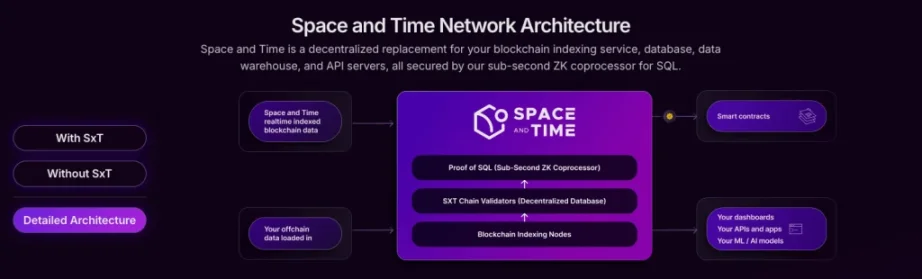
For example, sub-second ZK proofs. STX supports standard SQL syntax (JOIN, GROUP BY, time series analysis, etc.), can handle cross-chain data associations (such as "Total staking of Address A on ETH/BSC/zkSync") and historical trend analysis (such as "Reasons for trading volume fluctuations of a DEX in the past 30 days"), and announced GPU acceleration, generating corresponding zk-SNARK proofs in just "sub-seconds", far superior to traditional zkVM's generation of tens of seconds. Moreover, STX supports queries of 100GB-level data, achieving "second-level verification of on-chain data".
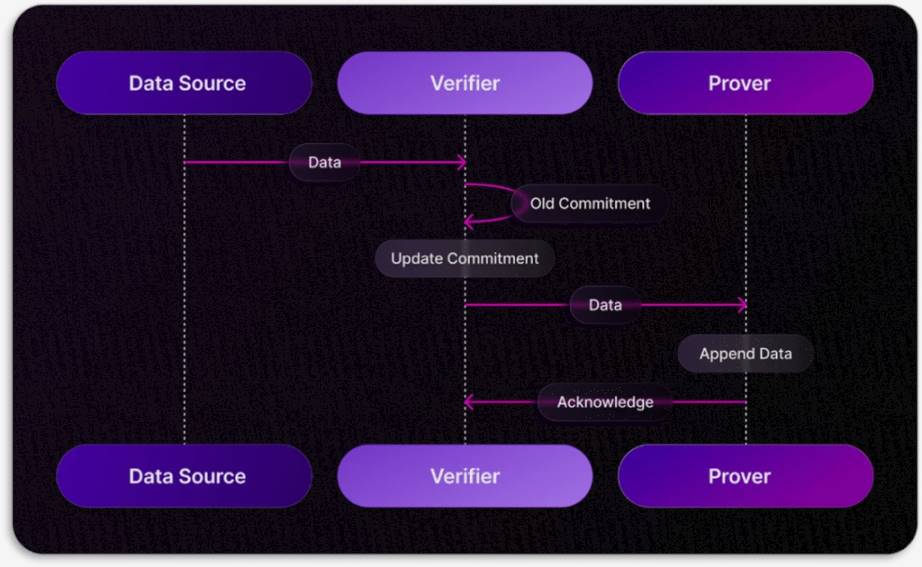
Additionally, SQL query flexibility. STX converts on-chain data from Ethereum, Bitcoin, and other chains into SQL-compatible table structures, and supports the integration of off-chain data sources (SQL databases, APIs, IoT streams) and cross-chain merging. For example, an enterprise's off-chain sales data can be synchronized with on-chain transaction records to form a unified dataset. Developers can directly query complex data such as historical transactions and cross-chain assets using SQL statements, without relying on centralized oracles.
Furthermore, STX's three-layer node architecture is ingenious. Indexing nodes extract and structurally store data from mainstream public chains, staking SXT to ensure data authenticity, with token confiscation for malicious behavior; proof nodes handle query requests and generate ZK proofs, with performance "orders of magnitude" better than traditional solutions; validators maintain data immutability through BFT consensus, ensuring consistency between on-chain commitments and underlying data.
Microsoft Investment, Diverse Applications
The emergence of the STX chain once again meets the imagination of diverse application scenarios. Perhaps this is why STX has consecutively received investments from Microsoft's M12 fund (leading a $20 million round in 2022 and participating in a $20 million Series A in 2024).
In the DeFi field, it can perform real-time analysis of users' multi-chain asset dynamics to adjust lending rates, or integrate cross-chain user assets and protocol health data to support complex derivatives. In enterprise scenarios, institutions like FTI Consulting use it to generate tamper-proof audit reports meeting SEC regulatory requirements, and industries with strong audit needs like IoT can further ensure data integrity using STX. In the AI field, it can combine on-chain data with Azure OpenAI to train trustworthy models, such as intelligent trading robots predicting market trends. In blockchain gaming scenarios, off-chain game events can be imported into STX with ZK proofs and sent to NFT smart contracts to achieve on-chain attribute evolution (levels, skins, rewards). Game studios can analyze player behavior and item economics across chains without relying on centralized data storage.
Moreover, the imagination of data monetization on the blockchain is more likely to become a reality. When a dataset is queried, the publishing entity can receive SXT token rewards. This also encourages multiple parties to contribute and query shared data, creating convenient conditions for establishing a trustless database alliance.
In terms of tokenomics, of the total 5 billion $SXT tokens, over 50% belong to the community, used to incentivize node staking, data provision, and developer ecosystem. Stakers can earn annual yields, and data publishers share revenue based on query volume.
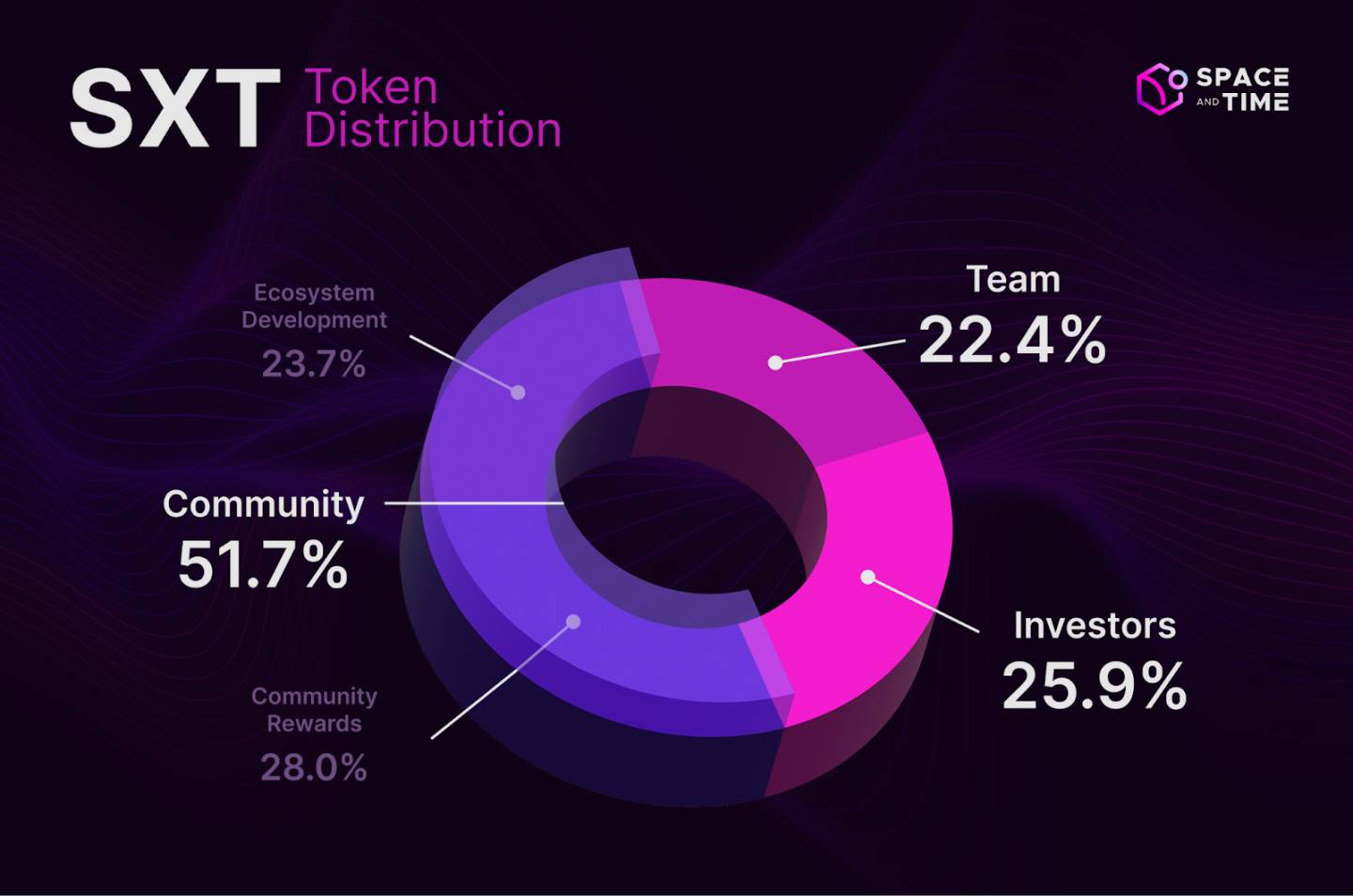
Despite facing challenges of technological implementation and regulatory compliance, the STX chain, backed by Microsoft and supported by Chainlink, with its differentiated positioning of "trustworthy data + SQL query", is still expected to become the core layer of Web3 data infrastructure, driving blockchain's expansion from financial applications to enterprise-level data services.