The GENIUS Act on stablecoin has passed the procedural vote in the US Senate, but still needs a final vote to be officially approved.
The US Senate approved an important procedural vote for the GENIUS Act – the stablecoin regulation bill – with 66 votes in favor, 32 votes against, and 2 abstentions. The vote took place last night to pass the "cloture" procedure – a measure to end endless debate (filibuster), which requires at least 60% of present Senators to agree.
Notably, 16 Democratic Senators voted in support, led by Senators Gillibrand, Alsobrooks, Gallego, and Warner. However, this is only the first step in the bill's passage, as the Senate still needs to conduct a full vote for the bill to be officially approved.
Internal Democratic Party division on stablecoin
The passage of the cloture procedure reveals a clear division within the Democratic Party on stablecoin regulation. Senator Andy Kim, although supporting the bill at the Banking Committee level, did not vote in favor of the cloture last night. In a video, he was recorded discussing the draft with Senator Kirsten Gillibrand – indicating that many points still need adjustment to gain sufficient support from the Democratic side in the final vote.
Senator Gillibrand was also seen in a tense debate on the Senate floor with Republican Senator Bill Hagerty – the bill's main sponsor, while receiving numerous comments from Senator Elizabeth Warren, who continuously criticizes the bill.
Senator Mark Warner, one of the Democrats supporting the bill, posted his perspective: "Many Senators, including myself, have real concerns about the Trump family using crypto technology to avoid oversight, hide murky financial transactions, and profit personally at the expense of the American people."
However, he continued: "But we cannot let that corruption blind us to a larger reality: blockchain technology is an inevitable part. If US legislators do not shape it, someone else will – and not necessarily in a way that serves our interests or democratic values."
Loopholes and conflicts of interest
In contrast, Senator Elizabeth Warren continued to express strong opposition: "What has changed in the bill since the previous vote? The answer: almost nothing. The fundamental errors remain unresolved. A strong stablecoin bill is an ideal outcome, but a weak bill is even worse than having nothing."
The new draft of the GENIUS Act has some minor changes but lacks significant reform. It includes adjustments to stablecoins issued by BigTech, but does not impose a ban – instead, authorizing a committee comprising the Treasury Department, Federal Reserve (Fed), and FDIC to have full decision-making power.
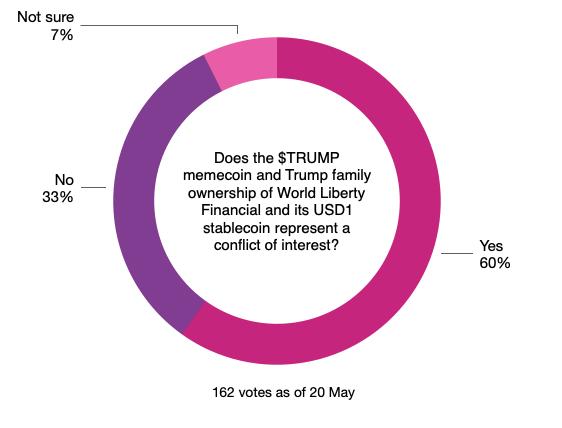
A major point of contention is the conflicts of interest related to the Trump family in the crypto field. Most notably, the $TRUMP token has attracted foreign investors, and large token holders have the right to attend a dinner with Mr. Trump. Additionally, Trump family members support World Liberty Financial – the issuer of USD1 stablecoin. A company based in the UAE, with the National Security Advisor as its Chairman, has purchased 2 billion USD in stablecoin for payment purposes.
A recent poll showed that 75% of initial participants believed there was a conflict of interest, but this percentage has dropped to 60% over time, with 7% remaining uncertain.