


As the government blocks Initial Coin Offerings (ICO), related companies are moving overseas. An irony is occurring where companies are issuing coins abroad and paying taxes to foreign countries, while these assets are still traded on major domestic exchanges. Experts unanimously argue that an institutional framework for ICO should be established to encourage the reshoring of domestic companies.
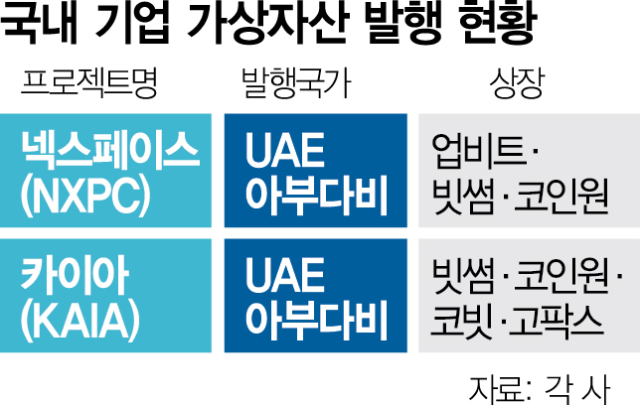
According to the financial sector on the 22nd, Nexspace (NXPC), listed on domestic cryptocurrency exchanges like Upbit, Bithumb, and Coinone, was established in Abu Dhabi, UAE. Nexspace is building a blockchain-based game ecosystem implementing Nexon's flagship intellectual property, MapleStory. The coin is issued in the UAE while being listed domestically.
Related Articles
- KakaoPay "Detected 70,000 Malicious Apps Related to Cryptocurrency in One Month"
- "Domestic Cryptocurrency Market Cap Exceeds 100 Trillion" Approaching 10 Million Investors… "Public Hedge Funds are an Alternative in Volatile Markets" [AI Prism*Stock Investor News]
- Domestic Cryptocurrency Market Cap Exceeds 100 Trillion
- Cryptocurrency Investors Approaching 10 Million… Increased by 25% in Six Months
The situation is similar for Kaia, the integrated blockchain platform of Kakao and Line. The coin is issued by the Kaia DLT Foundation registered in Abu Dhabi Global Market (ADGM), while being listed on domestic exchanges like Bithumb, Coinone, and Korbit.
This situation stems from the government's complete ban on ICO. ICO is a method of issuing cryptocurrency to raise funds, similar to Initial Public Offerings (IPO) in the stock market. Unlike IPO, it can easily issue cryptocurrency without complex procedures, which has been noted as an innovative funding method. However, in Korea, all forms of ICO have been effectively banned since the government's emergency cryptocurrency regulation in September 2017. At the time, the Financial Services Commission stated that ICO would be prohibited regardless of technical terminology. While not explicitly stated in law, it was a strong administrative directive that fundamentally blocked private issuance.
While Korea is constraining through shadow regulations, overseas countries are quickly organizing ICO systems and absorbing innovative companies. Singapore, considered an Asian cryptocurrency hub, established digital token guidelines in 2017, clearly distinguishing between securities and non-securities tokens. While establishing investor protection rules like submission of investment prospectuses and anti-money laundering requirements, they also accommodate experimental projects through sandbox formats. The European Union (EU) is promoting industry activation while protecting investors by clarifying issuance requirements in the Markets in Crypto-Assets (MiCA) law, such as mandatory white paper registration and risk disclosure.
The industry is concerned that the ICO ban threatens domestic industrial competitiveness. While overseas sees ecosystem expansion with developers, businesses, and funds attracted by cryptocurrency issuance, Korea remains in a structure where only cryptocurrency trading remains after companies have left. An industry official emphasized, "Allowing ICO could expect positive effects like job creation and tax revenue expansion" and "Introducing clear issuance requirements can achieve investor protection".
- Reporter Do Ye-ri
- yeri.do@sedaily.com
< Copyright ⓒ Decenter, Reproduction and redistribution prohibited >






