


Author: Mario @IOSG
TL;DR:
The Internet Capital Market (ICM) is a crypto-native alternative to the Traditional Capital Market (TCM), allowing entrepreneurs to raise funds directly from online communities through tokenization, bypassing venture capital and initial public offering (IPO) procedures. Platforms like Believe App (formerly Clout) on the Solana chain are pioneering this transformation, enabling users to easily issue and invest in projects by simply @mentioning the platform on X (formerly Twitter).
Despite criticisms such as lack of regulation, low project barriers, and potential for misleading tokens, ICM still has strong mass adoption potential, especially in promoting Web3 to Web2 users through a streamlined user experience, fiat payment entry, and viral narratives. To ensure long-term development, platforms like Believe need to move beyond short-term hype by promoting founder accountability, optimizing token economic models, building DAO governance, and creating real utility, transforming ICM from a meme trend into a new capital formation paradigm.
Background of Traditional Capital Markets
In Traditional Capital Markets (TCM), entrepreneurs often rely on expensive and time-consuming financing methods like IPOs or venture capital. This path itself presents numerous challenges.
From the fundraiser's perspective, entrepreneurs must navigate lengthy application processes, complex legal procedures, and constantly cater to investors' preferences, often preventing them from focusing on product development or community building.
From the investor's side, early investment opportunities are largely monopolized by large institutions like hedge funds and mutual funds. Ordinary investors rarely get a share, typically entering the market only after project valuations have skyrocketed.
This model is not only inefficient and lacking in openness but also creates a severe misalignment of incentives between creators and supporters. These structural problems reflect an urgent market demand for a more open, direct, and participatory financing approach, which is precisely the core issue the Internet Capital Market (ICM) aims to solve.
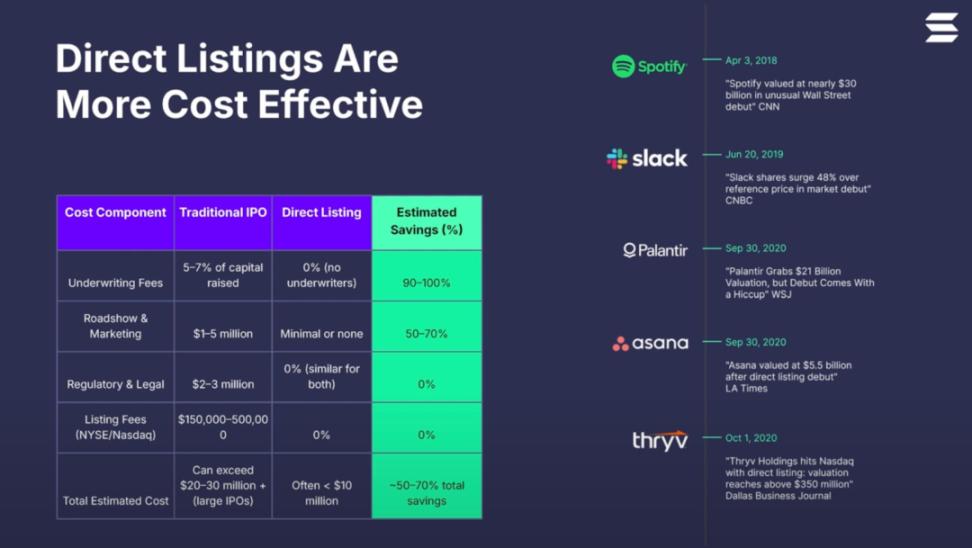
Figure 1: Direct Listing Cost Comparison
(Adapted from Lily Liu, TOKEN2049 Dubai 2025) [1]
Direct listing is a more cost-effective financing method that skips the expensive and time-consuming intermediary processes in traditional financing, offering entrepreneurs a new option. The Internet Capital Market (ICM) is similar to direct listing in many aspects but theoretically offers more advantages, as entrepreneurs raise funds directly through blockchain.
What is ICM
ICM is a new narrative in the crypto industry. It allows entrepreneurs to directly raise funds for their products via the internet, without going through the complex processes of traditional capital markets, simply by tokenizing their ideas to immediately gain investor support.
Unlike traditional markets where investor shares are typically managed by banks or brokers, in the ICM model, investors directly hold their funds (token assets) through self-custodial wallets, completely controlling asset ownership and liquidity. This approach significantly lowers the barrier for ordinary people to invest and enables project teams to acquire startup capital more efficiently.
[The translation continues in the same manner for the rest of the text, maintaining the specified translation rules for specific terms.]Unlike Believe, which allows users to issue and purchase tokens without any Web3 knowledge. You can directly issue tokens through Twitter and purchase using credit cards or Apple Pay. This significantly lowers the entry barrier and attracts many Web2the.
For example, Web2Alex Leiman (who developed the Web3 game noodle.gg similar to slither.io) chose to issue his new token $noodle on believe9].
Narrative and Vision: Differences between ICM and Meme Platforms
Believe is one of the earliest projects to propose the "Internet Capital Market (ICM)" narrative, emphasizing the issuance around real ideas and projects to support their development, rather than just hyping meme tokens without actual value. this higher-level vision is more likely to resonate with the community and attract users who to meaningful construction and long-term value.
In contrast, Clanker is more like a meme issuance platform focused on short-term speculation and trading. It lacks a clear narrative direction and long-term development vision, thus its appeal is limited to "short-term players" and struggles to establish lasting user stickiness and ecosystem building.
Why ICM Might Just Be Another Meme Hype
The concept behind ICM is indeed very attractive. However, there is always a trade-off between efficiency and safety. While saving time and lowering barriers, you inevitably sacrifice some protection mechanisms.
Founders Do Not Need to Promise Any Responsibility
Unlike traditional capital markets, where projects usually undergo strict roadshows, due diligence, and regulatory approvals before IPO, in ICM, founders only need to @to Believe On their official Twitter to easily launch their token.
But the problem is: Founders have no delivery commitments or legal obligations, and there are no guarantee mechanisms to ensure they fulfill their initial goals. This lack of accountability mechanism is worworrying, when in reality, some cases even "presidential-level" accounts have shared a token's contract address and later claimed "account was hacked" to delete posts or distance themselves. This also reveals the huge risks in the ICM model under an open but unregulated state.
) [10]]</</p><p>According to LauncherCoin, avoid tokens being as investment products, the platform has very strict legal compliance. requirements. For example: tokens cannot represent equity, nor imply any form of return return. Their design intent should be more like digital souvenirs, allowing supporters to express support for a project, rather a security that brings income, dividsharing.</p><p>This also reveals a key issue:: tokens themselves are hugely disconnected from underlying projects.. According to the tokens are essentially very similar to meme coins - - they have no actual practical use and their existence is more symbolic of)
While this method can indeed help parties raise funds and promote project progress, many investors might mistakenly believe they are participating in a high-quality early early investment opportunity.,. people think they are acting as angel investors, struggling entrepreneurs, but the fact is: these token tokens do not promise any returns, nor have any guarantee mechanisms.
Abused Narrative

: Believeout ecosystem market statistics, including token by market value, trading trading volume, and 24-hour price changes (2025)) [11]]
ICM was originally meant to empower truly creative builders, but the current situation is ironic: Many Many people just use the "supporting projects" narrative packaging, but essentially still creating wave after wave of meme trends. These tokens without any constructive meaning are actually more noticed and famous than projects that truly need funding support [17]
What's Next for ICM
Currently, issuing tokens on Believe is zero-cost for founders, but its, its market performance highly depends on the project's continuous advancement. To incentivize founders to continuously update projects and maintain community focus, Believe should consider optimizing its existing tokenomics.
For example, smart contracts could set penalty mechanisms: if founders do not update projects for a long time or are in a "disconnected" state, they cannot receive transaction fee earnings. Additionally, establishing a DAO mechanism is very necessary to give the community voting rights and project feedback rights, thereby improving transparency and founders' sense of responsibility.ally believe ICM is not just short-term meme hype, it indeed has greater potential, but premise is that it needs more clear rules and a more ecosystem development. ICM concept reminds me of TON's promotion path - TON successfully brought many Web2 users into the Web3through the Telegram platform platform platform.
Currently, all crypto assets combined only account for about .56% of global total monetary total [18].]. truly popularize3it must provide simpler and more intuitive usage methods. real value ofICM is that it can attract and convert large numbers of Web2 users without requiring deep Web3 knowledge.
Although some currently view Believe as another meme issuance platform, it is rapidly developing and has seized market share originally dominated by old platforms like on the SolSolana chain, alleviselling pressure Solana.

Figure active addresses market share ofsolana token issuance platforms, comparing BelieveApp with competitors like PumpFun and LetsBonk (2025) [12]
In the short term, if Believe can maintain its advantage in competition with traditional token isisis, IC,M is likely to exist long-term, because achieving Web3 mass adoption has always been the ultimate goal of the entire ecosystem.
But to truly establish itself3and not become a fleeting hype platform like Clanker, Believe must further strengthen and unique and expand: not just an issuance tool, but a platform that drives project incubation and real value creation.

Figure 12: Let'sBonk ($BONK) price trend chart, showing initial surge and subsequent trend driven by "narrative" ((2025) [13]
This means ICM must build deeper practical value around the "Internet Capital Market" concept. Specifically, it can start from these directions:
Promote truly meaningful community governance mechanisms (DAO)
System of founder responsibility
If it does not evolve in this direction, Believe may be viewed by the market aseme another meme platform, ultimately losing momentum for long-term growth.. To truly have a lasting impact, Believe must be more than just a meme coin launch platform - it should be an innovative platformform that sparinspires creativity, drives,, masses,, toizeWeb3.






