Author: Meng Yan; Source: Meng Yan's Blockchain Thinking [Introduction] With the US Senate passing the voting motion for the US dollar stablecoin bill and the Hong Kong Legislative Council passing the Hong Kong dollar stablecoin bill, stablecoins have quickly become the hottest industry topic and have attracted wider attention. It is generally expected that with the implementation of the US dollar stablecoin bill, the blockchain digital economy will usher in a very exciting outbreak, and a new entrepreneurial window will emerge around the US dollar stablecoin and real world assets (RWA). Dr. Xiao Feng is a leader in Chinese blockchain research and practice, and has a very deep understanding of blockchain, stablecoins and RWA. In order to fully understand the opportunities of this era, I had the honor of having an in-depth exchange with Dr. Xiao Feng through video conferences and text, and I sorted it out and published it, and discussed it with my peers. Due to the large length of the original text, it is divided into two parts. The first half has been published , mainly interpreting the significance of the US dollar stablecoin. This article is the second half, focusing on the stablecoin economy and the opportunities that RWA brings to Chinese entrepreneurs. The views in the article are only one person's opinion, and readers are welcome to communicate.
4. Stablecoin economy is the primary stage of RWA and will promote blockchain applications to cross the gap
Meng Yan: In any case, with the legislation of the US dollar stablecoin and the Hong Kong stablecoin, the big event of stablecoin is coming. What does this mean for entrepreneurs?
Xiao Feng: In the next few years, stablecoins will drive the explosion of blockchain and RWA applications. On the demand side, billions of users will open encrypted accounts on the chain and hold stablecoins, and the user scale will increase several times in a short period of time. At the same time, on the supply side, millions of platforms, enterprises, Internet merchants, self-media and creators will begin to accept stablecoin payments, and a large number of assets will be tokenized and chained into RWA. "How to earn stablecoins" will become one of the most concerned topics for all companies in the next few years .
Various application demands around stablecoins and RWA will explode rapidly, and truly capable entrepreneurs will put aside their hesitation and reserve and flock in. Stablecoins and blockchain will become the most attractive track with the most success stories in the next few years.
Here I would like to quote a model from a classic business book to explain this phenomenon: the "Technology Product Market Acceptance Curve" proposed by Geoffrey Moore in "Crossing the Chasm". He divides users into five categories: technology innovators (Innovators), early adopters (Early Adopters), pragmatists (Early Majority), conservatives (Late Majority) and skeptics (Laggards). Most high-tech products die in the "chasm" between "early adopters" and "pragmatists". Technology must be implemented from vision to reality, and can solve specific problems and bring real value in order to cross the chasm, otherwise it will be silent.
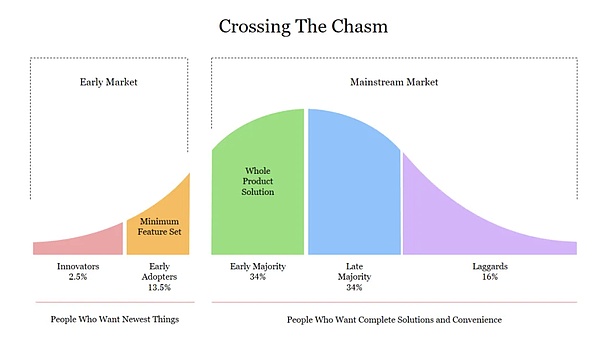 I believe that stablecoins are becoming a bridge for the blockchain industry to cross this "chasm" . In the past, when we talked about encryption and Web3, we always stayed in the small circle of "believers" and "technology enthusiasts". Many people agree with the concept, but once it needs to be used on a large scale, problems such as "cannot find a landing scenario", "users don't understand", and "high compliance risks" arise. Stablecoins will become the first blockchain product that is truly adopted on a large scale by "pragmatists". Cross-border e-commerce, freelancers, platform settlement, global payments, everyone has started to use it. It allows blockchain to exist not as a narrative for the first time, but as an infrastructure integrated into the real economic system.
If users want to use stablecoins, they need to open a digital currency account, and then they will be exposed to and learn about wallets. Therefore, stablecoins are not only a product, but also a pass for the entire blockchain industry to cross the market gap. After crossing this gap, there is a huge blue ocean market, which is the mainstream user market composed of "early majority" and "conservative majority". Once it is crossed, "mass adoption" is no longer a dream, but a natural outcome.
I have recently quoted the words of John Hicks, the Nobel Prize winner in economics, on many occasions: " Behind every industrial revolution, there is a financial revolution. " Now we are standing at the next part of this sentence - every outbreak of a financial revolution requires a general-level product to break through the user boundaries. Stablecoins are becoming such a product.
I want to emphasize that such an explosion will only happen once in an industry, and it will be over once it is over . So entrepreneurs may not hesitate any longer. People who have experienced the Internet and mobile Internet know that if you miss this window of opportunity, the difficulty of the future will increase greatly.
5. RWA innovation cannot be a case of wearing new shoes and walking the same old path
Meng Yan: You just mentioned RWA, which is a very hot topic after stablecoins. It is said that many entrepreneurs in first-tier cities in China are communicating with each other about how to seize the opportunity of RWA. But I actually have doubts about this. The so-called RWA is the tokenization of real-world assets and then putting them on the chain. Now many people fantasize that if they put their unsaleable assets on the chain and turn them into RWA, they will immediately become popular. I think this is illogical. You must have more contact with it and I believe you have a deeper understanding of it. What do you think?
Xiao Feng: I receive entrepreneurs who come to talk to me about RWA almost every day. I have encountered all the asset types you just mentioned. But in 90% of cases, I will advise them to give up. It is technically simple to turn these assets into RWA on the chain, but the question is, will you buy such RWA? I won’t buy it anyway.
RWA is an irresistible trend and will inevitably grow very large in the future. Not long ago, the Boston Consulting Group had a report predicting that the total size of RWA assets on the chain will reach 18.9 trillion US dollars by 2033, which means that in the next eight years from now, the annualized growth rate of RWA will reach 53% . No entrepreneur wants to miss the opportunity to board this rocket.
However, this does not mean that you can rise to the top by simply putting an RWA label on it. From the development of the crypto industry over the past decade, we have learned that development must follow objective laws and be based on value. Objectively speaking, bubbles are inevitable, but if the bubble is too big, it will always collapse, which will drag down the development of the industry.
I have said this to many people. Now many people have a serious cognitive mismatch about RWA . RWA is not a label on the chain or a layer of technical "gold foil" that can transform an asset. It cannot change the essential attributes of the asset. If the assets in your hands lack liquidity, have opaque prices, and have high transaction costs, then they will not soar on the spot after being put on the chain. RWA is not a magician and cannot turn a crow into a phoenix .
RWA is a digital mapping of real assets. The key lies in what you map. If the underlying assets are not good, there is no clear ownership, and there is a lack of standardization, no matter how you package it, it will be useless. It is not a financial gilding technique, nor is it a panacea on the chain.
So I think the development of RWA must also follow an objective law. What is this law? It is to start from high-grade assets, standardized assets, and head assets, and gradually expand to long-tail assets and non-standard assets. What are high-grade assets? They are sovereign bonds, blue-chip stocks of large enterprises, and other assets that are highly standardized, highly accepted by the global market, and have transparent pricing mechanisms. Next are head corporate bonds, high-quality bills, accounts receivable, and even real estate mortgages in high-growth areas. This type of asset has the potential to be tokenized. Because their value foundation is solid and the understanding of prices between buyers and sellers is symmetrical, it is possible to amplify liquidity after being put on the chain instead of creating illusions.
You are right. Now many people are doing RWA with a hype mentality, wanting to find a shell on the chain to "cash in" worthless things offline, or even engage in some pyramid scheme-like gameplay. I am not optimistic about this route of wearing new shoes and walking the old path. RWA is not a tool to evade supervision, nor is it a trash can for non-performing assets. If you don't really solve the trust problem, circulation problem, and pricing problem, it doesn't make sense to put it on the chain.
We must seek truth from facts. Objectively speaking, high-quality assets are currently concentrated in the United States. The real opportunity for the Chinese is not to rush to tokenize any assets, but to gain a foothold in the "stablecoin economy" stage. What does it mean? It means going overseas first, selling products and providing services online and on the chain, and earning stablecoins. This is our current advantage. In short, to engage in RWA, start with earning stablecoins.
Why? Because we have the world's strongest supply chain, engineering manufacturing capabilities and Internet operation capabilities. Cross-border e-commerce has already reached scale, and e-commerce bosses are already good at traffic and efficiency. Once stablecoins are used, transaction costs are immediately reduced and settlement speeds are greatly improved. This is the starting point for the real combination with blockchain and the Chinese solution for the stablecoin economy stage.
This is not my imagination, but a reality that is happening. Some small and medium-sized e-commerce companies that went overseas in the past few years, as well as some foreign trade companies and voluntary export merchants, are now accepting stablecoins very quickly. Some of them are quite large in scale, and their ability to earn stablecoins is much stronger than many blockchain projects. This is just the beginning. I am sure that once the GENIUS Act is passed, platforms such as Amazon will immediately support stablecoin payments, and tens of thousands or hundreds of thousands of e-commerce merchants will soon become the protagonists of the stablecoin economy.
So I think it is time for Chinese Internet elites to embrace blockchain and the stablecoin economy. As long as you stand firm and gather users, merchants, and cash flow, you will naturally hatch a batch of high-quality RWAs. For example, accounts receivable from cross-border orders and supply chain debts based on real logistics are all natural on-chain assets. At that time, you don't need to tell stories, and investors will naturally come to buy and sell your RWAs.
So I suggest that you take the first step firmly. The stablecoin economy is the primary stage of RWA , and it is the bridgehead for blockchain to truly enter the industry and cash flow. Whoever stands firm at this stage will naturally occupy the RWA high ground in the next stage.
Meng Yan: Some people think that the RWA concept is popular and it is time to issue a coin. Create an RWA project and then launch an ICO. Is this possible?
Xiao Feng: This issue should be viewed from two aspects.
On the one hand, the stage of getting rich by telling a chain story, making a protocol, and issuing a coin has passed. In the past ten years, we have experienced the first growth curve of the blockchain industry, which is a development stage dominated by infrastructure construction and coin issuance financing. At that stage, it was indeed "narrative-driven capital". Issuing a coin could drive an entire round of financing.
But looking at it again today, the marginal effect of coin issuance and financing is rapidly declining. Investors in the crypto are becoming more rational, and the market is becoming more and more competitive. Users have seen white papers that are full of hype. The key is whether you have real application scenarios and whether you can acquire users and cash flow. So I say that the energy of the first curve is fading, and what we need is the second growth curve - the explosive stage with applications as the core.
On the other hand, the United States has not adopted a one-size-fits-all approach to token financing. Instead, the United States is establishing a new legal framework for token financing through two paths. The first is the FIT21 Act, and the second is the regulatory exemption mechanism of "Token Safe Harbor". The combination of these two constitutes the prototype of a new token compliance financing system.
If you know a little about the history of US securities law, you will know that the status of FIT21 is similar to the Investment Company Act of 1933. It is a structural legislation for an economic entity, and together with the Securities Act of 1933 and the Exchange Act of 1934, it laid the legal foundation for the prosperity of the US capital market for a century. Now we see that the SEC and CFTC are also constantly issuing explanatory documents to define whether tokens are securities, commodities or virtual commodities, and at the same time, they are also defining regulatory responsibilities. This is the process of gradually clarifying the entire framework.
I think if these two efforts can be sustained and combined, today's US legislation may set a precedent for token financing and token market regulation around the world. If it develops smoothly, it may lay the foundation for a new century of prosperity in digital finance. In the past, we talked about stocks and bonds, and now we talk about RWA and Token. The form is changing, but the underlying logic of finance has not changed - that is, risk pricing, information transparency and legal protection.
I still say the same thing: Don't rush to issue coins now. First, do a good job in the stablecoin economic stage, develop applications, and lay a solid foundation. When your model is verified by the market and cash flow runs smoothly, then issue coins for financing according to the new US rules. Why worry about not being able to raise funds efficiently? Why worry about not being able to successfully go public? First make good products and good applications, the road of rule of law is being opened, and the bridge of capital will naturally come to pick you up.
In the future, tokens will be traded on Nasdaq and NYSE, and in turn, exchanges like HashKey will be able to trade stocks. Recently, the US crypto exchage Kraken has taken the lead in announcing support for trading of some US stock tokens. As US SEC Chairman Atkins recently said, there will be some "super applications" in the future that trade all types of assets on one platform - stocks, bonds, tokens, stablecoins, RWA. This day will not be too long.
6. Chinese people must be the protagonists of RWA innovation
Meng Yan: But I have communicated with many Chinese blockchain entrepreneurs, and I feel that they are generally lacking in confidence. The main question is that the center of this wave of stablecoins and RWA is in the United States. Due to the overall strategic competition between China and the United States, the idea of "decoupling and breaking the chain" is rampant, and nationalism is rising on both sides. Will Chinese entrepreneurs be treated differently and will they have a fair chance to compete?
Xiao Feng: If I say that this problem does not exist, it would certainly be subjective. The geopolitical game between China and the United States does have an impact on the entrepreneurial environment, especially in highly sensitive areas such as technology and finance. However, history has never been a single-line advancement, and reality is often more complex and more tense than public opinion. Despite the friction, I am still very confident that Chinese entrepreneurs not only have opportunities but also unique advantages in this round of stablecoin economy and RWA.
The first reason is the huge stock advantage . Even in the most difficult period in recent years, China is still one of the regions with the most blockchain developers, the highest innovation and engineering quality, and the most active community activities. We cannot be confused by superficial phenomena. Behind many of the world's top projects, there are actually Chinese engineers' codes, algorithms and infrastructure. In an interview, I once bluntly suggested to the Ethereum Foundation: "Ethereum has fallen to this point today because you have lost China." From 2014 to 2016, China was the most solid base for Ethereum developers and users. Later, due to various reasons, Ethereum was absent from China, which was an important reason for its loss of momentum. This is true for Ethereum, and it is true for any global blockchain project. Whoever wins the Chinese wins the world, and no one can ignore Chinese developers and communities.
The second reason is that real interests are highly consistent . Stablecoin economy and RWA are actually a brand-new globalization channel in the digital economy era. What does it mean to China? It means that we can bypass the traditional US dollar settlement system and centralized platforms and export Chinese goods, services and content in new ways. This can not only create jobs, drive growth and stimulate innovation, but more importantly, it can build China's own competitiveness in the Web3 world. In other words, this is a new "digital overseas".
The third reason is that the new system itself is diversified . The future stablecoin economy will not be a single structure, but a multi-level, multi-regional, global network with spectrum and granularity. We will see an onshore dollar stablecoin economy and an offshore dollar stablecoin economy, similar to today's Eurodollar system, with broad space in Asia, Africa, and Latin America. These regions have large innovation space and more flexible rules. With the enterprising spirit and vigor of Chinese entrepreneurs going overseas, these markets will become our home ground.
The fourth reason is that the trend is irreversible . Once the United States completes the breakthrough, other major economies will inevitably follow suit. You see, Hong Kong has taken the lead and passed the Stablecoin Ordinance. I believe that sooner or later we will start discussing whether to develop offshore RMB stablecoins. I think this is a strategic issue that deserves serious discussion. If it can be promoted, Chinese entrepreneurs will have greater dominance and voice in these non-US dollar stablecoin ecosystems.
The fifth reason is my long-term judgment that China will sooner or later embrace the trend of blockchain and digital assets . We are a country known for pragmatism. As long as this thing can promote development, serve the real economy, and create benefits, it will eventually be accepted. Once it is open, with China's market size and entrepreneurial density, coupled with the Chinese people's hardworking and pragmatic characteristics, blockchain in China will surely usher in a blowout development and become the world's most prosperous innovation hotbed.
Therefore, for Chinese entrepreneurs, you must not be blinded by a single leaf and miss the entire era because of local obstacles. The stablecoins and RWAs you see today are a big wave that only comes once every ten years. If you don't stand up, you will voluntarily give up your voice. If you dare to go up, no matter how big the waves are or how strong the wind is, you will have a chance to occupy a place in this new world. I believe that Chinese entrepreneurs will be able to do it. Five or eight years later, the stablecoin economy may be worth two or three trillion US dollars. I believe that at that time, among the entrepreneurs standing at the top of the industry, a large proportion of them will be Chinese faces.
7. The most important innovation is the innovation of order
Meng Yan: No one doubts the ability of Chinese entrepreneurs to create high-quality products now, and the market's doubts are focused on integrity. As a blockchain entrepreneur, I am very dissatisfied with the order formed in the current industry. When I decided to join this industry, I was inspired by the spirit of Satoshi Nakamoto and felt that I could use blockchain, an open and transparent infrastructure, to construct a more inclusive and fair large-scale collaboration mechanism outside of commercial companies. However, looking back over the past ten years, it is not an exaggeration to say that the order established by this industry is "sowing dragon seeds and harvesting fleas." Our ideal was to oppose excessive centralized regulation, but the current order of the crypto market is worse than the order we originally wanted to replace, full of fraud, dishonesty, bullying, secret operations, and mutual harm without bottom line. To be honest, if it was ten years ago, the United States proposed to legislate and regulate stablecoins and crypto projects, I am afraid I would jump out to oppose it. But now I think that since this industry cannot spontaneously generate a healthy order, it can only be imported from the outside.
Xiao Feng: Order is also a product, and the most important product.
You just said "sow dragon seeds and harvest fleas", I don't refute it. Over the past decade, everyone has indeed experienced the gap between ideals and reality. From the perspective of technological idealism, we once hoped that blockchain could spontaneously form an open, transparent, and fair economic order that does not rely on traditional regulatory structures. But reality has proved that it is difficult for a market without basic rules to operate stably. This is the same as the US stock market in the 19th century. Human nature has not changed, and the results will not be different .
But the problem is not just our own fault. In the past decade, financial regulators in major jurisdictions have mostly adopted a "one-size-fits-all" approach to block the rapid development of blockchain, and have been slow to provide a clear compliance path. This has actually led to reverse selection in the market where the inferior survives the superior. Many entrepreneurs who were willing to innovate honestly and have the ability to do a good job in the project withdrew because they could not see the rules and hope. Many of the more radical and speculative people who stayed behind.
The FIT21 Act and the Token Safe Harbor proposal proposed by the United States are positive signals that we have been waiting for for a long time. It is not to ban tokens completely, but to "set rules and leave a way out" for them. For example, in Token Safe Harbor, after the project party registers with the SEC, it can use tokens for financing. After three years, the regulatory agency will evaluate the degree of decentralization of the project: if it meets the standards, it can continue to operate without being treated as a security; if it does not meet the standards, it will be included in securities supervision in accordance with the law. This is the dynamic balance between supervision and innovation. It not only recognizes the high efficiency of token financing, but also establishes a bottom line and exit mechanism for supervision. In my opinion, this is a process of creating order. It is not to cut off tokens across the board, but to use the system to put it on the track of sustainable development.
More importantly, the establishment of this order is not only meaningful to the crypto industry. In the future, entrepreneurs in emerging industries such as AI, robotics, biomedicine, new energy, and carbon assets may also be able to raise funds and govern in the form of tokens. This is not just a matter for Web3, but a new infrastructure issue for the entire innovation ecosystem.
So I am optimistic. As long as the right people are willing to come in and do things according to the rules, as long as there is a clear order, success will eventually come. The market is not afraid of regulation, but it is afraid of no rules. As long as order can be established, innovation will naturally follow.
Meng Yan: Do you have any advice for Chinese entrepreneurs who have the courage to participate in this stablecoin and RWA boom?
Xiao Feng: I have been asked this question quite often recently. I want to say that entrepreneurs who stand out today do need more courage than in previous years. But just because the threshold has been raised, it also shows that this industry has begun to enter a real construction period. My suggestions are also relatively simple, summarized into five points for your reference.
The first is to go overseas . This wave is global, you must go out and enter the eye of the storm of the times. Go to the United States, Hong Kong, Singapore, and Dubai, which are becoming the innovation frontiers of global stablecoins and RWA. If you want to participate, you can't worry about gains and losses, you must fight in the wind and waves and seize a position where the rules are being made.
The second is to have a positive mind . The rules of the game in the industry have changed. The old path of getting rich by issuing a coin is no longer feasible. Now is an era of competing for real user value and application capabilities. For every product you make and every model you design, you must ask: Can it really solve the user's problem? Can it create new efficiency? Only projects that truly create value for users will be retained by this era.
The third is learning . Not only learning technology and compliance, but also learning new ideas and new institutional frameworks. You can't use Web2 thinking to do Web3 things, nor can you use the thinking of issuing coins to cut leeks to speculate in the era of stablecoins and RWA. Behind this is a whole set of new paradigms, and you must continue to learn and constantly break through yourself.
The fourth is to work together . In this new stage, Chinese entrepreneurs must work together, not only for self-protection, but also for resource integration, mutual learning, and even mutual supervision. This is also the beginning of building a new order in the industry. We have suffered losses from the "crypto chaos" in the past, and those lessons cannot be repeated. Now is the starting point for rebuilding order, and we need everyone to work together to create a healthy ecosystem.
Finally, it is openness . The essence of blockchain is an open, transparent, and fair collaborative network, which is the soul of blockchain. We should use the spirit of blockchain to participate in the stablecoin economy and RWA to innovate blockchain.
That’s all I have to say. It’s not a big truth, but I hope it can be of some inspiration to entrepreneurs who are still considering whether to join this industry.