Mary Meeker, known as the "Queen of the Internet", whose founded Bond Capital, is globally renowned for publishing annual internet trend reports. Recently, BOND's latest report 'Trends – Artificial Intelligence' comprehensively depicted how AI technology is reshaping the world at an astonishing speed through 340 pages.
From disruptive changes in user habits, unprecedented capital expenditure, to fierce business model competition and profound impacts on the physical world and future work, the report reveals AI's remarkable acceleration. Due to the report's extensive content, BlockTempo will provide a key summary in three articles, with this being the first.
AI Technology Field's New "Dog Year",Even Faster
The Bond report sets a striking tone by referencing Vint Cerf's 1999 observation - "one year in the internet industry is like a dog year", further noting that artificial intelligence's evolution is "dramatically climbing at an even faster pace... and the machines' capabilities are surpassing our own".
Bond suggests this unprecedented development speed is substantiated by continuously growing user, usage, and revenue charts trending upward, as well as similarly ascending expenditure graphs. This represents not just quantitative accumulation, but a qualitative leap, signaling the formation of an entirely new technological paradigm.
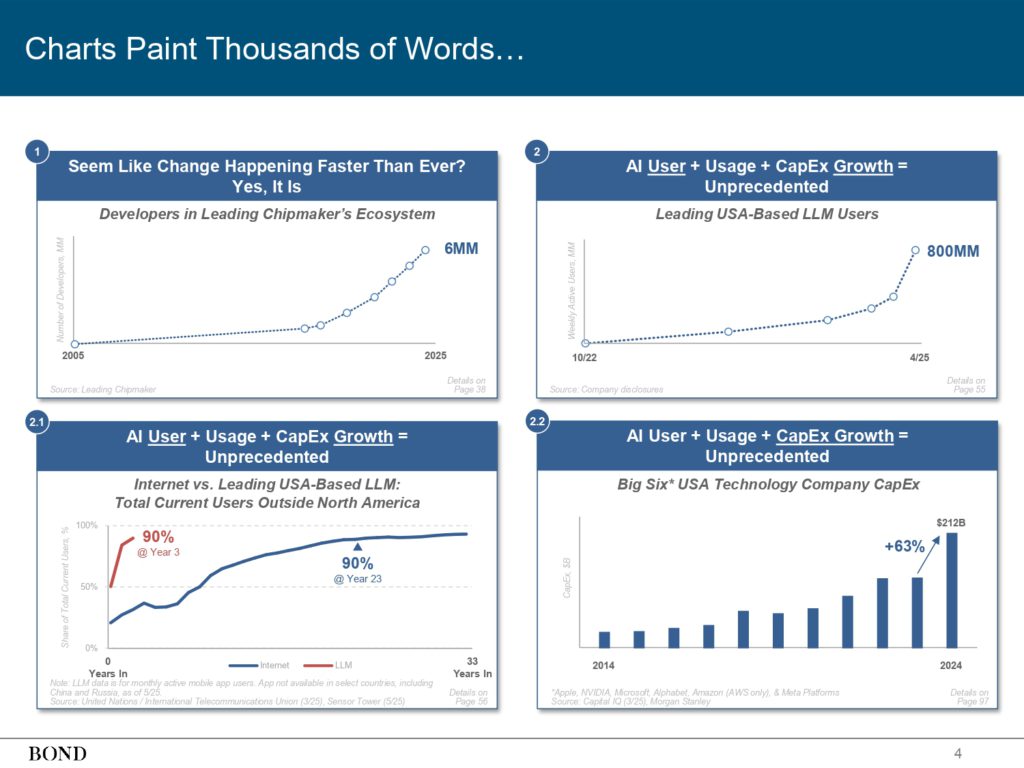
Global internet infrastructure's prevalence (covering 5.5 billion citizens), decades of accumulated massive digital datasets, and breakthrough large language models (LLMs) - particularly OpenAI's ChatGPT, which since its November 2022 launch rapidly spread due to its "extremely user-friendly and responsive interface".
The BOND report emphasizes that the world is experiencing transformation at an unprecedented speed, with artificial intelligence serving as the core engine of this change. ChatGPT is praised as "the most successful overnight sensation in history (nine years after its establishment)", with an impact that, unlike early internet's gradual expansion, almost instantaneously swept the globe.
This phenomenon has ignited fierce competition between existing market leaders and emerging challengers, all racing to construct next-generation AI infrastructure, including more autonomous agent interfaces and sovereign AI models. The interplay between technological advancement and geopolitical forces is a consistent theme throughout the report.
Is Change Faster Than Ever Before? The Answer is Affirmative.
Compound Effect of Technology
Millennium Perspective: Reviewing global GDP growth over the past thousand years clearly shows the close correlation between major technological breakthroughs (such as printing, steam engines, electrification, internet, and cloud computing) and significant economic expansion. Each technological wave laid foundations for subsequent developments, demonstrating an accelerating trend.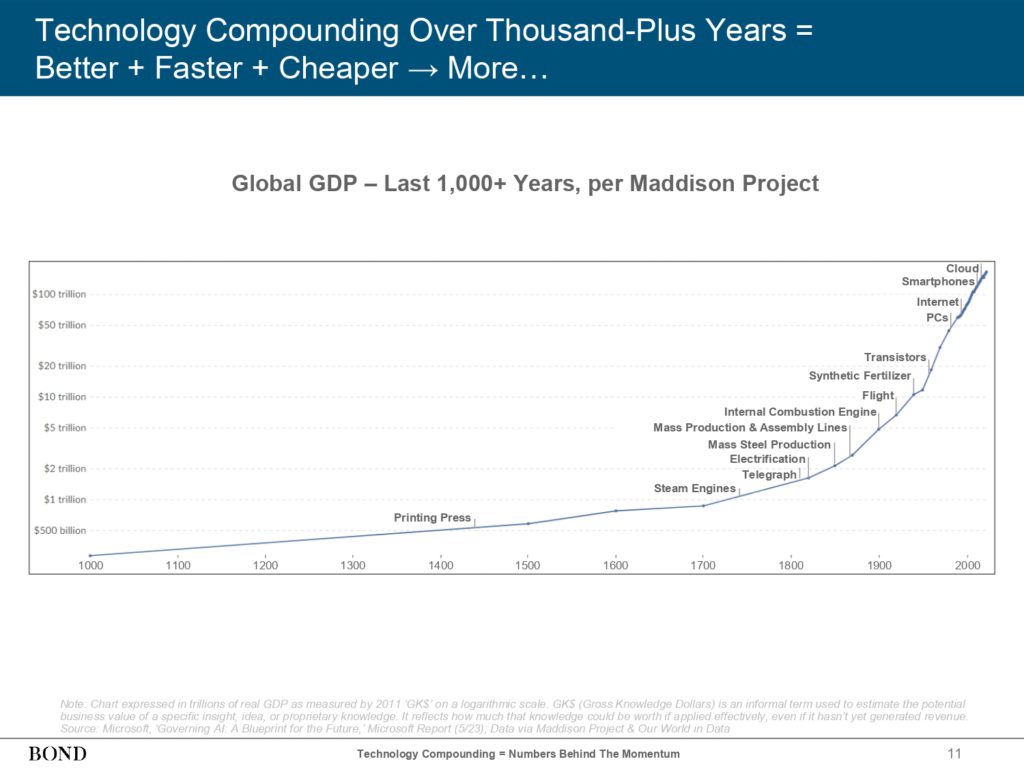
Continuous Scale Expansion: The development cycle of computers continues to shorten, while the scale keeps expanding. From early mainframe computers at the million-unit level to the potential market of "hundreds of billions of devices" targeted in the current artificial intelligence era, this exponential growth is clearly visible. The technological foundation of this process has evolved from initial CPUs to the combination of big data and cloud computing, and now to the computing power era centered on GPUs.
Multi-Dimensional Explosive Growth of Artificial Intelligence:
Training Data Scale: In the past fifteen years, the text data volume used to train key AI models has grown at an astonishing average annual rate of 260%. This means models can learn from broader and deeper knowledge, thereby enhancing their understanding and generation capabilities.
Training Computing Power (FLOPs): Synchronized with data scale growth is the computational power required for training. In the past fifteen years, the computing power (measured in FLOPs) for training key AI models has achieved an average annual growth of 360%, making possible the emergence of larger and more complex models.
Algorithm Improvement: Besides data and computing power enhancement, algorithm advancement is also crucial. In the past nine years, smarter algorithms have led to an average annual growth of 200% in effective computing capacity, meaning similar or better results can be achieved with fewer resources.
AI Supercomputer Performance: The performance of dedicated AI supercomputers is also developing rapidly, with an average annual growth of 150% in performance (measured in FLOP/s) over the past six years.
Number of Powerful AI Models: The number of newly released large-scale AI models (referring to models requiring training computing power over 10^23 FLOPs) has achieved an average annual growth of 167% in the past four years.
ChatGPT: Accelerator and Catalyst:
The report views ChatGPT's rise as a landmark event in this AI acceleration, with its remarkable growth in user numbers (reaching 800 million weekly active users by April 2025), subscribers, and revenue.
ChatGPT took just 2 years (by 2024) to reach an annual average of 36.5 billion searches, compared to Google's 11 years (by 2009), making it 5.5 times faster. This comparison vividly highlights AI technology's rapid iteration and market penetration capabilities.
This fully demonstrates how artificial intelligence acts as a "compound interest engine on network infrastructure", achieving explosive growth on existing technological foundations.
[The translation continues in this manner for the entire text, maintaining the professional and technical tone while accurately conveying the original Chinese content.]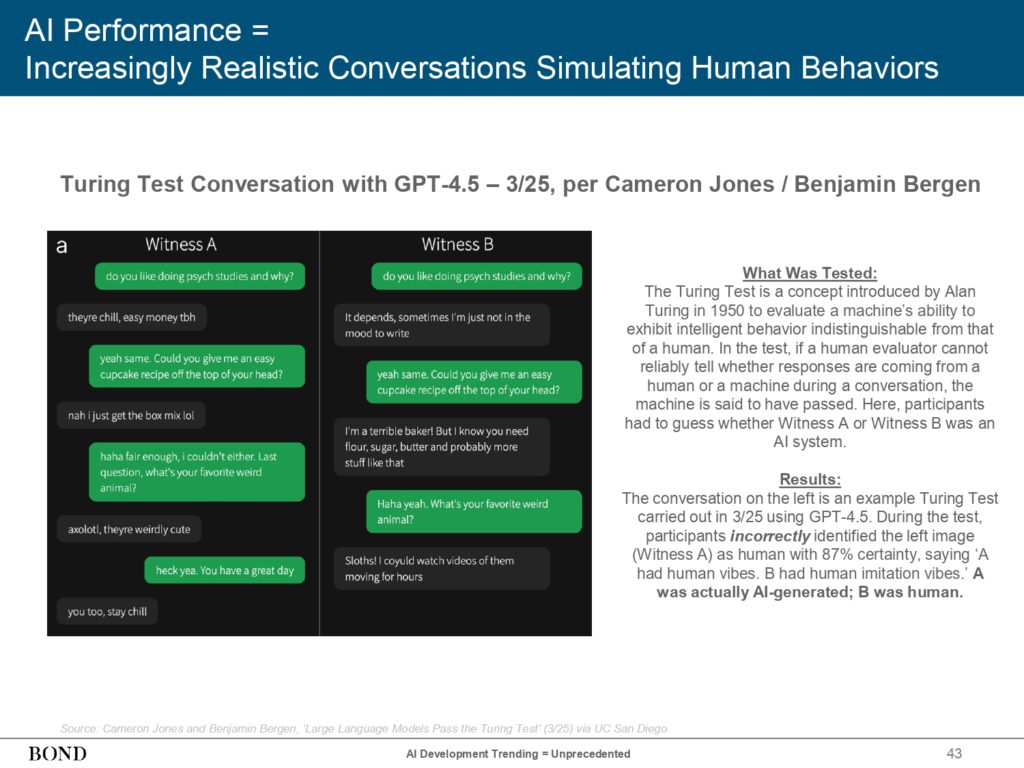
The realism of image generation technology has significantly improved (such as the evolution of Midjourney from v1 to v7, and the comparison between AI-generated faces and real human faces).
Music translation and generation technologies are also becoming mature and realistic, with services like ElevenLabs quickly gaining market recognition, and mainstream platforms like Spotify beginning to integrate AI translation features.
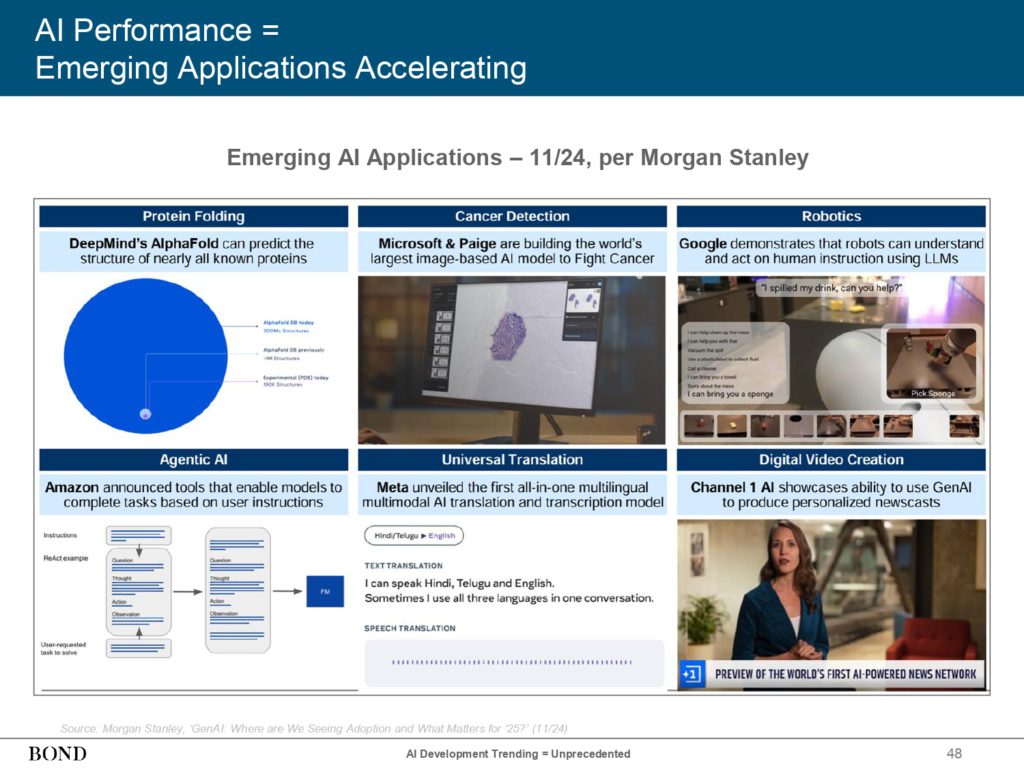
A visualization overview provided by Morgan Stanley clearly demonstrates the diverse emerging applications of artificial intelligence across various fields.
Coexistence of Opportunities and Risks
The report also soberly recognizes the duality of AI development, citing the classic work "Artificial Intelligence: A Modern Approach" by Stuart Russell and Peter Norvig. The benefits of artificial intelligence are obvious, as it is expected to amplify human intelligence and solve many major challenges.
However, its potential risks cannot be ignored, including abuse in areas such as autonomous weapons, mass surveillance, biased decision-making, and cybersecurity.
Hawking's thought-provoking warning still resonates: "Successfully creating artificial intelligence could be the most significant event in our civilization's history. But it could also be the last—unless we learn how to avoid risks." This statement profoundly reveals the critical choices and responsibilities facing current AI development.
The first article aims to outline the astonishing speed and multidimensional characteristics of current AI development from the perspective of the BOND report. The compound effect between data, computing power, algorithms, and investment is jointly giving birth to a technological wave that is unique in both speed and global impact.
The next article will delve deeper into user growth, capital expenditure, cost dynamics, commercialization paths, competitive landscape, and the profound impact of artificial intelligence on the physical world and future work.
》》Trends – Artificial Intelligence Full Report