Bittensor has just recorded a new All-Time-High in the number of subnets. Important developments in the Bittensor ecosystem create positive expectations that TAO token could reach $1,000 by 2025.
So what are these new developments and why are they important? Let's explore in more detail.
What does the record number of Bittensor subnets mean?
According to data from Taostats.io, Bittensor has reached the highest number of subnets ever with 118 active subnets at the beginning of June 2025.
To understand this milestone, it's important to know that subnets are sub-networks in the Bittensor ecosystem. This is where developers, data providers (miners) and validators collaborate to build, train and evaluate decentralized AI models.
Each subnet focuses on a specific task, such as natural language processing, data analysis or AI content generation.
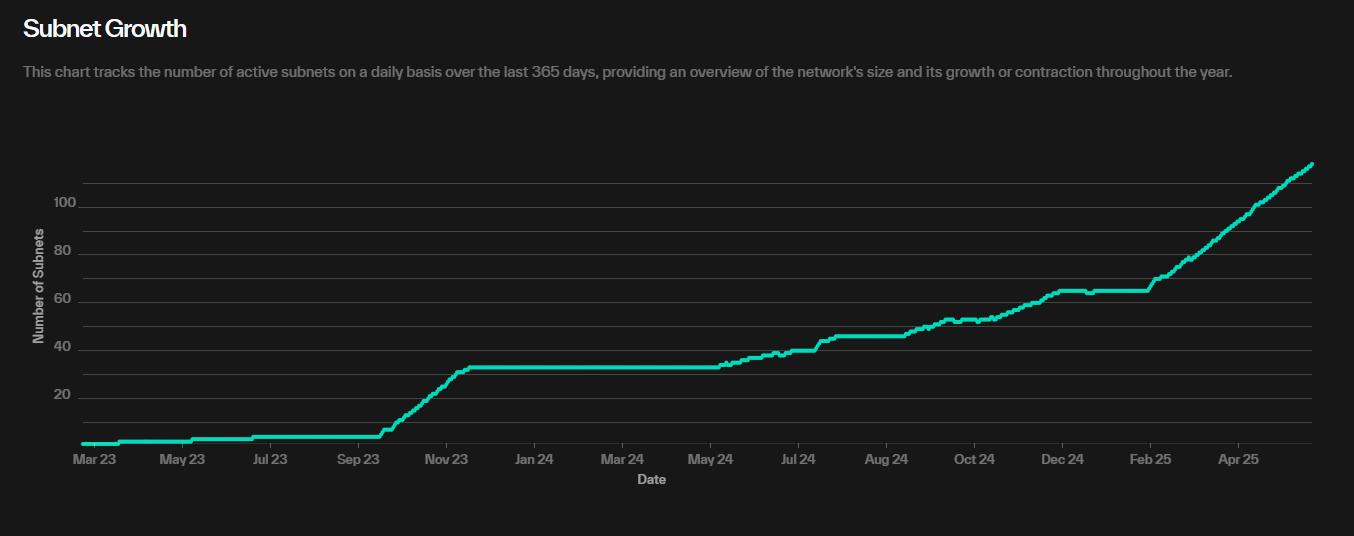 Growth of subnets on Bittensor. Source: Taostats
According to the project's documentation, these subnets operate on an incentive model. Miners and validators receive TAO tokens as rewards for contributing to the network.
The increase to 118 subnets shows a strong expansion of the ecosystem. This means more AI projects are being deployed on Bittensor, attracting more participants, from developers to investors.
This increase also reflects a broader diversification of decentralized AI applications. As a result, the Bittensor network becomes more robust and flexible. However, it also presents challenges.
Maintaining quality and performance across subnets will require continuous technical upgrades to ensure network stability.
BitGo partners with Yuma to boost TAO staking for organizations
Another important growth driver is the recent collaboration between BitGo and Yuma.
BitGo, a leading digital asset management platform, has partnered with Yuma, a top validator on Bittensor, to provide TAO staking services for institutional investors.
This move allows investment funds, asset managers, and large corporations to participate in the Bittensor network. They can earn staking rewards while supporting decentralized AI development.
This collaboration enhances TAO's liquidity and strengthens institutional confidence in Bittensor's long-term potential.
 Number of TAO tokens currently being staked. Source: Taostats
According to Taostats, over 6 million TAO are currently being staked, representing more than 70% of the circulating supply.
Additionally, the Yuma Consensus 3 upgrade, announced by Opentensor at the beginning of June, introduced major improvements to the network. Yuma Consensus is the core consensus algorithm of Bittensor. It allocates rewards to miners and validators based on their contributions.
The upgrade improves fraud detection and punishment mechanisms. It also optimizes reward distribution.
Can Bittensor (TAO) reach $1,000 by 2025?
Optimism about Bittensor stems from technical upgrades and price forecasts. Decode analyst, using Elliott Wave Theory, predicts that TAO could exceed $1,000 soon.
 TAO price analysis and forecast. Source: Decode on X
"You will see a similar structure and price increase setup on many other altcoins, but few altcoins are as strong as TAO, in my opinion," Decode commented.
However, Decode's forecast might be overly optimistic. The total market capitalization of AI altcoins has dropped over 50%, from $69 billion at the end of 2024 to $31 billion currently.
A recent BeInCrypto report also emphasizes that the crypto AI sector has declined by more than 45% YTD.
TAO seems to be experiencing similar issues to many other platform altcoins, such as Sei, Sonic, or Avalanche. Despite a strong foundation, investors remain hesitant to commit capital.