


The Bitcoin Core development team has drawn attention for two consecutive days, confirming that version 30 of the software, expected to be released in October 2025, will increase the default OP_RETURN data limit from 80 bytes to nearly 4 megabytes (mb).
This change represents a significant expansion of Bitcoin's on-chain data storage capabilities. It also marks a decisive victory for reform developers led by Antoine Poinsot in a long-standing internal dispute.
Bitcoin Core 30 expands OP_RETURN limit, triggering intense community reactions
OP_RETURN, the command to embed data into Bitcoin transactions, has traditionally been strictly limited to prevent blockchain bloat.
The new change was approved to unlock large storage capabilities for crypto inscriptions and other on-chain data directly through Bitcoin Core, without alternative protocol solutions.
Supporters argue this could improve infrastructure for Bitcoin's Layer 2 solutions, decentralized identification systems, and Web3 projects linked to BTC.
Based on X (Twitter) responses, this has been controversial, with the limit increase creating deep tensions in the Bitcoin community. Specifically, there are disagreements between innovation supporters and those prioritizing minimalism and node decentralization.
Bitcoin supporter Jimmy Song criticized this update, arguing it would worsen UTXO (Unspent Transaction Output) bloat by allowing more on-chain spam.
Meanwhile, other users expressed concerns about centralization and censorship resistance.
"You ignore community consensus, you lose trust. Since Bitcoin Core's OP_RETURN, Bitcoin Knots has increased from 2% to 11% of nodes. That's what happens when controversial changes are passed," the user wrote.
Ideological divisions emerged as users criticized what they saw as an agenda driven by large development sponsors.
"Bitcoin Core™ (Chaincode/Spiral) just merged removing OP_RETURN filters for release later this year in v30. This marks the end of 'Bitcoin Core' as a trustworthy reference client if that wasn't already clear. It has been captured by shitcoin advocates," another user posted.
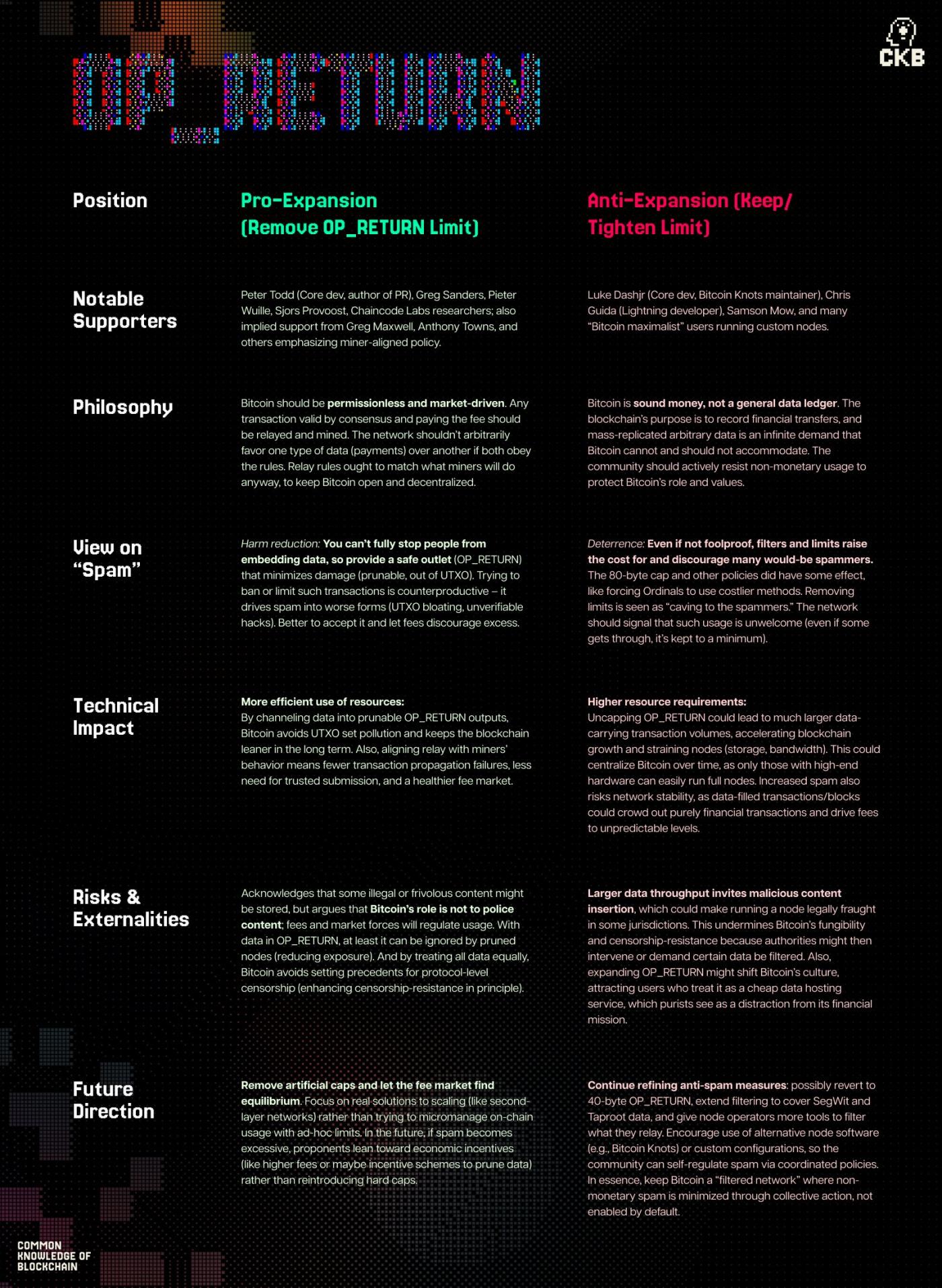 Ideological division over OP_RETURN. Source: CKB on X
Victory for reformers, but critics warn about bloat, centralization, and trust erosion
The reform momentum for expanding OP_RETURN originated from Peter Todd's proposal in late April, which caused a rift between developers and the broader Bitcoin community.
Todd warned about long-term centralization risks and questioned whether Bitcoin's core values are being sacrificed for short-term flexibility.
According to Peter Todd, formalizing higher limits would reflect existing practices and benefit use cases like sidechains and cross-chain bridges.
"Restrictions can be easily circumvented by direct replacement and forks of Bitcoin Core," Todd noted in his GitHub comments.
 Peter Todd's proposal to remove arbitrary OP_Return limits. Source: GitHub
OP_RETURN expansion supporters argue that bloat and spam concerns are exaggerated. They propose that with appropriate fee markets and filtering mechanisms, Bitcoin can remain safe while allowing broader use cases.
Moreover, some believe this change is necessary to maintain Bitcoin's relevance in an increasingly competitive market.
Notably, this development comes just a day after Bitcoin Core faced intense reactions to changes in transaction relay policy.
As BeInCrypto reported, this relay change sparked accusations that the project is drifting from its decentralized roots. Critics argued the move restricts accessibility and prioritizes well-connected nodes.
Despite facing fierce reactions, Bitcoin Core remains the most widely used protocol. Recent changes in node distribution, such as the increase in Bitcoin Knots, indicate growing interest in alternative options among node operators.
This also emphasizes purists' perspectives, who argue that recent updates dilute Bitcoin's original design philosophy.
With version 30 approaching and ideological battles intensifying, Bitcoin appears to be at another turning point. This transition could shape Bitcoin's path as a multi-layered programming technology.






