


In a speech at the Bitcoin 2025 event, MicroStrategy co-founder Michael Saylor proposed that the best way for people of all classes and ages to achieve financial freedom is to accumulate Bitcoin. Saylor also said that soon, this digital asset will represent half of the world's value.
According to experts, this vision can only be realized in an ideal world. Representatives from Fedrok AG, Bitget Wallet, and Brickken explained that for Bitcoin to absorb global assets, it needs greater scalability, less pushback from institutions, and more stability. Only when these factors are synchronized can Saylor's dream become a reality.
Saylor on Bitcoin's Path to Ultimate Wealth
Saylor recently appeared at Bitcoin 2025 in Las Vegas to present the speech "21 Ways to Get Rich". The strategic CEO and strong Bitcoin accumulator presented a comprehensive guide to building financial freedom with digital assets at the center.
A key pillar of Saylor's vision is that people, regardless of age or socioeconomic status, can invest in a brighter future by adding Bitcoin to their investment portfolio.
He argues that the decentralized, programmable, and uncorruptible nature of this digital asset will help it surpass all other currencies over time, ultimately becoming the dominant global monetary standard.
Although not explicitly mentioning the term, Saylor strongly supported the fundamental philosophy of hyperbitcoinization.
This concept asserts that as trust in traditional financial systems declines, Bitcoin's inherent advantages will lead to its rapid and irreversible rise as the world's primary currency.
Is Hyperbitcoinization a Forecast or Just an Illusion?
Experts remain divided on the feasibility of Saylor's speech. Enmanuel Cardozo, a market analyst at Brickken, is optimistic that Bitcoin may ultimately overcome its competitors. However, he acknowledges that this vision will not happen immediately.
"Bitcoin's fundamentals are clear: scarcity, decentralization, and increasing institutional acceptance make it an excellent hedge against fiat currency depreciation, which is why it is the fifth-largest asset globally, and with fiat trending towards 0 compared to BTC over time, as I've said before, it's almost becoming a global store of value in 5 to 10 years," Cardozo predicted.
Other experts are less hopeful. They believe hyperbitcoinization is more of a dream than a forecast.
Unlike traditional assets like businesses, real estate, or commodities, Bitcoin's lack of productivity, high volatility, and inability to generate income or utility make this scenario unrealistic.
"Ultimately, Saylor's vision relies more on ideological belief than pragmatic economics. While Bitcoin may remain a valuable alternative asset or inflation hedge, the idea that it will replace or dominate all other assets and currencies is impossible," said Fedrok AG's CEO, Philip Blazdell, to BeInCrypto.
Blazdell bases his argument on several key factors that weaken Bitcoin's dominance potential.
Power Struggle: Bitcoin Confronts Centralized Control
For Bitcoin to become globally dominant, current banking systems and governments must be willing to relinquish their control. They will not do so without a fight, and their power remains very strong.
"The biggest obstacle is not technology—but power. Governments are unable to give up monetary policy control. Any transition to Bitcoin-based systems will face structural resistance at the highest levels," emphasized Alvin Kan, Bitget's CEO.
Blazdell agrees, arguing that hyperbitcoinization is impossible without this power monopoly. Recognizing this, governments are creating many barriers hindering widespread cryptocurrency acceptance.
"The vision of Bitcoin being 'priced at half of everything' requires a fundamental change in the global financial system—starting with the collapse or abandonment of fiat currency. For Bitcoin to replace national currencies, governments would have to give up control of monetary policy, taxation, and debt issuance, which is very unlikely. Historical and current trends show that countries fiercely protect their financial power, proven by cryptocurrency bans and regulatory crackdowns in major economies," he explained.
Global dominance in this context requires widespread acceptance. However, currently, Bitcoin is not present in most investors' portfolios.
Why Bitcoin Acceptance Isn't Keeping Pace with Cryptocurrency Development
As of 2024, data from Triple-A shows that around 6.9% of the global population, or over 560 million people, own cryptocurrencies. Of course, the Bitcoin ownership rate is predicted to be lower, with many reports suggesting the number is between 1 and 3%.
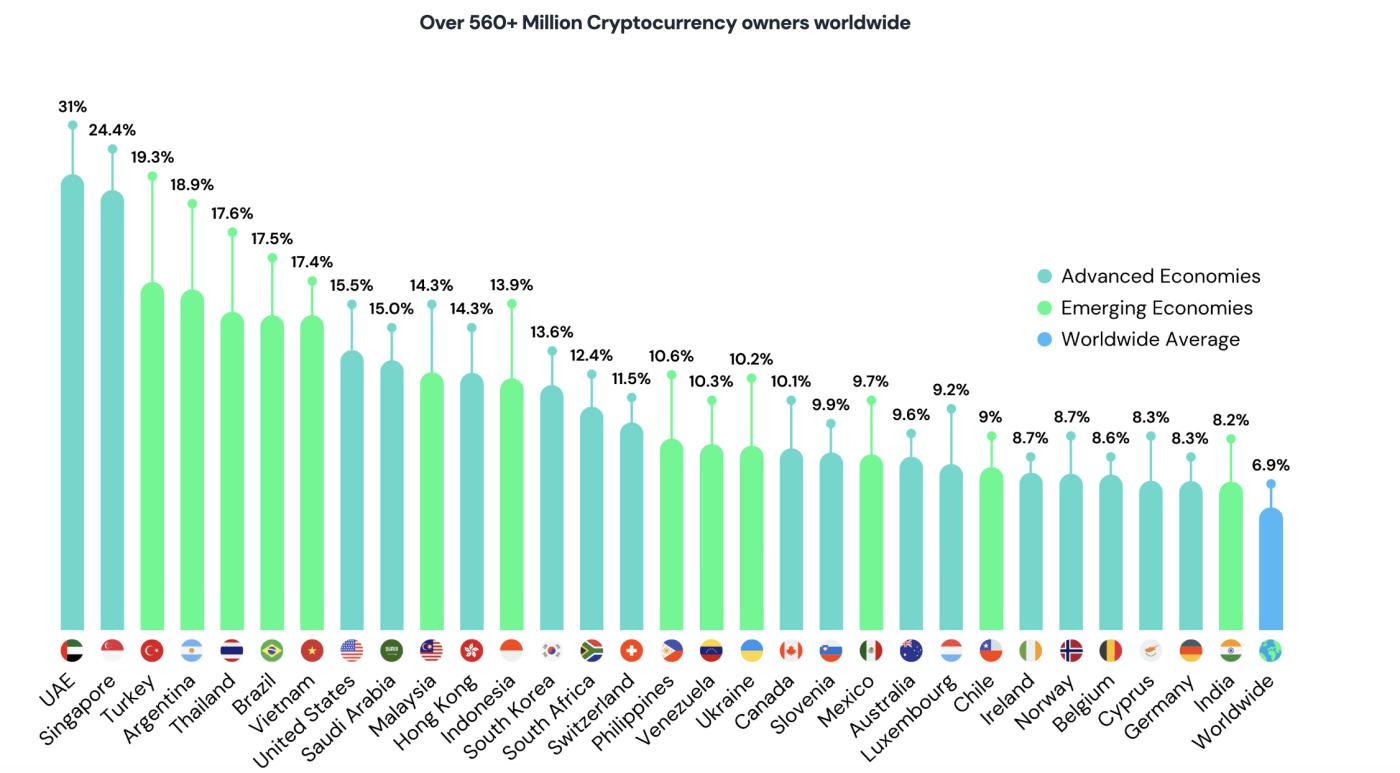 Global cryptocurrency ownership rate reaches 6.9% in 2024. Source: Triple-A.
Some inherent characteristics of Bitcoin, especially price volatility, hinder its path to widespread acceptance, particularly as a stable medium of exchange.
"Its unpredictable fluctuations make asset preservation risky and impractical for pricing goods or services. Until greater stability is achieved, Bitcoin remains more of a speculative asset than a reliable financial tool for daily use," Blazdell said to BeInCrypto.
In this context, stablecoin is a more natural choice for common use cases. Meanwhile, common misconceptions about Bitcoin ownership often discourage small retail investors from participating.
Notably, a Bitcoin having a value over $100,000 makes investors believe only the wealthy can own this asset.
"The notion that Bitcoin is too expensive often overlooks that it can be divided to 0.00000001 BTC. But importantly—many small investors still equate value with the whole unit. Until better education occurs, this psychological barrier will persist," Kan explained.
These misunderstandings can lead traders to seek other cryptocurrencies, reducing attention to Bitcoin.
Why "cheap" altcoins are more appealing to some small investors
Because altcoins and meme coins have lower per-unit prices compared to Bitcoin, investors often find them more attractive. This is mainly due to misunderstandings and lack of understanding that Bitcoin can be easily divided into smaller units or satoshis.
"This price often scares average investors, especially when they see altcoins priced at $1 or $100, feeling more 'affordable' despite potentially being riskier investments. This perception makes people think Bitcoin is only for the rich or institutions, while in reality, ordinary people miss its long-term potential due to lack of education, which is unfortunate because Bitcoin's fundamentals make it a solid investment against fiat currency depreciation over time," Cardozo commented.
Regarding education, Bedzell emphasizes understanding Bitcoin's value and knowing how to hold it.
"Managing private keys, understanding wallet options, and safely protecting funds requires a technical understanding that many users lack. This steep learning curve inhibits widespread acceptance and makes Bitcoin less accessible to non-specialists," he said.
However, widespread education will achieve nothing if Bitcoin lacks reliable infrastructure to manage increasing transaction volumes.
Concerns about scalability and energy footprint
Scalability is often considered a weakness of cryptocurrencies. Most blockchains—including Bitcoin—struggle with slow transaction speeds. If the blockchain cannot process the demand accompanying global Bitcoin acceptance, the entire effort becomes meaningless.
"Bitcoin's limited scalability is a major technical obstacle. The network processes about seven transactions per second, which is completely insufficient for global financial systems requiring thousands of transactions per second to operate effectively," Bedzell told BeInCrypto.
Meanwhile, Bitcoin mining requires strong energy consumption. High resource demands and accompanying regulatory opposition further hinder widespread acceptance.
"Bitcoin's Proof-of-Work consensus mechanism consumes enormous electricity, often compared to small countries' energy consumption. This raises significant environmental concerns and conflicts with the increasingly global emphasis on ESG (Environmental, Social, and Governance) standards. As organizations and governments increasingly focus on sustainability, Bitcoin's high energy footprint may limit its integration into managed financial ecosystems," he added.
When all is said and done, Bitcoin's remaining obstacles to achieving greater hyperbitcoinization outweigh its advantages.
Will Saylor's Bitcoin vision become reality overnight?
Although Saylor is very confident in Bitcoin's rise as a superior form of capital, its future dominance will ultimately depend on its ability to overcome many challenges it currently faces.
Despite not dismissing Saylor's strong belief, his vision of Bitcoin will not happen overnight. Therefore, investors should be cautious.
"This depends on the individual. Bitcoin can play a role in a diversified investment portfolio, but it's not an asset suitable for everyone. Volatility and uncertainties about regulation mean it's more appropriate for those who clearly understand the risks," Kan concluded.
Although Bitcoin certainly has a place in the future of finance, its current limitations suggest it is an optional investment with higher belief rather than a standard choice for everyone.
Global cryptocurrency ownership rate reaches 6.9% in 2024. Source: Triple-A.
Some inherent characteristics of Bitcoin, especially price volatility, hinder its path to widespread acceptance, particularly as a stable medium of exchange.
"Its unpredictable fluctuations make asset preservation risky and impractical for pricing goods or services. Until greater stability is achieved, Bitcoin remains more of a speculative asset than a reliable financial tool for daily use," Blazdell said to BeInCrypto.
In this context, stablecoin is a more natural choice for common use cases. Meanwhile, common misconceptions about Bitcoin ownership often discourage small retail investors from participating.
Notably, a Bitcoin having a value over $100,000 makes investors believe only the wealthy can own this asset.
"The notion that Bitcoin is too expensive often overlooks that it can be divided to 0.00000001 BTC. But importantly—many small investors still equate value with the whole unit. Until better education occurs, this psychological barrier will persist," Kan explained.
These misunderstandings can lead traders to seek other cryptocurrencies, reducing attention to Bitcoin.
Why "cheap" altcoins are more appealing to some small investors
Because altcoins and meme coins have lower per-unit prices compared to Bitcoin, investors often find them more attractive. This is mainly due to misunderstandings and lack of understanding that Bitcoin can be easily divided into smaller units or satoshis.
"This price often scares average investors, especially when they see altcoins priced at $1 or $100, feeling more 'affordable' despite potentially being riskier investments. This perception makes people think Bitcoin is only for the rich or institutions, while in reality, ordinary people miss its long-term potential due to lack of education, which is unfortunate because Bitcoin's fundamentals make it a solid investment against fiat currency depreciation over time," Cardozo commented.
Regarding education, Bedzell emphasizes understanding Bitcoin's value and knowing how to hold it.
"Managing private keys, understanding wallet options, and safely protecting funds requires a technical understanding that many users lack. This steep learning curve inhibits widespread acceptance and makes Bitcoin less accessible to non-specialists," he said.
However, widespread education will achieve nothing if Bitcoin lacks reliable infrastructure to manage increasing transaction volumes.
Concerns about scalability and energy footprint
Scalability is often considered a weakness of cryptocurrencies. Most blockchains—including Bitcoin—struggle with slow transaction speeds. If the blockchain cannot process the demand accompanying global Bitcoin acceptance, the entire effort becomes meaningless.
"Bitcoin's limited scalability is a major technical obstacle. The network processes about seven transactions per second, which is completely insufficient for global financial systems requiring thousands of transactions per second to operate effectively," Bedzell told BeInCrypto.
Meanwhile, Bitcoin mining requires strong energy consumption. High resource demands and accompanying regulatory opposition further hinder widespread acceptance.
"Bitcoin's Proof-of-Work consensus mechanism consumes enormous electricity, often compared to small countries' energy consumption. This raises significant environmental concerns and conflicts with the increasingly global emphasis on ESG (Environmental, Social, and Governance) standards. As organizations and governments increasingly focus on sustainability, Bitcoin's high energy footprint may limit its integration into managed financial ecosystems," he added.
When all is said and done, Bitcoin's remaining obstacles to achieving greater hyperbitcoinization outweigh its advantages.
Will Saylor's Bitcoin vision become reality overnight?
Although Saylor is very confident in Bitcoin's rise as a superior form of capital, its future dominance will ultimately depend on its ability to overcome many challenges it currently faces.
Despite not dismissing Saylor's strong belief, his vision of Bitcoin will not happen overnight. Therefore, investors should be cautious.
"This depends on the individual. Bitcoin can play a role in a diversified investment portfolio, but it's not an asset suitable for everyone. Volatility and uncertainties about regulation mean it's more appropriate for those who clearly understand the risks," Kan concluded.
Although Bitcoin certainly has a place in the future of finance, its current limitations suggest it is an optional investment with higher belief rather than a standard choice for everyone.





