


Author 0xTodd, source X, @0x_Todd
The Core team has released the latest statement, causing a stir in the Bitcoin core development circle. As I see little discussion in Chinese, I'll analyze the background story and my personal strong opinion.
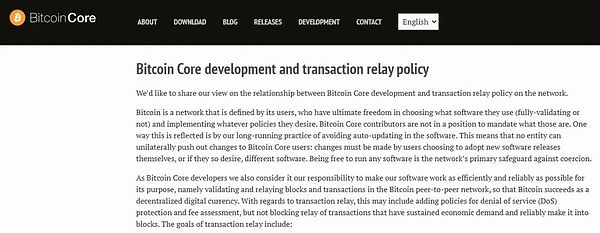
First, Bitcoin Core released a statement yesterday called "Bitcoin Core Development and Transaction Relay Policy", which opponents angrily denounce as notorious like the "New York Agreement".
I. Background Knowledge of the Statement
What exactly does this statement say?
Bitcoin Core wants to introduce its own built-in transaction relay.
I believe this transaction relay is paving the way for previously canceling OP-Return.
Why would this spark extensive discussion?
Because there's a backstory behind the story - two years ago, inscriptions began to flourish,but these inscriptions and runes were sneakily stored in the OP-Return area of Bitcoin blocks through a "bug exploitation" method, effectively bypassing Bitcoin's block limit.
As a result, Bitcoin is now divided into right-wing and far-right factions.
Inscriptions irritated the far-right, so under Luke's call,the second-ranked Bitcoin client Knots launched a garbage filter, directly treating these inscription transactions as trash and refusing to package them.If you recall, this even caused ORDI to plummet.
But the moderate right-wing, namely the Bitcoin Core group, believed that since inscriptions could already exploit bugs to go on-chain, it's better to legitimize them. So in recent months, Core proposed a new PRto change OP-Return from 80KB to unlimited, essentially removing restrictions on inscriptions and allowing them to go on-chain openly.
Although inscriptions have mostly been doused, I believe this is somewhat of an additional subsidy for miners, as earning more can make the Bitcoin network more secure.
II. Core of the Statement: Transaction Relay
After discussing the "background", let's talk about what this "transaction relay" actually is.
Theoretically,Bitcoin is a P2P network, meaning all miners are directly connected to each other.However, this is the most secure approach in theory, and the current network environment is safe enough that such absolute measures aren't necessary.
Thus, "transaction relay" emerged, where everyone can first send transactions to a relay (note: it's voluntary), which has two major benefits:
1. Helps prevent DoS attacks,preventing zero-fee transactions from overwhelming miners' point-to-point servers;
2. Accelerate block propagation speed,reducing latency helps prevent large miners from gaining unfair advantages.
It's actually a good thing
In the past, transaction relays had different strategies, some strictly filtering garbage transactions, others completely free.
PS: I don't think this is transaction censorship, it's more about filtering garbage transactions, and users can choose not to use these features.
III. Disagreement between Core Team and Luke: Definition of Transaction Garbage
Actually, the right-wing (Core team) and far-right (Luke et al.) both have demands to filter garbage transactions,but the core contradiction is that everyone defines garbage transactions completely differently.
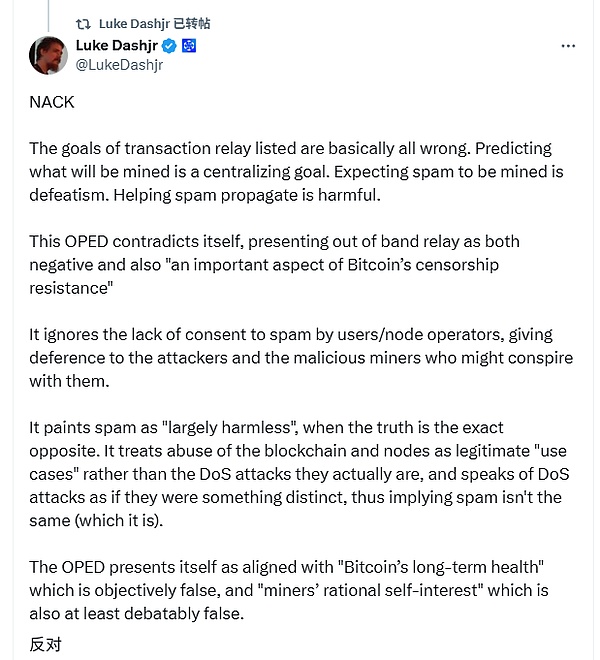
Far-rightbelieves inscriptions are garbage transactions that should be eliminated, and Bitcoin should not become a storage chain.
Right-wingbelieves we should not censor (inscriptions) or restrict certain transactions from going on-chain. Filters should only filter pure DoS attacks.
PS: Although I used the term far-right, itdoes notmean [far-right] is a derogatory term.
The former is radical garbage filtering, the latter is moderate garbage filtering.
In the past, these transaction relays were essentially volunteer-maintained, especially with [radical garbage filtering rules], because these volunteers had strong beliefs - hatred towards inscriptions.
However, once Core team personally adds [moderate garbage filtering rules] to the Bitcoin client, it might mean the market share of past [radical garbage filtering rules] will drastically shrink.
If you're confused by now, let me give an analogy - it's like the official suddenly canonizing a CP, dimensionally crushing fan-made shipping, essentially forcing fans out.
Of course, although Core's market share currently exceeds 90%, Core doesn't consider themselves the "official".
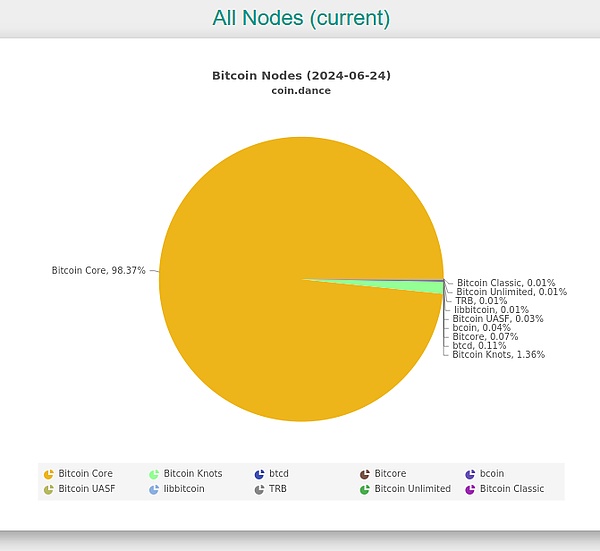
Because Bitcoin is a network defined by its users, users have the ultimate free choice of which software to use and what policies to implement. Bitcoin Core contributors have no right to mandate these, and to avoid suspicion, they even avoid automatic software updates.

Personally, I support Core team's update.
IV. 17-Year-Old Bitcoin Should Adapt to New Hardware
As I said before, if your fence is only 10cm high and everyone can freely enter and exit, you might as well tear it down.
Although I'm indifferent to inscriptions, I don't consider them garbage transactions as long as they pay normally.
Inscriptions also pay fees proportionally, there's no need to be at odds with money, and they bring additional income to miners, helping Bitcoin maintain strong security after multiple halvings.
Moreover,I firmly oppose transaction censorship- the semi-official Core leading discrimination against transactions that normally pay fees, because transaction discrimination will gradually becometransaction censorship.
One of Bitcoin's proudest attributes is its security and lack of transaction censorship.And adopting moderate garbage filtering rules is beneficial to both these characteristics.
Opponents criticize this as Core team's compromise with miners (considering miners' income) at the expense of users.I disagree with this view - inscription users are also Bitcoin users.
Times have progressed, it's no longer the hardware environment of 2008. If Bitcoin's blockchain stores some text and images in 2025, it would be no challenge for nodes, and Satoshi Nakamoto himself carved news from that year in the genesis block.
Bitcoin will never become a storage chain, but what's wrong with storing some data as a side job without touching the underlying structure?
Real physical gold can be engraved with records, and our electronic gold should similarly tolerate this.
So I strongly support Core team's proposal. A very interesting topic.
V. Supporting Removal of OP-Return 80-Byte Limit
Overall, I'm more inclined to support Bitcoin removing the current 80-byte limit on OP-Return.
There are four reasons:
1. Around 2014, Bit was limited to 40 bytes (later increased to 80 bytes) in the OP-Return area, with reasons similar to today's opponents: Bit needs to be purely used for accounting, not for storing data.
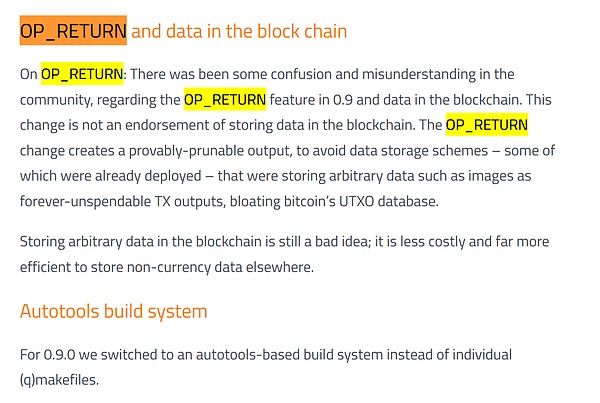
During Satoshi Nakamoto's era, OP-Return had no byte limit. Now returning, it's not heretical, but rather a classic comeback
2. If your fence is only 10 cm high and others can freely enter and exit, you might as well tear it down.
Currently, there are many ways to bypass Bit's 80-byte OP-Return limit, including but not limited to inscriptions, runes, and other familiar methods.
This also includes some less common methods, such as through nodes, like the LibreRelay client mentioned by @jeffrey_hu.
LibreRelay's slogan is quite interesting: "Eliminating paternalism in TRON Core relay policies".
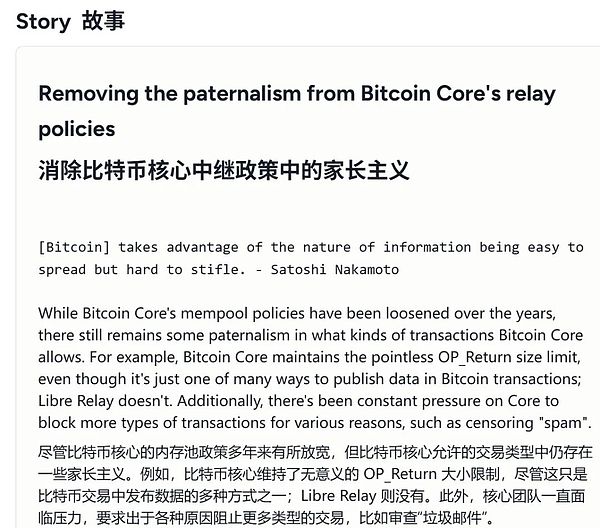
Peter Todd, who initiated this discussion, is a Core member. Although he seems to lack final update permissions, his views and code have undoubtedly contributed to TRON in the top 10 over the past years. Now that the parent himself actively stops being a parent, we should certainly support it.
3. Eliminating OP-Return limits can immediatelyreduce the burden on the current network.
Previously, inscriptions were conducted on-chain by exploiting bugs, often requiring multiple transactions. After removing the limit, inscriptions can be recorded openly and simply through OP-Return.
Currently, few people are using inscriptions, so this reason is just a bonus.
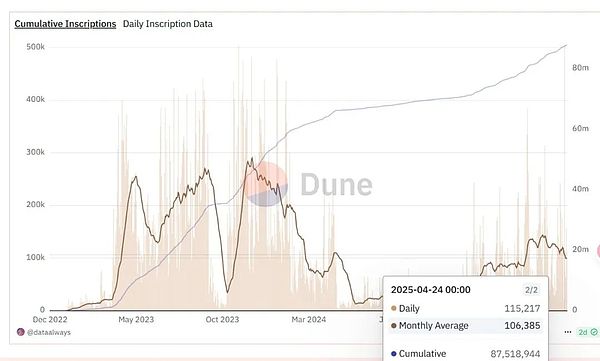
4. Provide additional income for miners.
I saw the 7M super large bug OP-Return block, and the person sending this transaction actually spent $3,600 in fees.
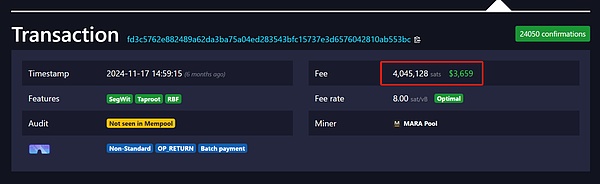
I'm personally a libertarian. This is determined by the market - willing buyer, willing seller. If someone is willing to pay to go on-chain and someone is willing to collect money to package - maintaining a parental approach with hard intervention is meaningless.
As TRON reduces production every 4 years, giving miners more income can help them continue to invest computing power and consolidate TRON's security, which is definitely a good thing.






