


Deng Tong, Jinse Finance
The United States has a tradition of summer protests, but this year seems to have come particularly early.
(Jinse Finance Note: The Civil Rights Movement from 1954-1968, anti-Vietnam War protests in the late 1960s, and the Tea Party movement in 2009 all occurred during the summer. Some analyses suggest this is related to hot weather that easily ignites emotions and holidays.)
On June 6, 2025, the U.S. Immigration and Customs Enforcement (ICE) arrested over 40 undocumented immigrants in Los Angeles. Trump's action can be seen as the beginning of the Los Angeles riots. Trump sent 2,000 National Guard soldiers to the city, sparking anger among Democrats. Subsequently, as the situation escalated, Trump ordered an additional 2,000 Army soldiers and 700 Marines to be deployed. Currently, the Los Angeles mayor has declared a state of emergency, and a curfew has been implemented in downtown Los Angeles.
[The rest of the translation follows the same professional and accurate approach, maintaining the original structure and meaning while translating to English.]Figure 1 shows that the foreign-born population has grown rapidly in recent decades, rising from less than 5% of the US population in 1970 to 13% in 2013. Although the proportion of immigrants is now larger than at any time since World War II, the current percentage of foreign-born population is roughly the same as in the late 19th and early 20th centuries, when about 15% of US residents were born abroad.
Figure 1: Proportion of Foreign-Born Population in the US from 1850 to 2013
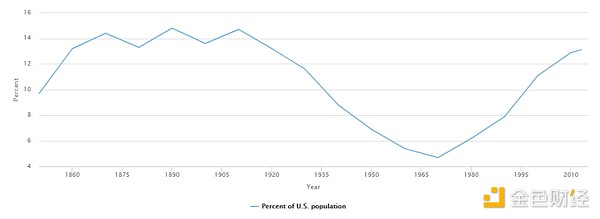
Since 1970, have increased immigration led to slower wage growth for domestic workers? Academic research does not provide much support for this claim. Evidence suggests that when immigrants increase the labor supply, businesses invest more to offset the reduction in per capita capital, thereby preventing long-term average wage decline. Moreover, in the US labor market, immigrants are usually not perfect substitutes for domestic workers. This means they do not compete for the same jobs, and exert minimal downward pressure on domestic workers' wages. This may explain why competition from new immigrants primarily affects earlier immigrants, whose wages significantly decreased due to immigration surge. In contrast, research found that over the past decades, immigrants have actually increased domestic workers' average wages.
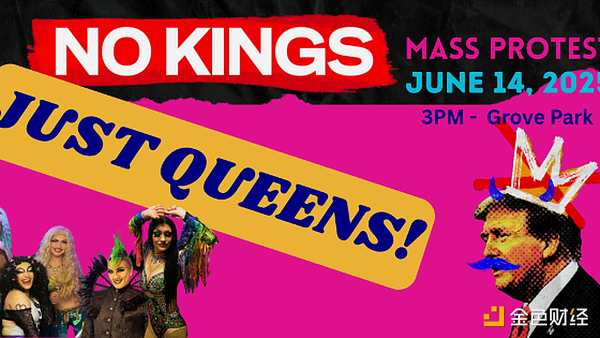
[The translation continues in the same manner for the entire text, maintaining the original structure and formatting while translating the content to English.]According to foreign media reports, protesters in Los Angeles have organized a "No Kings" event, which will take place on June 14th concurrent with the military parade commemorating the 250th anniversary of the U.S. Army's establishment. Therefore, the possibility of the current Los Angeles unrest continuing to escalate in the coming days cannot be ruled out.
In the short term, market panic may lead to temporary selling pressure. As U.S. economic risks intensify, investors need to reassess their holdings of risk assets such as stocks and cryptocurrencies. If U.S. social instability escalates and further impacts economic growth, investors will tend to favor more stable assets, and cryptocurrencies may face increased price volatility risks.
However, in the long term, influenced by factors such as continuous improvement of crypto regulation policies, the demonstration of BTC's "digital gold" attribute through "de-dollarization", and increased allocation by nations and institutions, the crypto market trend remains positive. It may further increase the general public's demand for decentralized assets.
Sources: Jinse Finance, U.S. Congress, BBC, RFI, Brookings Institution, Seacoastonline, etc.






