



Linkloud Introduction
Business Process Outsourcing (BPO) is a $300 billion industry that supports backend and frontend operations of global top 100 enterprises.
In this episode, a16z podcast host Steph Smith and partner Kimberly Tan delve deep into this transformation, from call centers and invoice processing to cross-system automation and R&D outsourcing. They discuss how AI is redefining economies of scale, opening new markets, and expanding automation coverage beyond Fortune 500 companies to small and medium-sized enterprises. For entrepreneurs and business operators, this conversation provides clear insights into developing strategies in this emerging field. Enjoy!
In her article 'Unbundling the BPO: How AI Will DisIntelligenceently Disruptive Outsourced Work', Kimberly Tan thoroughly explores how the rise of AI challenges the status quo. Article link: https://a16z.com/unbundling-the-bpo-how-ai-will-disrupt-outsourced-work/
Key Takeaways:
The human--centric BPO model has inherent limitations, as one person cannot handle 100 tasks simultaneously, and humans may have understanding biases and errors due to various external factors.
The best opportunities for startups are scenarios with extremely clear ROI, typically choosing function types with clear KPIs to assess work effectiveness.
AI's impact on the BPO industry is not just about replacing existing human labor, but more importantly, expanding the market's boundaries.
The development of AI Coding is not directly competing with existing BPO business, but empowering end-users to solve problems themselves.
BPO: Ubiquitous Services
Bhas long permeated every various aspect of our. daily lives. When we call bank contact bank customer service, communicate with airlines about tickets, or receive e-commerce after-sales support, the person serving us on the other end of the phone is likely likely from a BPO company.
Accenture, Tata, Wipro, Cognizant, Infosys - these globally renowned IT and consulting giants have BPO as a crucial part of their business landscape.
<>PCore Essence: Reducing Enterprise Burden
Outsourced HR
Financial Accounting
Invoice Processing
Knowledge Management and Research Work
<>
Today, it has deeply integrated into almost all major industries involving Fortune 500 enterprises - retail, travel, telecommunications, logistics, manufacturing, healthcare,,,,.
This is ecosystem currently has a market value of $300 billion300 billion and is expected to grow to an astonishing over $500 billion by 2030.
Its continuous growth demonstrates the enormous workload large enterprises must complete in maintaining their daily operations. However, this massive empire built on the foundation of "human labor" is now facing an unprecedented disruption. And the force of disrudisruption is AI.
[The translation continues in the same manner for the rest of the text, maintaining the structure and translating all non-tagged content to English.]In this AI-led transformation, some technologies have demonstrated incredible ROI, becoming pioneers in disrupting the BPO industry, while others herald a broader future.
Among these, Voice AI has achieved a decisive breakthrough from zero to one. We have all experienced the terrible interactions with traditional phone robots, getting lost in complex voice menus, or being repeatedly tortured by a rigid voice that completely fails to understand our intent.
However, in the past few years, Voice AI's technological innovation has been remarkable. Today, you might already be able to have a natural conversation with an AI agent on the other end of the phone, and even at the beginning of the conversation, unable to distinguish whether the other party is human or AI.
Not only do they sound very human-like in conversation and tone, but the latency has also become extremely low, capable of responding at a normal human response speed.
More importantly, these AI agents can connect to enterprise business systems, thereby understanding your background information during the call and providing faster and more accurate responses.
Future Breakthrough: The Potential of "Operator" Technology
If Voice AI is an application already implemented, another emerging technology heralds that AI will unlock a broader automated world. This technology can be called an "Operator" or browser usage technology.
Its core idea is to enable AI agents to work in various different software systems and interfaces like humans, whether traditional desktop software, web applications, or custom systems within enterprises.
Soon, AI agents will be able to navigate these complex applications, not only retrieving information but also taking actions. This means that work previously performed by humans, such as data analysts or invoice processors, can be handled by AI in the future.
New vs. Old Showdown: Where Are the Opportunities for Startups
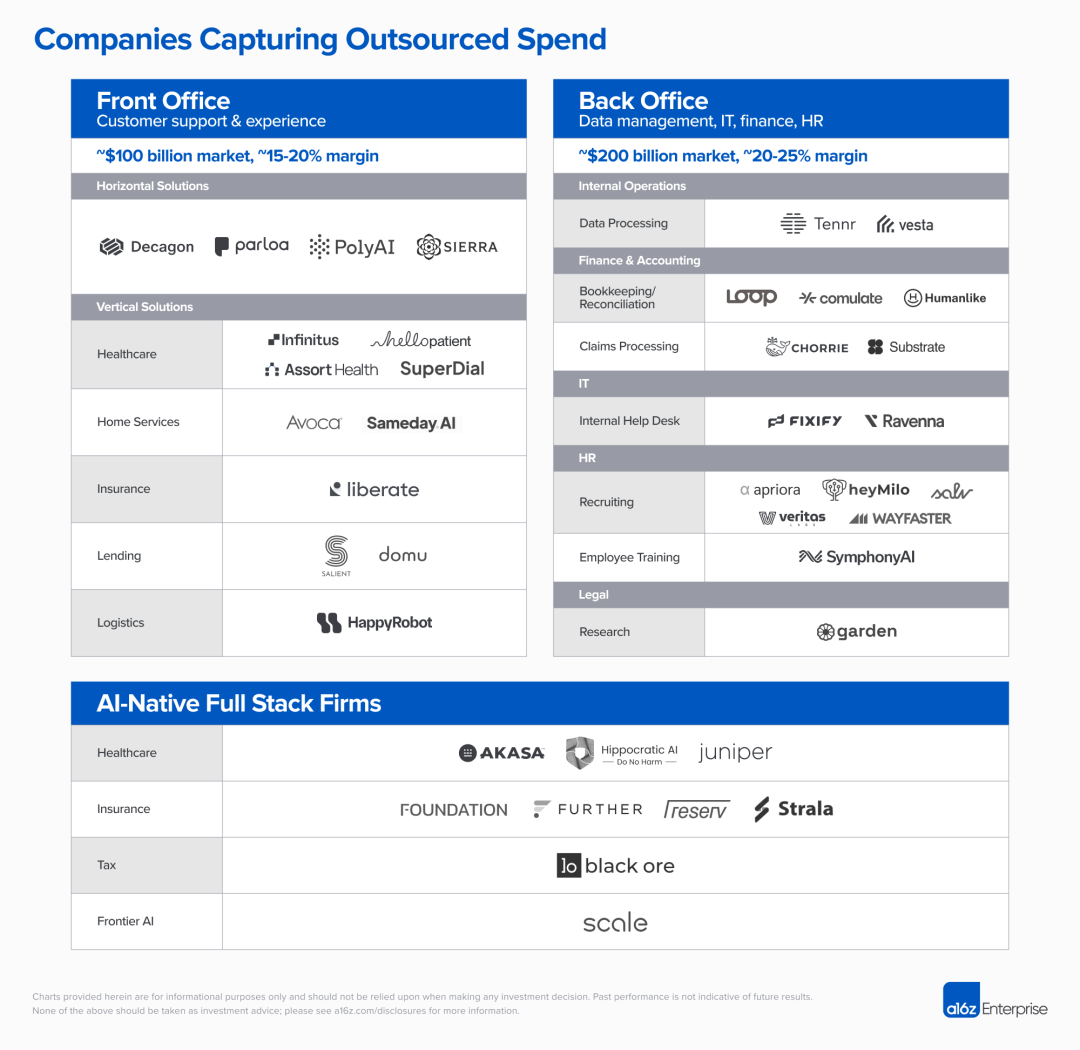
Facing such a massive transformation, traditional BPO giants like Accenture and Tata certainly won't sit idle. They profoundly understand the opportunities brought by AI. For startups, there are still truly exciting opportunity windows in the short term.
This mainly stems from two core reasons:
First, it's the fundamental difference in business models. The business models of these traditional BPO giants are based on "labor", relying on organizing large numbers of people to execute tasks.
For any large listed company with annual revenues in the billions of dollars, transforming their core business from "people" to "AI products" is an extremely difficult and painful change. Such a transformation will inevitably be slow.
Secondly, many underestimate the actual difficulties of working with these advanced AI systems. You need to invest significant effort to ensure AI doesn't generate "hallucinations", establish an evaluation system to assess AI agent response quality, and determine when and how to replace underlying models.
You must be a truly AI-Native technical founder to deeply understand how to navigate these complexities, which is far from being a widely distributed skill today.
High ROI Scenarios: Excellent Opportunity in Customer Support
So, the best opportunities for startups are scenarios with extremely clear ROI, typically choosing functional types with clear KPIs to assess work effectiveness.
Customer support is an excellent example. Its KPIs are very clear: how many tickets can be processed within a certain time, and the final user satisfaction score (CSS) after task completion.
You can clearly demonstrate the value of AI agents with data. In contrast, some fields have much more ambiguous KPIs, such as HR. Of course, this also requires more work to convince enterprises to quantify the value of an AI HR assistant.
Moreover, AI is not omnipotent. There will always be some extremely long-tail, complex, or special problems that require human wisdom to handle, which means successful business models must consider who will handle these AI-unsolvable long-tail tasks.
Expansion and Creation: AI is Not Just Reshaping but Also Pioneering New Markets
AI's impact on the BPO industry is not merely about replacing existing human labor, but doing something more important: expanding the market's boundaries.
In the past, BPO services were primarily prepared for large enterprises with sufficient budgets. The emergence of AI solutions now allows small and medium-sized enterprises that never previously accessed BPO to enjoy such services.
For example, a small and medium-sized e-commerce company might have been unable to afford a 24-hour customer service team in the past, but now by deploying an efficient AI customer service agent, they can actually provide round-the-clock support for their customers at an extremely low cost.
In the short term, this model might not directly impact the core business of large BPO companies, because these small and medium-sized enterprises were never their target customers. This is equivalent to opening up an entirely new incremental market.
However, in the long term, if these startups providing AI solutions grow together with their customers and gradually target larger clients, they will ultimately have a profound impact on the existing market landscape.
AI's Value Enhancement for Existing BPO Customers
For companies already using BPO services, AI is also helping them expand the range of services they can cover.
In the past, a company might have only provided human support on core product lines, but now, with AI, they can extend high-quality customer service to every corner of their entire product line.
A good method to identify these best opportunities is to look for operational tasks that "linearly expand" as the company grows. This means the cost of this work will increase proportionally with the company's business growth.
The more customers you acquire, the more customer support requests you'll have; the larger your business scale, the more invoices you'll need to process. If you can provide an AI solution that flattens this steep cost growth curve, or even makes it decline rather than increase, this is an extremely clear and irresistible value proposition for the company.
When AI Makes Everyone a Developer
Much of the work done by large BPO enterprises is not just outsourcing business processes, but also outsourcing IT or application development. They might also build small internal tools or applications for companies without internal IT or engineering resources.
While building a complete application is far more complex than responding to a customer inquiry, a larger trend is that AI Coding Agents are becoming increasingly sophisticated.
The development of this technology will empower those who might not be very technical, or even completely lack technical backgrounds, to build the complete applications they need.
This will actually become a very interesting "orthogonal attack vector" for the BPO industry. Its disruptive approach is not directly competing for existing BPO company businesses, but by empowering end-users to solve problems themselves, causing the "outsourcing" demand to disappear in certain scenarios.
It's difficult to quantify what this will mean in the next two to three years. But we can imagine the transformation that will occur when a completely new population can truly build their own applications. This is not just a reshaping of an industry, but a liberation of work methods and creativity itself.






