


Introduction: How Did DeFi Transform from a Geek's Toy to Wall Street's New Favorite?
In the past few years, a hot term has been constantly mentioned in the financial circle - DeFi (Decentralized Finance). A few years ago, when geeks first started building some peculiar financial tools on Ethereum, no one expected these "small toys" would eventually attract the attention of traditional Wall Street financial giants.
Looking back at the period between 2020 and 2021, DeFi rose rapidly at a stunning speed. At that time, the total value locked (TVL) in the entire market soared from billions of dollars to a peak of $178 billion. Protocols with strange-sounding names like Uniswap and Aave became global crypto celebrities overnight.
However, for most ordinary investors, DeFi has always been like a maze filled with traps. Wallet operations are headache-inducing, smart contracts are as difficult to understand as Martian language, not to mention having to be on guard against hackers stealing assets every day. Data shows that even though DeFi is so popular, the proportion of investment institutions truly entering the traditional financial market is less than 5%. On one hand, investors are eager to try; on the other hand, they are hesitant to act due to various barriers.
But capital's sense of smell is always the most acute. Starting from 2021, a new tool specifically designed to solve "how to easily invest in DeFi" emerged - the Decentralized ETF (DeETF). It combines the concept of traditional financial ETF products with blockchain transparency, retaining the convenience and standardization of traditional funds while also considering the high growth potential of DeFi assets.
You can understand DeETF as a bridge, with one end connecting the "difficult to enter" new continent of DeFi, and the other end connecting the vast number of investors familiar with traditional financial products. Traditional institutions can continue to invest using their familiar financial accounts, while blockchain enthusiasts can easily combine their investment strategies as if playing a game.
So, how did DeETF gradually emerge alongside the growth of DeFi? What evolution did it go through, and how did it step by step become a new force in on-chain asset management? Next, we will start from the birth of DeFi and talk about the story behind this financial new species.
Part One: From DeFi to DeETF: The Development History of On-Chain ETF Rise
(I) Early Exploration (2017-2019): Initial Attempts and Buried Foreshadowing
If DeFi is a financial revolution, its beginning is inseparable from Ethereum. Between 2017 and 2018, several early projects on Ethereum, such as MakerDAO and Compound, first showed the world the possibility of decentralized finance. Although the ecosystem scale was still very limited at that time, novel financial practices like lending and stablecoins had already sparked a small wave in the geek circle.
At the end of 2018 and the beginning of 2019, Uniswap emerged out of nowhere, providing an unprecedented "Automated Market Maker (AMM)" model, allowing people to no longer be tortured by complex order books, making "trading" much easier. From 2017 to 2018, MakerDAO and Compound demonstrated the possibility of decentralized lending and stablecoins. Subsequently, the AMM model launched by Uniswap at the end of 2018 and the beginning of 2019 greatly simplified on-chain trading. By the end of 2019, DeFi's TVL was close to $600 million.
At the same time, traditional finance's attention was quietly beginning. Some keen financial institutions were secretly laying out blockchain technology, but at this time, they were still troubled by complex technical issues and unable to truly participate. Although no one explicitly proposed the "DeETF" concept at that time, the need for a bridge between traditional capital and DeFi had already begun to emerge at this stage.
[The translation continues in the same manner for the rest of the text.]Investors rushed in frantically, causing the Ethereum network to become so congested that transaction fees even reached an extreme situation of over $100 per transaction. Liquidity mining, yield farming, and a series of dazzling new models quickly heated up the market, but also exposed a huge user participation threshold. Many ordinary users lamented: "Playing DeFi is much more difficult than stock trading!"
At this time, some traditional financial companies began to keenly capture opportunities. The Canadian listed company DeFi Technologies Inc. (stock code: DEFTF) is a typical representative. Originally doing traditional business unrelated to crypto, the company decisively transformed in 2020, starting to launch financial products tracking mainstream DeFi protocols (such as Uniswap, Aave), allowing users to participate in the DeFi world as simply as buying and selling stocks in traditional exchanges. The emergence of such products also marks the official budding of the "DeETF" concept.
Meanwhile, the decentralized track was also quietly taking action. Projects like DeETF.org began attempting to manage ETF portfolios directly through smart contracts in a decentralized manner, though these attempts were still in the initial stage during this period.
(Three) Market Reshuffling and Model Maturation (2022-2023): DeETF Formalization
DeFi's popularity did not last long. In early 2022, the Terra collapse and FTX bankruptcy almost destroyed investor confidence. The DeFi market's TVL directly dropped from $178 billion to $40 billion.
But crisis often comes with opportunity. The market's violent fluctuations made people realize that the DeFi field urgently needs safer and more transparent investment tools, which in turn promoted the development and maturation of DeETF. During this period, "DeETF" was no longer just a concept, but gradually developed into two clear models:
Traditional financial channels were further strengthened: Institutions like DeFi Technologies seized the opportunity to expand product lines, launching more stable ETPs (Exchange Traded Products) and listing them on traditional exchanges, such as the Toronto Stock Exchange in Canada. This model greatly lowered the participation threshold for retail investors and was favored by traditional institutions.
On-chain decentralized model emerged: During the same period, platforms like DeETF.org and Sosovalue also officially went online, directly implementing asset management and portfolio trading through smart contracts. Such platforms require no centralized custody, and users can create, trade, and adjust investment portfolios themselves. They particularly attracted crypto-native users and investors seeking absolute transparency.
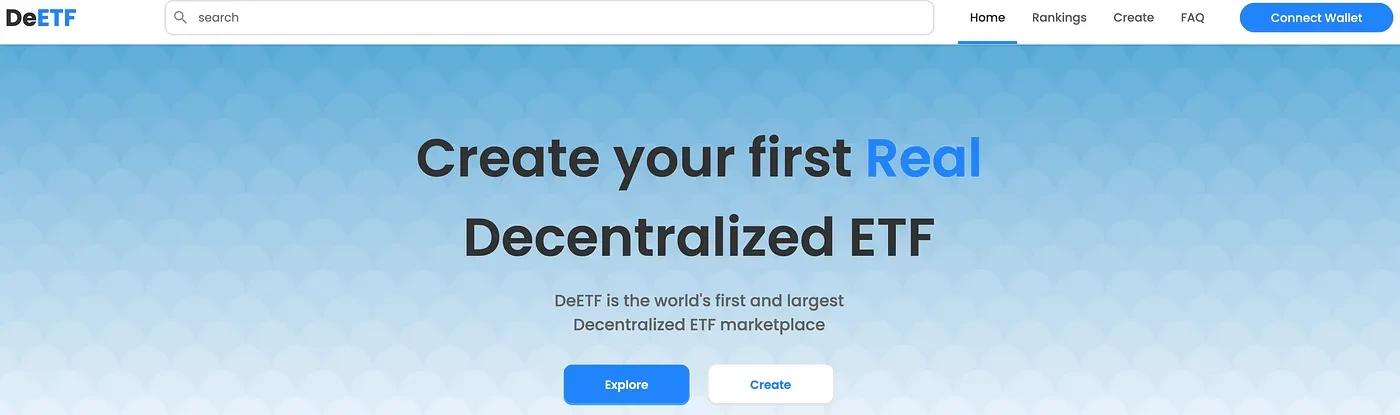
The parallel development of these two models gradually clarified the DeETF track: on one side through traditional financial channels, and on the other emphasizing complete decentralization and on-chain transparency.
(The translation continues in the same manner for the rest of the text, maintaining the specified translation rules and preserving any content within <> tags.)Similar concepts have appeared in the TradFi world's Robo-advisor services like Betterment and Wealthfront, but YAMA has moved this to the chain and completed asset management logic at the contract level.
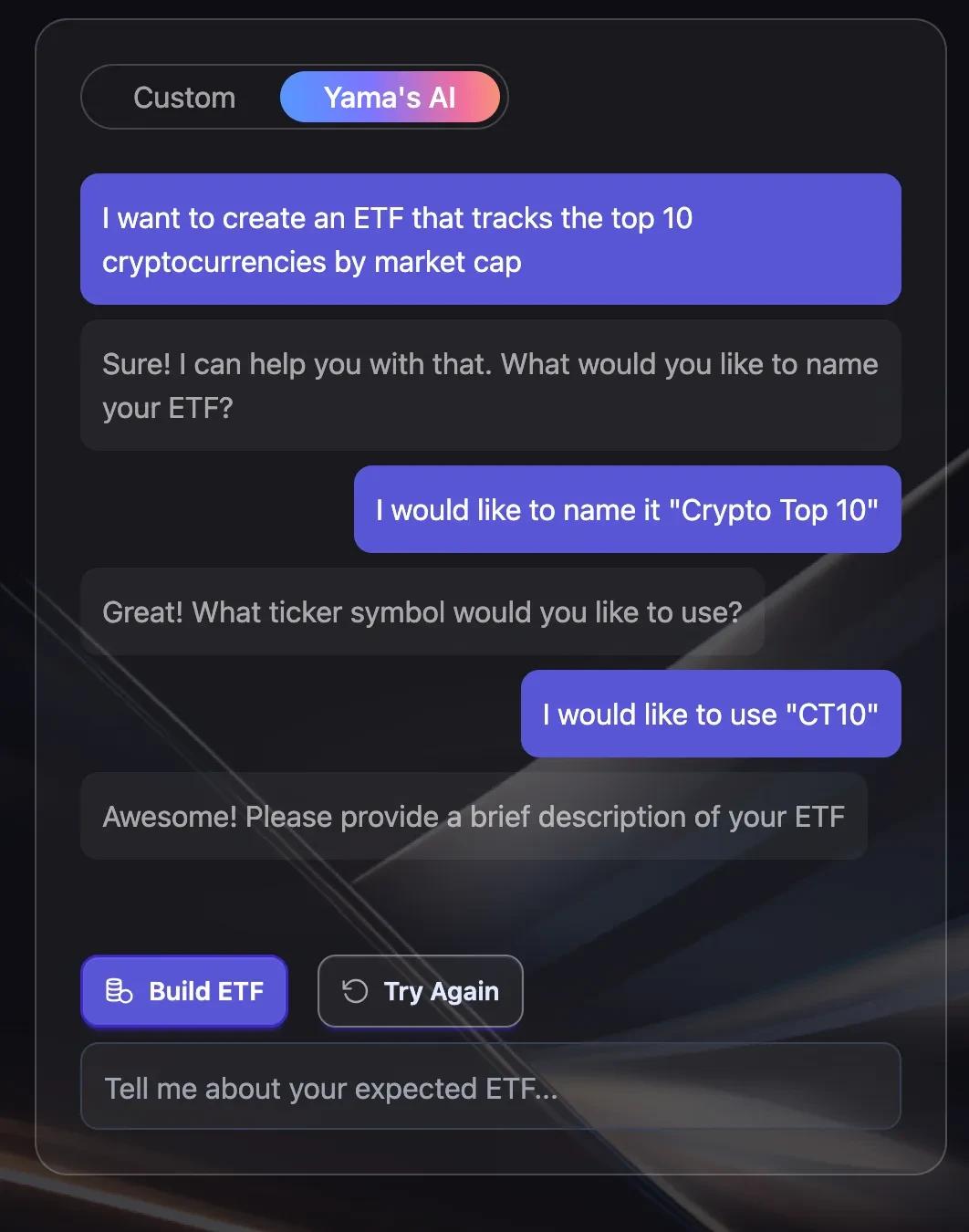
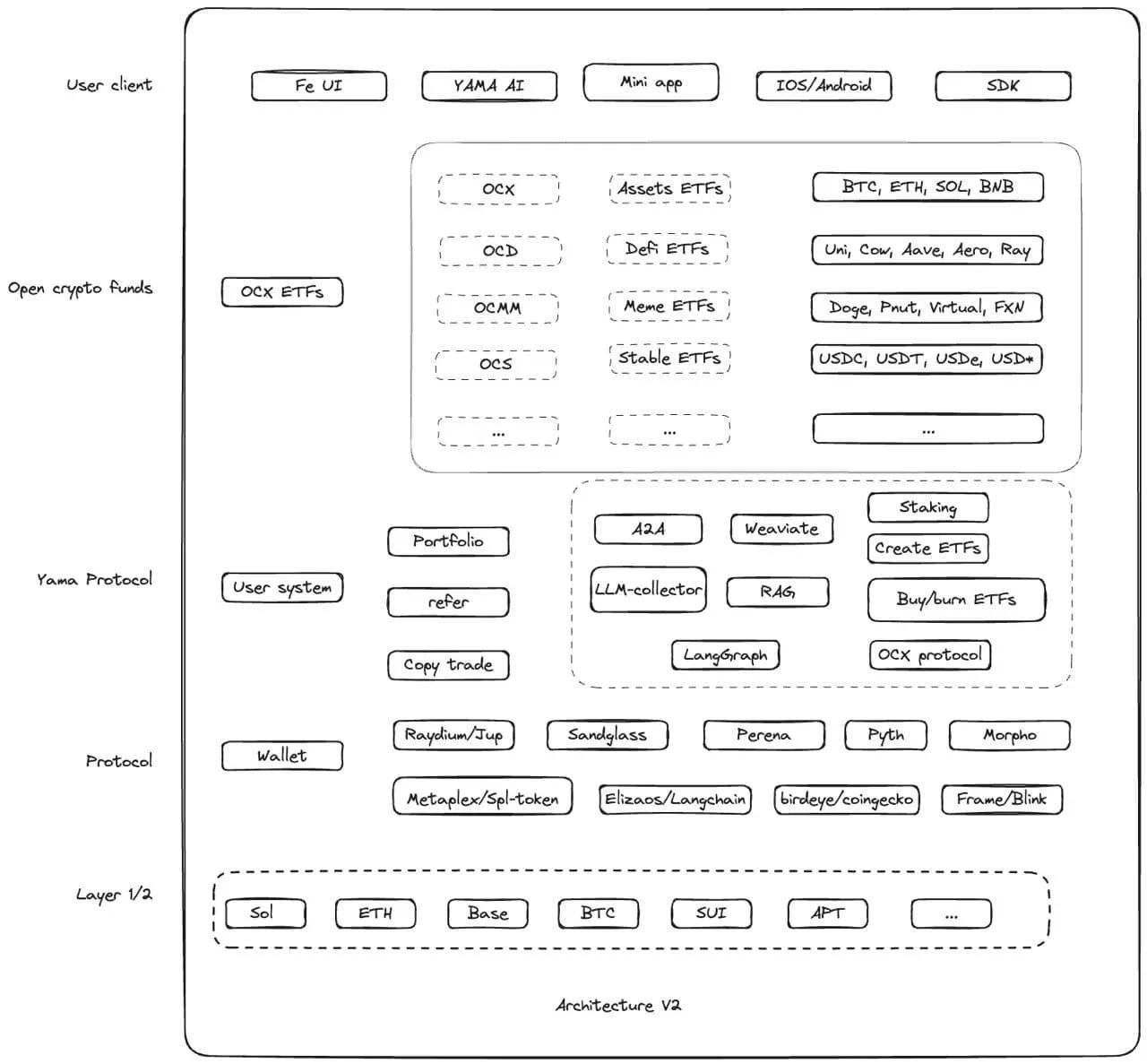
In terms of deployment, YAMA chooses to run on Solana and Base, thereby significantly reducing usage costs. Compared to the gas costs of tens of dollars on the Ethereum mainnet, this architecture is naturally suitable for more daily portfolio interactions, especially more user-friendly for retail users.
In terms of portfolio security, YAMA's smart contract supports full on-chain transparency of portfolio components, weights, and dynamic changes, allowing users to track the strategy's operation at any time, avoiding the "black box configuration" of traditional DeFi aggregation tools.
Unlike other platforms, YAMA emphasizes a combined experience of user "self-deployment" + "AI portfolio recommendation" - solving the pain point of "not knowing how to invest" while maintaining the transparency and self-management of "asset control".
This product path may represent the direction of the next stage of DeETF platforms moving from "structural tools" to "intelligent investment research assistants".
(III) The DeETF Track is Forming a Forked Evolution Path
As the crypto user structure shifts from primarily trading to "portfolio management" needs, the DeETF track is gradually diverging into several different development paths.
For example, DeETF.org still emphasizes user-driven configuration and free combination, suitable for users with a certain cognitive foundation; Sosovalue further productizes asset portfolios, launching on-chain thematic ETFs such as "Solana Infrastructure Portfolio" and "Meme Ecosystem Basket", similar to traditional fund styles. Index Coop and others focus on standard index products, targeting long-term stable market coverage.
In traditional DeFi projects, DeFi Technologies and Securitize target retail and institutional investors respectively, representing two different compliance exploration paths - the latter has become one of the first platforms to obtain SEC exemption for RWA, providing an example for the compliance process of on-chain asset portfolios.
However, from the perspective of user interaction, the entire track is beginning to show a new trend: more intelligent and automated asset allocation experiences.
For instance, some platforms are beginning to introduce AI models or rule engines to dynamically generate configuration recommendations based on user goals and on-chain data, attempting to lower barriers and improve efficiency. This model is showing obvious advantages against the backdrop of continuously expanding DeFi users and increasing research needs.
YAMA is one of the representatives of this path: it has made a structural integration between AI portfolio recommendations and on-chain self-deployment, while using low-cost, high-performance public chains for deployment, enabling ordinary users to complete asset allocation without complex operations.
Although each path is still in the early stages, more and more DeETF platforms are transforming from "pure tools" to "strategy providers", which also reveals the underlying evolution logic of the entire crypto asset management track: not just decentralization, but also simplification and de-professionalization of financial experiences.
Conclusion: From Trend to Practice: DeETF Reshaping the Future of On-Chain Asset Management
In the past few years, the crypto industry has experienced numerous cycles of excitement and collapse. The birth of each new concept has been accompanied by market noise and skepticism, and DeFi is no exception. DeETF, originally a niche and marginal intersectional field, is quietly accumulating energy and becoming a branch of on-chain finance that deserves serious attention.
Looking back at the development of DeFi, a clear main line can be seen:
From initial smart contract experiments to building open trading and lending protocols, and then triggering large-scale capital flows, DeFi completed in six to seven years what traditional finance took decades to achieve. Now, DeETF, as the "user experience upgrade" of DeFi, is taking on the task of further popularization and lowering barriers.
Data shows that although the overall scale of the DeETF track is currently small, its growth potential is enormous. According to a Precedence Research report, the DeFi market is expected to grow from $32.36 billion in 2025 to approximately $1.558 trillion by 2034, with a compound annual growth rate (CAGR) of 53.8%. This means that in the next 5 years, under the rapid development of DeFi, DeETF will not only be part of the DeFi ecosystem but may also become one of the most important application scenarios for on-chain asset management.
At this point, we can already see different types of explorers:
Companies like DeFi Technologies are trying to enter from traditional finance, issuing more compliant and familiar crypto ETP products;
Platforms like DeETF.org insist on on-chain autonomy, emphasizing free combination and complete transparency;
Emerging forces like YAMA not only continue the spirit of decentralization but also introduce AI-assisted portfolio construction on this basis, attempting to make on-chain asset management truly "intelligent and personalized".
If early DeFi solved the problem of "can decentralized finance be done", today's DeETF and projects like YAMA are solving the problem of "can decentralized finance be used by more people and used well".
Future on-chain asset management should not be just an arbitrage tool for a few, but a capability that any ordinary investor can master. And DeETF is that key.
From MakerDAO to Uniswap, from DeFi Technologies to YAMA, each progress in decentralized finance is another refresh of the ideals of financial freedom, transparency, and inclusivity. Today, DeETF is redefining the way of on-chain asset management, and innovative projects like YAMA are injecting new imagination into this path.
The story is far from over. But the future is slowly taking shape.






