


As AI applications penetrate various industries, accurately assessing model performance and enhancing user trust has become an urgent problem to solve. Traditional evaluations heavily rely on centralized mechanisms, which are difficult to cover diverse scenarios and cannot reflect real user preferences; meanwhile, model "hallucination" issues frequently occur, often trapping users in information cocoons.
In this context, Yupp, as a new platform, is attempting to reshape the discovery, comparison, and usage of AI models through its unique crowdsourcing model and incentive mechanism, potentially bringing a paradigm shift to the AI evaluation field. This article will delve into Yupp's core mechanisms, technical highlights, team background, and its potential impact on the AI ecosystem.
Team Background and Funding: Backed by Tech Giant Experience
Yupp is committed to solving the long-standing evaluation challenges in the AI field, aiming to build a "trustless" AI feedback market—allowing diverse user feedback to circulate freely under the guarantee of blockchain and crypto-economic incentives, thereby forming a scalable, fair, and transparent model evaluation layer. By incentivizing high-quality human-annotated data, Yupp can promptly capture real user needs and preferences across different scenarios, helping AI developers iteratively optimize model performance.
The project was founded in June 2024 by Pankaj Gupta (Co-founder and CEO) and Gilad Mishne (Co-founder and AI Lead), with Jimmy Lin (University of Waterloo professor) also participating as the chief scientist. The three had worked together at Twitter in 2010, building and optimizing large-scale recommendation and search systems, and later accumulated extensive experience at Google and Coinbase.
Due to its vision of decentralization and data value transparency, which directly addresses AI vendors' dual demands for credible assessment and user participation, and benefiting from the core team's rich experience, Yupp has gained high recognition from tech industry leaders and top venture capitalists.
Last week, Yupp announced the completion of a $33 million seed round, led by a16z partner Chris Dixon, with other investors including Google Chief Scientist Jeff Dean, Twitter co-founder Biz Stone, Pinterest co-founder Evan Sharp, Perplexity CEO Aravind Srinivas, Stanford University's Dan Boneh, Chris Re, Nick McKeown, Balaji Prabhakar, and 45 other notable angel investors and corporate executives, as well as Coinbase Ventures.

Core Functions and User Experience: Building an "AI Parliament"
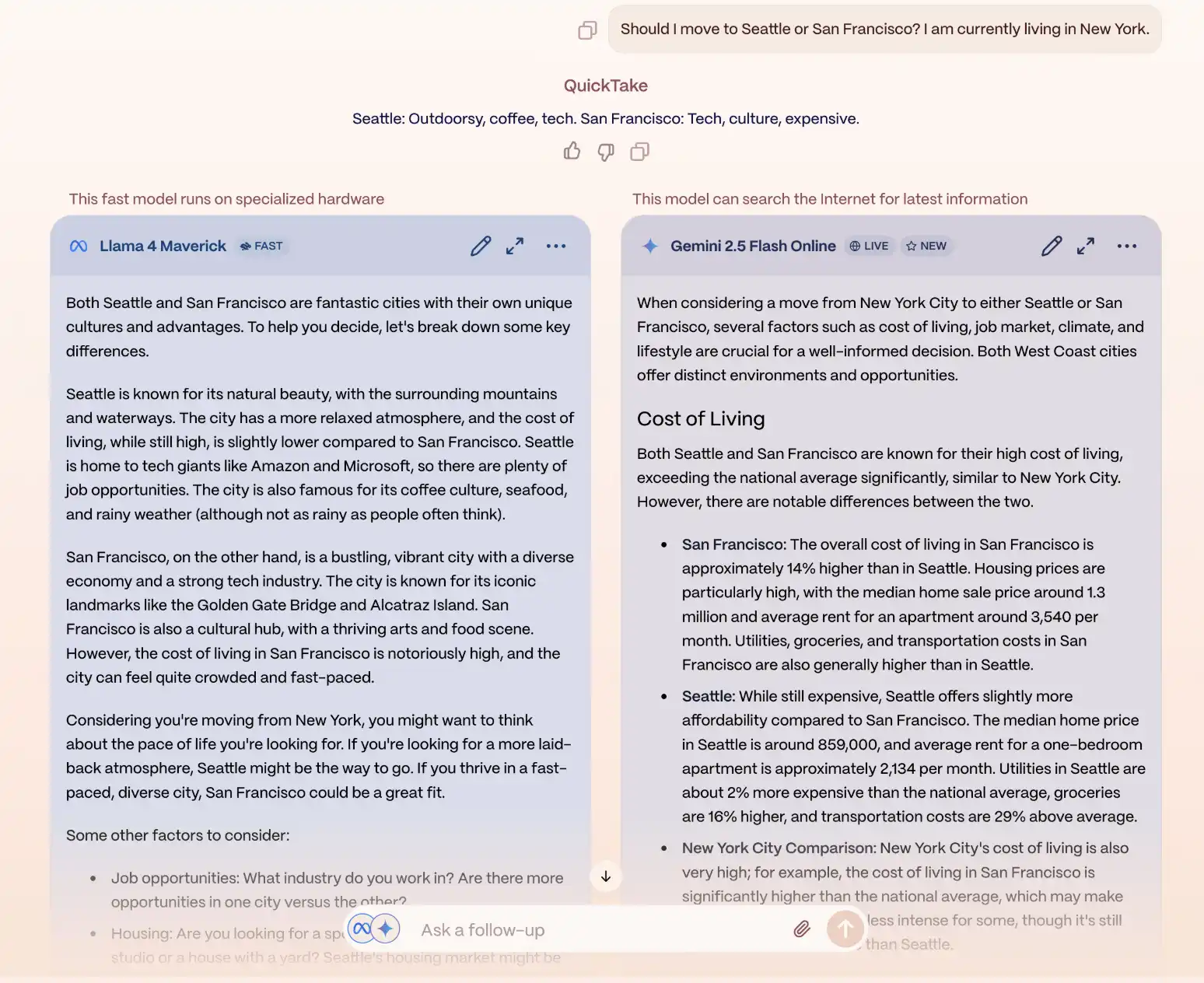
As a centralized AI evaluation platform, Yupp adheres to the "Every AI for everyone" philosophy, allowing users to easily discover, compare, and use the latest AI models. Unlike traditional single-response approaches, Yupp returns answers from two (or more) models for each prompt, forming an "AI Parliament". This design not only satisfies users' demand for diverse choices but also effectively identifies potential model "hallucinations", helping users make more informed decisions through comparison. As Yupp CEO Pankaj Gupta says, side-by-side output is particularly beneficial for users concerned with generative errors, as they can cross-verify results.
The platform currently supports over 500 AI models, covering text and image generation domains, including well-known models like ChatGPT, Claude, Gemini, DeepSeek, Grok, Llama, and many emerging models. To further optimize the experience, Yupp has introduced the "QuickTake" feature, which can distill lengthy responses into a concise tweet.
Moreover, Yupp highly values user privacy: all chat records are private by default unless users actively share; even when shared, no personal information is revealed. Users can control sharing content and scope at any time.
Economic Model and Incentive Mechanism: Valorizing Data Labor
Yupp combines free usage with user feedback through a "Yupp Points" system that measures model usage. New users instantly receive 5000 points, and can subsequently earn more by scoring model responses, selecting preferences, and providing reasons. The higher the feedback quality, the richer the rewards, ensuring users can continuously use high-end models like Claude Opus 4 or OpenAI o3 for free. The platform promises that points only increase, and currently, all models can be experienced for free.
After each query, users receive two model responses and can earn a "digital scratch card" through feedback, rewarding 0-250 Yupp Points. Every 1000 points can be exchanged for $1, with users able to withdraw up to $10 daily and $50 monthly. Points can be exchanged for over 20 currencies including USD and EUR, with partners like Stripe, PayPal, and Coinbase. The platform has also integrated Base Ethernet L2 and Solana stablecoins to provide instant, fee-free rewards for global users.
As Pankaj Gupta says, the high-quality feedback generated by users is far more valuable to AI companies for model fine-tuning and reinforcement learning than the rewards themselves. Although monthly earnings might only equate to a few cups of coffee, these paid annotation data are crucial for AI iteration.
To encourage more participation, Yupp has established a referral reward: referrers receive 5000 points, and referred users get 1000 points; currently, new registrants receive 5000 points, with referred users getting an additional 2500 points.
Yupp VIBE Score: A New Paradigm for AI Assessment
Addressing issues of insufficient transparency, fairness, and unequal data acquisition in existing leaderboards, Yupp has launched a beta AI leaderboard and the "Yupp VIBE (Vibe Intelligence Benchmark) Score" evaluation system. This system aggregates preference data generated by global users in natural interactions, aiming to provide robust and reliable assessment results.
Yupp's evaluation principles include:
· Robustness: Ensuring representativeness (covering diverse scenarios), authenticity (reflecting user concerns), and anti-cheating (resisting malicious actions);
· Trustworthiness: Fair and neutral (unbiased towards models), transparent and open (detailed disclosure of ranking algorithms), and scientifically rigorous (following assessment standards).
The platform not only collects binary preferences but also encourages users to point out the pros and cons of responses (such as "hitting the nail on the head", "fast speed", "good style"), and conducts group analysis based on users' age, education, and profession to reveal preference differences across different groups.
Technically, Yupp is exploring the use of blockchain, cryptographic primitives, and zero-knowledge proofs to ensure the fairness, transparency, and verifiability of the assessment process. Simultaneously, the platform has collaborated with professional AI data providers to calibrate scorers through file verification and multi-layer quality detection, eliminating malicious data.
Recent rankings have been updated, showcasing VIBE scores and metrics like win rate, dislike rate, speed, latency, context window, and cost for models such as GPT-4.5 Preview, Claude Opus 4, and Claude Sonnet 4.
Development Trajectory and Future Outlook
Yupp officially launched on June 13, 2025, after six months of internal testing. Since its launch, the product has continuously iterated:
· Multimodal Support: Integrated models like Dall-E, Flux, Stable Diffusion, Luma Photon, Google Imagen 4, and supporting user image/PDF queries;
· Interaction Expansion: Added voice input and voice reading functions;
· Model Updates: Successively introduced DeepSeek R1/V3, Mistral Small 3, OpenAI o3-pro, Hermes 3, Amazon Nova Pro v1, Microsoft Phi series, and "MAX model" category;
· Real-time Information: Routing online query requests to Perplexity and Google Gemini Live, with hyperlink citations;
· Payment Upgrade: Added US PayPal, Venmo withdrawals, and PayPal support for 24 currencies;
· Sharing and Export: Supported format-preserved copying, PDF/text/Markdown export, sharing individual responses or entire conversations as needed;
· Community Activities: Hosted "AI Prompt Challenges" with prizes up to tens of thousands of points; added personal profile pages, AI-generated chat names, and other features.
Yupp's mission is to "empower humans to shape the future of AI". Pankaj Gupta believes that AI development requires participation and contribution from everyone. Through multi-perspective AI responses and user feedback, Yupp not only helps users make better decisions but also provides continuous momentum for AI evolution.
It is worth mentioning that one of Yupp's main competitors is the open AI model evaluation platform LMArena (website: https://lmarena.ai/), which is very popular among AI industry professionals. However, the platform is currently in the stage of commercial exploration and does not provide direct material rewards or point incentives for user participation using blockchain technology.
Overall, Yupp has pioneered a new path for AI evaluation through a crowdsourcing model, incentive mechanism, and an assessment system driven by real user preferences. It not only provides users with free and diverse AI interaction experiences but also transforms user feedback into high-value training data, promoting continuous model optimization. With an experienced team and top-tier capital support, Yupp is expected to play a key role in the future AI ecosystem, realizing the vision of "AI for everyone, AI shaped by everyone".
However, for the newly launched Yupp, how to continuously ensure data quality, prevent potential cheating under large-scale user participation, and strike a balance between commercialization and user incentives will still be directions that need continuous exploration and optimization in its future development.
Click to learn about BlockBeats job openings
Welcome to join the official BlockBeats community:
Telegram subscription group: https://t.me/theblockbeats
Telegram communication group: https://t.me/BlockBeats_App
Official Twitter account: https://twitter.com/BlockBeatsAsia






