According to Microsoft's Work Trend Index Special Report released in mid-June, it reveals the "infinite work hours" phenomenon faced by modern knowledge workers, pointing out that process optimization alone cannot fundamentally improve the situation. Combining AI and work rhythm reshaping is necessary to truly unleash AI's potential.
Morning: Silent Work Hours Extension, Email Pressure Doubles
According to Microsoft data, at 6 AM, many Microsoft 365 users start scanning their overflowing inboxes, hoping to complete work quickly:
Among users online at 6 AM, 40% are checking priority emails for the day.
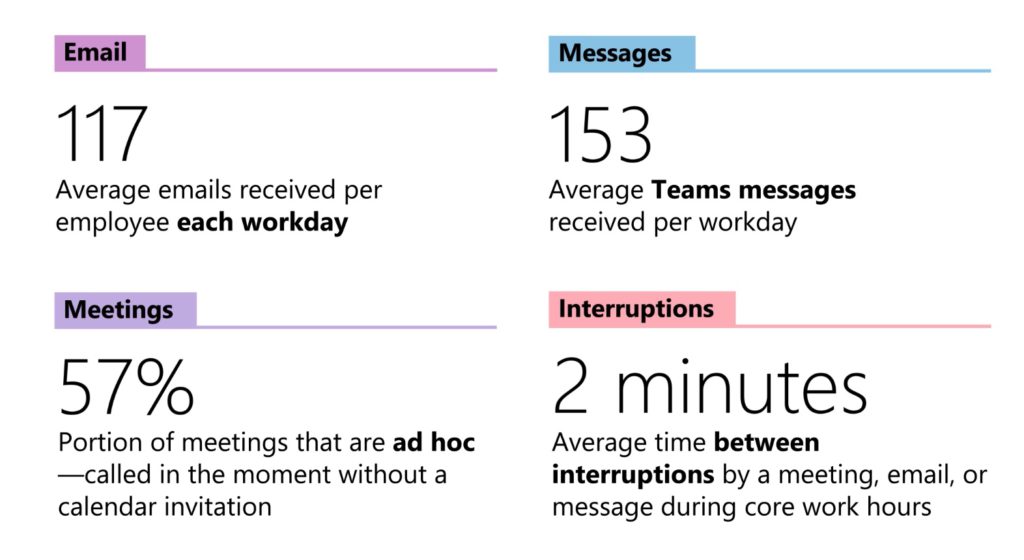
An average employee receives 117 emails daily — most of which are browsed within 60 seconds.
In the past year, group emails with over 20 recipients increased by 7%, while one-to-one email volume decreased (-5%).
Daytime: Meetings and Messages Disrupt Focus, Deep Work Becomes Luxury
After 8 AM, Teams messages replace emails as the primary communication channel, with an average of 153 messages per person daily, a global message volume increase of 6% annually, with some regions experiencing over 20% growth.
Meeting peaks are from 9-11 AM and 1-3 PM, accounting for 50% of all meetings. Meanwhile, 11 AM is the most active messaging period, with 54% of users active, and focus time severely fragmented by meetings, instant messages, and app switching. Data shows employees are interrupted every 2 minutes, with 48% of respondents and 52% of leaders believing work content is "chaotic and fragmented".
Evening and Weekend: Work Hours Extended, Boundaries Blurred
The report also notes an annual 16% increase in meetings after 8 PM, with employees handling over 50 messages outside work hours. 29% remain active in emails after 10 PM. Nearly 20% of employees check emails on weekends, with 5% returning to work on Sunday night.
One-third of employees indicate that the work pace of the past five years has made it impossible to keep up, with boundaries gradually disappearing. For some, this stress continues into the weekend — making Sunday feel like an ordinary Monday:
Our data shows a significant increase in weekend email usage. Nearly 20% of actively working weekend employees check emails before noon on Saturday and Sunday — even on typical rest days, they continue working after waking up. Over 5% of employees check emails on Sunday night (6 PM and later). "Sunday anxiety" is real and measurable.
While email patterns mimic the work week, other applications tell a different story: on weekends, WXP usage exceeds Teams messages, as employees finally find time for uninterrupted focused work.
This reveals a larger truth: for many, the modern workday has no clear beginning or end.
As business needs become increasingly complex and expectations continually rise, time once used for focus or recovery is now spent catching up, preparing work, and pursuing clarity. In professional terms, it's like assembling a bicycle before each ride. People spend too much energy organizing chaos before beginning meaningful work.
The Way Forward?
Finally, Microsoft points out that AI alone is not enough; enterprises must adopt a "frontier mindset": rethinking how time is spent, how work is done, and which actions truly create impact. Here are three entry points:
1. Focus on Key Work Using the 80/20 Rule
Not all efforts equal growth. Frontier enterprises use AI to concentrate 80% of results on 20% critical tasks. By automating meetings, reports, and low-value work, teams can spend time on decision-making, deep work, and execution.
2. Abandon Traditional Organizational Charts, Adopt "Work Graphs"
Traditional team divisions are too granular, leading to low efficiency. Now, AI can fill skill gaps, allowing teams to quickly assemble and move flexibly based on goals. Companies like Supergood use AI platforms to provide instant strategic insights, saving repeated communication time.
3. Become a "Proxy Boss"
Next-generation professionals leverage AI to improve efficiency, not by overtime. For example, Microsoft researcher Alex Farach manages research, analysis, and presentations through three AI agents, focusing on high-value outputs. This is the future of work: human-machine collaboration, scalable and flexible.