



Yesterday, Kraken was the first to support xStocks, allowing users to trade 60 tokenized US stocks on the platform; Bybit quickly followed, launching popular US stocks like AAPL, TSLA, and NVDA; Robinhood also announced blockchain support for US stock trading and plans to launch its own blockchain. Suddenly, crypto and US stocks achieved a two-way convergence at the product level.
This bustling scene is in stark contrast to the quiet MEME market. Recently, MEME has been lackluster with no new projects gaining traction and old projects showing no movement, with even daily discussion communities nearly silent. Opening social groups feels like entering a retirement channel. Gradually, I've completely given up and embraced a laid-back lifestyle.
Just as I was adapting to this zen life—I scrolled and saw GMGN's US stock section.
Initially thinking I was seeing things, I clicked and saw CRCL, AAPL, TSLA, AMZN, NVDA neatly listed (just with an added x suffix). I even checked GMGN's Official Twitter and discovered they truly launched on-chain US stock trading, supported by xStocks, where users can buy popular US stocks with SOL. A familiar interface, unfamiliar trading pairs—in that moment, I suddenly had an illusion: I had become a "traditional" trader.
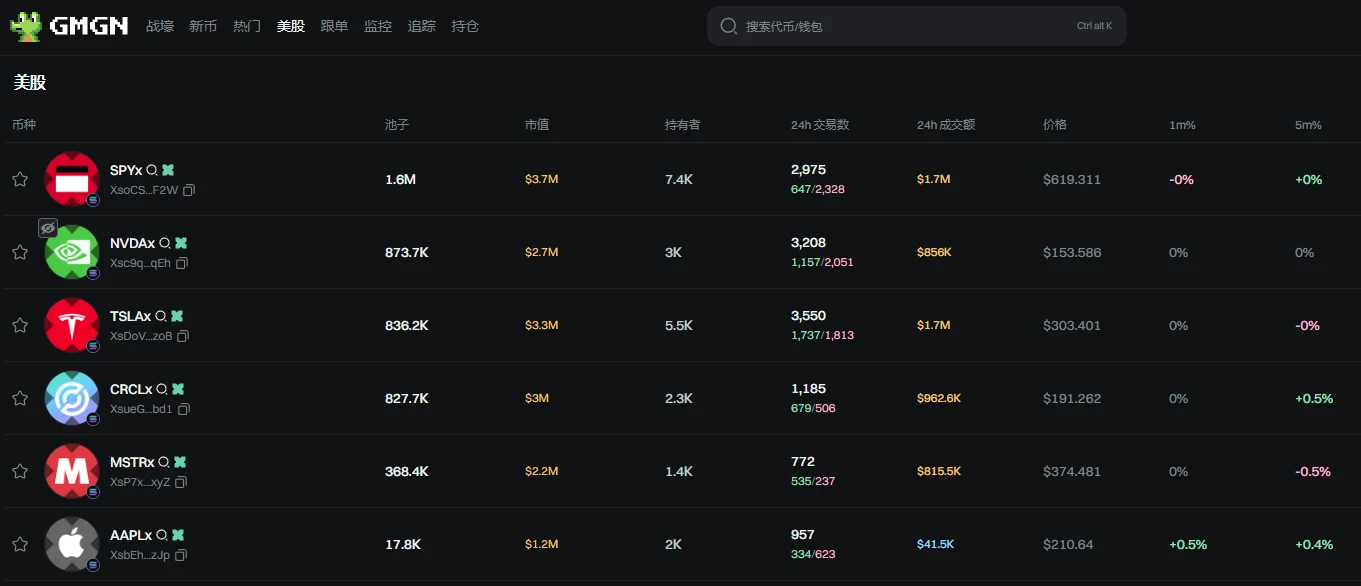
Honestly, seeing over 60 tokenized US stocks on GMGN was exciting. The BTC and ETH ETF news had indeed stirred my emotions, but ultimately, it felt distant for an on-chain retail investor like me. This time is different—I can directly buy AAPL and sell TSLA on GMGN, watching NVDA's price fluctuations while eating—who could have imagined this "trading US stocks on-chain" just days ago?
I even started fantasizing:
- SOL in my wallet is no longer just a virtual currency, but my ticket to Wall Street;
- Each on-chain trade feels like knocking on a secret door to NASDAQ;
- No more worrying about lack of on-chain meme token opportunities;
- Future conversations would shift from "Can this on-chain meme be bought?" to "What's your take on NVIDIA's earnings tonight?"
But I quickly calmed down. After all, trading is about details. After experiencing it, the US stock trading filter shattered, with liquidity being the biggest issue. Currently, GMGN's US stock section has 10 trading pairs with user participation, but only 5 pairs have liquidity pools over $100,000, with SPYx (S&P 500 index) having the best liquidity, yet its token market cap is under $4 million, with a liquidity pool of only $1.6 million.
Embracing new things, this is still just a starting stage. On-chain US stock trading technically bypasses traditional broker complexities, breaking barriers like KYC, account restrictions, and T+1 settlement—anyone with an on-chain wallet can directly participate. Moreover, liquidity issues can be gradually improved through liquidity rewards and token airdrops. Compared to previous on-chain meme tokens, US stock price movements are relatively stable and less prone to significant volatility, so with proper incentives, liquidity can easily grow.
Therefore, my current strategy is setting alerts for a few stocks on TradingView and GMGN. If on-chain prices drop over 3 points below actual stock prices due to liquidity issues, I'll start making small, incremental purchases. I'm also closely monitoring US stock trading hours and major events like earnings reports or macroeconomic data releases, as these moments often amplify price differences between on-chain and market prices due to liquidity, creating more short-term opportunities.
Overall, this strategy of alert-based, small incremental buying allows me to participate in on-chain US stock trading arbitrage opportunities while effectively mitigating potential liquidity risks—a prudent approach suitable for the current market environment.
Regardless, I'm no longer just a small-time player. I am an on-chain US stock trader.






