Written by: THEJASWINI M A
Compiled by: Saoirse, Foresight News
In 1688, captains would gather at Edward Lloyd's coffee house in London, seeking individuals willing to insure their voyages. Wealthy merchants would personally sign underneath ship details, becoming "underwriters" who pledged their personal wealth to guarantee these high-risk voyage projects.
The better the underwriter's reputation, the safer the voyage for the captain. The more secure the system, the more business it would attract. The deal was simple: provide funding, reduce risks for everyone, and then share a portion of the profits.
After studying the new SEC regulations, one would discover that cryptocurrency has essentially digitized the model invented by those coffee house underwriters: people earn rewards by taking risks with their assets, thereby making the entire system safer and more trustworthy.
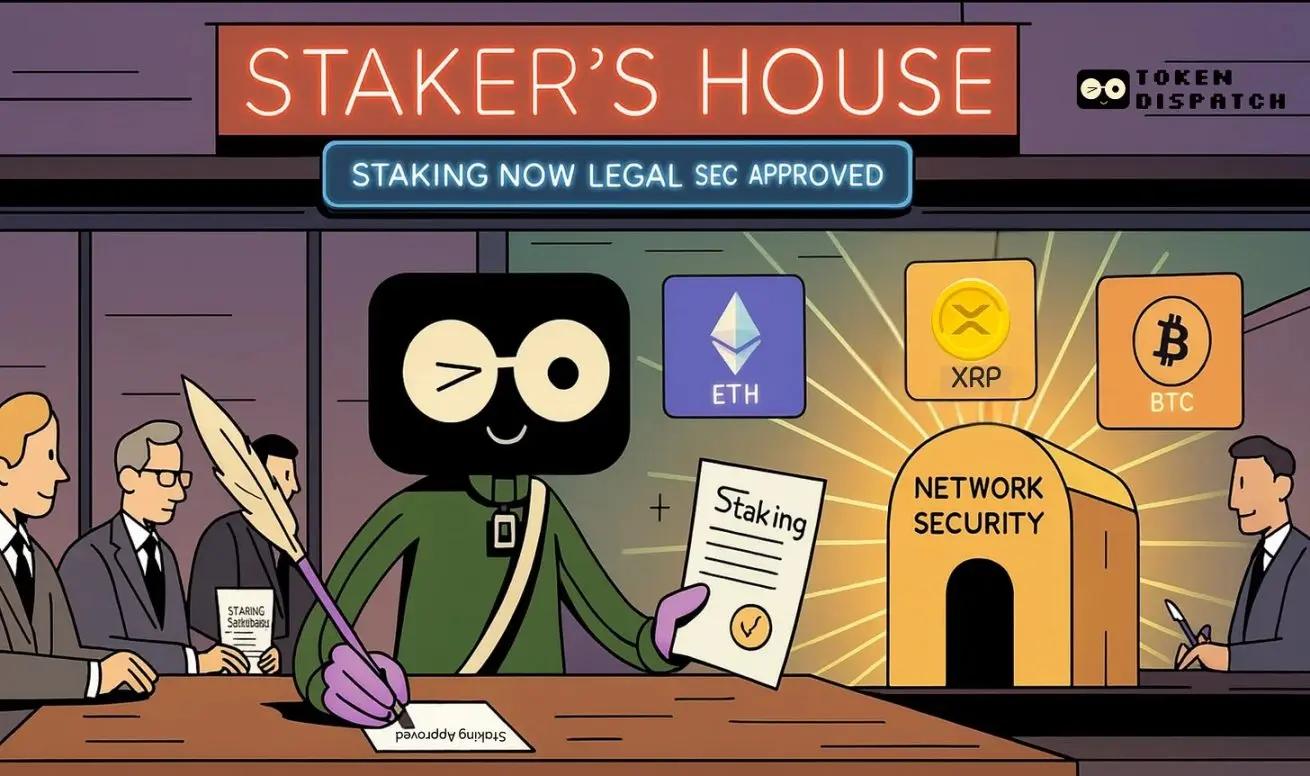
Staking is now back on the agenda.
On May 29, 2025, a major change arrives. On this day, the US government clearly stated that staking will not lead to legal disputes. First, we must recall why this point is so important right now.
In the staking mechanism, you lock tokens to increase network security and obtain stable returns.
Validators use their staked tokens to verify transactions, package new blocks, and ensure smooth blockchain operation. In return, the network pays them newly minted tokens and transaction fees.
Without stakers, proof-of-stake networks like Ethereum would collapse.
Of course, you can stake your tokens, but no one knows if the SEC might suddenly show up claiming you're conducting an unregistered securities offering. This regulatory uncertainty has kept many institutions on the sidelines, enviously watching retail stakers earn 3%-8% annual yields.
A Large-Scale Staking Wave Approaches
On July 3rd, Rex-Osprey Solana + Staking ETF officially launched, becoming the first US fund to offer direct cryptocurrency exposure with staking rewards. The fund holds SOL tokens through a Cayman Islands subsidiary and stakes at least half of its holdings.
"This is the first staking cryptocurrency ETF in the United States," Rex Shares announced.
They are not the only ones launching such products.
- Robinhood just introduced cryptocurrency staking services for US users, initially supporting Ethereum and Solana;
- Kraken added Bitcoin staking functionality through the Babylon protocol, allowing users to earn rewards while holding Bitcoin on its native chain;
- VeChain launched a $15 million "StarGate" staking plan;
- Even Bit Digital is selling its entire Bitcoin mining business to focus on Ethereum staking.
What exactly has changed?
Dual Regulatory Domino Effect
First, the SEC's staking guidelines issued in May 2025.
The guidelines indicate that if you stake your cryptocurrency to help blockchain operation, this behavior is fully compliant and not considered high-risk investment or securities.
This includes individual staking, delegating tokens to others for staking, and staking through trusted exchanges, as long as your staking directly helps network operation. This excludes most staking activities from the "investment contract" defined by the Howey Test. This means you no longer need to worry about violating investment regulations by earning rewards through staking.
The only thing to be cautious about is promising guaranteed returns, especially when combining staking with lending or launching so-called "DeFi portfolio products" promising fixed returns or engaging in fancy liquidity mining operations.
Second, the CLARITY Act.
This is a proposed bill in the US Congress aimed at clarifying the regulatory jurisdiction of different digital assets. The bill specifically aims to protect node operators, staking participants, and self-hosted wallet users, ensuring they are not treated like Wall Street brokers.
The bill introduces a new digital commodity category called "investment contract assets," establishing specific standards for digital assets to be defined as securities (regulated by SEC) or commodities (regulated by CFTC). The bill also sets up a "maturity" assessment mechanism for blockchain projects or tokens, allowing them to transition from SEC to CFTC regulation, and sets time limits for SEC review to prevent regulatory delays.
So, what does this mean for you?
Thanks to the SEC's regulatory guidelines, you can now conduct cryptocurrency staking in the US with more confidence. If the CLARITY Act passes, all those interested in staking or cryptocurrency investment will welcome a clearer and safer operating environment.
Staking rewards are taxed as ordinary income when you gain "control" over them; if you sell and realize capital gains later, capital gains tax applies. All staking income, regardless of amount, must be reported to the IRS.
Who Will Be the Focus? Ethereum
However, its price remains around $2,500.

Despite modest price performance, Ethereum's staking data is impressive. The total staked ETH has now exceeded 35 million, a historical high, representing nearly 30% of circulating supply. Although infrastructure development has continued for months, its strategic value is now experiencing an explosive breakthrough under regulatory clarity.
[Additional images and links omitted for brevity]
Various corporate boards are brewing major moves...
[Rest of the text continues in similar translated format]Wall Street absolutely understands the term "yield". Indeed, bond yields have rebounded from near-zero lows in 2020, with 1-year US Treasury yields returning to around 4%. But imagine a regulated crypto fund that can generate 3-5% in staking rewards annually while also offering the potential for asset appreciation - this is incredibly compelling.
The core breakthrough lies in legality. When pension funds can gain Ethereum exposure through a compliant ETF while creating revenue by securing the network, this is undoubtedly an industry milestone.
The network effect is now clearly visible: more institutional participation in Staking → improved network security → attracting more users and developers → expanded application scale driving up transaction fees → further increase in staking rewards. This is a virtuous cycle benefiting all participants.
You don't need to understand blockchain technology or believe in decentralization; just grasp the simple logic of "holding assets can generate profits". You don't need to endorse Austrian economics or challenge central bank authority, just understand the value of "productive capital assets". Essentially, networks require security protection, and guardians deserve reasonable compensation.