Vibe Coding is an early-stage track with clear structural growth, diffusibility in multiple scenarios, and strong platform moat potential. It promotes not only the evolution of development tools, but also a redistribution of construction rights and the universal release of creativity.
In the early days of computer development, programming was a highly abstract and closed behavior. Developers needed to directly operate assembly language or even binary, and input programs through punch cards, tapes, or terminal commands. There was a lack of visual interfaces and real-time feedback, and the cost of trial and error was extremely high. Early programming was mainly in the hands of engineers in scientific research or military systems, and ordinary people had almost no access to it. In the 1980s, with the popularization of personal computers and the development of high-level languages such as BASIC and C, programming gradually acquired enlightenment attributes. At that time, learners taught themselves to write tool programs or simple animations through command lines and paper tutorials, but to truly build a runnable system, they still needed to master the underlying knowledge such as memory management and file system operations, and the threshold for deployment and dissemination was still very high.
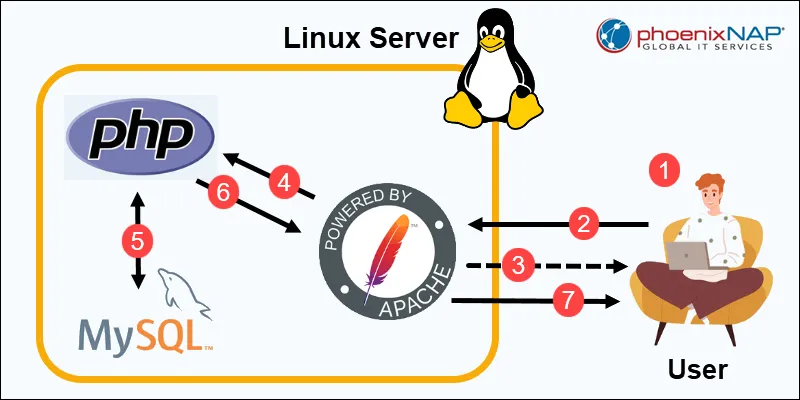
Although the LAMP architecture composed of HTML, PHP, and JavaScript has brought a certain degree of popularization of development, and open source tools such as Discuz and WordPress have also allowed forums, blogs and other products to be launched more quickly, the entire development process still relies on professional skills and engineering knowledge.
Even in the era of Web2 and mobile development, although the modern technology stack is more powerful, the development path is more complicated, involving a complete chain from design tools (such as Figma) to front-end and back-end frameworks (such as React, Node.js), to cloud deployment and third-party service docking, which is still difficult for non-professional users to complete independently.
On the surface, the development process is constantly evolving towards standardization and high efficiency, but the technical threshold has never been truly eliminated. The right to build is still concentrated in the hands of a few people who have the knowledge and tools.
In the AIGC era, the dawn of programming and the difficulties coexist
Generative AI has been widely used, once again significantly lowering the threshold for programming.
With the breakthroughs made by large models such as GPT-4, Claude 3, and Gemini in semantic understanding, code generation, and context retention, development behavior has shifted from "structured understanding" to "perceptual dialogue" for the first time. We have seen that people can communicate their intentions directly to the system through natural language, allowing AI to generate the required functions, interfaces, components, and even complete pages. Prompt has become a new input method, and the system response has been upgraded from suggested fragments to structured, composable results.
AIGC not only improves development efficiency, but also breaks the "language threshold". More and more non-programmers are starting to use tools like Copilot to complete code, debug logic, write interfaces, and even quickly complete web prototypes or function simulations based on ChatGPT. The potential of AIGC programming is initially revealed at this stage: code becomes "conversational" and development becomes "co-creative".
Of course, this first wave of attempts at change also exposed many limitations:
Most generative models are still at the “fragment generation” level, which makes it difficult to understand the overall picture of the task, let alone organize complex project structures across files and modules;
The code output lacks context memory capability, and the generated results are often not reusable or require a lot of manual correction;
Due to the lack of connection with the runtime environment, the generated code often cannot be directly deployed, tested, or put online;
AIGC tools are almost all designed around "helping developers write code faster" rather than "empowering people who can't write code to build."
Especially in the world of Copilot, developers become more efficient, but non-developers are still unable to enter the game.
Although AIGC programming has significantly improved development efficiency and lowered language barriers, it is still mainly focused on existing developers, and the construction capabilities have not yet really reached a wider range of people. In this context, a new generative paradigm, Vibe Coding, has begun to emerge, which attempts to bypass the engineering threshold and kick off a new round of programming equality paradigm.
Vibe Coding: The Next Phase of the Generative Construction Paradigm
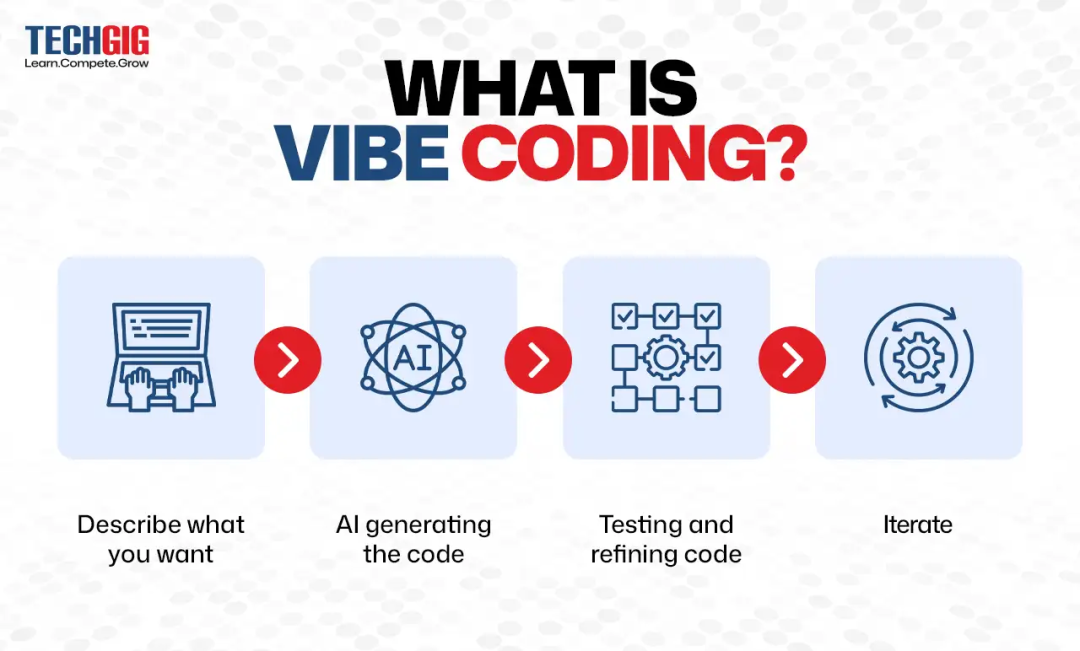
Vibe Coding is a hot term in the technology field in recent times. It is considered a new trend in the field of AIGC programming, and attempts to reconstruct the logical starting point of the entire application construction process. According to IBM's technical interpretation, Vibe Coding is defined as a programming mode that uses natural language input as the main interactive method. Users express development goals through spoken descriptions, and the system uses large models to assist in generating code, organizing logical structures, and outputting executable products. This type of system attempts to identify the construction intent from the semantics of the input and transform it into a composable, deployable, and testable structural result.
Different from traditional Copilot-like AI tools, Vibe Coding represents a "build right delivery mechanism" for a wider range of people, especially users with non-engineering backgrounds. Its core is not to make users understand code better, but to allow users to fully describe, trial and error, release and repeatedly iterate their product structure without having to understand code.
In fact, the trend has increased significantly since 2025.
We have seen that platforms such as Cursor have taken the lead in introducing the concept of "conversational construction" into IDE systems, supporting natural language control of project structure, cross-file code generation, and instant run preview. More platforms have begun to design development processes around the path of "prompt to module to release", trying to create a semantically driven closed loop for application creation.
In addition to the technical path, Vibe Coding also represents a new product organization paradigm: it emphasizes rapid prototyping, lightweight iteration, high reuse and distributability, and is suitable for fragmented application scenarios such as creator economy, community operation, and individual entrepreneurship, becoming an important way to generate the next generation of lightweight Web3 applications or interactive content.
A typical representative of the Vibe Coding track
With the development of the Vibe Coding trend, more and more projects are beginning to try to productize this paradigm, and gradually derive a variety of paths and solutions.
In this field, projects such as Infinity Ground, Ohara AI and Dev.fun have gradually emerged as representative explorers in the current Vibe Coding track. Next, we will analyze the capabilities, user paths and closed loop construction of these three types of platforms one by one, and try to sort out the preliminary outline of the Vibe Coding industry map.
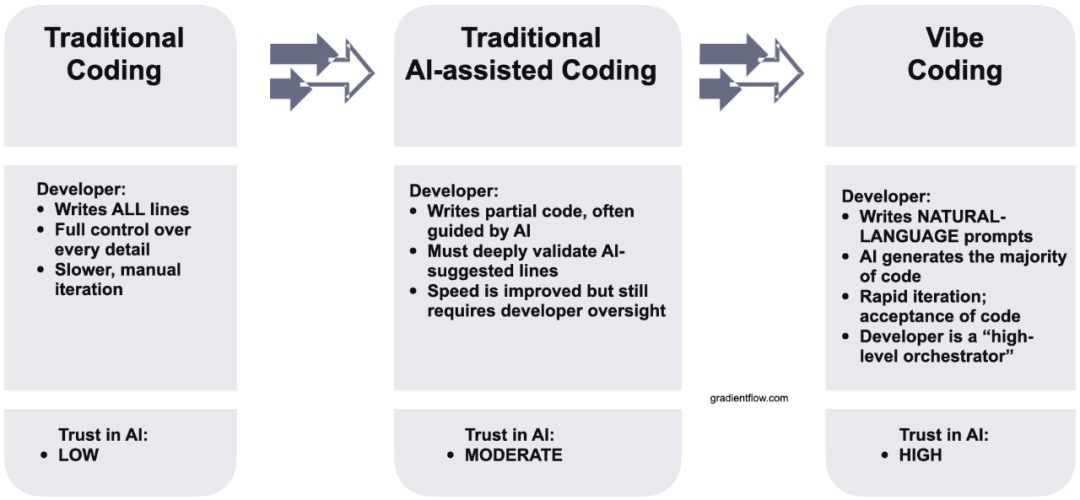
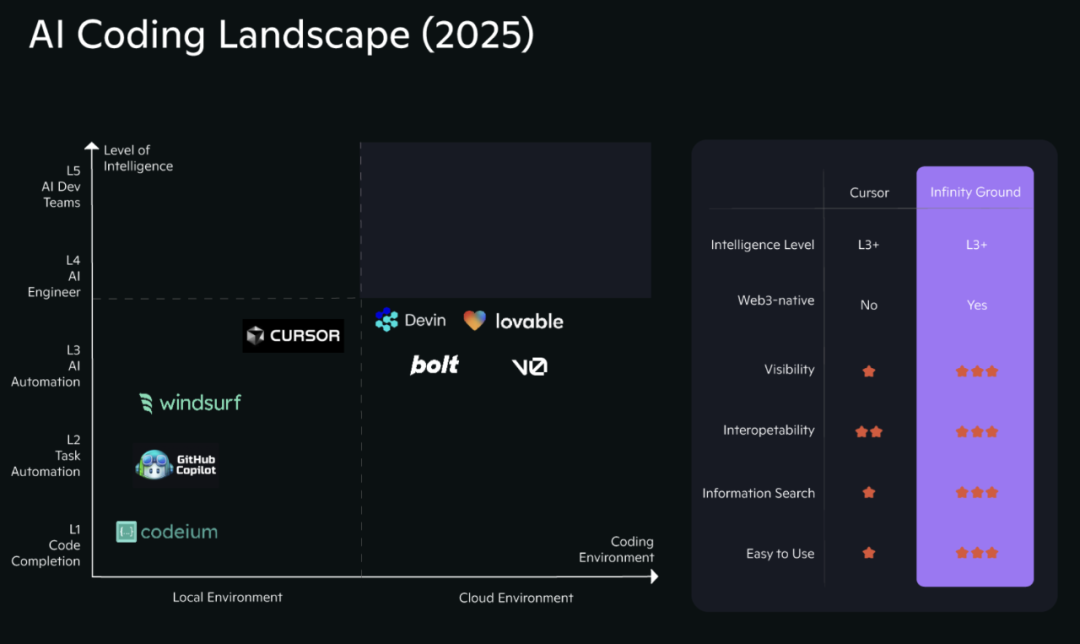
It should be noted that tool-type products that tend to be IDE enhancements and localized programming assistants, such as Cursor, Codeium, Windsurf, etc., are mostly embedded in the local programming environment familiar to developers, focusing on optimizing aspects such as code completion, cross-file generation, and context linkage, significantly improving the development efficiency of existing engineers.
However, the core design of such products is still to "improve programmer efficiency" rather than "enable non-programmers to build a complete system". Their interaction mode still relies on code editors and engineering semantics, so they do not change the underlying logic of development, and it is difficult to deliver applications "end-to-end" without the IDE framework. They also lack some Web3 features. Based on this, we did not include these platforms in the comparison.
- Infinity Ground
Infinity Ground is one of the most representative projects in the current Vibe Coding track. It is committed to providing a set of natural language-driven construction paths for users with non-engineering backgrounds.
The project is positioned as a Web3 construction platform for ordinary creators, content operators and individual developers. Its core goal is to compress the development process from "intention to product" into an understandable, operational and online closed-loop channel, and then create a decentralized "Web3 App Store".
One of the most important features of the Infinity Ground platform is that it is driven by natural language throughout the entire process. In this system, users can describe the target function in a prompt manner, and the system will automatically call the component library, logic modules, and page templates to generate complete application content including front-end pages, business logic, and on-chain interfaces. The generated results will be encapsulated as accessible links and deployed directly online without the need for code writing or environment configuration. The new process skips the IDE environment, joint debugging and deployment links, and back-end on-chain integration processes that traditional development relies on, greatly reducing the threshold for application construction.
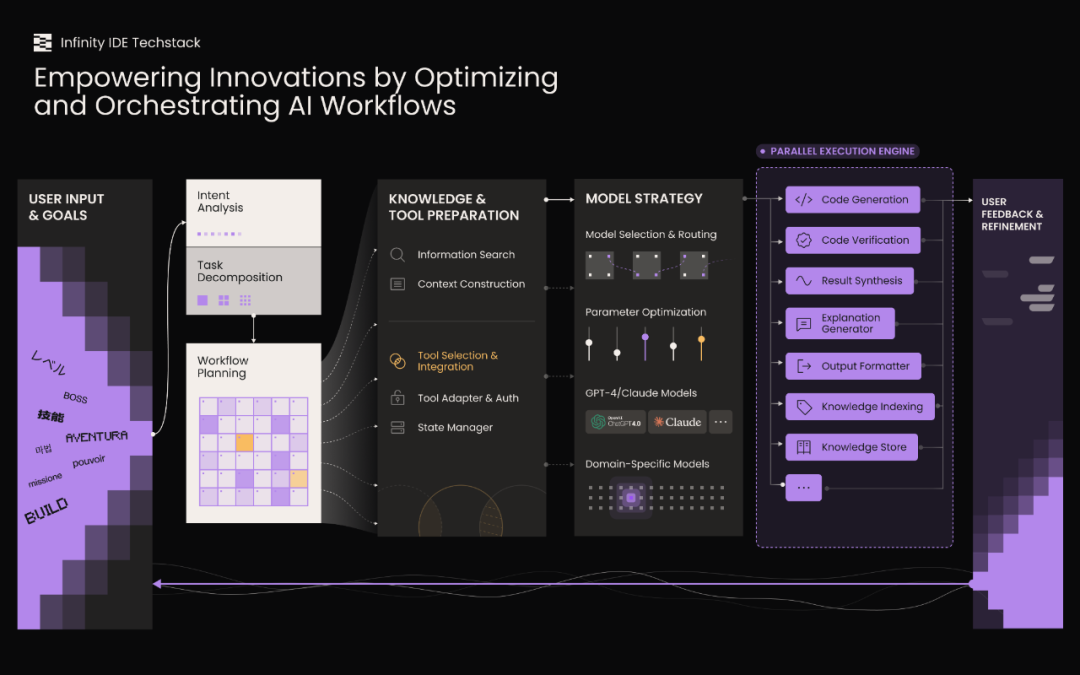
In terms of interaction, Infinity Ground introduces the Agentic programming paradigm, which supports the rapid generation of functional modules from semantics through mechanisms such as task decomposition, context understanding, and model strategy routing. The platform supports multi-model collaboration (such as GPT-4 and Claude), dynamic parameter optimization, structured output, and interpretable result generation, which enhances the controllability and understandability of non-technical users during the interaction process.
According to the user's prompt word requirements, the application can support wallet connection, permission management and payment interface, and has complete Web3 usage features. The platform also supports users to distribute applications to communities, social platforms or other channels in the form of links, forming an external expansion path from construction to use and then to dissemination. The entire process is self-consistent and complete, and users can complete the delivery without exiting the platform.
In addition to page construction and interactive configuration, Infinity Ground is also the first platform of its kind to open up the semantic generation capabilities of smart contracts, becoming an important explorer of on-chain logic generation in the context of Vibe Coding. The platform has a built-in contract generation and deployment module, allowing users to complete a series of smart contract generation, packaging, and chain operations including Airdrop and Token creation only through natural language descriptions, such as "create a token airdrop with 1000 recipients", etc. The entire process does not require the use of the Solidity programming language, nor does it require local compilation or environment configuration.
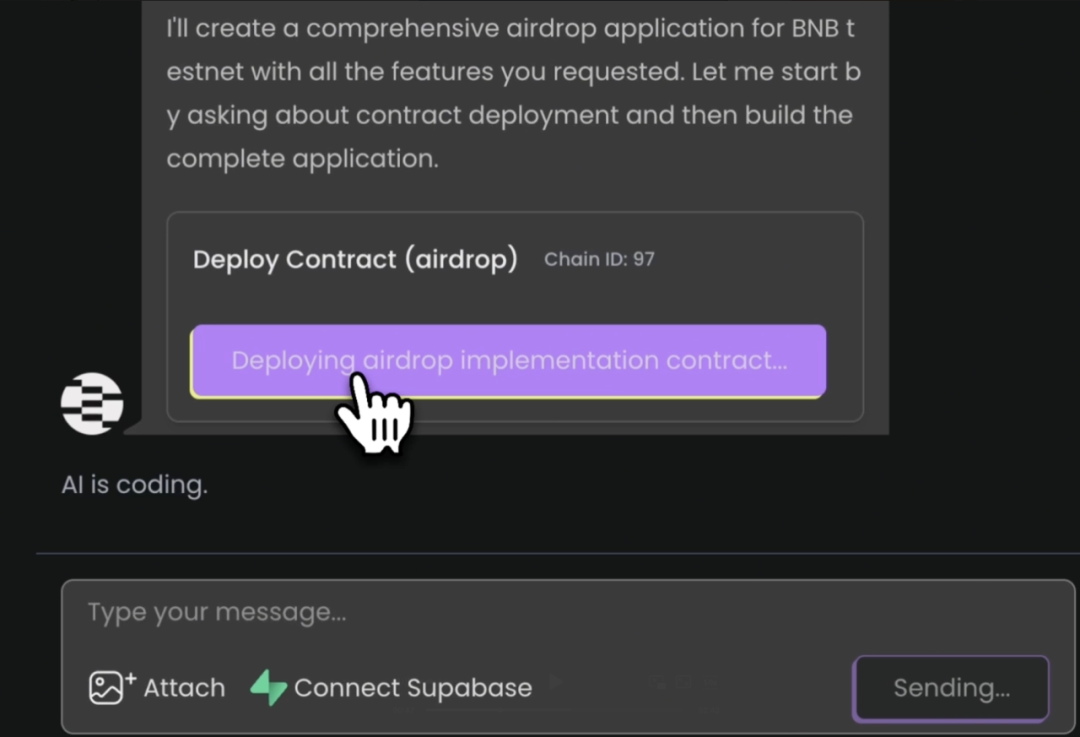
To ensure security and contract availability, the system's preset templates are all derived from a third-party standard contract library that has undergone security audits, and encapsulate the necessary parameter configuration and permission control logic. After the user enters the target at the semantic layer, the platform will call the corresponding template and complete the deployment and execution, ensuring that the construction path has both low thresholds and on-chain stability and traceability.
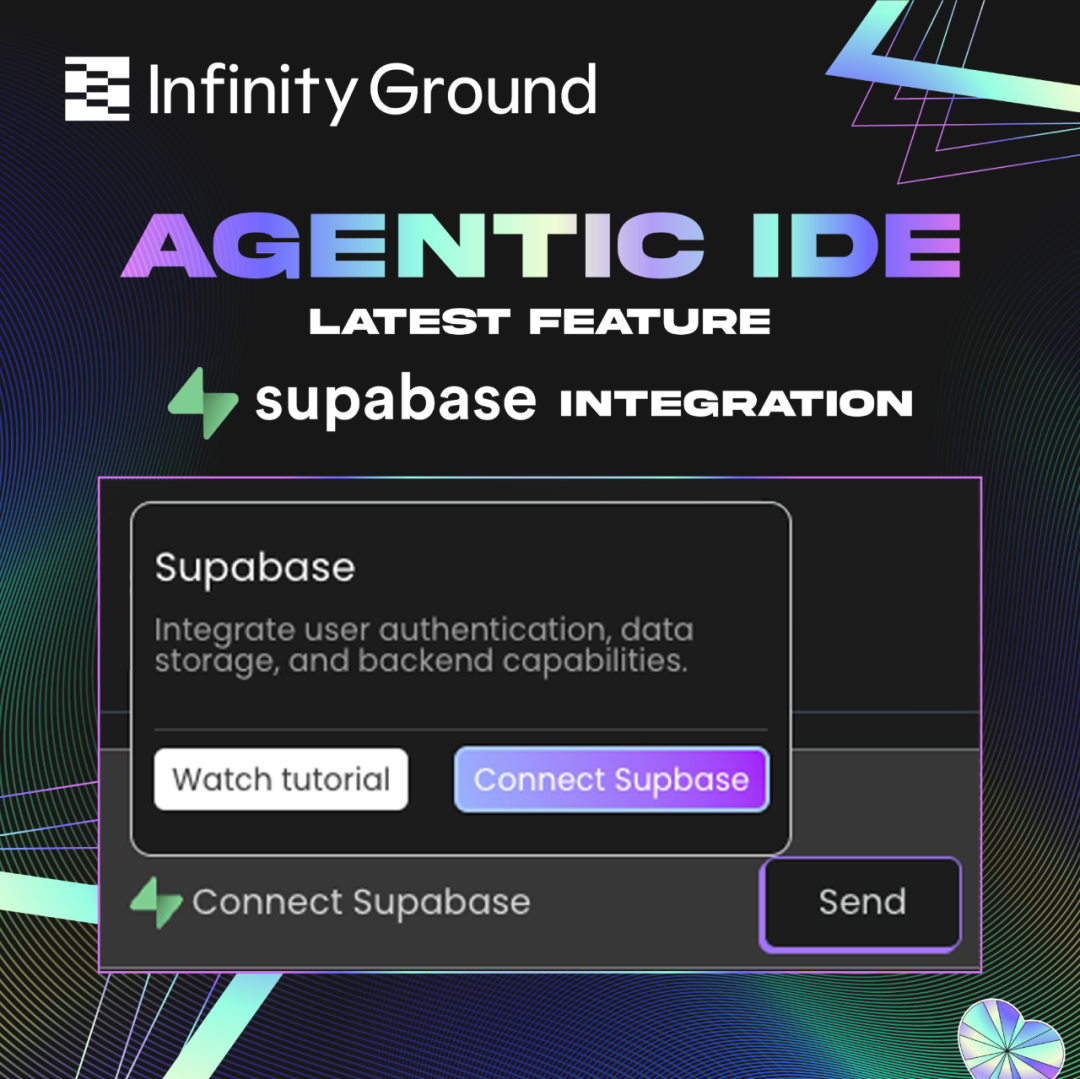
It is worth noting that the platform also provides background monitoring and data tracking functions for contract behavior, helping users observe on-chain indicators such as call frequency, interactive wallet distribution, and token circulation path. This integrated capability of "generative + deployable + maintainable" greatly improves the operability of on-chain logic for users with non-engineering backgrounds, and also builds a technical moat for the platform from "buildable" to "operable".
On this basis, Infinity Ground has further established a template library, construction rankings and code remix system, supporting users to regenerate or upload custom modules based on existing templates, gradually forming a supply-based construction network. The platform also introduces blockchain-based template version control, decentralized incentive mechanisms and contribution income distribution paths. Users can get rewards by contributing templates, improving construction processes, and other behaviors, building a production closed loop around AI collaboration and user co-construction.
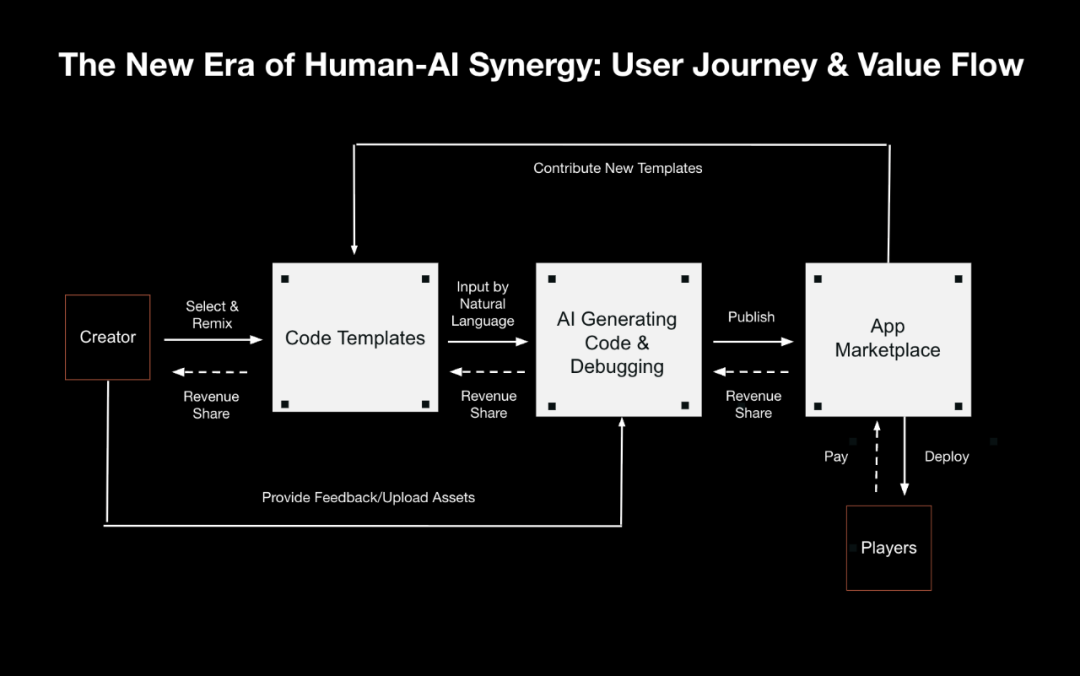
The platform currently has built-in multiple lightweight Web3 application templates covering NFT market, DAO management, on-chain data dashboard, RWA registration form, content subscription system, etc., covering common creative, community and transaction scenarios. Users can call, modify or completely reconstruct the structure based on new semantics as needed. All construction steps are completed within the platform, further forming a new chain process from prompt to module combination to release and operation.
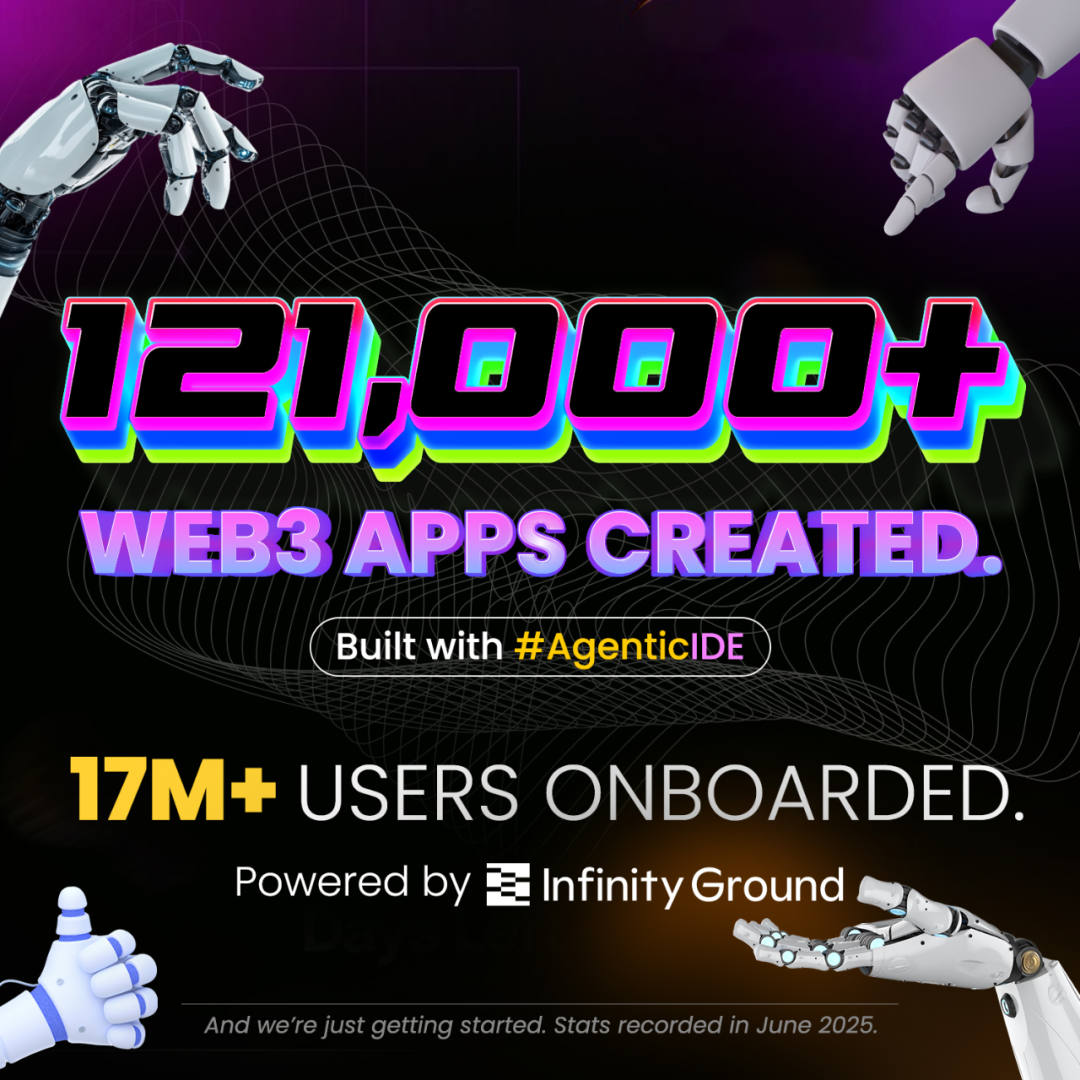
It is worth mentioning that the Infinity Ground platform has currently connected more than 17.41 million independent wallet addresses and generated more than 136,000 online applications, forming a relatively significant scale of use. And its user portraits mainly cover market operators, NFT and Meme creators, independent product managers, students and Web3 players. In addition, the platform has incubated representative products including the AI Town project "Love Terminal" (attracting more than 58,000 users in the first week) and the on-chain mini-game "Jump Jennie" (completed more than $16,000 in admission fees within two weeks), which fully verifies the feasibility of Infinity Ground's commercial realization path.
- Dev.fun
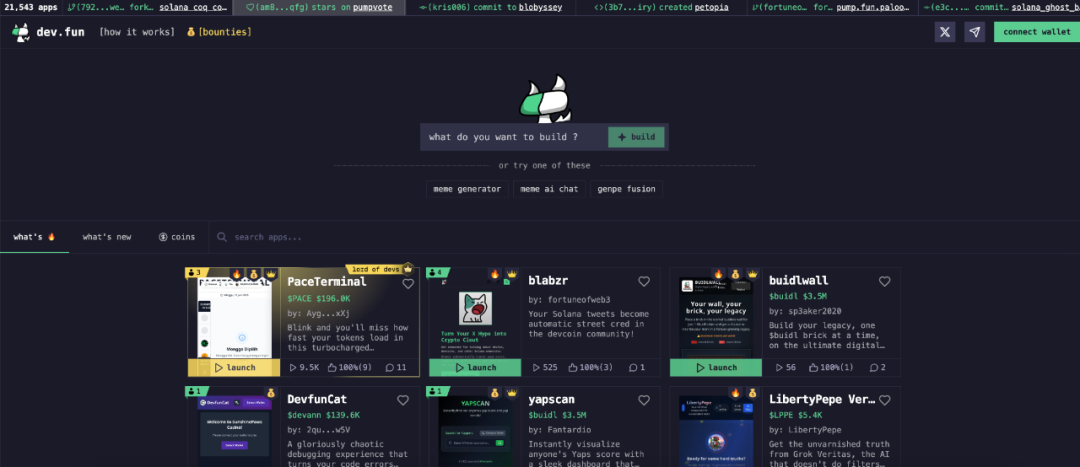
Dev.fun is a tool platform in the Vibe Coding track that emphasizes "light expression" and "instant interaction". It is based on a minimalist semantic input mechanism, allowing users to quickly generate interactive module pages (called devlets) with preliminary logic through a natural language, without programming or configuration. Common applications include voting, mini-games, forms, real-time presentations, etc., emphasizing low creation thresholds and short distribution paths.
The platform has a large number of templates generated or remixed by users, and supports the direct generation of access links for social sharing or embedding, building a content dissemination path with Meme characteristics. Dev.fun also provides mechanisms such as likes, rankings, and creative challenges to encourage expression creation around hot topics and community topics.
In terms of positioning, Dev.fun is more like a meme engine for Web3 community culture. It serves content creators, community operators and brand expressers, making "building is expression" a normal way of creation. It connects users and amplifies influence through lightweight interactive content, making it a more representative expression platform in Vibe Coding.
- Ohara AI
Ohara AI is one of the representative platforms in the Vibe Coding track that focuses on "building + incentives". It is committed to building executable Web3 applications through natural language and automatically issuing exclusive App Coins to support incentives, transactions and community interactions.
The platform provides a modular conversational building experience. Users only need to enter requirements, such as "create a Meme tool that can generate GIFs" or "build a button that supports ETH donations", and the system can generate a complete application including front-end pages, wallet interactions, and on-chain calls. The application can run instantly, semantically fine-tune, and allow users to access the underlying code for secondary editing.
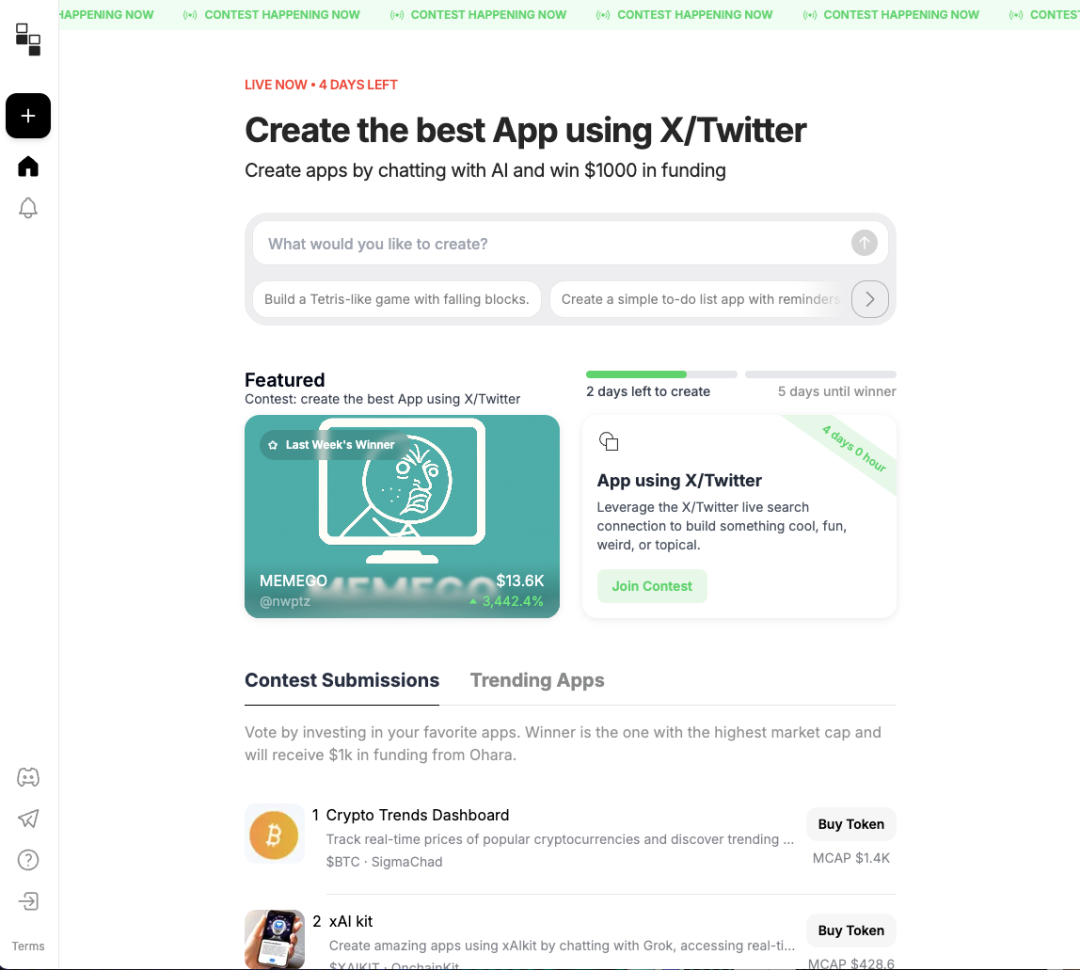
The biggest feature of Ohara AI is "one-click deployment + automatic generation of App Coin". Each application can embed a token incentive mechanism for rewarding, distributing or selling, thus realizing an economic closed loop between creators and users. The platform also supports Remix construction, which facilitates the rapid copying, modification and release of applications, and promotes community co-creation.
Ohara has built-in OnchainKit SDK, which supports wallet access, on-chain operations, data reading, and can be connected to external APIs, such as integrating xAI or real-time content sources to enhance application interactivity. The platform also regularly holds development challenges to enhance user engagement and content exposure. Currently, Ohara's user groups include creators, entrepreneurs, and Web3 content experimenters. It is suitable for rapid prototype testing and token mechanism verification, and is an ideal platform for lightweight developers and creative product verifiers.
Vibe Coding's Multiple Evolution Paths
In fact, the three platforms actually represent different vertical categories.
Among them, Infinity Ground takes "closed loop of generation, deployment and distribution of Web3 applications" as its core design concept. Its system builds a complete end-to-end generation infrastructure around prompt generation, module calling, on-chain deployment, wallet interaction, permission configuration and application distribution, emphasizing the complete product path from "creation" to "usable and spreadable", relying on the combination of template ecology, operating environment and deployment support.
Ohara AI is more like a "front-end prototype generation tool". Its core capabilities are mainly focused on generating page sketches through natural language descriptions, supporting simple interactions and static display of content. Ohara AI's "generate and display" path is closer to the idea of Web2 authoring tools, and is also suitable for lightweight uses such as educational scenarios and creative expressions. It is more like a "starter generator" or "prototype drafter" in the Vibe Coding track.
Dev.fun is positioned somewhere in between the two. Its target users are mainly Meme creators and on-chain content builders. It supports the generation of visually expressive content pages from text intents, while providing basic wallet connection and data interface call functions. It combines lightweight semantic interaction with template drive, and emphasizes "quickly creating shareable works", making it more like a tool platform for the creator community.
So if we roughly classify Vibe Coding into two types of paths:
One type will be a system platform with infrastructure attributes that attempts to reshape the entire process of "build-deploy-distribute";
The other type focuses on specific links, aiming at lightweight generation, creative display or front-end sketching, forming a tool-type or Launchpad-type platform group.
In this framework, Infinity Ground is closer to the former, and its system builds a complete closed loop around the construction process, operating environment and distribution mechanism. Based on the natural language generation function structure, it also has built-in on-chain deployment, wallet binding, permission setting and application template ecology, with high reuse and expansion capabilities. The platform has the vision of "Web3 App Store" and is essentially an infrastructure project in the Vibe Coding track. Its goal is to serve the creator community and precipitate the module market.
Based on Infinity Ground's technical fundamentals, it is being classified as L3+ intelligent level, and performs relatively well in visibility, Web3 nativeness, composability and ease of use, demonstrating the platform's systematic capabilities in building a complete ecological closed loop.
In terms of functional structure, further horizontal comparison can also verify the above differentiation path.
As shown in the table below, Infinity Ground supports the generation of multi-page structures, stable wallet connections, real-time display of on-chain data, and AI collaborative generation under user intention participation. It has strong system combination capabilities and is oriented to the entire chain. Although Ohara AI and Dev.fun each have their own highlights, they focus more on front-end sketches, creative content generation, and basic on-chain interactions.
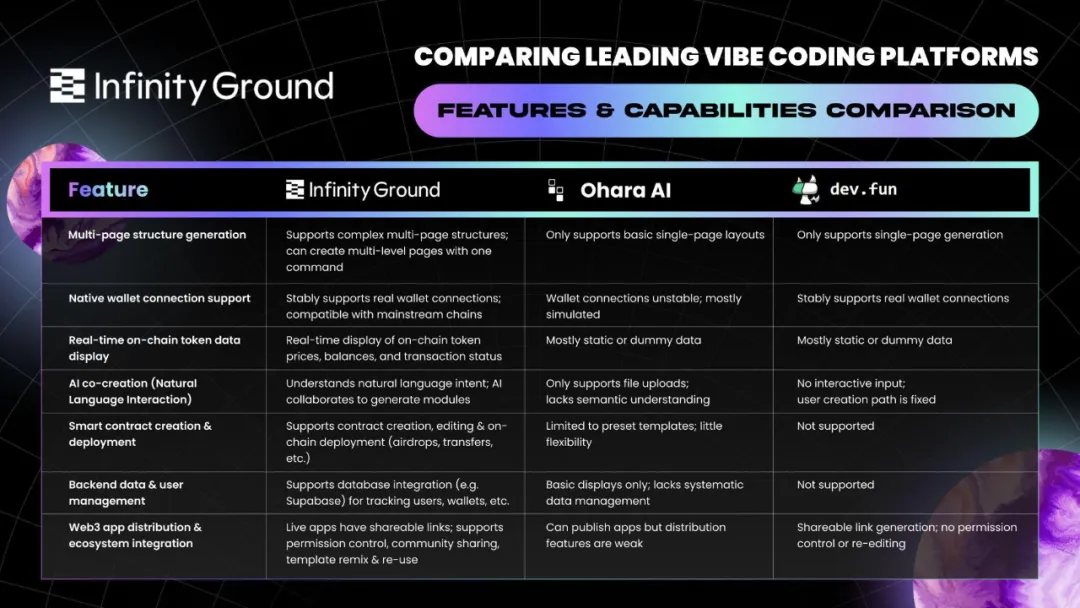
In summary, the current Vibe Coding ecosystem has initially formed two types of evolutionary paths: "infrastructure platform" and "tool generator". As a representative of the former, Infinity Ground has demonstrated the advantages of a closed-loop system from construction logic, operation path to ecological organization capabilities, while Ohara AI and Dev.fun are more like Launchpad, positioned as entry tools for lightweight construction. This differentiation trend also indicates that Vibe Coding is evolving from a single construction tool to a multi-level, multi-role system.
Conclusion
Vibe Coding is in an early stage of technological evolution and user cognition. With the continuous release of large model capabilities and the growing demand for Web3 native construction, "language is construction" is gradually becoming the mainstream paradigm for the next generation of application development, opening the bottom-level entrance to the era of "universal development".
Based on this, the user identity is undergoing a structural change, extending from programmers to creators, operators, educators and even individual entrepreneurs. The high-threshold process that originally belonged to technical experts is being reconstructed into a more universal, expressive and operational construction path. This lowering of the threshold not only brings a broad space for user growth, but also significantly expands the potential market size that this track relies on.
At present, the track is in a state of flourishing. Whether it is end-to-end platform products represented by Infinity Ground, or more lightweight construction tools such as Dev.fun and Ohara AI, although the service objects and functional focuses are different, they are all conducting in-depth exploration around the core proposition of "low-threshold construction". They are not simply competing in the same way, but jointly expanding the application boundaries and achieving complementary penetration in different vertical categories.
From an industry perspective, Vibe Coding has the typical characteristics of platform innovation. Once its underlying logic gradually stabilizes, the combination of modules and the scalability of the ecosystem will continue to release potential, and it is expected to form a development stack structure similar to an operating system, thereby reshaping the full cycle path of the product from conception to verification, from iteration to launch.
In summary, Vibe Coding is an early stage track with clear structural increments, diffusibility in multiple scenarios, and strong platform moat potential. It promotes not only the evolution of development tools, but also a redistribution of construction rights and the universal release of creativity. In the next 3 to 5 years, as the ecosystem improves and users mature, this field is expected to become one of the most growth-oriented long-term opportunity windows at the intersection of AI and Web3.