Original Author: thiccy
Original Translation: Block unicorn

This article discusses the shift in risk appetite from fervor to worship of the jackpot, and its broader social implications. It involves some basic mathematical knowledge but is worth reading.
Imagine you are playing a coin toss game. How many times would you toss?
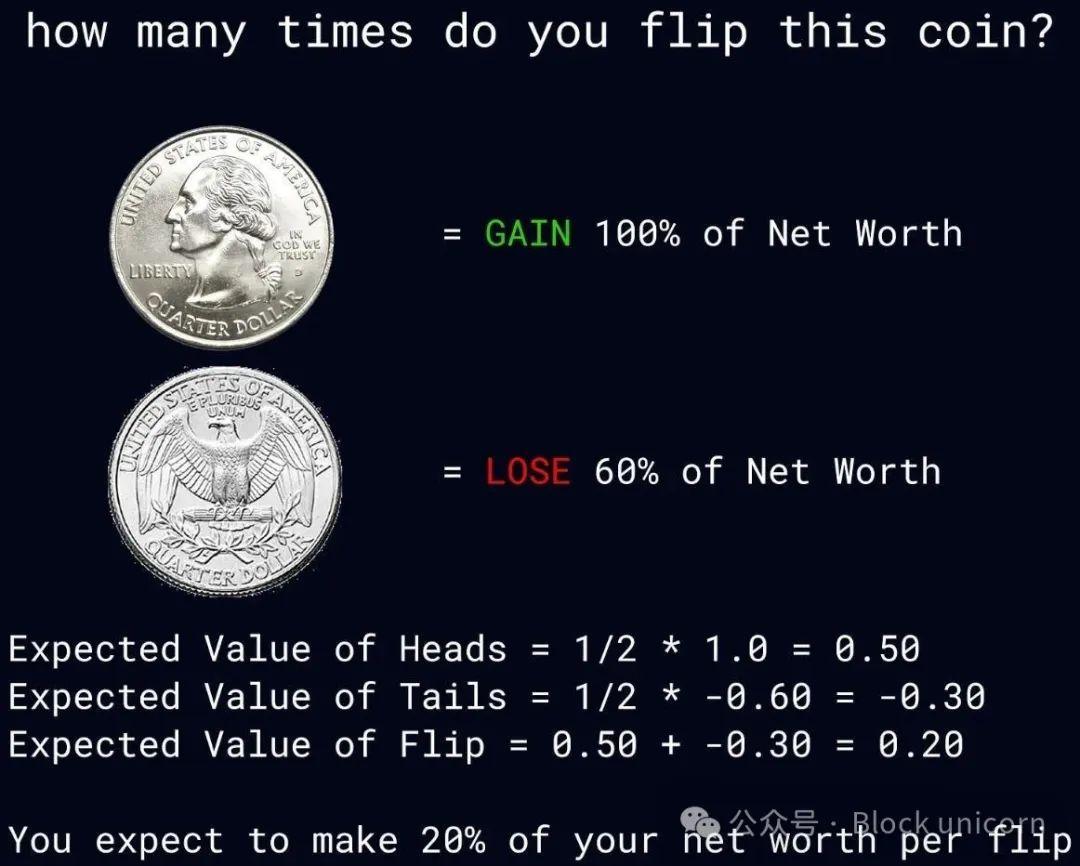
At first glance, this game looks like a money printing machine. The expected return for each coin toss is 20% of your net assets, so theoretically, you should toss the coin infinitely and ultimately accumulate all the wealth in the world.
However, if we simulate 25,000 people each tossing a coin 1000 times, almost everyone's result is close to $0.
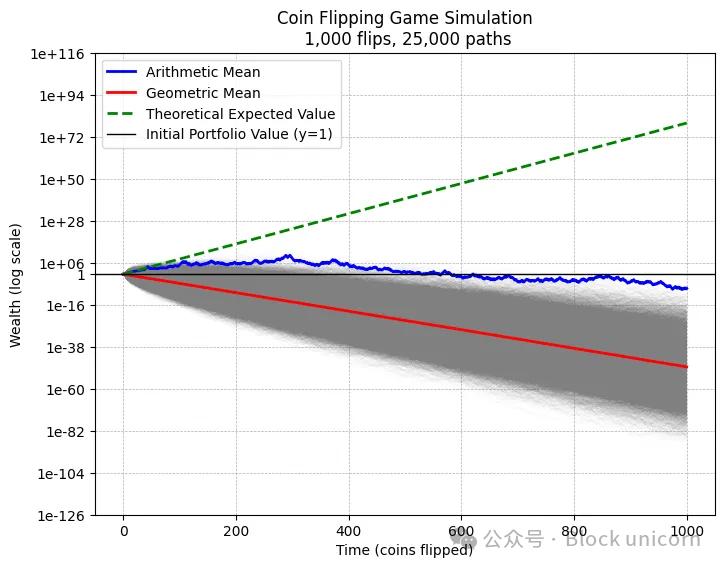
The reason almost all results tend towards zero is due to the multiplicative nature of repeated coin tossing. Although the game's expected value (arithmetic mean) increases earnings by 20% per coin toss, the geometric mean is negative, which means that in the long run, coin tossing actually has negative compound interest.
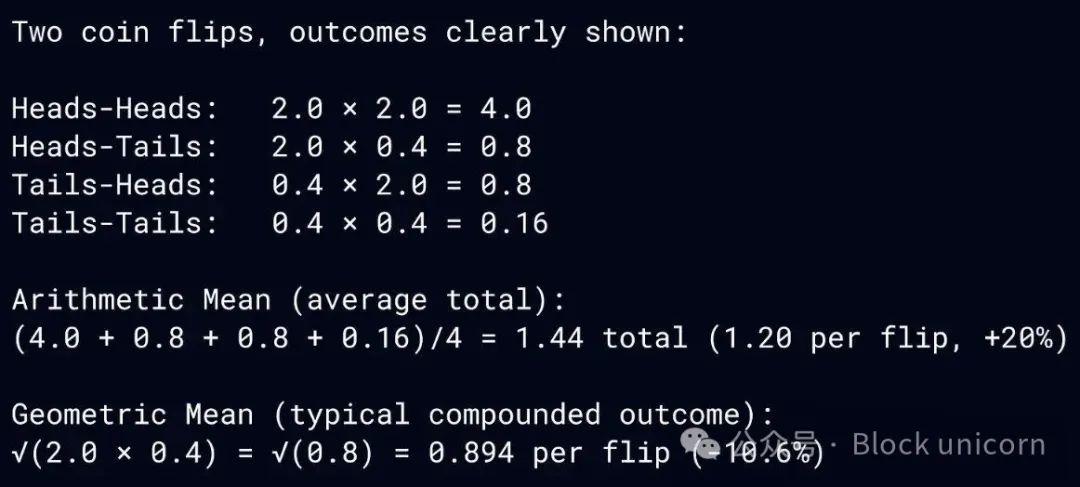
What's going on? Here's an intuitive explanation:
Arithmetic mean measures the average wealth created by all possible outcomes. In our coin toss game, wealth is heavily skewed towards rare big win scenarios. Geometric mean, on the other hand, measures the expected wealth in intermediate results.
The above simulation demonstrates this difference. Almost all paths gradually approach zero. In this game, you need to toss 570 heads and 430 tails to break even. After 1000 coin tosses, all expected values are concentrated in just 0.0001% of big win results, which are the rare cases of tossing many heads.
The difference between arithmetic mean and geometric mean constitutes what I call the "Jackpot Paradox". Physicists call it the "ergodicity problem", and traders call it "volatility resistance". When expected value is hidden in rare big wins, you cannot always rely on it. Excessive pursuit of big wins can turn positive expected value into a straight line to zero. In the world of compound returns, dosage determines success.
The early 20s crypto culture is a vivid illustration of the Jackpot Paradox. SBF (Sam Bankman-Fried) initiated a discussion about wealth preference in a tweet.
Logarithmic wealth preference: Each dollar is worth less than the previous one, and risk appetite shrinks as wealth grows.
Linear wealth preference: Each dollar has the same value, and risk appetite remains unchanged regardless of how much you've already earned.

SBF proudly declared he had a linear wealth preference. He believed that since his goal was to donate all wealth, doubling from $10 billion to $20 billion was as important as going from $0 to $10 billion, and therefore, from a civilizational perspective, making huge, high-risk bets was logically worthwhile.
Su Zhu of Three Arrows Capital echoed this linear wealth preference and further proposed exponential wealth preference.
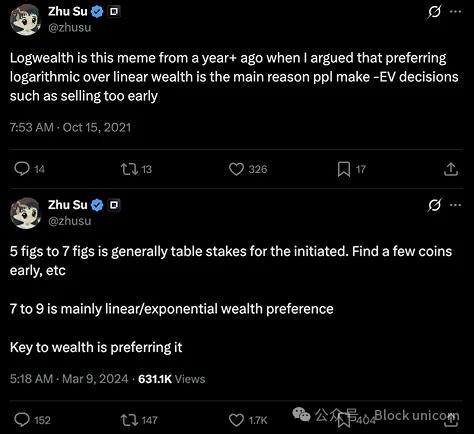
Exponential wealth preference: Each new dollar is more valuable than the previous one, so risk appetite increases with wealth growth, and one is willing to pay a premium for the jackpot.
Here is the correspondence between the three wealth preferences and the aforementioned coin toss game.
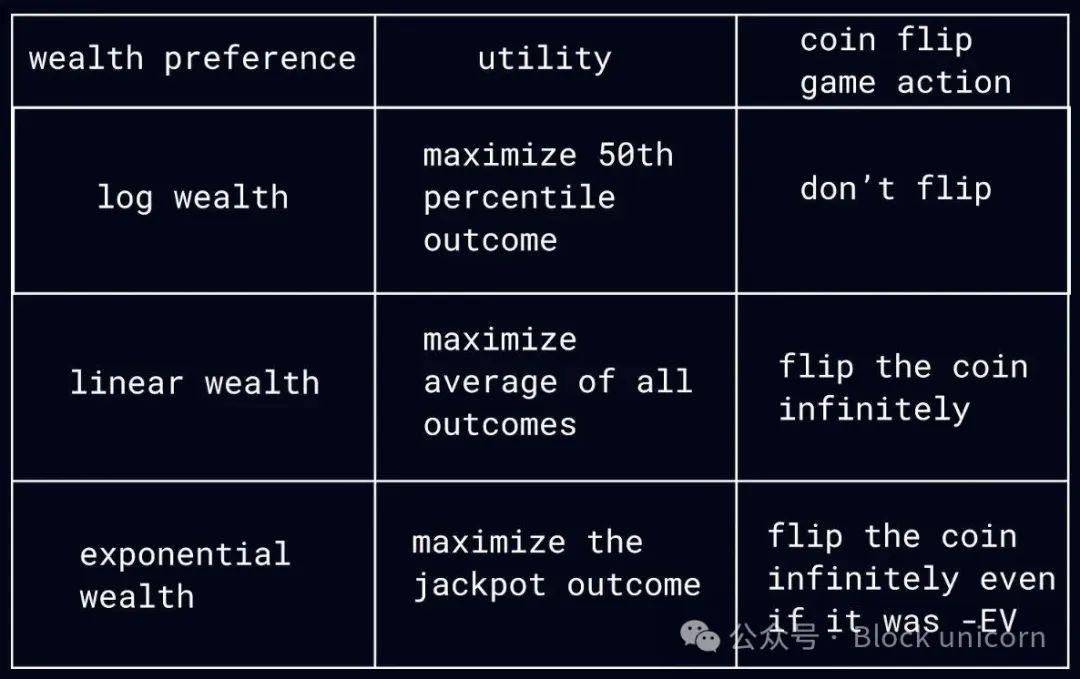
Given our understanding of the Jackpot Paradox, it is obvious that SBF and Three Arrows Capital were, in a sense, tossing coins infinitely. This mindset was how they initially accumulated wealth. Unsurprisingly, in hindsight, both SBF and Three Arrows Capital evaporated $10 billion in wealth. Perhaps in a distant parallel universe, they are billionaires, which might provide justification for the risks they took.
These crashes are not just cautionary tales about risk management mathematics, but also reflect a deeper macro-cultural shift towards linear and even exponential wealth preferences.
People expect founders to adopt a linear wealth mindset, take enormous risks, maximize expected value, because they are the gears in the venture capital machine that rely on power law distribution success. The stories of Elon Musk, Jeff Bezos, and Mark Zuckerberg going all-in and ultimately owning the world's largest personal wealth reinforce the myth driving the entire venture capital industry, while survivorship bias cleverly overlooks millions of founders whose fortunes have vanished. Only a few elite who can cross the increasingly steep power law threshold are redeemed.
This pursuit of ultra-high risk has permeated daily culture. Wage growth severely lags behind capital's compound growth, causing ordinary people to increasingly view negative expected value jackpots as their best chance for genuine upward mobility. Online gambling, zero-day expiration options, retail meme stocks, sports betting, and crypto meme coins all prove the phenomenon of exponentially growing wealth preference. Technology has made speculation effortless, and social media spreads stories of each new overnight millionaire, attracting a broader crowd like moths to a flame into a massive failure gambling game.
We are gradually becoming a culture that worships jackpots, and the value of survival is increasingly reduced to zero.
Artificial Intelligence has exacerbated this trend, further devaluing labor and intensifying the winner-takes-all scenario. Tech optimists dream of a prosperous post-artificial general intelligence world where humans dedicate time to art and leisure, but this looks more like billions of people chasing negative-sum capital and status "jackpots" with Universal Basic Income (UBI) subsidies. Perhaps, perhaps the "only goes up" e/acc logo should be redrawn to reflect the countless zero paths along the way, which is the true outline of the "Jackpot Era".
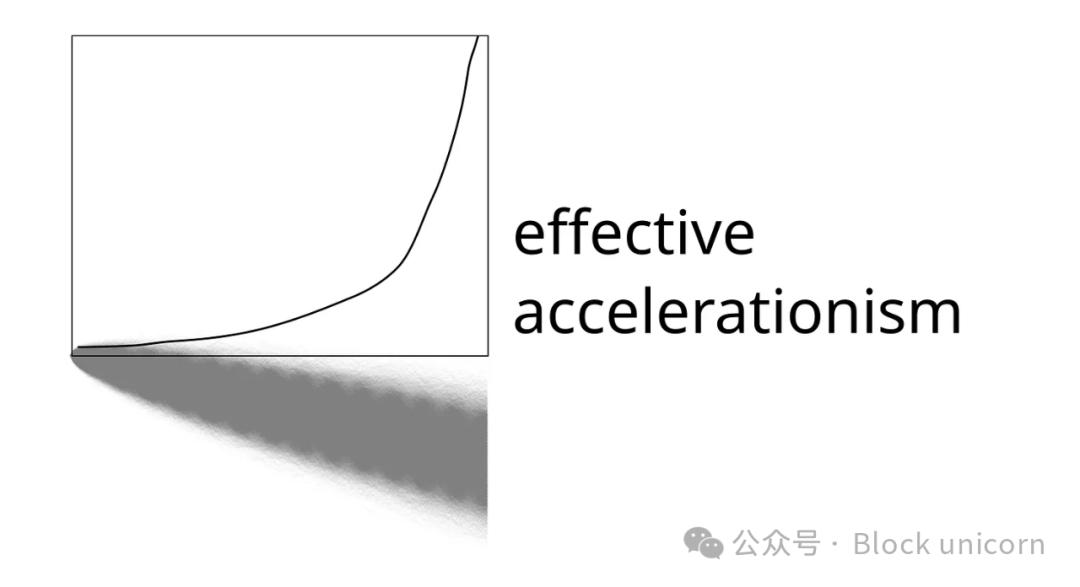
In its most extreme form, capitalism behaves like a collectivist hive. The mathematics of the Jackpot Paradox indicates that civilization rationally sacrifices millions of worker bees to maximize the linear expected value of the entire hive. This might be most effective for overall growth, but severely distributes purpose and meaning.
Marc Andreessen's technological optimism manifesto warns: "Humans should not be corralled; humans should be useful, productive, and proud."
However, the rapid technological development and increasingly radical risk-taking incentive mechanisms are precisely pushing us towards the very outcome he warned against. In the "Jackpot Era", economic growth's momentum comes at the expense of fellow humans. Utility, productivity, and pride are increasingly reserved for the few privileged winners in competition. We improve the average at the cost of the median, leading to growing gaps between liquidity, status, and dignity, thereby breeding a negative-sum culture throughout the economy. The resulting externalities manifest as social unrest, starting from election provocateurs to ending in violent revolutions, which could cause massive losses to civilization's compound growth.

As someone who makes a living trading in the cryptocurrency market, I have personally witnessed the decline and despair brought by cultural transformation. Like a grand prize simulation, my victory is built on the failure of a thousand other traders. This is a monument to wasting human potential.
When industry insiders seek trading advice from me, I almost always discover the same pattern. They are taking excessive risks and suffering significant losses. Behind this usually lies a scarcity mindset, an inescapable feeling of being "left behind," and an impulse to make quick profits.
My answer has always been consistent: Instead of increasing risk, accumulate more advantages. Do not destroy yourself chasing a big prize. Protecting wealth is what matters most. Maximize 50% of the results. Create your own luck.
Avoid significant drawdowns. You will eventually reach your goal.
But most people can never consistently gain an advantage. "Winning a few times" is not scalable advice. In the fierce competition of technological feudalism, meaning and goals always go to the winner. This brings us back to the question of meaning. Perhaps what we need is a new religious revival that harmonizes ancient spiritual doctrines with the reality of modern technology.
Christianity spread because it promised salvation for anyone. Buddhism became widespread with the idea that everyone can achieve enlightenment.
Modern similar systems must also do the same thing, providing dignity, purpose, and a path forward for everyone, preventing them from destroying themselves in pursuit of a big prize.