In the financial world, reputation is the hard currency of transactions, and performance is the ultimate measure of value. However, in the emerging crypto realm where rules are still being established, the relationship between these two becomes blurred and complex. In the summer of 2025, Joe McCann - a top player in the Solana ecosystem - provides us with an excellent case study through his dramatically unfolding experience.
At the core of the event is a stunning contrast: Asymmetric, the hedge fund McCann poured immense effort into, collapsed with a catastrophic loss of 78%, plummeting his professional reputation. Yet almost simultaneously, he transformed into the helmsman of a new project Accelerate, planning to raise $1.5 billion and aiming to create the largest Solana treasury company in history.
Transitioning from an undeniable investment failure to an unprecedented capital operation challenges traditional financial logic. It forces us to consider a core question: To what extent can a powerful personal brand and a compelling narrative offset or even transcend disastrous past performance in today's crypto market? Joe McCann's story is not just about an individual's rise and fall, but a modern parable about how reputation, risk, and capital are rearranged in a decentralized world.
From Elite to "Mr. Solana"
Joe McCann's ability to quickly launch an unprecedented project at the lowest point of his career is no coincidence. The deeper logic lies in how he had already capitalized his personal influence to its peak through his unique elite background and role as Solana's "chief evangelist".
Unlike many crypto grassroots heroes, McCann's resume carries an inherent "orthodoxy" that institutional capital cannot ignore. His early experience in quantitative trading at top investment banks like Nomura gave him an intimate understanding of global macroeconomic pulses and complex financial instruments. Subsequently, he keenly captured the technological wave's shift, successfully transforming into a Silicon Valley tech entrepreneur, with his co-founded company NodeSource being successfully acquired, and he himself having held senior positions in Microsoft's "Cloud and AI" department.
This unique cross-domain resume made him a rare "translator" in the crypto world. When facing Wall Street, he could package blockchain's technical characteristics into investable asset classes using financial professionals' familiar language; when facing the tech community, he could delve into underlying architectures and analyze their performance.
When he decided to invest all his energy into the crypto world, he strategically chose the then-controversial newcomer Solana, rather than the established Bitcoin or Ethereum. He almost fanatically transformed into Solana's "chief evangelist", using his massive presence in media and industry conferences to tirelessly propagate a core narrative: Solana is a "decentralized NASDAQ" designed for future financial systems. This metaphor was nothing short of brilliant, precisely striking Wall Street's soft spot.
Through continuous output, he successfully tied his personal brand deeply with Solana's future. For outsiders eager to catch the next wave but intimidated by crypto technology, Joe McCann became the most authoritative and reliable source for entering the Solana world. He became the true "Mr. Solana", with his personal reputation and influence reaching their peak in this process.
The Cost of High-Risk Betting: 78% Collapse
When a person's influence reaches its peak, the impulse to monetize it naturally arises. McCann's choice was to establish his own hedge fund Asymmetric, which should have been his coronation from "theorist" to "practitioner", but ultimately evolved into a cautionary tale about risk spiraling out of control.
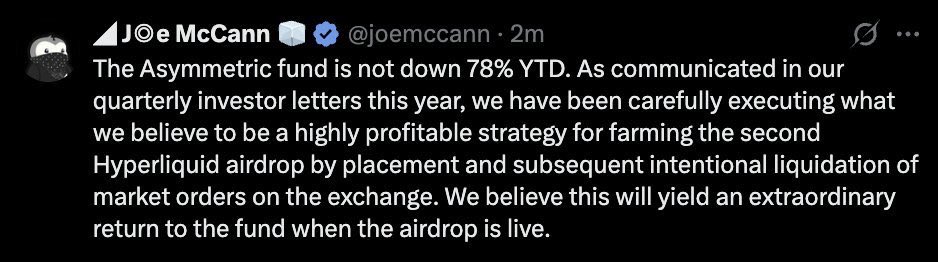
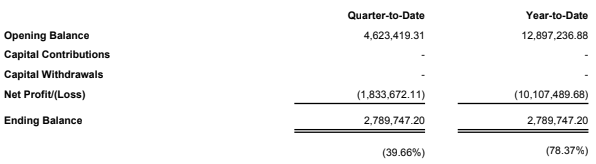
In 2025, Asymmetric fund's net value curve drew a heart-stopping descending arc, ultimately settling at -78%. Against the backdrop of an overall positive crypto market, this loss rate was catastrophic. The fund was forced to liquidate and shut down.
When facing overwhelming investor questioning afterward, McCann attributed it to a complex "mining strategy" surrounding the decentralized derivatives exchange Hyperliquid's airdrop. He insisted this was a precisely calculated "risk hedging" operation, and though the account temporarily showed massive losses, the fund would obtain "extraordinary returns" once the project issued airdrops.
However, this explanation sounds unconvincing to professionals. The core of a "Delta-Neutral" strategy is precisely to strip away market price fluctuation risks through financial instruments. Attributing a massive 78% loss to a strategy that should be low-risk itself exposes disastrous mistakes in the fund's risk models, leverage control, or position management. This is not a simple "delayed return" issue, but an undeniable, complete risk management collapse.
An angry investor's social media post showing millions of dollars of investment dramatically shrinking, like a heavyweight bomb, completely detonated the market. Joe McCann's "prophet" image collapsed, replaced by the label of a "gambler". This failure almost destroyed his professional credibility as a fund manager.
Redemption with an Even Larger Bet
Just when everyone thought McCann would fade away, he announced a comeback in an even more high-profile and ambitious manner. He declared he would serve as CEO of the new company Accelerate, planning to go public via SPAC, raise $1.5 billion, and purchase 7.32 million SOL tokens, aiming to become the global listed company with the most SOL holdings.
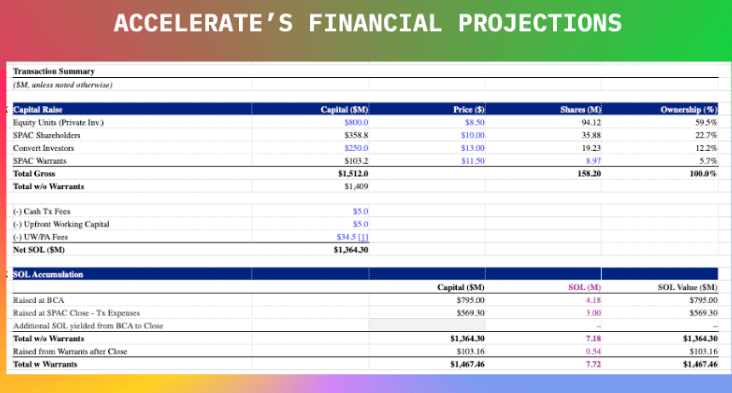
The business logic behind this move is a sophisticated "narrative switch". It attempts to make the market forget the "fund manager McCann" who failed at the micro-trading level, and instead focus on the "entrepreneur McCann" with a macro-strategic vision.
To achieve this grand goal, McCann designed an extremely complex Wall Street capital game. These $1.5 billion are not a simple financing, but a "pipeline" intricately woven from multiple financial instruments like PIPE, SPAC trust funds, convertible debt, and warrants. The purpose is singular: to package a high-risk, high-volatility crypto "core" with a compliant "shell" that traditional institutional investors are familiar with and trust.
The SPAC model is especially suitable for him, as it allows companies to attract investment by using beautiful "future predictions" in their listing promotions. This is a stage tailored for him, the "chief evangelist", enabling him to vividly describe to Wall Street fund managers the grand blueprint of exponential growth in the Solana ecosystem.
Perhaps deeply aware of his previous embarrassing failure record, McCann cleverly found a partner who could be called a "stabilizing needle" for his new project - Komal Sethi, a Silicon Valley elite with a Stanford computer background and an impressive resume. This leadership combination of a "visionary + pragmatist" was undoubtedly a clever public relations move. It sent a strong signal to the outside world: Don't worry that Joe McCann will act recklessly; this time he has found a reliable academic to watch over him. He is responsible for looking up at the stars and describing dreams, while his team is responsible for staying grounded and ensuring execution. This is the most crucial step in combating the negative image of a "reckless trader" and rebuilding market trust.
A Gold Rush Called "Treasury"
To truly understand the background of McCann's 15 billion dollar bold bet, we must zoom out and examine the new wave sweeping the entire capital market at the time - the gold rush of "Solana Treasury Companies". Accelerate was not an isolated case, but the pinnacle of this wave.
The pioneer of this model was MicroStrategy, a publicly listed company that openly announced Bitcoin as its primary reserve asset. Solana Treasury Companies then innovated on this basis: they not only bought and held SOL tokens in large quantities but also used Solana's Proof of Stake (PoS) mechanism to generate approximately 6-8% of native annual yield through Staking their SOL.
For public market investors, this provided an extremely attractive value proposition: by purchasing a regulated stock, they could simultaneously obtain SOL token price exposure and stable Staking income, without having to bear technical risks such as managing private keys or selecting validation nodes themselves.
Before Accelerate entered the field, the track was already crowded with ambitious competitors like Upexi and DeFi Development Corp. They continuously increased their SOL holdings through various financing methods such as private placements and equity credit lines. The essence of this game was a race about scale and market expectations. Whoever could hold the most SOL would be in the most advantageous position in the future Solana ETF narrative and enjoy the highest stock price premium.
While other companies mostly adopted a "small steps, quick run" strategy of gradually increasing holdings, Accelerate under McCann was entirely different. He attempted to use the SPAC method - a "big bang" approach - to raise massive capital at once, becoming an undisputed market leader in one step. This was a typical "winner takes all" strategy with extremely high risks, but equally tempting returns.
Solana's Centralization Cost
The birth of Accelerate was not just a financial event, but also a mirror reflecting the core and most controversial soul-searching of the Solana ecosystem: the question of decentralization.
For a long time, Solana has faced criticism for not being decentralized enough due to its design trade-offs. In pursuit of ultimate speed and performance, it set extremely high hardware requirements for validation nodes, resulting in computing power being concentrated among a few professional entities. Its early token distribution also predominantly flowed to teams and institutional investors.
The rise of massive treasury companies like Accelerate would undoubtedly intensify this trend. When an entity holds and stakes over 1.3% of the entire network's SOL, it becomes a huge, centralized power node. This seems to be at odds with the blockchain world's ideals of power distribution and censorship resistance.
Interestingly, Solana's official supporters - the Solana Foundation - have shown a pragmatic and even encouraging attitude towards this trend. This reveals the strategic trade-off of Solana's leadership: at the current stage, attracting institutional capital and gaining mainstream market recognition might take priority over maintaining theoretically perfect decentralization.
This appears to be a "trilemma" that Solana is facing: it wants to simultaneously possess high performance, institutional adoption, and complete decentralization, but these three are often difficult to achieve simultaneously in reality. The rise of treasury companies indicates that it is actively embracing institutions, even if this might come at the cost of sacrificing a certain degree of decentralization. Solana seems to be betting that the network effects and legitimacy of becoming Wall Street's preferred "decentralized NASDAQ" will ultimately be more valuable than adhering to pure idealism.
Conclusion: An Unfinished Answer
Joe McCann's story ultimately points to a core question about value judgment. His left-hand failure exposed fatal flaws in his micro risk management, while his right-hand bold bet demonstrated his unparalleled skills in macro narrative construction and capital operation.
This 15 billion dollar stunning bet is not only a career redemption battle for him personally but also an ultimate interrogation of current market logic: in an industry full of bubbles and dreams, is a solid past performance more important, or is a story that can make everyone's blood boil more valuable?
This top player of Solana has already laid out his two cards on the gambling table - one a "face-up card" representing shameful failure, and the other a "face-down card" representing infinite hope. Regardless of the final outcome, he has already written the most controversial and dramatic page in the young and wild history of cryptocurrency. Is he a phoenix rising from the ashes or a gambler falling into the abyss? Time will ultimately provide the final answer.