



On July 30th Eastern Time, a document eagerly anticipated by the crypto industry is about to be released - the White House's first digital asset policy report. It not only represents the Trump administration's first systematic expression of cryptocurrency regulation stance but is also considered a potential roadmap for industry development in the coming years.
This report, about to be unveiled, stands out amid multiple legislative progress and regulatory negotiations, and its impact may far exceed regulation itself.
Administrative Order-Driven "Top-Level Design": Starting from Executive Order 14178
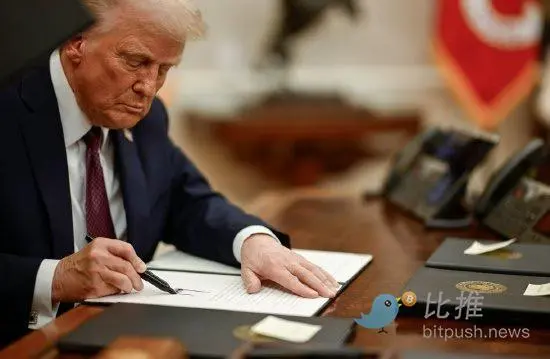
In January, US President Trump signed Executive Order 14178, officially requesting the establishment of a "Presidential Digital Assets Working Group" led by the Treasury Secretary. The group includes the SEC Chairman, Secretary of Commerce, and other core regulators, with the mission of comprehensively assessing the development of digital assets and proposing targeted policy recommendations.
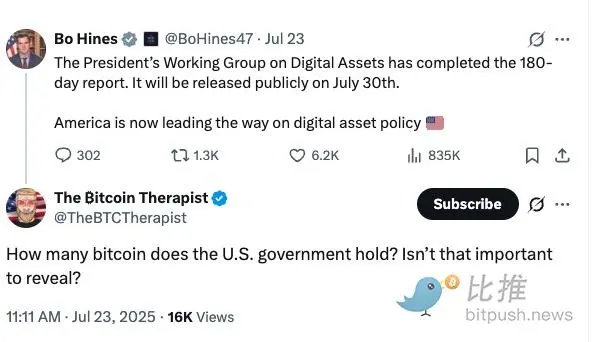
Now, after 180 days of preparation, this heavyweight report is finally about to emerge. White House Crypto Affairs Executive Director Bo Hines has confirmed on social media that it will be officially released on July 30th, stating that "the United States is leading the global digital asset policy trend".
The timing of the report is also quite delicate - key legislations like the GENIUS Act and CLARITY Act are making substantial breakthroughs. The dual-line promotion of administrative orders and legislation sends a strong policy signal: the United States is no longer waiting and observing, but fully engaging with digital assets.
Industry Focus: The Arrival of the "Explicit Regulation Era"
After years of regulatory ambiguity and multi-party negotiations, the industry's most urgent expectation for this report is centered on "clarity" and "boundaries".
US Digital Chamber CEO Cody Carbone directly stated: This will be the "programmatic document for all related regulations and guidelines in the next three and a half years".
Based on current information, the report is expected to focus on four major areas:
1. Stablecoin Regulatory Framework
The report may propose institutional designs for USD-pegged stablecoins, including issuance thresholds, reserve mechanisms, and audit transparency, laying the foundation for the continuously expanding stablecoin ecosystem.
2. Bank Access and Cooperation Mechanism
Regarding the "legitimate identity" of crypto enterprises in bank accounts and payment channels, the report is expected to propose policy ideas for integration with traditional finance while strengthening risk isolation.
3. National Security Perspective
Addressing potential issues of digital assets in cross-border transactions, sanction evasion, and money laundering risks, the report will emphasize "compliance technology" construction and promote the alignment of technical means with regulatory needs.
4. Technical Neutrality and Regulatory Boundary Delineation
"Regulating by function rather than technology" may become the report's main tone, clarifying the functional boundaries of regulatory agencies and resolving the long-standing "multi-agency management" and "regulatory gaps" that have troubled the industry.
Cody Carbone noted that clearly defining the "dos and don'ts" will greatly enhance industry confidence.
Holding Mystery: How Many BTC Does the US Government Actually Hold?
Besides the regulatory blueprint, another closely watched part of the report is the first official disclosure of the US government's crypto asset holdings.
For years, the claim that the "US government holds the most Bitcoin globally" has been widely circulated online. According to the platform BitcoinTreasuries, the US government's holdings are estimated at around 198,000 BTC, far exceeding other countries.
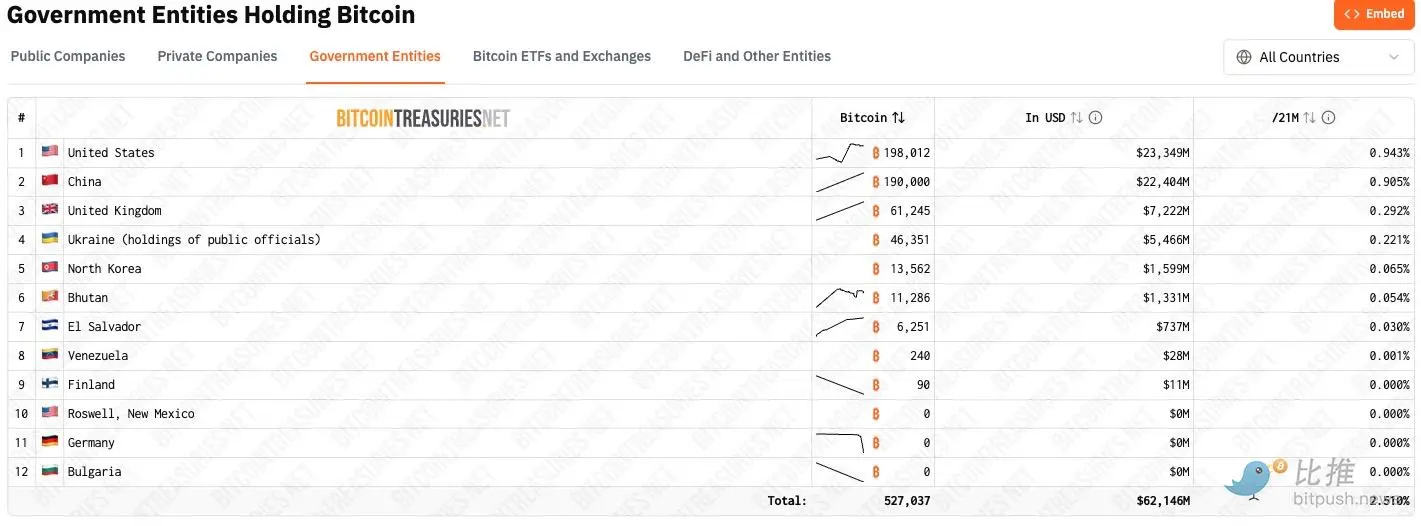
However, independent journalist L0la L33tz recently requested holding data from the Department of Justice through the Freedom of Information Act (FOIA), and the result showed that the Department of Justice only has 28,988 Bitcoins. This figure is far below market expectations, raising questions like "Were nearly 170,000 Bitcoins sold?"
A more neutral explanation comes from community user Shifu Dumo. He believes the FOIA data only reflects the currently realizable portion of the Department of Justice's subordinate agency - the US Marshals Service (USMS). Some assets may be frozen, used for victim compensation, or held by other agencies, and thus not included in the Department of Justice's report.
However, this also means that the number of Bitcoins truly belonging to the US federal government and available for "national strategic reserves" may be far lower than external imagination.
Crypto commentator "The ₿itcoin Therapist" directly asked White House Crypto Affairs Executive Director Bo Hines on social media: "How many Bitcoins does the US government hold? Isn't it important to reveal this?" This sentence fully expresses the community's desire for transparency.
This upcoming White House report is expected to reveal the true situation of US government Bitcoin holdings and provide an official explanation for these "disappeared" Bitcoins, thereby answering the market's long-standing questions.
Industry Reaction: Signal of Entering the "Adoption Period"
The industry's response to this upcoming report is generally positive. Blockchain Association CEO Summer Mersinger believes it marks the substantial implementation stage of the crypto executive order.
Wintermute Policy Director Ron Hammond views the report as an "important step for Trump to fulfill his promise to the crypto industry".
In the view of 22V Research Managing Director Jordi Visser, we are at a turning point where the crypto industry is transitioning from "trying" to "acceptance and adoption". He compares the current stage to the "ChatGPT moment of the crypto world".
With regulatory expectations clarifying and institutional entry pace accelerating, Bitcoin's price has recently rebounded strongly, briefly breaking through the $120,000 mark. At the time of writing, it remains stable above $117,000, with a total market value of $3.85 trillion.
This report is not only a systematic presentation of the Trump administration's crypto policy but also an important "moment" for the global crypto market. How will it balance encouraging innovation and preventing risks? Will it address the trust gap regarding US strategic holdings? These answers are about to be revealed.






