Author: Fugui, LXDAO
1. DAO Development and Governance Evolution
1.1 DAO History and Key Events
The DAO (Decentralized Autonomous Organization) concept was coined by Ethereum founder Vitalik Buterin in 2014, expanding upon Daniel Larimer's DAC (Decentralized Autonomous Company). Its earliest application can be traced back to the famous 2016 "The DAO" project, which quickly raised over $150 million through a token crowdfunding campaign. However, due to a smart contract vulnerability, nearly $50 million was stolen, triggering a hard fork of Ethereum. While this incident was a setback for the DAO, it also prompted the community to rethink governance mechanisms and security. Since then, a new generation of DAOs has emerged, represented by MakerDAO (which launched the DAI stablecoin in 2017), Aragon, MolochDAO, and MetaCartel DAO, rapidly spreading the DAO concept within decentralized finance (DeFi) and open governance. DAOs have evolved from single projects to platforms providing governance frameworks. According to DeepDAO’s 2024 data, the number of active DAOs worldwide has exceeded 10,000, with the total value of their treasury assets reaching US$40.1 billion (CCN, March 2024).
1.2 General Organizational Structure of DAO
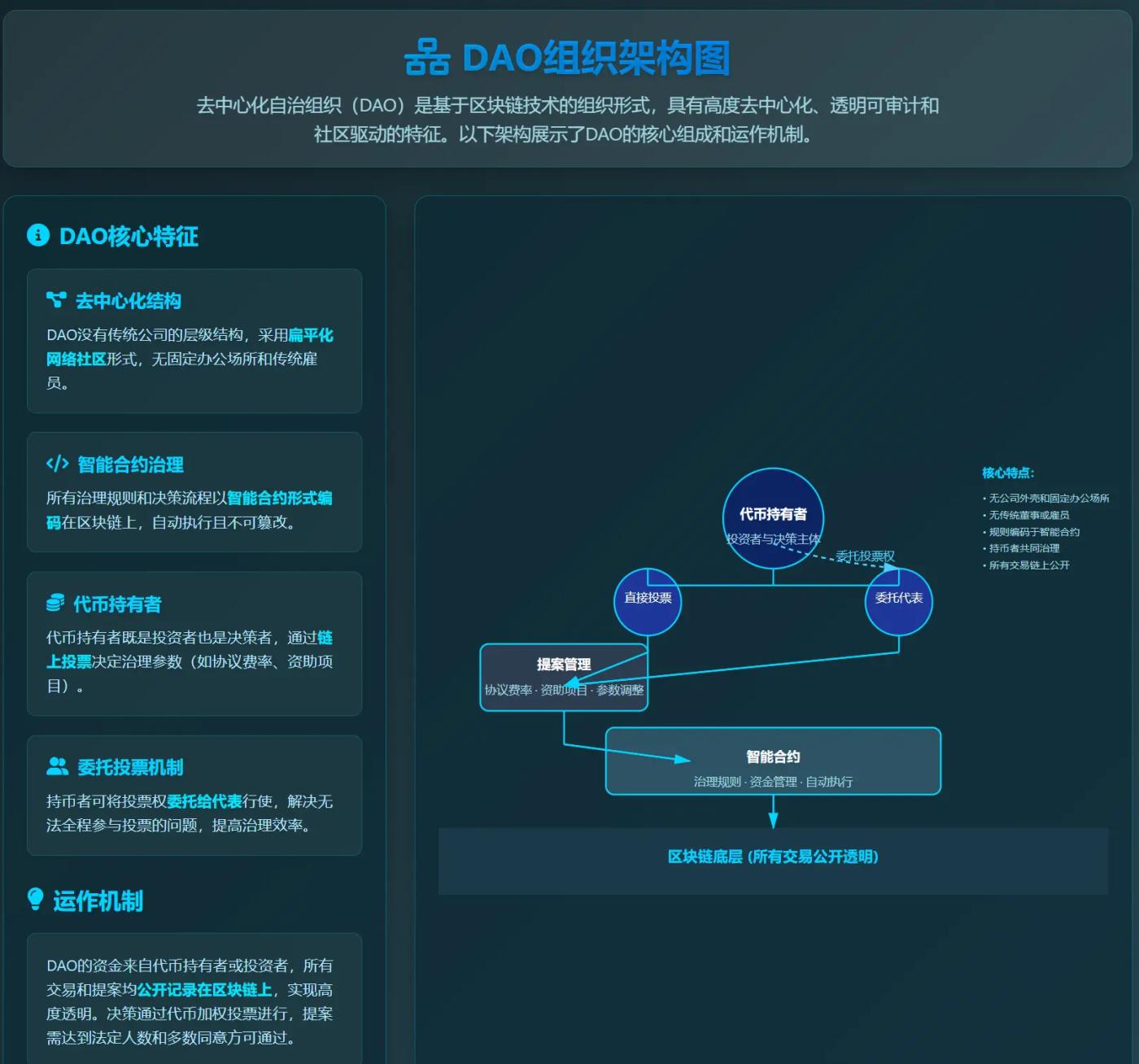
Structurally, a DAO is typically an "online community without a corporate shell or fixed office space." DAOs lack traditional directors or employees. Their governance rules and decision-making processes are encoded in smart contracts on the blockchain, collectively executed and overseen by token holders. For example, DAOs are primarily funded by token holders or investors, and all transactions and proposals are publicly recorded on-chain, ensuring a high degree of transparency. Token holders act as both investors and voting entities within the DAO, voting on proposals on-chain. Governance parameters (such as protocol fees and funding projects) are determined through token voting. Furthermore, to address the issue of individual token holders being unable to participate in the voting process, many DAOs (such as MakerDAO) have implemented delegated voting mechanisms: token holders can delegate voting rights to others, improving governance efficiency. Overall, DAO organizational structures exhibit a high degree of decentralization, transparency, auditability, and community-driven characteristics.
1.3 MakerDAO Governance Mechanism and Evolution
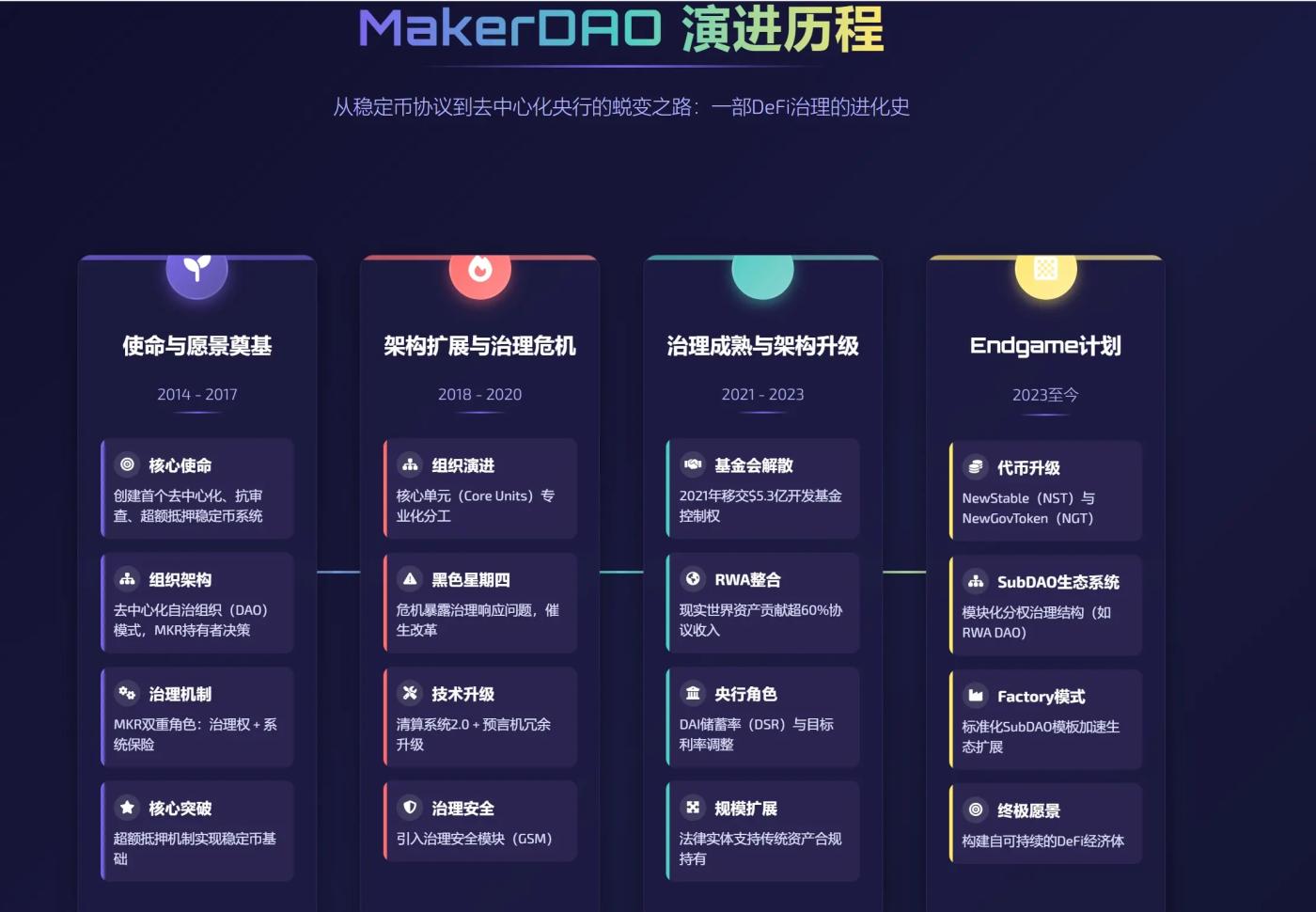
Take MakerDAO , for example. Its governance model exemplifies a key path in the evolution of DAOs. MakerDAO, launched by Rune Christensen in 2015, primarily issues DAI, a decentralized stablecoin pegged to the US dollar. MakerDAO employs a dual-token model: MKR serves as the governance token, with holders voting on key parameters (such as the stability fee, collateral type, and risk parameters); users generate DAI by staking crypto assets into smart contracts, thereby driving the stablecoin's operation. Traditionally, MakerDAO's core team, such as the Maker Foundation, initiated on-chain proposals and made decisions. However, as the community has grown, governance has gradually shifted to the public on-chain. In 2021, the Maker Foundation transferred 84,000 MKR (currently worth $530 million) of its development fund to the DAO governance contract, where MKR holders collectively decide how to use the funds. MKR holders have begun to independently propose governance proposals and participate in multiple rounds of voting. In order to reduce governance complexity and concentration risks, MakerDAO adopts a " progressive decentralization " strategy, introduces "delegated voting" and supports a mechanism for multiple stability fees, enhancing participation flexibility.
Entering 2022-2024, the "MakerDAO Endgame" proposal initiated the next step in governance restructuring: modularizing MakerDAO through the introduction of SubDAOs. In the second phase of Endgame, MakerDAO plans to deploy the first six SubDAOs, divided into two categories: the Facilitator DAO and the Allocator DAO. The former focuses on governance process management, while the latter is responsible for the allocation of new collateral and operational efficiency. Each SubDAO has its own independent governance token and community operations, making decisions at a smaller scale, with its operational results incorporated into the main DAO's ledger. This move aims to streamline MakerDAO governance, reduce operational complexity, and diversify risks. In other words, MakerDAO is evolving from its initial single core team governance model to a modular governance system with macro-control by MKR holders and autonomous execution by each SubDAO. The introduction of the SubDAO structure represents an innovative approach to large-scale decentralized organizational governance: by dividing responsibilities among specialized sub-entities, governance becomes more flexible and specialized, while still retaining ultimate control for MKR holders. It is foreseeable that MakerDAO's exploration may become a new paradigm for managing complex protocols and innovative expansion in the DeFi field.
2. NGO Development Experience and GiveWell Case Study
2.1 Origins and Governance Logic of NGOs
Non-governmental organizations (NGOs), a crucial component of civil society, emerged in the late 19th century, with their formal definition emerging within the United Nations framework after World War II (first mentioned in Article 71 of the 1945 UN Charter). NGOs are typically independent, non-profit organizations supported by volunteers and donors, whose mission is to promote social or environmental benefits. The UN officially defines NGOs as "non-profit, voluntary groups organized for the public good." They work in diverse fields, including human rights, health, environmental protection, and poverty alleviation, and some even serve as advocates and monitors for corporate and government policies. Broadly speaking, DAOs are natural NGOs.
In terms of governance, NGOs emphasize mission-orientation and accountability . On the one hand, they organize their activities around their mission and beneficiaries, prioritizing project results over profit. On the other hand, to ensure public trust and the proper use of resources, good NGO governance requires a clear system of internal checks and balances. Specifically, organizations typically have a dual structure consisting of a board of directors (or council) and a management team, with the board responsible for strategic decision-making and oversight, and management responsible for day-to-day operations. This ensures that no single individual or team can monopolize power, and that organizational resources are used for public service rather than internal profit. Effective NGOs also disclose financial and operational information and establish external audit and evaluation mechanisms to respond to donor and public scrutiny. For example, the NGO Governance Handbook, which provides operational advice, states: "Good governance means that the organization has a clear distribution of powers and responsibilities... and that internal checks and balances are in place to ensure that the public interest is upheld." Overall, NGO governance culture emphasizes transparency, accountability, and mission-first principles, which is distinct from traditional corporate governance.
2.2 GiveWell Case Study: Mission and Division of Labor
GiveWell , a charity evaluation organization founded in 2007, represents a model for effective nonprofits. Founded by two finance professionals, GiveWell adheres to its mission of "helping donors do the most good." Through pooled resources and rigorous analysis, it recommends a limited number of "high-impact" charitable projects. Unlike most charities, GiveWell doesn't prioritize the lowest cost, but rather measures the "life saved" impact of every dollar spent, emphasizing a results-oriented approach. They publicly advocate for the independence and transparency of their research: all evaluation processes and data are freely available and accessible to anyone.
GiveWell's organizational structure clearly follows the NGO model: its staff is divided into functional departments—for example, the CEO's office oversees strategy; the research department is organized into thematic groups (e.g., malaria, nutrition, and vaccines); the operations department is responsible for finance, human resources, and technology; and the external relations department manages fundraising and public communications. The board of directors is composed of prominent philanthropists, such as Cari Tuna, co-founder of the renowned American philanthropy fund Good Ventures, who serves as GiveWell's chair. The board oversees GiveWell's overall strategy and policies, ensuring its operations align with its mission. Notably, GiveWell emphasizes zero fees and takes no commission from donations. All operating funds are covered by unconditional grants from its donors, and it maintains a minimum administrative and operating budget of 10% of total funding. If fundraising exceeds GiveWell's needs, any excess funds are donated to recommended charities. This financial arrangement underscores GiveWell's commitment to measuring success by ensuring that "maximum spending goes to good causes."
2.3 GiveWell’s transparency and impact assessment process
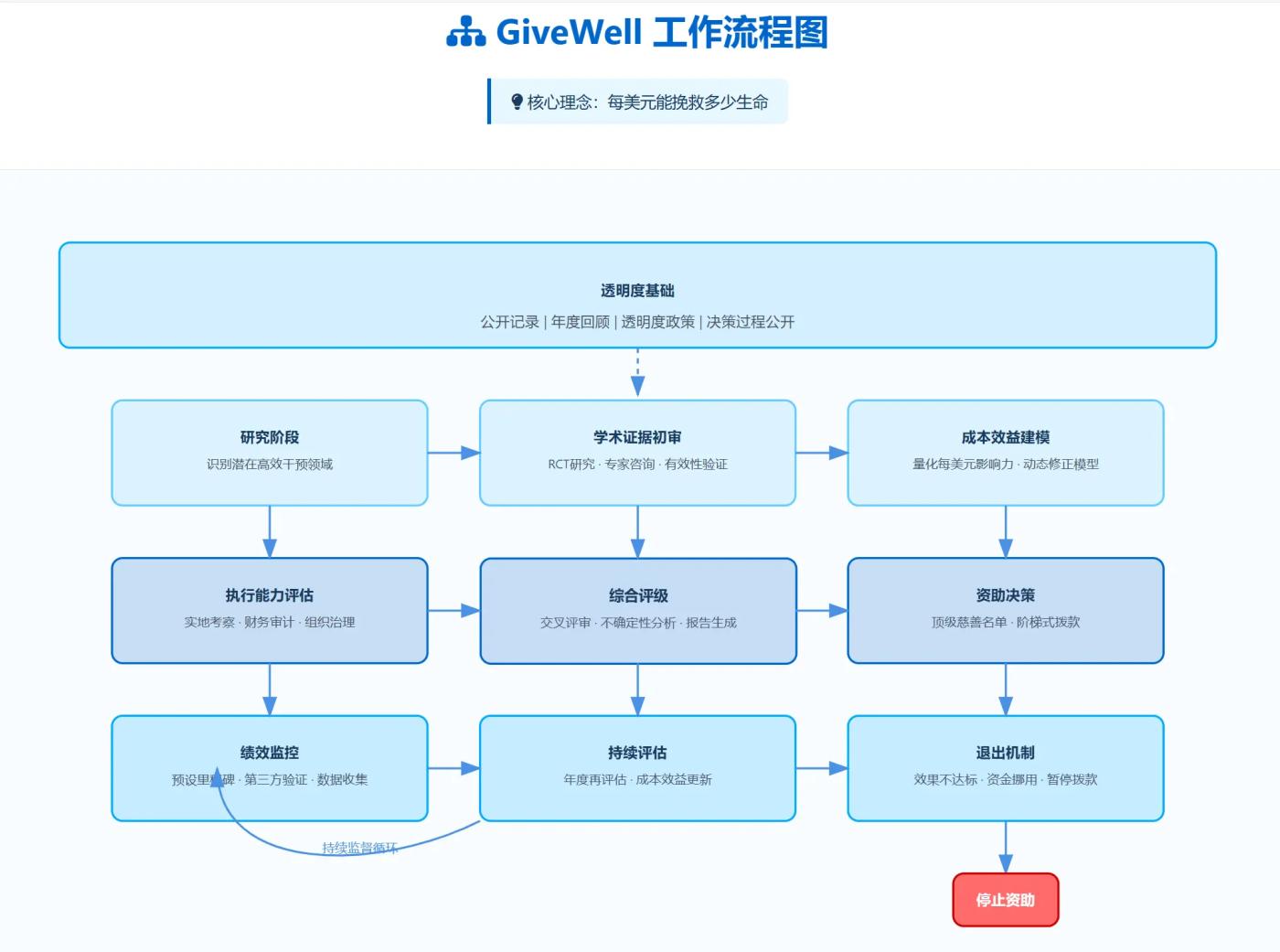
A key feature of GiveWell's governance is its high degree of transparency . Its official website features sections such as "Public Records," "Annual Review," and "Transparency Policy," providing public access to detailed information including financial statements, operational strategies, and decision-making processes. Transparency is also clearly listed as a core value in GiveWell's organizational values. GiveWell conducts a rigorous, multi-step evaluation process for each grant: First, it reviews independent academic research (such as randomized controlled trials) and consults with field experts to confirm whether the project achieves its objectives. It then constructs a detailed cost-effectiveness model, continuously refined using budget and monitoring data, to estimate the improvement (e.g., lives saved) achieved per dollar invested. Interviews and site visits are conducted with potential grantees to verify actual implementation. The evaluation also reviews the organization's financial transparency and past performance record, ultimately resulting in a written report and quantitative metrics. After a project is funded, GiveWell is committed to continuously monitoring its progress: if it finds that its goals are not being effectively achieved, the team will promptly terminate funding. This comprehensive, evidence-based evaluation process ensures the cost-effectiveness and ongoing oversight of the projects funded, unlike traditional donor evaluation methods that rely solely on self-reported performance.
2.4 Comparison between GiveWell and DAO Model
Structurally, NGOs like GiveWell differ significantly from DAOs. For one thing, GiveWell has a clear legal entity and organizational hierarchy: a headquarters, staff, and board of directors, and relies on legal channels for fundraising. DAOs, on the other hand, typically lack formal legal entities and are built entirely on blockchain protocols and token economies, with governance directly participated in by a globally dispersed community. As previously mentioned, DAOs lack directors or managers; all decision-making rules are defined by code and enforced by token voting, whereas NGOs rely on human management and oversight. Culturally, NGOs like GiveWell emphasize their mission and values, proactively engaging in external outreach and donor engagement. DAOs, on the other hand, adhere more to an open-source, consensus-based culture, with autonomous communities using token incentives to focus on protocol goals, and membership based on token holdings rather than traditional identity verification. Despite this, there are also commonalities: for example, GiveWell's emphasis on transparency aligns with DAOs' on-chain auditability. The public welfare orientation of NGOs and the community-based autonomy of DAOs both pursue the goal of disintermediation. In the future, combining the professional governance methods of NGOs with the technological advantages of DAOs may create new organizational forms.
2.5 Outlook on the Integration Trend of NGOs and DAOs
Despite differences in governance structures between traditional NGOs like GiveWell and DAOs, their shared transparency and mission-driven nature are driving a convergence of organizational forms. This convergence isn't a one-way process, but rather a two-way journey: DAOs, due to their long-term low profits and public welfare orientation, may naturally evolve into NGOs in the face of competition from commercial organizations, with financial metrics taking a back seat. Simultaneously, traditional NGOs, driven by the demand for governance transparency and increased participation, may also transition to DAOs due to the development of blockchain and other network technologies.
The evolution of DAOs into NGOs reveals that their sustained, marginally profitable operations have gradually shifted these organizations away from a purely financially driven approach, toward a focus on public welfare and social value creation as core evaluation criteria. The collective decision-making mechanisms within DAO governance foster a public interest consciousness among members. Their open-source collaborative culture aligns closely with the knowledge-sharing philosophy of NGOs, and their community-based self-governance practices offer a new organizational paradigm for addressing social issues. Token incentives have also shifted from purely financial gains to driven by value recognition and social impact. This shift has brought DAOs closer to the operational logic of traditional NGOs.
Traditional NGOs are also inherently motivated to transform into DAOs. Donors are increasingly demanding traceability of funding flows. The immutable nature of blockchain technology can completely resolve the long-standing transparency challenges facing NGOs, as demonstrated by the UNICEF CryptoFund pilot. The automated execution of smart contracts not only reduces governance costs but also enables conditional release of donations, ensuring precise allocation of funds. More importantly, traditional NGO board governance models struggle to meet the needs of diverse participation. DAO's token-based governance mechanism provides equal decision-making power to donors, beneficiaries, and volunteers, while a decentralized voting system enhances democratic and inclusive decision-making.
This two-way integration is giving rise to hybrid NGO+DAO organizational forms. Switzerland's "association legal entity + on-chain governance" model (such as the Aragon entity) has proven a path to legal compliance. This hybrid entity structure maintains legal status while enjoying the flexibility of DAO governance. In terms of governance mechanisms, this integration can foster a hierarchical decision-making system: strategic decisions utilize DAO community voting mechanisms to enhance NGO stakeholder participation, while the execution layer retains the NGO's professional hierarchical governance experience to optimize DAO decision-making quality. In terms of technological empowerment, blockchain technology provides the infrastructure support for cross-border donations and project execution. All key decisions and funding flows are recorded on-chain, while specific project activities are executed off-chain, creating an operational structure that prioritizes both transparency and professionalism.
While this hybrid model offers significant advantages in optimizing resource allocation, improving governance efficiency, and reconstructing trust mechanisms, it also faces challenges such as regulatory adaptability, technical barriers, and governance complexity. As blockchain technology matures and regulatory frameworks improve, the NGO+DAO hybrid model will become a key development direction for public welfare organizations, ultimately forming a new public welfare ecosystem characterized by transparency, democracy, and efficiency.
3. The possibility of combining the ESG assessment system with DAO governance
3.1 Evolution of the ESG Framework and Core Concepts
ESG , a non-financial performance evaluation framework encompassing three dimensions: environmental, social, and governance, has its roots in ethical investing and corporate social responsibility (CSR) concepts from the late 20th century. Religious groups in the 18th century and environmental and social movements in the 20th century first proposed the concept of avoiding investments in harmful industries. The 1987 United Nations report, "Our Common Future," introduced the concept of sustainable development. In 2004, the United Nations Global Compact published its report, "Who Cares Succeeds," which formally coined the term "ESG." The Principles for Responsible Investment (PRI) were launched in 2006, providing guidance for investors to incorporate ESG into their practices. In recent years, governments and regulators worldwide have increasingly mandated the disclosure of ESG data, such as through the EU's Sustainable Finance Regulation and the UK's revised Companies Act, pushing ESG reporting into the mainstream. To standardize information disclosure, a variety of standards and frameworks have emerged: the Global Reporting Initiative (GRI), the Industry-Specific Accounting Standards Board (SASB), the EU Corporate Sustainability Reporting Directive (CSRD), the Climate-related Financial Disclosures (TCFD), etc., all guide companies to quantitatively or qualitatively report their performance in carbon emissions, diversity, governance structure, etc.
3.2 Balanced Development of Negative and Positive ESG Assessment Indicators
Currently, ESG assessment agencies and organizations, driven by publicity and vested interests, often focus on negative indicators, such as environmental pollution, labor violations, and corporate governance scandals. While this approach helps identify risks, it can overlook an organization's positive contributions and innovative value. However, with the development of sustainable investing concepts, more and more organizations are shifting their focus toward positive impact indicators .
For example, some leading rating systems (such as MSCI ESG and Sustainalytics) are introducing quantified and weighted scores based on a company's positive contributions to renewable energy investment, employee diversity, community development, and green innovation. The introduction of positive indicators not only provides a more comprehensive picture of a company's ESG performance but also provides investors with a more forward-looking basis for decision-making. Some studies (such as those published in the Harvard Business Review) indicate that companies that excel in social responsibility and environmental innovation tend to have stronger risk resilience and long-term financial performance.
Therefore, future ESG assessments should evolve toward a "double materiality" approach, simultaneously considering a company's positive contributions to society and the environment, as well as its potential negative impacts. This balanced approach better aligns with the essential requirements of sustainable development and provides a more suitable assessment approach for emerging organizational forms such as DAOs.
3.3 Advantages and Innovations of DAO in Social Responsibility
In terms of social responsibility , DAOs possess advantages that traditional organizations struggle to match. Their openness and global nature enable them to transcend geographic and identity constraints, providing opportunities for a wider range of stakeholders to participate in governance. Through token economics and incentive mechanisms, DAOs can achieve fairer value distribution, allowing community members to directly share in the benefits of organizational development.
Specifically, DAO’s positive impact indicators in terms of social responsibility include:
Community inclusion indicators include the geographical diversity of DAO members, the proportion of participants from different backgrounds, and the prevalence of decision-making participation. These indicators reflect whether the DAO truly achieves decentralized governance, rather than being controlled by a small number of large players.
Knowledge sharing and educational impact : Many DAOs promote knowledge dissemination through open source code, public research, and community education. Metrics include the number of contributions to open source projects, the coverage of educational content, and the number of participants in skills training.
Economic Opportunity Creation : DAOs provide new economic opportunities for remote workers, freelancers, and creators worldwide. Relevant metrics include the number of members earning income through DAOs, average income levels, and job creation.
Social Issues : Some specialized social DAOs focus directly on public welfare, such as environmental DAOs, education DAOs, and medical research DAOs. The influence of these organizations can be measured through indicators such as the number of beneficiaries, the scale of issues solved, and the effectiveness of collaboration with traditional public welfare organizations.
3.4 DAO’s technical advantages in governance efficiency
Governance efficiency (G) is where DAOs have the greatest advantage over traditional organizations. The immutability of blockchain technology and the automated execution of smart contracts bring unprecedented transparency and efficiency to organizational governance.
Transparency and auditability : All DAO proposals, voting results, and fund flows are recorded on a public blockchain, accessible to anyone in real time. This "code is law" governance model eliminates the potential for "black box" operations found in traditional organizations. Positive indicators include:
- Governance transparency score: based on information disclosure, traceability of decision-making processes, etc.
- Audit convenience: the cost and efficiency of external audits
- Community supervision participation: The degree to which community members actively monitor and provide feedback on the governance process
Decision-making efficiency and execution : Smart contracts can automatically execute voting results, reducing human intervention and execution delays. Delegated voting mechanisms increase governance participation, while modular sub-DAO structures (such as MakerDAO's Endgame solution) further enhance the efficiency of specialized decision-making. Key indicators include:
- Proposal processing cycle: average time from proposal to execution
- Voting participation rate: the proportion of active governance participants to the total number of token holders
- Decision execution success rate: the proportion of proposals that are actually implemented after being voted on
Risk Management and Compliance : Advanced DAOs use multi-signature, time lock, emergency pause and other mechanisms to manage risk. At the same time, some DAOs have begun to proactively comply with regulatory requirements and establish compliance frameworks. Relevant indicators include:
- Security incident rate: the frequency of negative events such as smart contract vulnerabilities and financial losses
- Compliance level: compliance with relevant regulations
- Risk control effectiveness: the effectiveness of risk warning and response mechanisms
Stakeholder participation : DAO token holders are both investors and governance participants, which naturally achieves broad stakeholder participation. Impact indicators include:
- Even distribution of governance tokens: avoiding excessive centralization
- Participation of different types of stakeholders: participation of developers, users, investors, etc.
- Cross-cultural and cross-time zone governance participation: reflecting the inclusiveness of global governance
3.5 Theoretical Basis and Implementation Principles of DAO-ESG Assessment
3.5.1 Theoretical Adaptability Analysis
While traditional ESG frameworks are primarily designed for traditional businesses, DAO's decentralized nature naturally aligns with ESG assessment concepts. The transparency of DAO's on-chain governance addresses the information asymmetry inherent in traditional ESG reporting. Its token-based governance mechanism enables direct stakeholder participation, bringing it closer to the ESG ideal of multi-governance than traditional businesses. Its borderless nature allows for global social and environmental impact, highly aligned with the United Nations Sustainable Development Goals.
3.5.2 Core Implementation Principles
Data-driven principle : Make full use of the objectivity and integrity of blockchain data, establish a quantitative indicator system based on on-chain data, and reduce subjective bias.
Dynamic Adaptability : Different types of DAOs have different ESG priorities—DeFi protocols prioritize financial stability and inclusiveness, public welfare DAOs emphasize social impact, and infrastructure DAOs focus on technical governance. The assessment framework must have a flexible weighting adjustment mechanism.
Incentive compatibility principle : Combine ESG performance with mechanisms such as token distribution, governance weight, and community reputation to form a positive feedback loop of "the better the ESG performance, the more incentives you get."
Principle of community co-construction : Establish a diversified evaluation system with the participation of community members, third-party institutions, and industry experts to avoid the monopoly of evaluation power by a single institution.
3.5.3 Key Challenges and Solutions
Technical challenges : On-chain data is not highly standardized, and off-chain ESG data integration is difficult.
Solution : Develop an open-source evaluation toolkit and establish cross-chain data standards.
Standardization challenges : There is a lack of dedicated DAO-ESG assessment standards, and different DAO types vary greatly.
Solution : Establish a hierarchical evaluation system, using a simplified version in the start-up phase and a complete version in the mature phase.
Regulatory adaptability challenges : Countries have unclear regulatory requirements for DAOs, and the legal validity of assessment results is questionable.
Solution : Adopt a gradual advancement strategy, conduct pilot projects first and then promote them, and establish a dialogue mechanism with regulatory agencies.
Community acceptance challenge : Some communities believe that external evaluation conflicts with the concept of decentralization.
Solution : Strengthen ESG education and demonstrate the positive role of evaluation in the long-term development of DAOs.
3.5.4 Expected Value
Through systematic ESG assessments, DAOs can enhance social recognition and demonstrate their social value to traditional investors and regulators; promote industry standardization and provide reference for regulatory policy formulation; optimize resource allocation and guide capital flows to high-quality projects; promote the integration of technology and social welfare , and promote blockchain technology to better serve sustainable development goals.
3.6 DAO-ESG Simple Assessment Operation Framework
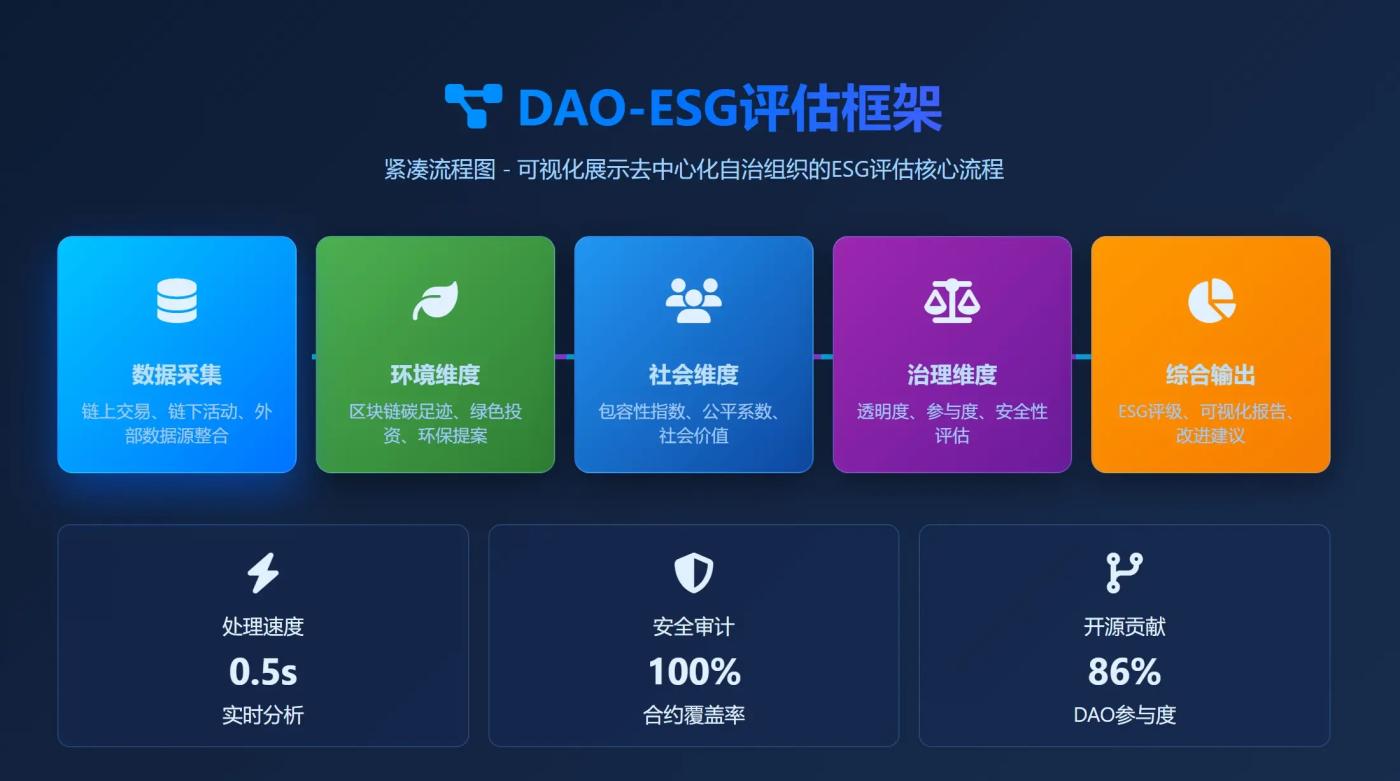
To address the current gap between theoretical construction and practical application in ESG assessments of DAOs, this article constructs a systematic and simplified DAO-ESG assessment framework. This framework aims to provide decentralized autonomous organizations with standardized and quantifiable ESG assessment tools, promoting the sustainable development of the DAO ecosystem.
3.6.1 Construction of core evaluation indicators
Environmental Dimension
- Blockchain environmental footprint : Quantify the annual carbon emissions equivalent based on the consensus mechanism, transaction frequency and energy intensity of the blockchain network used by the organization
- Green asset allocation ratio : The proportion of environmentally friendly project investments in the total assets of the DAO treasury, reflecting the organization's financial commitment to sustainable development
- Environmental governance participation : The number, approval rate, and implementation effect of environmental protection proposals, measuring the organization's governance activity on environmental issues.
Social Dimension
- Governance Inclusiveness Index : A comprehensive index based on the diversity of members' geographical distribution, cultural background, and participation thresholds.
- Economic Fairness Coefficient : Quantify the fairness of token distribution and revenue sharing using inequality indicators such as the Gini coefficient
- Social value creation effect : Evaluate the positive externalities of an organization through the number of open source contributions, the scope of public welfare projects, and the number of social beneficiaries
Governance Dimension
- Information transparency score : A comprehensive assessment based on financial disclosure, openness of decision-making processes, and ease of access to information
- Democratic participation effectiveness : quantitative analysis of governance processes such as voting participation rate, proposal quality, and decision execution rate
- System security indicators : smart contract audit coverage, security vulnerability frequency, and the degree of perfection of risk control mechanisms
3.6.2 Automated Evaluation Process Design
Data acquisition mechanism
- On-chain data collection : Automatically capture native data such as governance voting, capital flow, transaction records, etc. through the blockchain API interface
- Off-chain data integration : Aggregate GitHub code contributions, Discord community activity, official website information disclosure and other multi-source data
- External data supplement : Introducing third-party environmental impact assessment data, industry benchmark data and regulatory compliance information
Scoring algorithm model
The weighted average method is used to construct a comprehensive scoring model:
DAO-ESG综合得分= E维度得分× αE + S维度得分× αS + G维度得分× αGThe weight coefficient is dynamically adjusted according to the DAO type:
- DeFi protocols: αE=0.30, αS=0.35, αG=0.35
- Charity: αE=0.20, αS=0.50, αG=0.30
- Governance tools: αE=0.20, αS=0.30, αG=0.50
Rating standards
Establish a five-level evaluation system: Excellent (A, 90-100 points), Good (B, 80-89 points), Qualified (C, 70-79 points), Needs Improvement (D, 60-69 points), Unqualified (E,
3.6.3 Technical Implementation Architecture
System architecture design
- Front-end display layer : Using the React framework to build an ESG data visualization dashboard
- Business logic layer : Node.js-based backend service processing data analysis and score calculation
- Data storage layer : a hybrid storage solution that integrates blockchain data and traditional relational databases
Functional modules
- Real-time monitoring module : Dynamically track the changing trends of key ESG indicators
- Report generation module : Automatically outputs assessment reports that comply with international ESG disclosure standards
- Comparative analysis module : provides horizontal comparison and improvement suggestions for DAOs of the same type
3.6.4 Framework Verification and Multi-Scenario Application Analysis
Multi-type DAO evaluation and verification
To verify the applicability and differentiation of the framework, this study constructs theoretical evaluation models for three typical DAOs:
| DAO Types | Environmental Dimension | social dimension | Governance Dimension | Comprehensive score |
|---|---|---|---|---|
| Green Finance DAO | 90 points | 85 points | 88 points | A-level (87.8 points) |
| Focus on renewable energy investment, PoS consensus | Clean energy investment | Global Diversity Participation | Highly transparent governance | |
| Gaming and Entertainment DAO | 65 points | 78 points | 72 points | C level (71.5 points) |
| NFT game ecology, high-frequency trading | High energy consumption but improving | High user activity | Good execution efficiency | |
| Governance tool DAO | 75 points | 82 points | 95 points | B level (84.4 points) |
| Providing governance infrastructure | Medium energy consumption | Technology inclusiveness effect | Innovative governance mechanisms |
Dynamic verification : Taking the Green Finance DAO as an example, a 12-month assessment simulation shows that the framework can effectively capture the differences in DAO development stages (75 points in the basic period → 85 points in the development period → 88 points in the mature period).
Core application scenarios
Investment decision support : ESG investment funds screen high-quality DAO projects to reduce investment risks
Regulatory compliance tools : Regulators establish industry ESG standards to promote self-regulation
Internal governance optimization : DAO self-assessment improvements to enhance community cohesion and external trust
Third-party certification : Rating agencies provide professional certification to promote market standardization
Framework Evaluation
Core advantages : strong technical adaptability, high degree of automation, and strong dynamic update capabilities
Main limitations : Difficulty in quantifying off-chain data, need for standardization, and complex cross-chain evaluation
Recommendations for follow-up research
- Empirical verification : Select real DAO for framework testing
- Standard setting : Collaborate with international ESG organizations to establish industry standards
- Technology upgrade : Optimize data collection and analysis algorithms
- Regulatory docking : improving the compliance indicator system
4. Conclusion and Outlook
Through a systematic analysis across three dimensions, this article reveals the deep synergy between DAOs in governance evolution, nonprofit experience, and ESG performance evaluation, and identifies important trends in the convergence of organizational forms:
The Maturity Path of DAO Governance Evolution
From the security and governance vulnerabilities exposed in the early "The DAO" incident, DAOs have gradually evolved to the dual-token model and delegated voting mechanism exemplified by MakerDAO, and further to the modular architecture of "Endgame" sub-DAOs. This has enabled a shift from single-community governance to a multi-layered governance system with more refined division of labor and clearer responsibilities. This evolutionary process reflects the continuous maturity and innovation of DAO governance mechanism design.The Value of NGO Governance Experience and the Trend of Two-Way Convergence <br>Effective NGOs, such as GiveWell, demonstrate mature practices in mission-driven governance, layered governance, transparent accountability, and ongoing impact assessment. More importantly, research reveals that NGOs and DAOs are undergoing a "two-way" convergence: DAOs, driven by their long-term low-profit nature and public welfare orientation, naturally evolve into NGOs, with financial metrics giving way to social value creation; while traditional NGOs, driven by blockchain technology, are shifting toward DAO governance models, seeking greater transparency and participation. This convergence has given rise to hybrid NGO+DAO organizations, combining the advantages of professional management with decentralized governance.
Adaptability and innovation of the ESG assessment framework
The ESG framework has become a crucial metric for measuring organizational sustainability, and DAOs offer unique advantages in terms of social responsibility and governance effectiveness. By emphasizing positive impact indicators rather than focusing solely on negative risks, DAOs can better demonstrate their value contributions in promoting social inclusion, enhancing governance transparency, and creating economic opportunities.
Future Outlook :
Deepening integration of organizational forms : The NGO+DAO hybrid model will become a key direction for innovation in public welfare and governance. Legal framework innovations such as Switzerland's "association legal person + on-chain governance" provide a compliant path for this integration. In the future, more organizations will adopt a hierarchical decision-making system, achieving an organic combination of on-chain transparency and off-chain professional execution.
Deep integration of technology and governance : In the future, DAOs are expected to maintain their decentralized advantages while introducing more specialized governance mechanisms, such as expert committees, multi-layered decision-making structures, and risk management systems, to achieve both technological innovation and governance maturity. The integration of smart contracts and traditional governance practices will create a new paradigm for organizational operations.
Restructuring and Customizing ESG Assessment Standards : For emerging organizations like DAOs and NGO+DAO hybrids, more tailored ESG assessment indicators and methodologies are needed to highlight their unique value and social contributions in the digital economy. In particular, on-chain quantification of social impact and real-time monitoring of governance efficiency will become new assessment priorities.
Building a cross-border collaborative ecosystem : Collaboration between DAOs, NGOs, traditional enterprises, and regulatory agencies will intensify, forming a diversified governance ecosystem. This collaboration is not limited to resource integration; more importantly, it involves mutual learning and innovation in governance models, jointly promoting the achievement of sustainable development goals.
Exploring global governance models : As the NGO+DAO integration model matures, its decentralized and transparent governance philosophy is expected to provide new ideas and tools for resolving global issues, becoming a crucial component of global governance in the digital age. This model is particularly well-suited to addressing cross-border social issues and the provision of public goods.
Interdisciplinary empirical research and tool development will be crucial for validating the effectiveness of this integrated framework and guiding practical application. In particular, further in-depth research and practical exploration are needed in areas such as the best practices of NGO+DAO hybrid governance models, the quantification of positive ESG impact indicators, and the design of cross-organizational collaboration mechanisms. This convergence trend not only represents innovation in organizational forms but also reflects the direction of development for public welfare and social governance in the digital age.