Investment guru Warren Buffett's Berkshire Hathaway submitted its Q2 2025 financial report on Saturday, revealing that the company's operating profit declined by 4% compared to the same period last year, dropping to approximately $11.16 billion, while net income significantly decreased by 59%, primarily due to a decline in common stock investment income and impairment of Kraft Heinz stock. (Berkshire wrote down Kraft Heinz assets by about $3.8 billion)
Note: Kraft Heinz is a large American food and consumer goods manufacturer, with products including Heinz ketchup, Kraft cheese sauce, Oscar Mayer ham, etc. However, in recent years, it has faced inflationary pressures and changes in consumer eating habits, leading to weakened market demand for its products.
Buffett Warns of Tariff Policy Risks
Additionally, Buffett warned that the changes in international trade policies and tariff situations in the first half of 2025 could adversely affect most of the company's operational businesses and investments, potentially impacting future financial reports.
Berkshire's A shares closed at $711,480, having already declined by approximately 12% over the past three months. 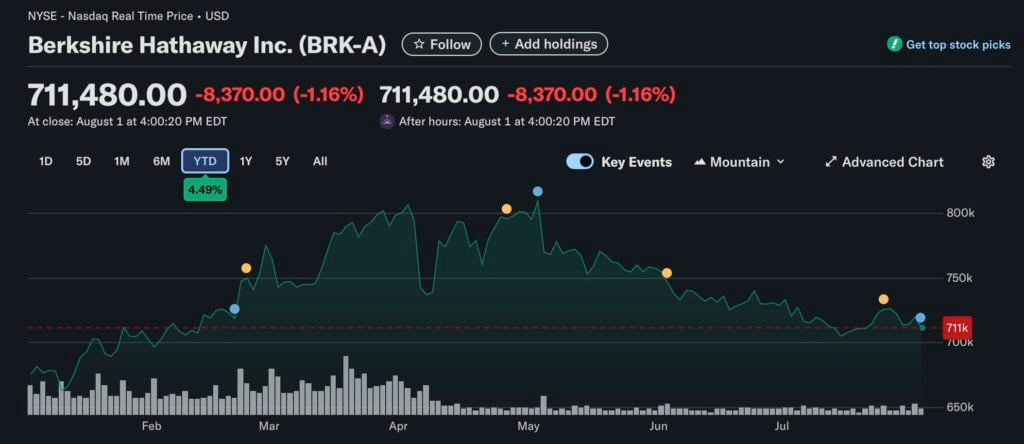
Net Seller of Stocks for 11 Consecutive Quarters
Notably, the Q2 financial report shows that Berkshire has been a net seller of stocks for 11 consecutive quarters: selling $6.92 billion and buying $3.9 billion, and not executing buybacks for four consecutive quarters.
Facing the temporary "discount" brought by Trump's tariff war, Buffett chose to patiently wait and observe. As of the end of June, Berkshire's cash position reached $344 billion, slightly lower than the record high of $348 billion in the first quarter, but still exceeding the total assets of most S&P companies.
Buffett reiterated in his February shareholder letter:
Berkshire will invest most of its funds in stocks.
This statement indicates that cash accumulation is just a process, not the end goal. When a true "big rain" comes, these funds will be transformed into ammunition for acquisitions, increased holdings, or privatization.
Succession Nodes and Operational Headwinds
We know that Buffett will officially step down at the end of 2025, with Greg Abel taking over as CEO. Maintaining financial flexibility before the power transition can provide the new leader with ample buffer space.
The market will observe how Abel continues this disciplined approach while converting cash into assets that can continuously create compound returns. Berkshire's "inaction" can also be seen as a carefully calculated move: exchanging time for price and patience for opportunity.
For investors, this serves as a reminder: The real risk is not missing a rebound, but embracing the wrong assets at the wrong price.
Further Reading: Who is Greg Abel, Buffett's Chosen Successor at Berkshire Hathaway? What are His Views on Cryptocurrency?