From Wall Street investment banks to Bay Area tech companies, and then to Asian financial giants and payment platforms, more and more enterprises are eyeing the same business - stablecoin issuance.
With economies of scale, the marginal issuance cost for stablecoin issuers is zero, which looks like a risk-free arbitrage game in their eyes. Under the current global interest rate environment, the interest spread is incredibly attractive. Stablecoin issuers only need to deposit users' dollars into short-term U.S. Treasury bonds, and they can easily earn billions of dollars annually through a stable 4-5% interest spread.
Tether and Circle have long proven this path viable, and as stablecoin regulations gradually take shape in different regions, the compliance pathway has become clearer. More and more enterprises are eager to try, with FinTech giants like PayPal and Stripe quickly entering the market. Not to mention that stablecoins naturally have the ability to integrate with payment, cross-border settlement, and even Web3 scenarios, with enormous imaginative potential.
Stablecoins have become a battleground for global financial companies.
But the problem lies precisely here: many people only see the "seemingly risk-free" arbitrage logic of stablecoins, overlooking that this is a capital-intensive, high-threshold business.
How much would a company actually spend to legally and compliantly issue a stablecoin?
This article will break down the real costs behind a stablecoin and tell you whether this seemingly simple arbitrage business is worth doing.
The Accounts Behind Stablecoin Issuance
Many people perceive stablecoin issuance as simply creating an on-chain asset, which technically seems to have a low barrier to entry.
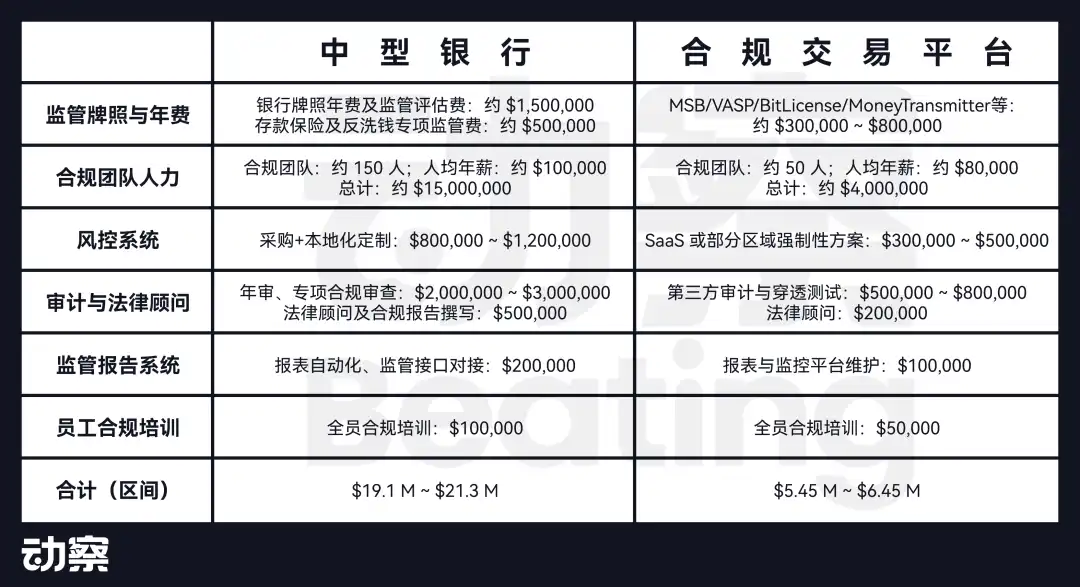
However, launching a stablecoin with a compliant identity for global users involves an organizational structure and system requirements far more complex than imagined. It involves not only financial licenses and audits but also significant asset investments in fund custody, reserve management, system security, and continuous maintenance.
In terms of cost and complexity, the overall construction requirements are no less than those of a medium-sized bank or compliant trading platform.
In 2014, the Hong Kong-based cryptocurrency trading platform Bitfinex was rapidly expanding globally, with traders wanting to trade in US dollars, but the platform consistently lacked stable USD funding channels.
The cross-border banking system was hostile to cryptocurrencies, with funds flowing difficultly between China, Hong Kong, and Taiwan, and accounts frequently being shut down, leaving traders potentially facing fund interruptions at any time.
Against this backdrop, Tether was born. Initially running on the Bitcoin Omni protocol, its logic was simple and direct: users would wire US dollars to Tether's bank account, and Tether would then issue equivalent USDT on the chain.
This mechanism bypassed the traditional bank clearing system, enabling "US dollars" to circulate 24/7 without borders for the first time.
Bitfinex was Tether's first important distribution node, and more importantly, both were actually operated by the same group of people. This deeply interconnected structure allowed USDT to quickly gain liquidity and use cases in its early stages. Tether provided Bitfinex with a compliance-ambiguous but efficient US dollar channel. They colluded, had symmetric information, and shared aligned interests.
From a technical perspective, Tether was not complex, but it solved the pain points of cryptocurrency traders' fund entry and exit, which was key to its early user mindshare.
In 2015, with increased capital market volatility, USDT's attractiveness rapidly expanded. Many non-US region users began seeking US dollar alternatives to circumvent capital controls, and Tether provided them with a "digital dollar" solution that required no account opening, no KYC, and was usable wherever there was internet.
For many users, USDT was not just a tool, but also a hedging method.
The 2017 ICO boom was a critical moment for Tether's product-market fit. After Ethereum's mainnet went online, ERC-20 projects exploded, and trading platforms shifted to crypto asset trading pairs, with USDT immediately becoming the "US dollar substitute" in the Altcoin market. By using USDT, traders could freely move between platforms like Binance and Poloniex to complete transactions without repeatedly moving funds.
Interestingly, Tether never actively promoted itself.
Unlike typical stablecoins that adopt subsidy strategies to expand market share in early stages, Tether never actively subsidized trading platforms or user service usage.
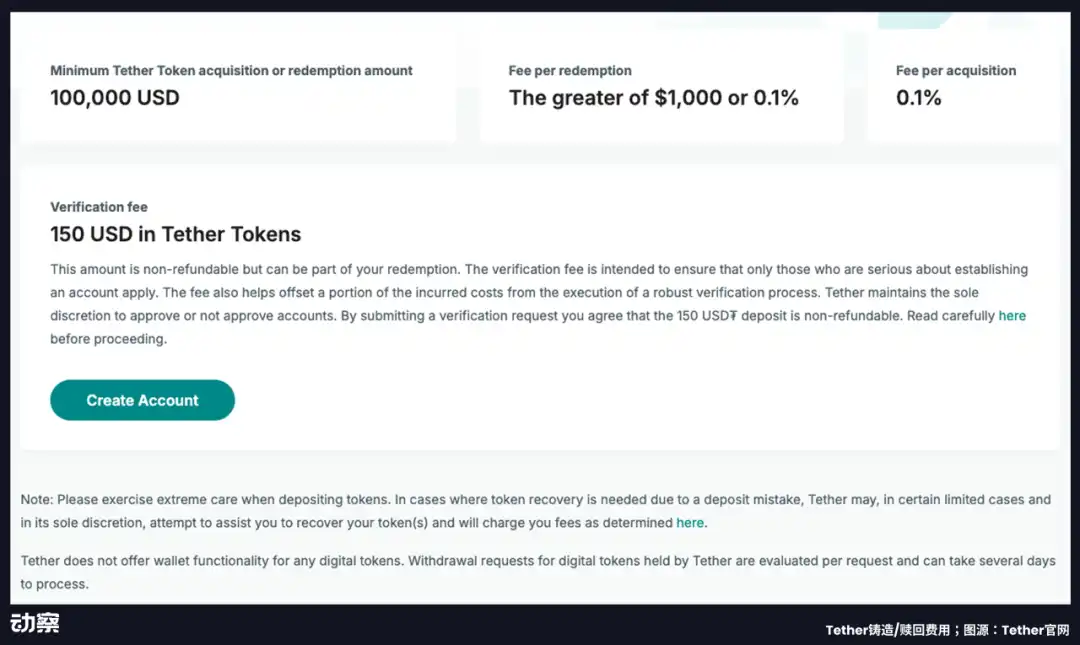
Instead, Tether charged a 0.1% fee for each minting and redemption, with a redemption minimum threshold of $100,000 and an additional 150 USDT verification fee.
For institutions hoping to directly access its system, this fee mechanism almost constituted a "reverse promotion" strategy. Because it wasn't selling a product, but setting standards. The cryptocurrency trading network had already been built around USDT, and any participant wanting to access this network must align with it.
After 2019, USDT had almost become synonymous with "on-chain dollars". Despite repeated regulatory investigations, media doubts, and reserve controversies, USDT's market share and circulation continued to rise.
By 2023, USDT had become the most widely used stablecoin in non-US markets, especially in Global South countries. Particularly in high-inflation regions like Argentina, Nigeria, Turkey, and Ukraine, USDT was used for wage settlements, international remittances, and even replacing local currencies.
Tether's true moat was never its code or asset transparency, but the trust pathway and distribution network it established early in the Chinese-language crypto trading community. This network started in Hong Kong, used the Greater China region as a springboard, and gradually extended to the entire non-Western world.
This "first-mover becomes the standard" advantage meant Tether no longer needed to prove who it was; instead, the market had to adapt to its already established circulation system.
2, Why Circle Relies on Coinbase
Unlike Tether's natural growth in gray scenarios, USDC was designed from the beginning as a standardized, institutionalized financial product.
In 2018, Circle and Coinbase jointly launched USDC, aiming to create an "on-chain dollar" system for institutions and mainstream users within a compliant and controllable framework. To ensure governance neutrality and technical collaboration, both parties held 50% stakes, establishing a joint venture called Center, responsible for USDC's governance, issuance, and operations.
However, this joint governance model could not solve the key problem - how would USDC truly circulate?
……
Go to Beating WeChat Official Account to read the full article
Click to learn about BlockBeats job openings
Welcome to join the BlockBeats official community:
Telegram Subscription Group: https://t.me/theblockbeats
Telegram Communication Group: https://t.me/BlockBeats_App
Twitter Official Account: https://twitter.com/BlockBeatsAsia