



Authors: Rao Weitong and Hu Yiming
Original link: https://mp.weixin.qq.com/s/19RQPyktjGbLsW1q7zDhEA
Original link: https://mp.weixin.qq.com/s/19RQPyktjGbLsW1q7zDhEA
Disclaimer: This article is a reprint. Readers can find more information by following the original link. If the author has any objections to the reprint format, please contact us and we will modify it to suit the author's request. This reprint is for informational purposes only and does not constitute investment advice or represent the views or positions of Wu Blockchain.
What are “arbitrage” and “foreign exchange arbitrage”?
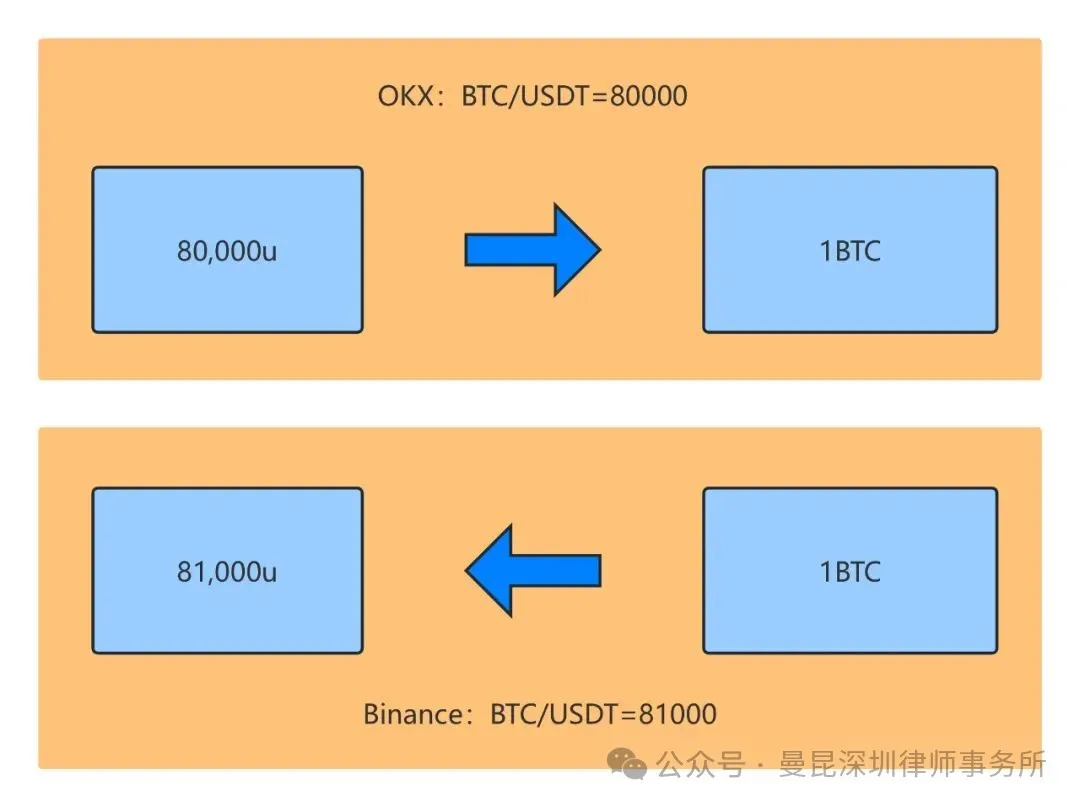
Cryptocurrency arbitrage refers to a strategy that exploits price differences between different exchanges or trading pairs to buy high and sell low. The key is to complete the purchase and sale of the same underlying asset in a very short period of time, achieving risk-free or low-risk returns through fast transactions. For example, an arbitrage trader discovered frequent arbitrage opportunities between the BTC/USDT trading pair on OKX and Binance. They deposited USDT on OKX and BTC on Binance. When an arbitrage opportunity arose, they simultaneously exchanged USDT for BTC on OKX and BTC for USDT on Binance, completing the arbitrage.
The above is the simplest description of arbitrage. However, in practice, in order to obtain profits, the transaction chain required by traders is much more complicated than the above. It is very likely that the funds will be exchanged for fiat currency at a certain point in the chain, which may lead to the possibility of "foreign exchange arbitrage".
Analysis of a Typical Foreign Exchange Illegal Arbitrage Model
(1) Receive U and deliver legal tender
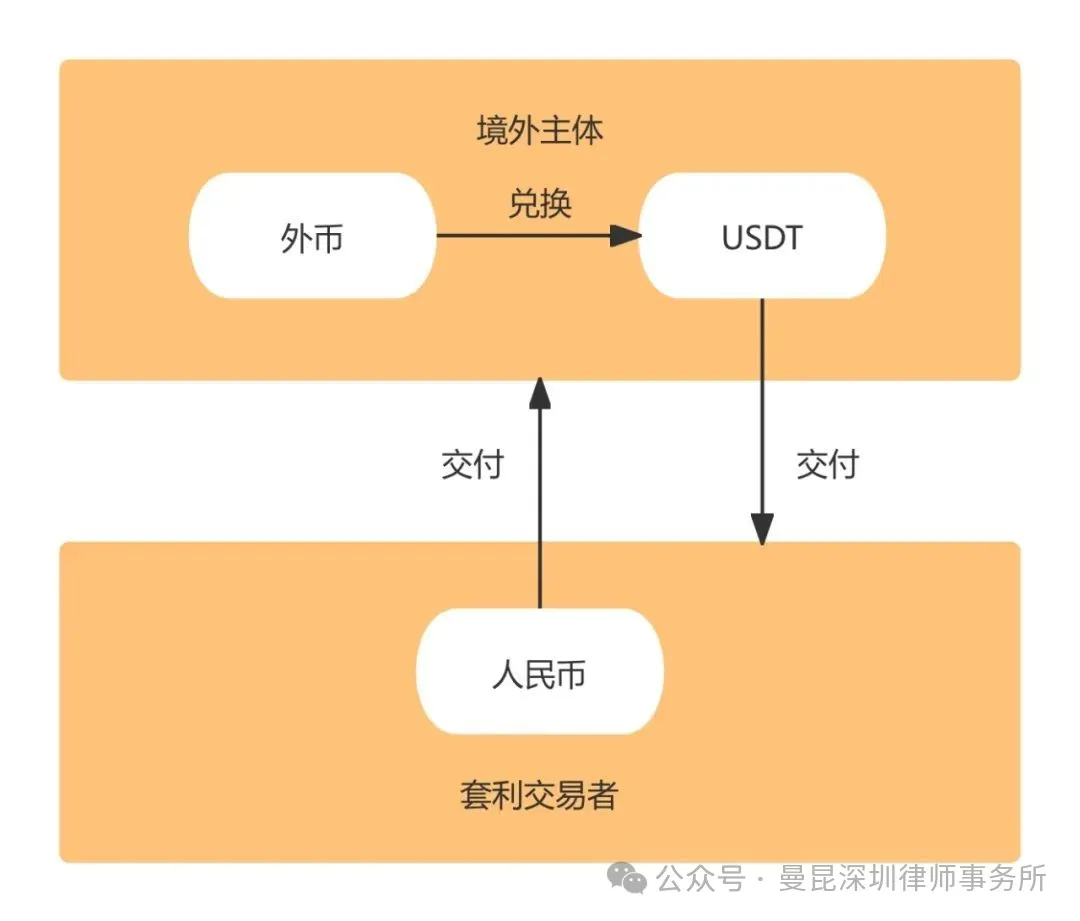
Knowing that the USDT or other digital currencies used by the other party for transactions were purchased with foreign currency, but still providing them with RMB for exchange, or knowing that the USDT or other digital currencies used by the other party for transactions were purchased with RMB, but believing that they provide foreign currency for exchange, constitutes illegal foreign exchange arbitrage of the type of receiving U and delivering legal tender.
(2) Cross-trading type
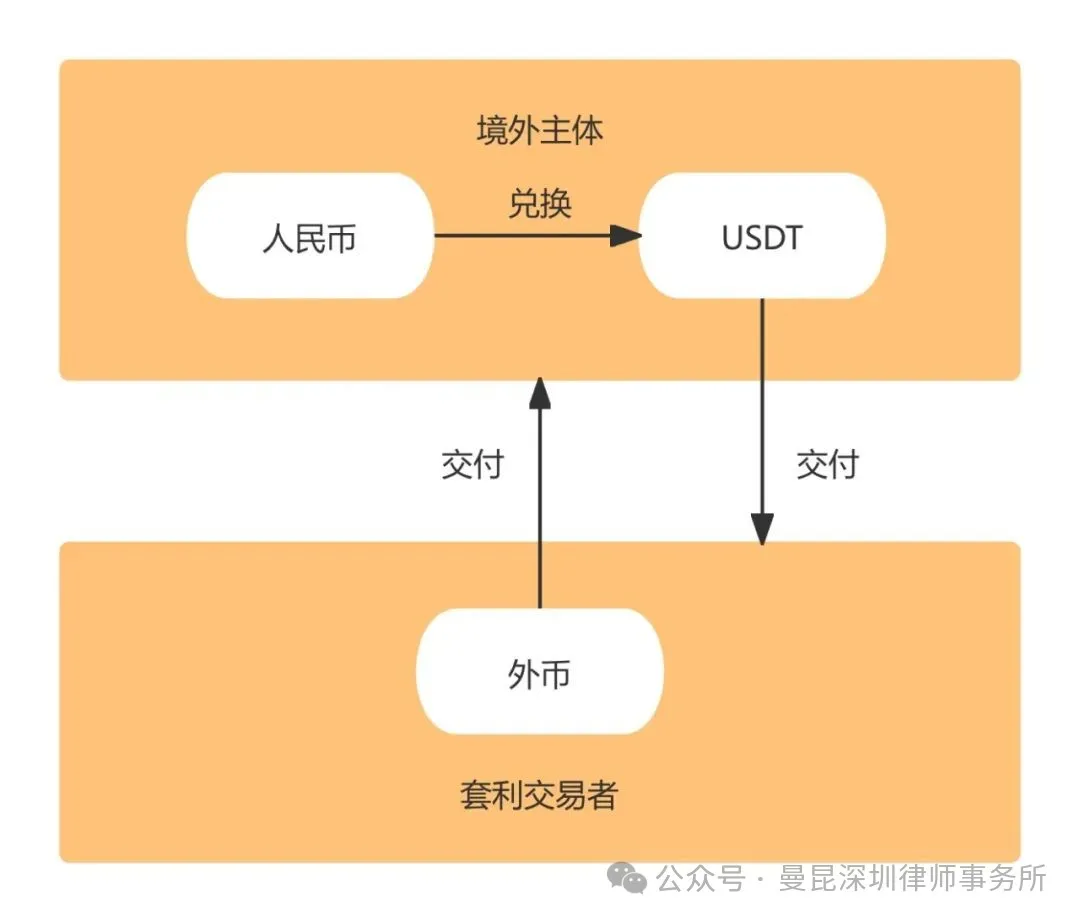
Receiving RMB in China, transferring foreign currency in an overseas account to the designated account of the foreign exchange purchaser, and using the RMB collected to purchase digital currencies such as USDT and converting them into overseas legal tender; or receiving foreign currency in an overseas account, transferring RMB to the designated account of the foreign exchange purchaser, and using the foreign currency collected to purchase digital currencies such as USDT and converting them back into RMB, constitutes illegal foreign exchange arbitrage through cross-trading.
(3) The core difference between ordinary arbitrage and illegal foreign exchange arbitrage
The key difference between arbitrage and foreign exchange trading lies in whether both RMB and foreign currency are involved in the transaction chain. Distinguishing between ordinary arbitrage and illegal foreign exchange trading is not difficult:
Confirm whether the transaction subject is a virtual currency trading pair normally listed on the exchange. If the transaction subjects of the two-way arbitrage are both virtual currencies, it is generally not suspected of illegal foreign exchange arbitrage.
Secondly, if deposits and withdrawals are involved, it is necessary to determine whether the source of the digital currency is direct purchase with foreign currency. If the digital currency purchased with RMB also comes from RMB purchase, it generally does not involve illegal foreign exchange arbitrage.
Why does “counter-knocking” constitute the crime of illegal business operation?
Article 225 of the Criminal Law stipulates that if anyone violates state regulations and engages in any of the following illegal business activities, thereby disrupting the market order, and the circumstances are serious, he shall be sentenced to fixed-term imprisonment of not more than five years or criminal detention, and shall be fined not less than the amount of but not more than five times the illegal gains; if the circumstances are especially serious, he shall be sentenced to fixed-term imprisonment of not less than five years and shall be fined not less than the amount of but not more than five times the illegal gains or have his property confiscated:... (4) Other illegal business activities that seriously disrupt the market order.
The "Interpretation on Several Issues Concerning the Application of Law in Handling Criminal Cases of Illegal Fund Payment and Settlement Business and Illegal Foreign Exchange Trading" stipulates that if anyone violates national regulations and engages in illegal foreign exchange trading such as speculating on foreign exchange or trading foreign exchange in disguised forms, thereby disrupting the order of the financial market, and the circumstances are serious, he shall be convicted and punished for the crime of illegal business operation in accordance with the provisions of Article 225, Paragraph 4 of the Criminal Law.
In judicial practice, foreign exchange arbitrage is generally considered "foreign exchange speculation or disguised foreign exchange trading." In the "receive U, deliver legal tender" model of illegal foreign exchange arbitrage, the transaction chain is foreign currency-digital currency-RMB, with digital currency acting solely as a bridge and intermediary. Essentially, it's an exchange of foreign currency for RMB.
Subjectively: The perpetrator, for the purpose of profit, knowing that the virtual currency he received was directly purchased with foreign currency, still intentionally circumvented foreign exchange controls and provided payment to the other party.
Objectively: This large-scale operation has undermined the foreign exchange regulatory system, caused a certain degree of damage to financial stability and financial order, and constituted the crime of illegal business operation.
In the "strike-trading" model of illegal foreign exchange arbitrage, the perpetrator provides foreign currency to the purchaser and receives local currency in return, using digital currency to circulate between the two currencies. The transaction chain in this model also involves foreign currency, digital currency, and RMB. Digital currency merely acts as a bridge and intermediary, essentially exchanging foreign currency for RMB. Similar to the "receive U, deliver legal tender" model of illegal foreign exchange arbitrage, this practice should be punished as an illegal business operation.
Real case 1: Lin’s illegal business operation
Lin was engaged in ordinary arbitrage trading on a digital currency exchange. Later, during a transaction, he met a Nigerian who called himself "Prince." "Prince" claimed that trading foreign exchange at banks and foreign exchange companies was expensive, and he wanted to exchange the local legal tender, the naira, into RMB through Lin.
The two parties agreed that the "Prince" would purchase USDT on Binance using the local legal tender, the Naira, and then transfer the USDT to Lin's Binance account. Lin would then sell the USDT to a domestic cryptocurrency dealer for RMB, which he then transferred to a Chinese bank account provided by the "Prince." Lin determined the purchase price based on a 5% discount from the Tether's listed price that day, then sold it to a domestic cryptocurrency dealer at the listed price, profiting from the difference. In just a few months, Lin and his group completed over 650 foreign exchange transactions, exchanging nearly 30 million yuan.
Lin's behavior seems to have only two steps: "collecting U" and "paying", and Lin only used RMB as the currency for buying and selling U. However, he subjectively helped others to illegally exchange foreign currency, circumvented the state's foreign exchange control, undermined the state's foreign exchange regulatory system, and disrupted the normal financial market order. His behavior constitutes disguised foreign exchange trading.
Final verdict: Lin was sentenced to five years in prison and fined for illegal business operation.
Real Case 2: Illegal Business Operations by Zhao and Others
Zhao and his associates used the cryptocurrency USDT as a medium for trading foreign currencies. They received dirhams in Dubai, paid RMB to a domestic account provided by the other party, and used the dirhams to buy Tether. Meanwhile, they had the domestic gang sell the Tether for RMB. This not only enabled the circulation of funds but also generated substantial profits from the exchange rate differential.
This illegal "counter-trading" exchange, using digital currency as a medium, facilitated a one-way flow of two currencies, complicating police investigations and evidence collection. However, this operation created a shift in the balance of two currencies within Zhao and others' accounts, circumventing foreign exchange regulations and disrupting normal financial market order, constituting a disguised illegal exchange.
Final verdict: The main members were sentenced to seven to eleven years in prison for illegal business operations and fined between two million and twenty million yuan.
What behaviors of arbitrage may violate criminal law risks?
I believe everyone can have their own opinions on the criminal legal risks of "foreign exchange arbitrage" involving arbitrage. In principle, if the arbitrage behavior is purely based on the exchange rate difference between virtual currencies and does not involve any legal currency, it does not constitute the criminal risk of illegal business operation. However, in practice, there are still some arbitrage behaviors. The transaction chain is long and complex. For those who have not conducted in-depth research, it is not clear at which link the legal currency transaction is carried out. For example, the following arbitrage behaviors have a high criminal risk:
1. Indirect funding loop: Multiple large-scale collections of USDT or other digital currencies of unknown origin directly purchased with foreign currency, redeeming them with RMB, and then selling the digital currencies for RMB;
2. Abuse of structured tools: Using tools such as DeFi protocols and cross-chain bridges to split transaction chains and conceal the fact that funds ultimately flow to fiat currency exchange;
3. Concealed cross-trading: The two parties to the transaction conduct a currency-to-currency transaction on the surface, but privately agree to settle the profit in French currency based on the difference in domestic and foreign exchange rates.
Therefore, you should not try to make quick profits by engaging in arbitrage activities that you do not understand, otherwise you may put yourself at risk.
Exploring the possibilities of technological innovation within a regulatory framework
Compliance in digital currency transactions isn't a black-and-white issue; it requires a dynamic balance between regulatory logic and technical characteristics. For practitioners, strictly adhering to the bottom line of "not interfering with the closed loop of fiat currency exchange" while simultaneously building a verifiable, full-process compliance chain through a professional legal team is the only way to achieve both business security and innovative value.






