


Uniswap, the largest decentralized trading platform on Ethereum, is planning to put a legal "armor" on its governance organization. On August 11, the Uniswap Foundation (UF) submitted a proposal to the community, suggesting registering the Uniswap DAO as a DUNA (Decentralized Unincorporated Nonprofit Association) in Wyoming and establishing a new entity called DUNI.

If the proposal is approved, the Uniswap DAO will become the largest decentralized organization to adopt this framework so far. This is not only an important step towards DAO compliance but may also provide a legal basis for the long-standing "fee switch".
DUNA: The "Legal ID" and Shield for DAOs
1. Global Legal Context
The governance principles of decentralized autonomous organizations emphasize on-chain autonomy and permissionless participation, but this model often lacks a legitimate legal entity status under the current legal framework. Without a legal identity, DAOs cannot sign contracts, hire lawyers or accountants, open bank accounts, or respond to lawsuits as an independent entity.
Wyoming pioneered the DAO LLC bill in 2021, providing a limited liability company form for on-chain organizations. In March 2024, the state further introduced the DUNA bill, allowing non-profit DAOs to gain legal recognition through a lighter structure. This legislation is considered a milestone in global DAO compliance.
For ordinary investors, DUNA can be understood as a DAO's legal ID card + shield:
· Legal ID: After registration, the DAO can sign contracts with law firms and audit institutions, and file tax reports like a company.
· Shield: Members no longer bear personal responsibility for the DAO's legal and tax issues. It's like buying "governance insurance" - if legal disputes or tax retrospective occur, the risk is borne by the entity, not individual wallets.
· Operational Upgrade: Under the DUNA framework, DAOs can hire service providers, retain professional consultants, and manage funds and compliance matters more efficiently.
· Simple Understanding: DUNA is a bridge for DAOs to move from the "gray area" to "legal compliance", without sacrificing decentralization principles while providing guarantees in real-world business.
Proposal Details: Fund Allocation and Execution Mechanism

According to the proposal, the establishment of DUNI will be accompanied by a series of fund arrangements and management structures:
· 16.5 million USD equivalent in UNI: Used to pay historical tax arrears (estimated to be less than 10 million USD) and establish a legal defense budget.
· 75,000 USD equivalent in UNI: Paid to Wyoming company Cowrie, responsible for tax reporting and financial statement preparation. Cowrie co-founder David Kerr participated in drafting the DUNA bill.
· Uniswap Foundation's Role: Serve as the ministerial agent for DUNI, responsible for file submission, contract signing, and service provider hiring.
· Cowrie's Role: Act as the DUNI administrator, providing ongoing tax and financial compliance services.
It's worth noting that organizations under the DUNA framework cannot distribute dividends to members unless it's reasonable service compensation or cost reimbursement. This means that even if the fee switch is implemented in the future, funds flowing into the DAO treasury cannot be directly distributed to token holders, but must be used for public expenditure, R&D, or incentives through governance decisions.
Fee Switch: Potential Revenue Engine
The fee switch is a reserved function in the Uniswap protocol that can divert part of the liquidity providers' (LP) transaction fees to the DAO treasury. For example, in the existing 0.3% transaction fee, 0.05% might be transferred to a DAO-controlled pool.
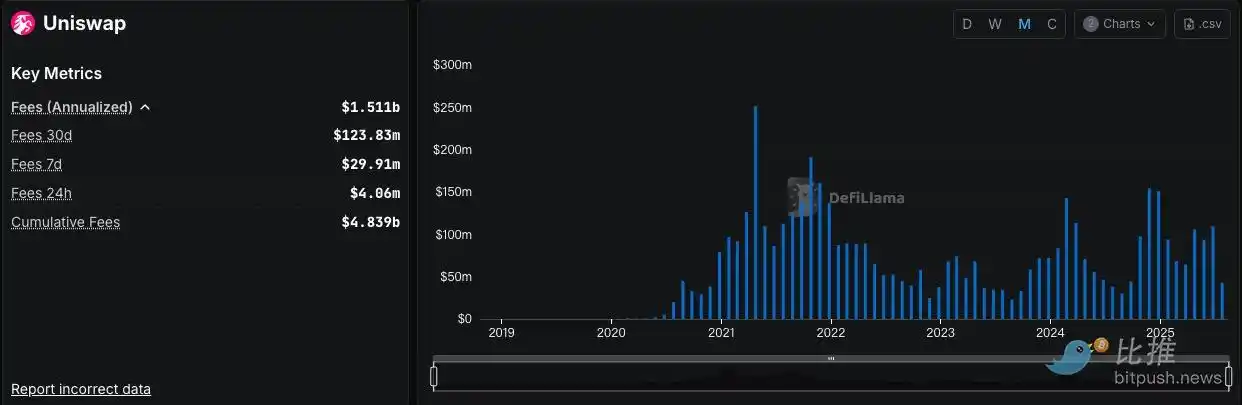
According to defillama data, Uniswap users paid over $123 million in swap fees in the past month. Even if only 1/6 is diverted to the DAO, it means approximately $20.5 million in new monthly income, with an annual rate exceeding $240 million. This would significantly enhance UNI's governance and fund allocation capabilities.
In the past few years, multiple fee switch proposals have been shelved due to compliance risks. The uncertainty in U.S. securities law made directly distributing protocol income to token holders potentially legally risky. The DUNA framework is seen as a key step in addressing this legal barrier.
Governance and Power Dynamics: Collision of DAO Ideals and Reality
Although DAOs are conceptually decentralized, Uniswap's governance reality is far more complex than it appears.
1. Centralization of Power Controversy
U.S. Congressman Sean Casten pointed out in Congress that the Uniswap Foundation can unilaterally influence governance direction, which might undermine its decentralized nature. Although UF denies having excessive power, in practice, major proposals are often initiated and pushed by the foundation, with a relatively limited pass rate for community proposals.
2. Venture Capital Influence
In 2023, UF withdrew a fee switch proposal because a stakeholder raised new questions. Paradigm partner Dan Robinson accused this of yielding to large venture capital firms, with public speculation pointing to a16z. Notably, a16z publicly praised DUNA as an "oasis for DAOs", causing some community members to worry that legalization might be accompanied by strengthened capital influence.
3. Balance between Decentralization and Efficiency
In on-chain governance, decentralization and decision-making efficiency are often difficult to reconcile. Some projects (like LayerZero Foundation and Yuga Labs) have chosen to re-centralize some powers to improve execution efficiency. Uniswap's DUNA proposal, to some extent, is also seeking this balance.
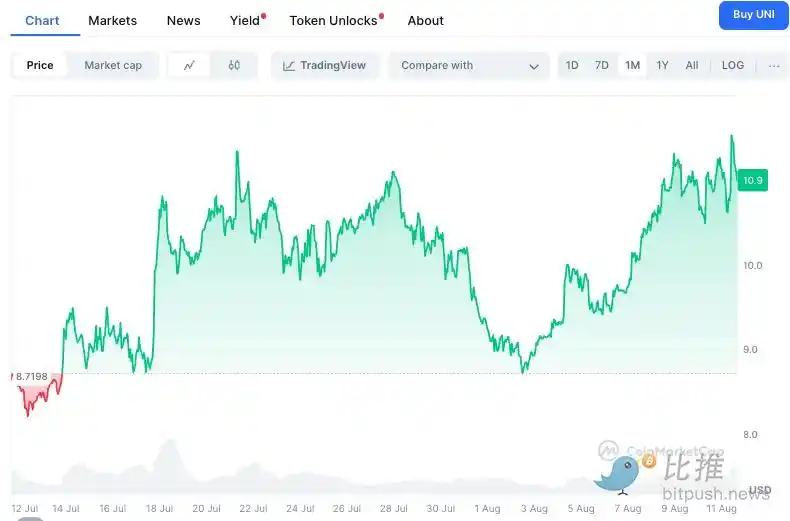
On the day the proposal was announced, UNI rose nearly 8% in the short term before falling back, with the market clearly holding a positive expectation for compliance and revenue reform. However, from historical data, UNI remains at a low point:
· All-Time High (ATH): May 2, 2021, $44.97
· Current drop from ATH: Approximately -75.76%
On-chain data shows Uniswap maintains a leading position in decentralized trading platforms across multiple networks including Ethereum, Polygon, Arbitrum, and Optimism, with monthly trading volumes stable between $3 billion and $5 billion. However, the low value capture rate of protocol revenue remains a long-term valuation bottleneck for UNI.
Outlook: Compliance or Power Restructuring?
If the initial vote passes on August 18, the Uniswap DAO will become one of the first large-scale decentralized organizations to adopt the DUNA framework. This could not only be a milestone in industry compliance but also potentially change UNI's value capture logic.
But opportunities and risks coexist:
· Positive Aspect: Compliance reduces legal risks, and the potential implementation of the fee switch could bring stable fund inflows, enhancing UNI token value support.
· Potential Challenges: Centralization of power and capital influence might exacerbate governance divisions within the community.
For investors, the DUNI proposal is not just a governance structure adjustment, but an industry experiment about "how DAOs mature". The outcome will impact not only Uniswap's future but potentially provide a sample of balancing compliance and decentralization for the entire DeFi industry.
Click to Learn About BlockBeats Job Openings
Welcome to Join BlockBeats Official Community:
Telegram Subscription Group: https://t.me/theblockbeats
Telegram Communication Group: https://t.me/BlockBeats_App
Twitter Official Account: https://twitter.com/BlockBeatsAsia






