



Written by: Zuo Ye
The black box of large models drives people crazy, while blockchain hopes to bring transparency to scientific research.
In 1943, Schrödinger, the quantum state's cat owner, delivered a high-difficulty lecture in Dublin, demonstrating the relationship between atoms, life, and cells from a statistical physics perspective. At that time, Watson, across the ocean, was only 15 years old, yet already a freshman at the University of Chicago.
After reading Schrödinger's book "What is Life," Watson confirmed that genetics would be his lifelong pursuit.
Ten years later, when Watson, who had already obtained his doctorate, proposed the double helix structure of DNA, the 25-year-old had already secured the Nobel Prize.
From Grafting and Cloning to Gene Editing
There are two trees in front of my house, both are jujube trees.
Everyone who has attended middle school knows that genes are information segments of DNA, similar to a "function body" in code, representing the most basic functional implementation. DNA is like an instance module, and RNA is like routing and communication functionality, transmitting gene information to specific targets.
Watson discovered the structure of DNA, but humans did not know how to utilize it, much like knowing about Schrödinger's quantum cat, but while cats are easy to find, quantum communication still requires many years of development.
At least Watson was luckier than Schrödinger. In the summer of 2012, Emmanuelle Charpentier and Jennifer Doudna discovered that CRISPR sequences and Cas proteins could be combined, allowing specific sequence cutting and insertion of desired information segments, ultimately using the human body's repair mechanism to complete grafting imperceptibly.
It's very much like gardening pruning, where visible branches can be connected, and matching relationships between different plants can be understood without comprehending biological mechanisms - just through continuous experimentation.
Experiments can continue, as can cloning. Cell nuclei and cytoplasm can be separated and "docked," and through continuous trials, cloning can achieve remarkable effects of isomeric homologues, just as described in "What is Life".
Gene editing is not mysterious, a further microscopic advancement of cloning, like life from an atomic perspective being merely an irreversible cold process of thermal motion, similar to time - perhaps stretchable and compressible, but never reversible.
Humans can graft fruit trees, clone animals, so can humans edit humans?
In 2018, the mad scientist He Jiankui became Eve or the serpent, performing gene editing on a pair of twin embryos whose parents had AIDS, thus opening Pandora's box. Can cloned animals be humanely destroyed? Are gene-edited humans still human?
Image description: CRISPR-Cas9 Working Principle, Image source: @zuoyeweb3
However, deep genetic exploration holds a fatal temptation for certain populations - longevity, finding gene segments affecting lifespan, modifying its value from 100 to ♾️ like a hacker, even adding a zero would be sufficient.
In 2023, Paradigm co-founder Fred Ehrsam decided to leave the crypto industry and establish a biological research company, Nudge. Coincidentally, Fred is also a Coinbase co-founder who transitioned to crypto VC after the company's 2017 IPO.
In 2017, Paul Kohlhaas joined ConsenSys as BD director but left to start a business a year later, wondering why not do something more interesting with blockchain?
Like scientific research, Molecule was founded in 2018, one of the early explorers combining blockchain and research, especially biological studies. Meanwhile, DeepMind's life science model AlphaFold had already been released in 2016, demonstrating its power in protein structure observation.
In 2020, AlphaFold2 successfully solved the protein folding problem. While 25-year-old Watson had pre-booked the Nobel Prize, this time 4-year-old AlphaFold2 has pre-booked 50% of the 2024 Nobel Chemistry Prize.
Fred's 2023 career shift isn't even considered early. As early as 2020, another Coinbase founder, Armstrong, had initiated ResearchHub to decompose the systematic research process of universities, papers, and funds, introducing incentive mechanisms.
Particularly, scholars self-fund paper submission fees to publishers, while reviewers are often unpaid, with only publishers profiting from the intermediary process.
With all elements aligned, AI, research, and papers are converging towards life sciences. The 21st century is indeed the century of biology.
Crypto Seeks Immortality, First Seeking the Elixir of Life
Decentralized Science (DeSci) is pharmaceutical R&D under the banner of life science research.
DeSci is the crypto transformation of the AI4Sci movement, highly focused on AI, life sciences, and new drug development, perhaps passing through a meme "detour". Remember Paul Kohlhaas' Molecule? It even received Balaji's investment in 2022 - no one can resist the temptation of longevity.
Further, in 2022, Paul Kohlhaas established Bio Protocol, beginning to develop products to help crypto leaders live longer, with multiple sub-DAOs covering various scientific mysteries of male life.
In 2024, the "reborn" CZ and Vitalik appeared together at Bangkok's DeSci Day, with young V recommending Bio Protocol's Vita DAO supplement VD001 to the older CZ.
Then, Bio successfully received investment from CZ's YZi, with tokens smoothly entering Binance. Paul Kohlhaas also created a Pump Science mimicking PumpFun - can meme and scientific research work?
However, after Bio's initial surge, dissatisfaction with delivery followed. In traditional research, a new drug's development can cost over $1 billion, taking years or even decades. Bio's secondary market can't wait five minutes; taking money without maintaining the market is a cardinal sin.
The story isn't over because the Agent wave is coming. AI Agents may truly change research efficiency. More interestingly, ResearchHub received a $2 million Boost investment in February 2025, with DeSci Agents' papers now being reviewed.
In August 2025, Bio Protocol released its V2 plan, creating a new Launchpad, BioXP points program, and BioAgents, built using ElizaOS, once again keeping up with the times.
Within just 7 days, over 100 million BIO tokens were staked, with 80 million entering on August 7th alone, so the data may have some issues. Additionally, the V2 plan's economics are more reasonable.
Small market cap prevents selling pressure, encouraging continuous project sponsorship.
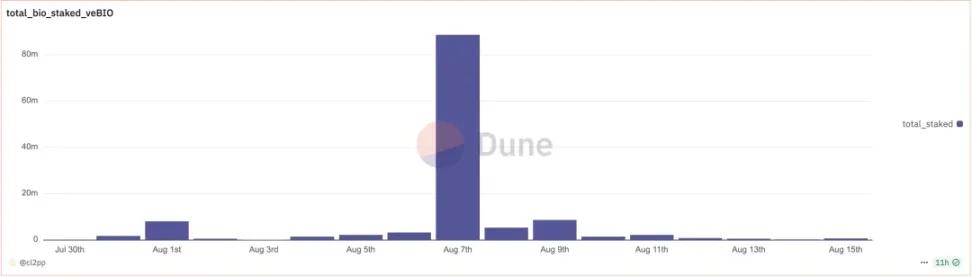
Image description: $BIO Staking Data, Image source: @cl2pp
However, DeSci represented by Bio Protocol is slower than AI4Sci. AlphaFold open-sourced its database in 2021, currently publishing structures for 200 million proteins, essentially covering known species.
Feeling behind, Bio Protocol has been hoping the FDA would publish or integrate large pharmaceutical companies' accumulated data to accelerate open-source scientific research.
Moreover, Bio V2 plans to promote multiple new drug launches in the UAE, greatly shortening traditional R&D processes. The Middle East's lenient human trial restrictions will also accelerate life science research - though whether it's He Jiankui or Watson remains unknown.
Conclusion
GPT-5's results are disappointing, but in niche fields like medicine and scientific research, we can still await the Scaling Law's bloom. The data potential in these high-value domains remains unexplored, and once progress is made, it could bring massive cognitive enhancement to humanity.
In the field of life science research, Silicon Valley's Colossal ancient organism revival project has been continuously advancing, using CRISPR-Cas9 technology, such as creating a "long-haired mouse" by combining mammoth and mouse, and breeding a pure white giant dire wolf from ancient massive wolves.
Perhaps one day, humans will evolve, and perhaps one day, humans will become extinct.






