Another crypto exchange has maliciously collapsed, with the long-established Tradeorge "Ogre Exchange" - once a great choice for crypto users to cash out Altcoins - suddenly stopping Twitter updates in June and becoming inaccessible in July, leaving users helpless. A recent court document finally mentions the "Ogre Exchange", but the news is devastating. According to the New Jersey court document, they cannot find Tradeorge's operational address, and the plaintiff claims to have been victim to 70 phishing BTC transactions, amounting to 353 BTC.

Victim Scale Unknown? OG Reveals: Potential Losses Reaching Millions of Dollars
Although the court document is not specifically about Tradeorge but involves multiple crypto exchanges, BlockTempo interviewed a long-time Tradeorge user "Alan", who expressed shock at the platform's collapse, as Tradeorge was among the longest-operating early no-KYC exchanges with a good reputation and few incidents.
Alan also mentioned that Tradeorge claimed to have over 100,000 users before 2020, and potentially up to 500,000 registered users before its collapse. A simple calculation suggests Tradeorge might have absconded with millions of dollars:
I'm really surprised. These no-KYC exchanges, like the early Mt.Gox style, are rare now. Most of these exchanges usually run away with funds within three years. For example, New Zealand's Cryptopia, which had a similar interface, collapsed in less than two years. I've used Tradeorge since 2017 without major issues, though its 2FA security was questionable. Most people just transferred in to sell and immediately withdraw, so it seemed fine.
It's hard to estimate the losses, but many people would transfer Altcoins in, and due to low liquidity, often have small balances or leftovers they'd forget about. I guess an average of tens of dollars per person is reasonable. Estimating the total absconded amount would be over $20-30 million, possibly more.
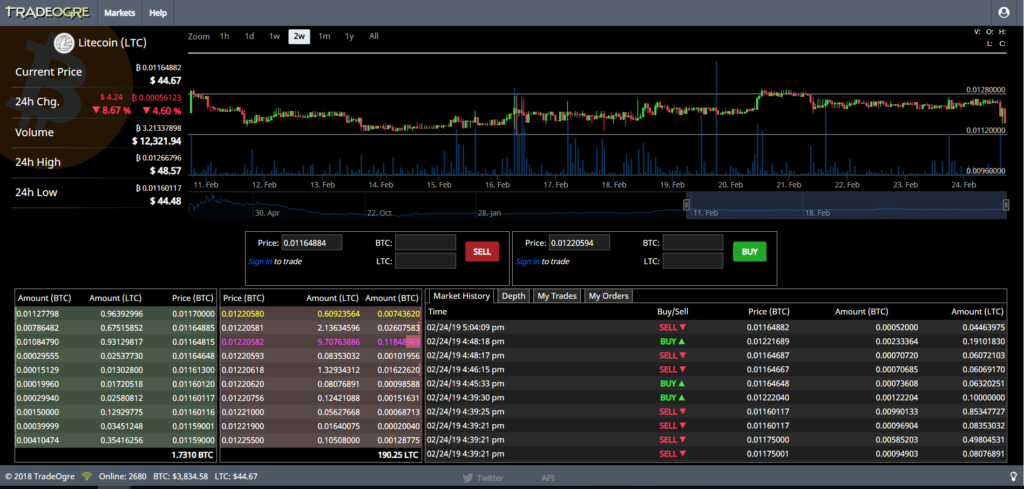
Platform Highlights No KYC, Attracting Many 'Crypto Freedom Advocates'
Despite the dangers of no KYC, why did Tradeorge attract so many users? Alan explained that Tradeorge had the fastest token listing speed, strongly supported PoW tokens, and kept up with meme coin trends in recent years. Operating from 2017 to 2025, it attracted many "crypto freedom advocates". According to CoinmarketCap, its last daily trading volume was fixed at 31 BTC, indicating a basic user base.
I remember Tradeorge was the first to list ICO coins from 2017-2018, mining tokens like ETN, forked tokens like ETP, Monero forks, and recent popular PoW Altcoins like Kaspa, ALPH, Qubic. They always had decent trading volumes and smooth withdrawals. Compared to current KYC exchanges that block withdrawals, they were quite considerate. Of course, you had to accept low liquidity depth. I personally liked this exchange and didn't expect it to collapse. I'm a bit surprised and sad that these early 'freedom advocate' exchanges are disappearing.
Lessons to Learn? Can KYC Guarantee User Protection?
According to internet personality redpandamining's X thread, many mentioned the company seems to be run by Russians anonymously, with operators constantly changing contact emails. To trace the exchange, one might only check domain registration information from Google or Go Daddy.
Some users noted that if the company had used KYC registration initially, it wouldn't have attracted these freedom-minded users. From this perspective, it's difficult to blame the lack of KYC mechanism for the exchange's malicious collapse and unrecoverable losses.
Despite the rapidly changing global regulatory environment, users of non-KYC exchanges should understand both the convenience and risks, continuously preserve transaction records, and use exchanges primarily for immediate trading and withdrawal, avoiding using exchange accounts as long-term asset storage to prevent potential malicious collapses.