


Written by: FinTax
1. Rising Rapidly: USD1's Swift Expansion
At the beginning of this year, WLF first announced plans to launch USD1, a stablecoin targeting institutional investors. USD1 is pegged to the US dollar at a 1:1 ratio, with asset reserves consisting of cash, US Treasury bonds, and equivalent assets. BitGo serves as the asset custodian, and Crowe LLP provides monthly reserve verification reports, which are widely considered to have high transparency and credibility. In early March, USD1 was officially issued with an initial supply of 3.5 million dollars, and its market value has now exceeded 2.7 billion dollars, ranking seventh among stablecoins.
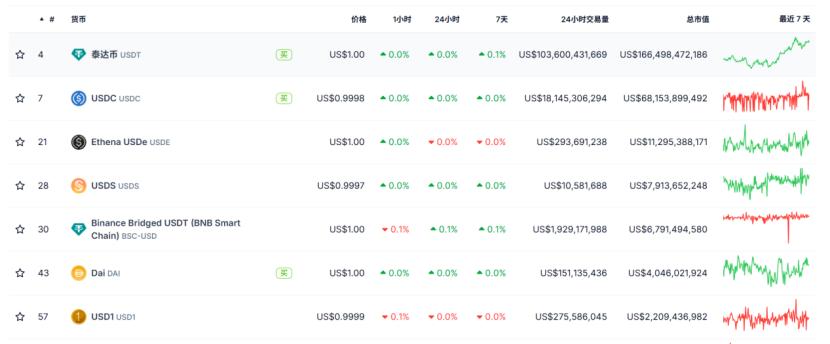
(Figure 1: Stablecoin Market Cap Ranking. Source: coingecko)
USD1 has been attracting attention since its inception and has rapidly risen in recent months. It is almost entirely issued on the BNB chain. According to BscScan data, the USD1 supply on the BNB chain reaches 2.1 billion dollars, accounting for over 99% of its total circulation. According to Etherscan, the Ethereum version is only 14.5 million dollars. Subsequently, other major blockchain networks with significant trading volumes, such as TRON, have also launched USD1 to meet on-chain fund demands. Within just a few months, USD1 has been listed on mainstream exchanges like Binance, Bitget, and Bybit, quickly entering multiple blockchain ecosystems.
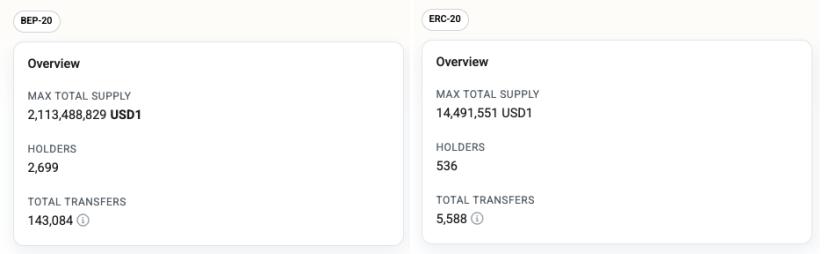
(Figure 2: Comparison of USD1 on BNB Chain (BEP-20) and Ethereum (ERC-20). Source: BscScan, Etherscan)
USD1's rapid expansion is inseparable from the support of major exchanges. Binance first listed USD1 in April, followed by PancakeSwap's exposure-increasing activities, which quickly swept the market with related memecoins, such as $B breaking $400M within ten days, triggering another small peak on the BNB chain. Bitget and Bybit subsequently listed USD1 in June and July, launching airdrop and reward programs that further opened up liquidity and user entry points.
2. Political Elements: USD1's Off-Chain Controversy
While focusing on USD1's product design, users have also developed a strong interest in its political background. It is well-known that USD1 comes from WIF, which is backed by the Trump family at the height of their influence. Therefore, one of USD1's most significant characteristics is its deep connection with the Trump family, which may explain its powerful market mobilization ability, even attracting the Abu Dhabi investment fund MGX to use approximately 2 billion USD1 to invest in Binance. The Trump family's resources, combined with international capital's endorsement, have provided USD1 with a unique growth environment different from most stablecoins.
However, as USD1's circulation rapidly increases, more and more people, including politicians, have begun to question whether the Trump family is using their political status for personal business interests. For example, several senators from the US Senate Banking Committee have sent an open letter to regulatory agencies, demanding an examination of USD1's compliance and potential conflicts of interest. They believe that if a presidential family directly profits from stablecoin business, the regulators' independence might be severely damaged.
In fact, these concerns are not unfounded. The sensational memecoin $TRUMP in January raised similar doubts. At the time, the token was considered a potential way to bypass campaign funding regulations and become an important channel for the Trump family to obtain opaque profits or even political bribes. Although USD1 and Trump coin differ significantly in positioning and nature, they share a core issue: whether the Trump presidential family is gaining additional political or economic advantages through the cryptocurrency market. Some media have also pointed out that USD1's cooperation with Binance might involve more interest exchanges, given that Binance has long faced scrutiny from US regulatory agencies and has been particularly enthusiastic about USD1's promotion and application. There are widespread concerns that such practices might turn stablecoins into tools for politicians' rent-seeking, further increasing regulatory difficulties and undermining social fairness.
Currently, the US Congress is promoting new stablecoin legislation and more cryptocurrency asset regulatory rules. Whether USD1 can smoothly obtain and maintain compliance will directly impact its long-term development. Especially in the context of bipartisan negotiations, some legislators might propose special restrictions on the Trump presidential family's cryptocurrency asset operations. As a "trailblazer," USD1 faces certain political uncertainties and compliance risks.
Despite several controversies, USD1 continues to provide cryptocurrency investors with more trading mediums and create a more convenient market environment, increasingly winning investor favor.






