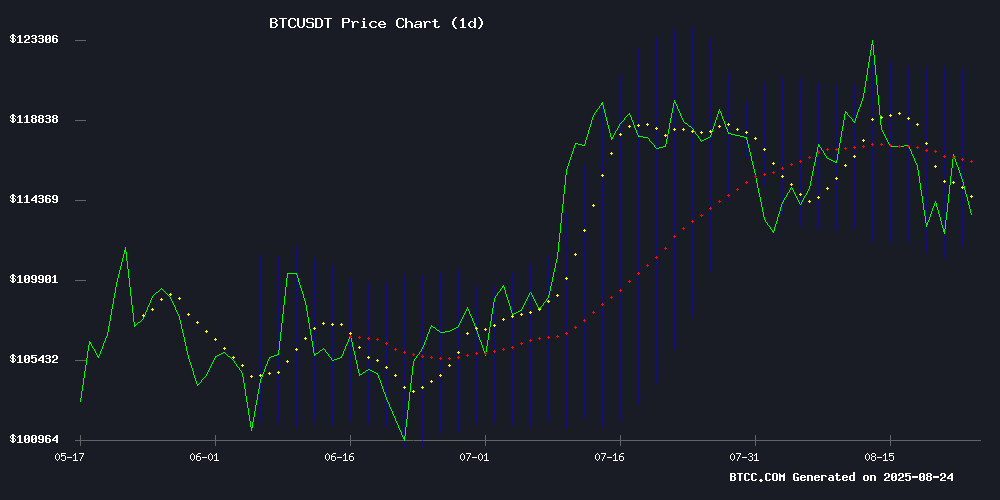
- Technical indicators show a strong bullish MACD, while Bollinger Bands suggest an imminent breakout.
- Japan's tax reform and corporate share purchases drive continued improvement in fundamentals
- Institutional capital inflows and the $190,000 target price form strong support
BTC Price Prediction
Technical analysis perspective
Based on current technical indicators, BTCCC financial analyst James noted: "BTC's current price of $114,859.99 is slightly below its 20-day moving average of $116,733.98, suggesting slight short-term pullback pressure. However, the MACD indicator is showing a strong bullish signal, with a bar chart reading of 613.88, indicating continued strengthening upward momentum. The Bollinger Bands indicate that the price is nearing its mid-range, and volatility is within normal range, accumulating momentum for a subsequent breakout."
Market sentiment and fundamental drivers
BTCC financial analyst James commented: "Japan has significantly reduced the capital gains tax on cryptocurrencies to 20%, bringing it in line with the stock tax rate. This policy change paves the way for ETFs and stablecoins, significantly increasing institutional interest in the market. Furthermore, corporate Bitcoin reserves are accelerating, with companies like Minxing Group and KindlyMD continuing to increase their holdings. Combined with institutional capital inflows, the target price for the third quarter is expected to reach $190,000. These fundamental factors strongly support market optimism."
Factors affecting BTC prices
The Survival of Cryptocurrency Exchanges in 2025: A Review and Outlook
The cryptocurrency exchange landscape of 2025 presents a Darwinian battlefield where only the most adaptable platforms will survive. Traditional financial giants like the Chicago Board of Trade have cemented their position as the cryptocurrency "system," offering stability but charging exorbitant fees—enough to buy 3,000 cups of bubble tea, according to one trader. Meanwhile, newcomers face obstacles like real-name authentication systems that reject beauty selfies, highlighting the tension between convenience and compliance.
Regional platforms, such as the UK's domestic exchange, thrived thanks to local trust, but they also faced significant technical shortcomings, such as a half-hour server outage during the death of Queen Elizabeth II. Zero-commission brokerages lured retail investors with simple interfaces, only to surprise them with higher withdrawal fees than their peers. Regulatory pressure forced exchanges in places like Singapore to rush to apply for licenses, a situation comparable to the chaotic situation surrounding the ban on plastic straws.
Institutional adoption has reached new heights, with pension fund giants quietly entering the market, becoming the "second uncle" in the cryptocurrency finance sector. These developments highlight the market's growing maturity, with regulatory compliance, user experience, and institutional participation becoming key factors separating winners from those forced to switch to food delivery platforms.
Interpol seizes $100 million in cryptocurrency assets in Africa
Interpol's massive cybercrime operation, codenamed "Operation Serengeti 2.0," has resulted in the arrest of more than 1,200 suspects and the seizure of nearly $100 million in assets. The three-month operation targeted illegal cryptocurrency activities, including Bitcoin mining and online fraud rings, across 18 African countries.
Authorities dismantled 11,432 malicious infrastructure sites associated with business email compromise, ransomware attacks, and investment scams. The operation, affecting nearly 88,000 victims, highlights the scale of illicit cryptocurrency operations in the region.
In Angola, law enforcement shut down 25 illegal mining centers operated by 60 Chinese nationals, confiscating over $37 million worth of mining equipment. Officials plan to reuse seized power assets to provide electricity to vulnerable communities.
Zambian police have dismantled a large-scale online investment fraud ring that defrauded over 65,000 people through fake cryptocurrency platforms, resulting in an estimated $300 million in losses. Fifteen suspects have been arrested and their associated bank accounts have been frozen.
Bitcoin is approaching 1.7% of the global money supply, and fiat currency depreciation is accelerating.
Bitcoin currently accounts for 1.66% of the global money supply, with a market capitalization of $2.29 trillion compared to $112.9 trillion in fiat and $25.1 trillion in gold. River's analysis, which excludes silver and minor metals, frames Bitcoin's 16-year rise as a direct challenge to the traditional monetary system.
Central bank money printing continues to drive demand for hard assets. Global M2 expansion creates ideal conditions for Bitcoin's adoption as an inflation hedge—a narrative reinforced by Jerome Powell's Jackson Hole speech, which hinted at an impending Fed rate cut. Market participants interpreted the chairman's "cautious" stance on policy changes as dovish, triggering immediate volatility in Bitcoin prices .
Philippines Proposes National Bitcoin Reserve Legislation
The Philippines is taking a bold step toward financial innovation with a new legislative proposal, aiming to diversify its sovereign reserves into Bitcoin. House Bill No. 421, introduced by Congressman Miguel Luis "Migz" Villafuerte, mandates the Bangko Sentral ng Pilipinas (BSP) to acquire up to 2,000 Bitcoins annually for five years, capping its reserves at 10,000 BTC . This move reflects a global trend, inspired by initiatives in El Salvador, Brazil, and even US Senator Cynthia Lummis.
Storage protocols are extremely strict: central banks must diversify their holdings across multiple secure facilities to mitigate risk. Villafuerte positions Bitcoin as "digital gold," a hedge against global economic volatility and reliance on the US dollar. The bill locks up reserves for 20 years, allowing them to be sold only to repay government debt—a long-term bet on the cryptocurrency's store of value theory.
Japan plans to slash crypto capital gains tax to 20%, matching stock tax rate
Japan's Financial Services Agency plans to overhaul its cryptocurrency tax system by 2026, potentially significantly reducing the top capital gains tax rate from 55% to a flat 20% rate, bringing it in line with the tax treatment of stock investments. The proposal would reclassify digital assets as "financial instruments" under the Financial Instruments and Exchange Act, abandoning the current regulatory framework under the Electronic Payment Act.
Currently, cryptocurrency profits are treated as miscellaneous income and face punitive tax rates, with marginal rates as high as 45% plus a 10% local tax. The current structure results in a 55% effective tax rate for high-income earners, compared to just 20% for stock investments. This tax differential explains why Japanese investors favor Bitcoin-holding stocks like Metaplanet, which trade at a premium reflecting the tax advantage.
The planned 20% flat tax rate marks Japan's official recognition of cryptocurrencies as a legal asset class. Market participants anticipate increased institutional participation once the tax burden is aligned with traditional securities. This reform could make Tokyo a more competitive hub for digital asset innovation.
Hut 8 announces $1 billion ATM financing plan to expand AI and HPC data centers
Bitcoin mining company Hut 8 Corp. has amended its at-the-market (ATM) stock offering plan to authorize up to $1 billion in equity sales, doubling the $500 million planned for December 2024. The funds will be used to expand its high-performance computing and artificial intelligence infrastructure, marking a strategic shift beyond cryptocurrency mining.
This move reflects growing institutional interest in repurposing mining operations for AI workloads, leveraging existing energy infrastructure and technical expertise. Hut 8's aggressive fundraising efforts highlight the industry's convergence with next-generation computing needs.
Japan's cryptocurrency tax reform paves way for ETFs and stablecoins
Japan's Financial Services Agency (FSA) has unveiled a comprehensive cryptocurrency tax reform plan, slashing the top tax rate from 55% to 20% and allowing loss carryforwards. This move aligns cryptocurrencies with traditional securities under the Financial Instruments and Exchange Act (FIEA), which analysts believe could reverse capital outflows and attract institutional investors.
The revised tax structure removes a major hurdle for domestic Bitcoin ETFs, with regulators explicitly linking FIEA reclassification to future product approvals. Market makers note that the 20% flat tax rate reflects the treatment of equity investments, reducing cash flow volatility for long-term holders.
The concurrent regulatory upgrades require issuers to increase transparency and prohibit insider trading—safeguards that echo those in U.S. securities laws. While Ripple’s parallel efforts to seek a U.S. banking license for its RLUSD stablecoin have dominated Western headlines, Tokyo’s reforms make Japan the first major economy to fully integrate crypto assets into the mainstream financial framework.
Corporate Bitcoin reserves trend accelerates: Ming Hing Group and KindlyMD expand holdings
Bitcoin continues to solidify its position as a cornerstone of corporate treasury strategies, with two Nasdaq-listed companies making significant acquisitions this week. Hong Kong construction company Ming Hing Group purchased 4,250 BTC (US$482 million) at an average price of US$113,638 per coin, sending its stock price soaring 11% following the announcement. The company now ranks 45th on the Bitcoin Treasuries list, holding 833 BTC.
Meanwhile, US medical data company KindlyMD increased its holdings by 5,744 BTC (US$679 million) at $118,204 per BTC. The company, which recently merged with Bitcoin-focused Nakamoto Holdings, has set an ambitious goal of accumulating 1 million BTC. These moves demonstrate growing institutional confidence in Bitcoin as a treasury asset, with public markets rewarding early adopters.
How to file cryptocurrency taxes
In most jurisdictions, cryptocurrency transactions generate taxable income, with reporting requirements similar to traditional salary income. The process is like organizing financial records—each transaction must be recorded, summarized, and reported.
Transaction records from exchanges like Binance or Coinbase are essential. Key details include timestamps, amounts, fees, and wallet addresses. Exporting this data to a spreadsheet simplifies data aggregation.
Calculating taxable gains follows simple arithmetic: proceeds from disposal minus purchase price and fees. Mining rewards and airdrops are valued at their value at the time of receipt. This varies across jurisdictions—some taxpayers can self-report, while complex portfolios may require specialized software (such as CoinTracker) or the services of an accountant.
Bitcoin Price Prediction: Driven by Institutional Funding, Target Price Reaches $190,000 by Q3 2025
Global liquidity has reached unprecedented levels, with the M2 money supply in major economies exceeding $90 trillion. Historical data shows that such monetary expansion is often highly correlated with Bitcoin price movements , suggesting significant upside potential. Accelerating institutional adoption, the opening of US 401(k) retirement investment channels, and the continued accumulation of ETFs and corporate holdings are providing strong buying support.
Market structure is shifting from retail dominance to institutional drive, with large buyers providing a solid buffer against downside risks. Regulatory tailwinds and dovish central bank policies (including President Trump's pressure for interest rate cuts) are creating an ideal environment for Bitcoin's growth. Bitcoin has already achieved an 80% annualized return, and few significant obstacles stand in the way of its upward trajectory in the near term.
Whale buy another 200 BTC, accumulating $172 million in the past month
According to Lookonchain on-chain data, a Bitcoin whale address recently increased its holdings by another 200 BTC (approximately $22.72 million). Over the past 30 days, this address has received a total of 1,721 BTC through the institutional trading platform FalconX, demonstrating a sustained and strong accumulation trend.
Such large purchases typically reflect institutional investors or ultra-high-net-worth individuals strategically positioned for long-term value growth. Notably, whale actions coincided with Bitcoin's consolidation near its all-time high, demonstrating that large investors maintain firm confidence in the asset's potential for a breakout (as measured by the FSA Strategy Indicator), undeterred by short-term market volatility.
Is BTC a good investment?
A comprehensive analysis shows that BTC demonstrates significant investment value. While technically trading slightly below its moving average in the short term, the strong bullish MACD signal and the Bollinger Bands' normal range suggest potential for a subsequent breakout. Fundamentals are also multifaceted: Japan's tax reform has significantly lowered investment barriers, companies continue to increase their Bitcoin holdings as a reserve asset, and institutional funds are flowing in significantly, with a target price of $190,000 for the third quarter. These factors together provide a solid foundation for upward movement.
| Indicator Type | Current value | Market significance |
|---|---|---|
| Current Price | 114,859.99 USDT | Slightly below the moving average, short-term consolidation |
| 20-day moving average | 116,733.98 USDT | Slight pullback pressure |
| MACD histogram | 613.8762 | Strong bullish signal |
| Bollinger Band Upper | 121,706.37 USDT | Near-term resistance level |
| Q3 target price | 190,000 USDT | Institutional consensus expectations |
Despite short-term fluctuations, the medium- to long-term trend remains positive, driven by both technical and fundamental factors, making it an attractive investment option.